Is MLC Dead? Understanding the Rise of pSLC in Industrial NAND
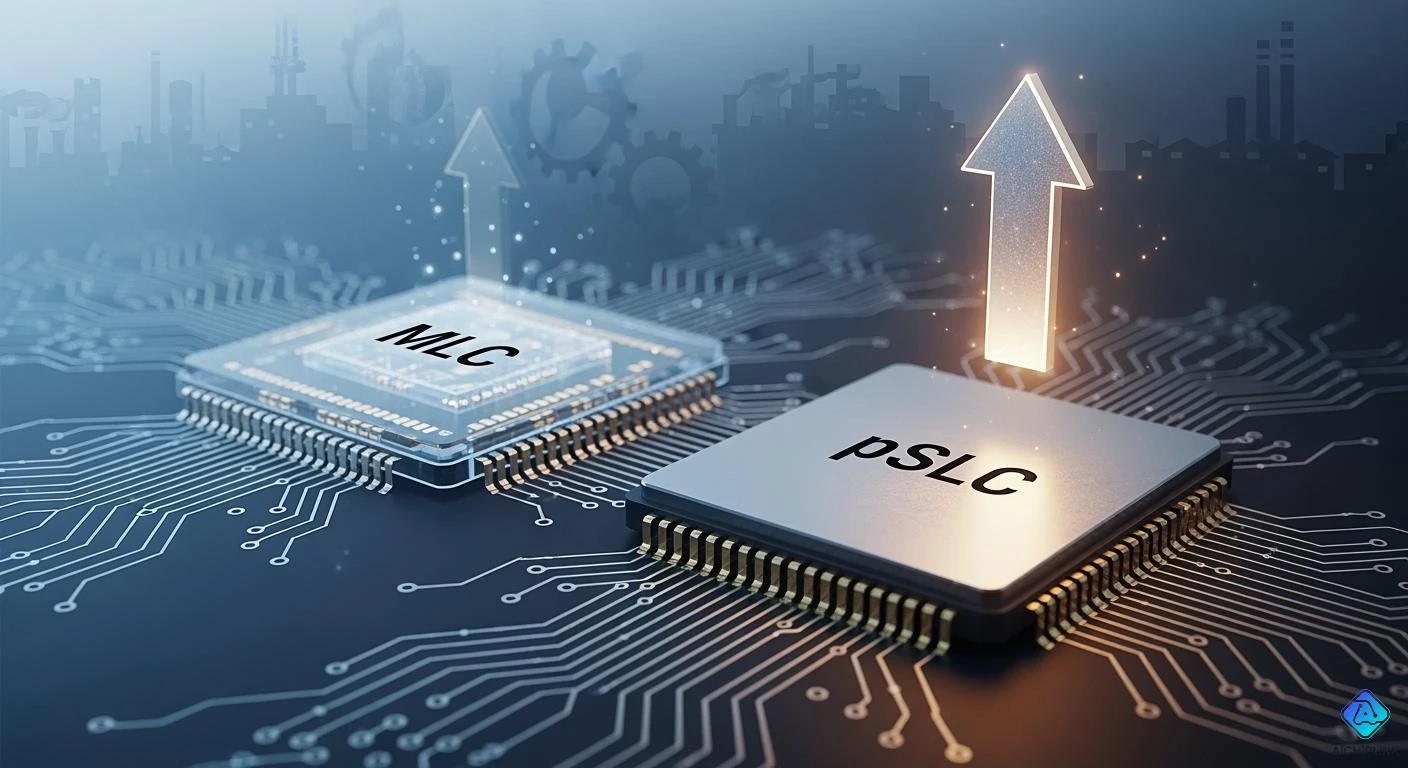
You may ask if MLC is still used in industrial NAND storage. TrendForce research shows MLC NAND Flash capacity will drop by 41.7% by 2026. Big suppliers like Samsung make less MLC now as they focus on other technologies instead. This shift contributes to a decrease in supply and an increase in prices. The main reasons for this trend are the need for more reliability, better performance, and longer life in tough environments. The rise of pSLC is becoming popular because it meets these needs effectively. It offers higher endurance and ensures data safety for industrial applications.
Key Takeaways
-
pSLC is becoming more popular in industrial NAND storage. This is because it lasts longer and works better than MLC.
-
MLC NAND is used less now. It does not work well in hard conditions. It cannot handle tough jobs or last as long.
-
Picking pSLC can help save money. It gives speed and endurance like SLC. This makes it great for industrial uses.
-
MLC can still be cheap for jobs with little writing. But pSLC is usually better if you want it to be reliable.
-
Always check how much your system writes before you pick NAND. This helps you get the best performance and keeps your data safe.
MLC’s Decline in Industrial Storage
Supply Reduction and Manufacturer Shifts
Big companies are making less mlc nand now. Samsung and others want to use new technology that makes more money. They see that multi-level cell nand is not as good for profits as TLC or QLC. Companies want to get the most from their money. Because of this, there is less mlc storage to buy. Prices for mlc products have gone up because there is not much supply.
Companies also know that industrial storage needs to be very reliable. They want storage that lasts longer and works better. This is why they are moving away from mlc. Now, you will see more pSLC and other new types in industrial storage. This change matters when you pick storage for your work.
MLC Performance Limits
You might ask why mlc is not used as much in industry. Multi-level cell nand has some problems in hard places.
-
It costs less than SLC nand, so it helps save money.
-
You can use it for saving data and settings.
-
It works best if you do not write data a lot.
But mlc can only handle 3,000 to 10,000 program/erase cycles. This may not be enough for storage that must be very strong. If you use storage for things like edge computing or cameras, mlc can work. But if you write data a lot, mlc may not last long.
-
mlc writes slower because it has to control more voltage levels.
-
Writing these levels makes mlc slower than SLC.
-
You might see more mistakes because mlc stores data in a tricky way.
-
Problems like program interference and read disturbance can happen more.
In factories or tough places, there are extra problems:
-
Changes in temperature can make nand work worse.
-
You need special error correction to keep data safe.
-
More complex software, like Block RAID, can cause more problems.
When you start using mlc nand, you may see 2 to 5 bit errors in each ECC block. As you use the storage more, errors can go up to 15 to 25 bits. If you keep using the same blocks, errors can reach 35 or more bits. At this point, the storage may not fix errors, and you could lose data.
Some special mlc, called eMLC, tries to fix these issues. It has better features and can work in harder jobs. Still, most people now want storage that lasts longer and keeps data safe.
The Rise of pSLC Technology
How pSLC Works
You may wonder how the rise of pSLC changes the way you use storage in tough environments. pSLC stands for "pseudo single-level cell." This technology uses MLC or TLC NAND chips but programs them to act like single-level cell memory. Instead of storing two or three bits per cell, pSLC writes only one bit per cell. This simple change makes a big difference.
-
pSLC mode uses MLC or TLC NAND by writing just one bit in each cell.
-
The voltage gap between charge states gets bigger, which makes it easier for the chip to tell if a cell is a 0 or a 1.
-
You get more write and read cycles because the cells do not wear out as fast.
You can think of pSLC as a smart way to get better endurance and reliability from regular NAND chips. While true single-level cell NAND lasts the longest, pSLC gives you a strong balance between cost and performance. You get SLC-like speed and endurance without paying the high price of pure SLC storage.
Note: pSLC cannot match the full durability of real single-level cell NAND, but it offers much better endurance than standard MLC or TLC. For many industrial jobs, this is enough.
pSLC vs. MLC Reliability
When you compare pSLC to MLC, you see why the rise of pSLC matters for industrial storage. pSLC boosts reliability and data retention by making the chip act like single-level cell memory. This means fewer errors and longer life for your data.
-
pSLC gives you SLC-like endurance and speed, which helps your storage last longer.
-
Many modern industrial systems use pSLC because it balances performance, durability, and cost.
-
You get good reliability at a lower price, with medium endurance and solid data retention.
Let’s look at how endurance cycles and reliability compare:
| Type of NAND | Endurance Cycles | MTBF (Hours) |
|---|---|---|
| Industrial SLC | > 2,000,000 | > 4,000,000 |
| Industrial MLC | 50,000 – 100,000 | 200,000 |
pSLC sits between these two. It does not reach the highest numbers of single-level cell NAND, but it far outperforms MLC. You can trust pSLC for many years, even if you write data often.
The rise of pSLC is not just about better numbers. It means you get storage that works well in factories, cars, and other hard places. You see fewer errors, faster writes, and better data safety. Over the next five years, experts expect the use of pSLC in industrial NAND to grow quickly, especially in areas like IoT, cars, and edge computing.
Tip: If you need storage that lasts and keeps your data safe, the rise of pSLC gives you a smart choice. You get many of the benefits of single-level cell NAND without the high cost.
pSLC Performance and Industrial Applications
Endurance and Data Integrity
You want your storage to last a long time. You also want it to keep your data safe. pSLC works well in tough places. This nand type uses MLC or TLC chips. It makes them act like SLC. This helps pSLC last longer and be more reliable. pSLC can handle 20,000 to 30,000 program/erase cycles. This is much more than MLC nand type. MLC only handles 3,000 to 10,000 cycles. So, your storage will work for more years.
Here is a quick comparison of endurance:
| Type of NAND | Endurance (Program/Erase Cycles) |
|---|---|
| pSLC NAND | Higher than MLC NAND |
| MLC NAND | 3,000 to 10,000 |
| SLC NAND | ~100,000 |
pSLC keeps working well in hot or cold places. Industrial storage faces heat, cold, and shaking. pSLC nand type works from –25°C to +85°C. This keeps your data safe. MLC nand type can lose data at high temperatures. But pSLC keeps working the same. You also get power-loss protection. There is a 10-year supply promise. This makes pSLC a good choice for industrial storage.
Tip: pSLC technology uses only the top and bottom states of the cell. This means you get fewer errors and better data holding than MLC nand type.
Industrial Storage Use Cases
Many industries use pSLC nand type for high performance and safety. Factories use pSLC storage in their machines. Embedded PCs work in hot places. Industrial SSDs with pSLC nand type fail less than 1% of the time up to 85°C. Buses use pSLC storage for their systems. City buses use SSDs for checking and maps. These SSDs last over five years.
Energy and airplanes also use pSLC nand type. Airplane systems need safe storage for important data. The FAA wants certified parts. pSLC performance meets these rules. Hospitals use pSLC nand type for medical machines. These need to be very safe and follow rules.
Here is a table of real-world use cases:
| Use Case | Industry | Description | Observations |
|---|---|---|---|
| Factory Automation | Manufacturing | Embedded PCs in high-temperature environments | <1% failure rate up to 85°C |
| Vehicle Systems | Transportation | SSDs for diagnostics and navigation in city buses | Lasts 5+ years, outperforms consumer |
| Aerospace Systems | Energy | Avionics in commercial aircraft | Reliability is critical, FAA certified |
People pick pSLC nand type for its speed, long life, and data safety. It works well in hard places and keeps your storage safe.
Is There Still a Role for MLC?
Niche Uses and Cost Factors
You might ask if mlc is still useful in industrial nand storage. Many companies now use pSLC, but mlc can help in special cases. MLC is good if you want to spend less money and do not need high endurance. For example, mlc works well in devices that save settings or logs and do not write data a lot.
Here are some cost facts to think about:
-
pSLC gives more endurance than mlc, but it costs 30% to 50% more.
-
pSLC is cheaper than SLC. It costs only 50% to 70% of SLC, but gives almost the same endurance.
-
pSLC lasts longer, but mlc is the cheapest for simple storage.
If you need storage for easy jobs, mlc nand is a smart pick. You save money and still get good performance for tasks that do not use the memory much.
Tip: Always check how often your system writes data. If you do not write data much, mlc nand can last for years.
Legacy Systems in Industrial Storage
You might have old machines that need mlc nand. These old systems often use special firmware and software. Changing from mlc to pSLC or SLC can cause trouble. Some machines need mlc nand for important firmware. It is very important to check if new nand types will work.
Look at this table to see how different nand types affect old systems:
| NAND Type | ECC Requirement (bits per 512 bytes) | Performance Impact |
|---|---|---|
| SLC (43nm) | 1 | Minimal |
| SLC (24nm) | 8 | Significant |
Old systems may not work well with new nand types. You must check if your machine supports pSLC or SLC. Sometimes, you need to update firmware or software to use new nand. If you cannot update, mlc nand is still needed to keep your machines working.
Note: Safety-critical control systems often use mlc nand. You must think about compatibility and firmware before switching to new nand types.
You notice pSLC is now the top pick for industrial nand. It has more supply, works well, and is very reliable. MLC nand is not gone, but people use it less. It is helpful only for special jobs or old machines. If you want storage that lasts long and keeps data safe, choose pSLC nand. If your work does not write much data, MLC nand can still be okay. Always look at what your system needs before picking nand for your project.

Written by Jack Elliott from AIChipLink.
AIChipLink, one of the fastest-growing global independent electronic components distributors in the world, offers millions of products from thousands of manufacturers, and many of our in-stock parts is available to ship same day.
We mainly source and distribute integrated circuit (IC) products of brands such as Broadcom, Microchip, Texas Instruments, Infineon, NXP, Analog Devices, Qualcomm, Intel, etc., which are widely used in communication & network, telecom, industrial control, new energy and automotive electronics.
Empowered by AI, Linked to the Future. Get started on AIChipLink and submit your RFQ online today!
Frequently Asked Questions
What is the main difference between pSLC and MLC NAND?
You use pSLC to store one bit per cell. MLC stores two bits per cell. pSLC gives you more endurance and better data safety. MLC costs less but does not last as long in tough jobs.
Why do industrial systems prefer pSLC over MLC?
You get longer life and fewer errors with pSLC. Industrial systems need storage that works in heat, cold, and vibration. pSLC handles these conditions better than MLC. You see less data loss and better performance.
Can you use pSLC with nvme drives?
Yes, you can use pSLC with nvme drives. You get fast speeds and strong endurance. Many nvme SSDs for industry use pSLC to balance cost and reliability. This helps your system run well for years.
What is pseudo-slc caching and how does it help?
You use pseudo-slc caching to speed up writes on nvme SSDs. The drive writes data in pSLC mode first. This makes your storage faster and more reliable. Later, the drive moves data to slower storage areas.
Is pSLC used in enterprise storage?
Yes, you find pSLC in enterprise storage. It gives you a good mix of speed, endurance, and cost. Many companies use pSLC for servers and data centers. You get safe and long-lasting storage for important data.