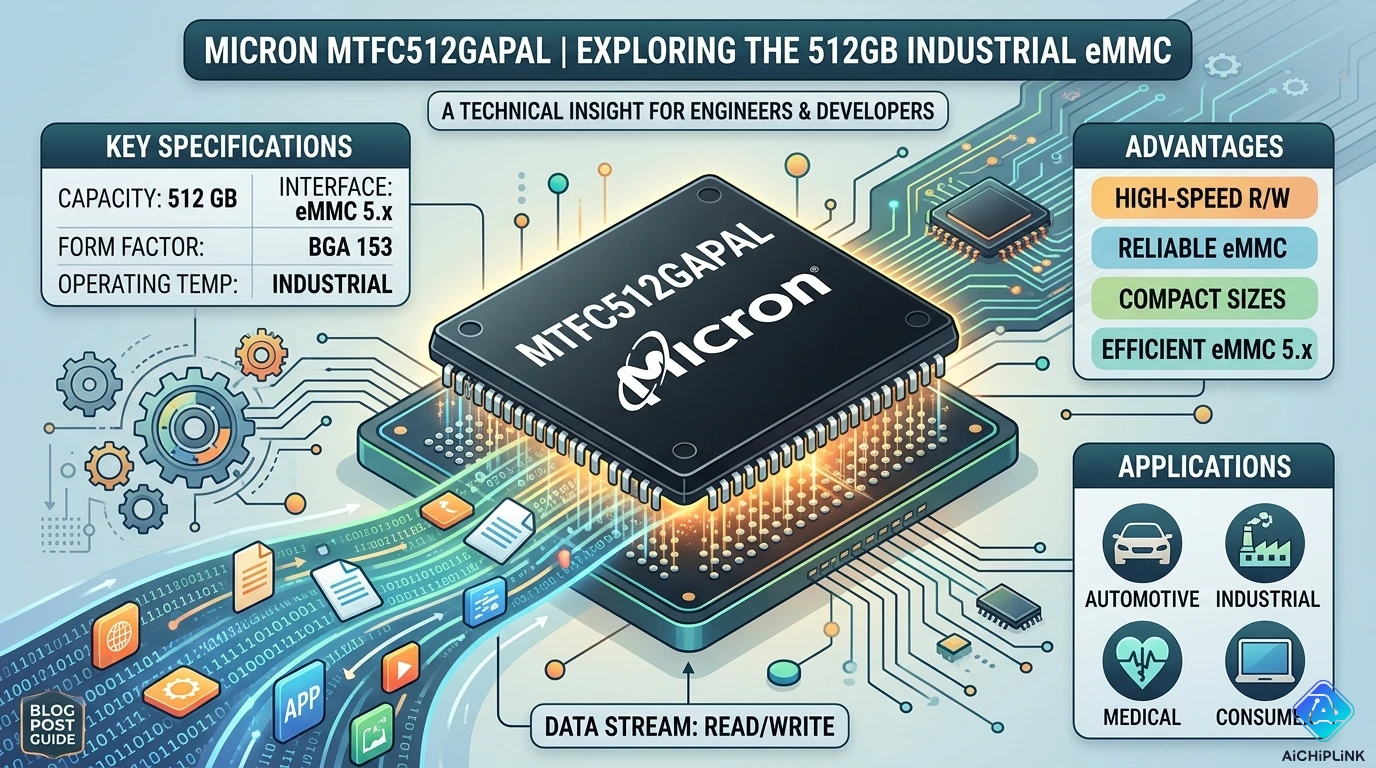
If you reached this page searching for MTFC512GAPAL, here is what the search engines will not tell you upfront: Micron's publicly documented eMMC catalog tops out at 128GB in their standard industrial MTFC series (MTFC128GAPAL variants). MTFC512GAPAL is not listed in Micron's standard industrial eMMC catalog as of early 2026. This part number may correspond to a custom-orderable configuration, an unreleased product, a regional catalog entry, or a part number entered with the wrong density digit (the 512G in Micron's MTFC family refers to 512 Gigabits = 64GB, not 512 Gigabytes).
What this means for you: if you are looking for 512 Gigabytes of embedded managed NAND in a BGA package for an industrial Linux platform, you are either looking at the very edge of what eMMC can currently deliver — or you need to reconsider whether eMMC is the right storage technology for your application at all.
This guide is the one you need before making that decision. It answers the question embedded storage architects are actually asking when they search for 512GB eMMC: how do I size and specify high-density embedded storage for an industrial platform that cannot use removable media, cannot accommodate an M.2 slot, and must run at −40°C to +85°C without intervention for five to ten years?
1.0 Understanding the MTFC Part Number and What MTFC512 Actually Means
Micron's MTFC eMMC part number structure is consistent and decodable:
MT — Micron Technology
FC — Flash Controller (managed NAND = eMMC)
[density][unit] — the density field, where the unit matters critically:
| Field | Meaning | Example |
|---|---|---|
| MTFC8GA | 8 Gigabytes (64Gbit) | MTFC8GAMALBH = 8GB |
| MTFC16GA | 16 Gigabytes (128Gbit) | MTFC16GAPALBH = 16GB |
| MTFC64GA | 64 Gigabytes (512Gbit) | MTFC64GAPALBH = 64GB |
| MTFC128GA | 128 Gigabytes (1Tbit) | MTFC128GAPALNS = 128GB |
| MTFC512G... | Ambiguous — see below | — |
The density number in Micron's MTFC naming refers to Gigabytes of user capacity, not Gigabits. So MTFC512G would imply 512 Gigabytes — which is 4 Terabits of NAND. This is beyond the density of any known Micron eMMC product in standard production as of early 2026. Micron's standard industrial eMMC line stops at 128GB.
What you may actually need instead:
If the part number MTFC512GAPAL appeared in a BOM or reference design, three possibilities apply. First, it may be a typographic error for MTFC64GAPAL (64GB) — the "512" would then refer to 512 Gigabits = 64 Gigabytes, which is Micron's actual nomenclature. Second, it may refer to a custom-density or regional product not in Micron's public industrial catalog — contact Micron directly or check with an authorized distributor. Third, it may be a future product — Micron has not yet publicly released a 512GB consumer or industrial eMMC under the MTFC naming scheme, though 512GB eMMC density is now achievable using 3D TLC NAND stacking and is offered by other manufacturers.
If you genuinely need 512 Gigabytes of managed NAND in a BGA package: read on — this guide covers exactly that specification and the products that actually deliver it today.
2.0 Three Questions to Answer Before Specifying 512GB Embedded Storage
Before selecting any high-density managed NAND for an industrial embedded design, answer these three questions honestly. Your answers determine whether 512GB eMMC is the right answer — or whether you should be specifying something else entirely.
Question 1: What is your daily write volume, and what is your design life?
512GB of TLC NAND at ~1,000 P/E cycles (TLC baseline) gives a theoretical TBW of 512 GB × 1,000 = 512 TB. With a write amplification factor of 3× (realistic for mixed-workload TLC eMMC): effective TBW ≈ 170 TB. At 10 GB/day: 170 TB ÷ (10 GB × 365) = 46 years. At 100 GB/day: 4.6 years. At 500 GB/day: less than 1 year.
If your daily write volume pushes the TBW calculation below your design life × 1.5 safety margin, 512GB TLC eMMC is not the right answer. Consider pSLC mode (see Section 5), or move to NVMe SSD.
Question 2: Does your SoC actually support eMMC at this density?
Not all eMMC host controllers on industrial SoCs are validated against 512GB devices. The eMMC protocol uses 512-byte sector addressing, and the maximum addressable sector count at 512 bytes per sector over the 32-bit sector address field is: 2³² × 512 bytes = 2 TB — so the protocol can theoretically support 512GB without issues. However, SoC firmware and bootloader support for large eMMC densities is not universal. Verify your SoC's eMMC controller datasheet confirms 512GB device support, and check your bootloader (U-Boot or equivalent) has been tested against large eMMC densities — some older U-Boot versions have bugs with eMMC devices above 128GB.
Question 3: Could you achieve the same result with a smaller, more endurance-appropriate eMMC?
Ask whether 512GB is driven by actual data requirements or by future-proofing speculation. In practice, most industrial embedded Linux systems running a rootfs, application stack, and local data logging can operate comfortably within 64GB–128GB. A 128GB MLC eMMC provides significantly better endurance (3,000 P/E cycles vs ~1,000 for TLC) at lower cost. If the 512GB requirement comes from "we might need it someday" rather than a concrete storage budget, a 128GB MLC eMMC today plus a documented upgrade path to higher density in a future product revision is often the better engineering decision.
3.0 Decision Flowchart: eMMC, UFS, or NVMe for Your Application?
Work through this flowchart from top to bottom:
Step 1 — Does your SoC have only an eMMC host controller (no UFS, no PCIe)? → Yes: eMMC is your only managed NAND option. Go to Step 3. → No (has UFS or PCIe): Go to Step 2.
Step 2 — Does your application require > 400 MB/s sequential storage throughput or > 50,000 random IOPS? → Yes: Evaluate UFS 3.1 (up to 2,100 MB/s) or NVMe M.2 (up to 3,500+ MB/s). eMMC cannot meet this requirement. → No: eMMC at HS400 (up to 400 MB/s) may still be appropriate and simpler to implement. Continue.
Step 3 — What is your operating temperature requirement? → −40°C to +85°C: Standard industrial eMMC is available (MTFC series -IT grade). → −40°C to +105°C or higher: Requires automotive-grade eMMC (-AAT grade) or industrial-wide NVMe SSD. → Above +105°C: eMMC is not rated for this environment; specialized storage required.
Step 4 — What is your required capacity? → ≤ 128GB: Use MLC-based industrial eMMC — best combination of endurance, availability, and cost. → 128GB–256GB: TLC eMMC available; calculate TBW (Section 5) to verify endurance. → > 256GB: Limited eMMC options; evaluate UFS or NVMe M.2 if SoC supports it; for eMMC-only platforms, check availability of 256GB TLC eMMC (some manufacturers offer this; Micron's MTFC256G variants exist in some product lines). → 512GB in BGA package: Very limited availability; currently offered by select manufacturers (Samsung, SK Hynix, Kioxia) in mobile configurations; industrial-grade 512GB eMMC is rare and commands a significant price premium.
Step 5 — Is the form factor constrained to BGA (no M.2 slot possible)? → Yes: eMMC or UFS (both BGA) are the only soldered options. → No: Consider NVMe M.2 for the best performance/density/endurance combination at larger capacities.
4.0 Comparison Matrix: High-Density Embedded Storage Options
For the system architect trying to replace or extend what MTFC512GAPAL represents — 512GB of managed embedded storage for an industrial SoC platform — here is the complete landscape as of 2025/2026:
| Solution | Interface | Max Capacity | Seq Read | Endurance | Temp Range | Form Factor | Relative Cost |
|---|---|---|---|---|---|---|---|
| eMMC 5.1 (TLC, 256GB) | MMC x8 | 256 GB | ~300 MB/s | 1,000 P/E | −40 to +85°C | BGA153 | Reference |
| eMMC 5.1 (TLC, 512GB) | MMC x8 | 512 GB | ~300 MB/s | ~1,000 P/E | −25 to +85°C (industrial limited) | BGA153 | +40–60% |
| eMMC 5.1 (MLC, 128GB) | MMC x8 | 128 GB | ~300 MB/s | 3,000 P/E | −40 to +85°C | BGA153 | −20% vs TLC 256GB |
| UFS 3.1 (256GB) | M-PHY serial | 256 GB | ~2,100 MB/s | ~1,500 P/E | −40 to +85°C | BGA | +30–50% |
| NVMe M.2 2242 (256GB) | PCIe 3.0 x4 | 4+ TB | ~3,500 MB/s | Varies | −40 to +85°C (industrial) | M.2 plug-in | +50–80% |
| Micron MTFC128GAPAL-IT (128GB MLC) | MMC x8 | 128 GB | ~300 MB/s | 3,000 P/E | −40 to +85°C | BGA153 | Best endurance/$ |
Key observations from this matrix:
512GB TLC eMMC exists but is primarily in mobile configurations from Samsung (KLMAG series) and SK Hynix (H26M series), where the temperature range is typically −25°C to +85°C — not the full industrial −40°C required by many embedded designs. Industrial-grade (−40°C) 512GB eMMC is extremely limited in availability as of 2026.
At the 512GB density, the per-GB cost premium of eMMC over NVMe M.2 becomes difficult to justify unless the form factor is absolutely BGA-constrained. A 512GB industrial NVMe M.2 SSD offers 10× the sequential bandwidth, better endurance on TLC NAND (due to more sophisticated SSD controllers), and is available from multiple qualified industrial suppliers.
5.0 The TBW Calculation: Does TLC eMMC Actually Survive Your Workload?
This is the calculation most engineers skip, and it is the one that determines whether 512GB TLC eMMC survives your product's design life.
Step 1 — Identify your write workload:
Estimate the average daily write volume for your application. Common patterns:
| Application | Typical Daily Write | Notes |
|---|---|---|
| Industrial HMI (display, config, logs) | 0.1–1 GB/day | Light write — almost any eMMC survives |
| Edge gateway (telemetry logging, forwarding) | 1–10 GB/day | Moderate — calculate carefully for TLC |
| Video surveillance (local buffering, edge recording) | 50–200 GB/day | Heavy — TLC eMMC often insufficient |
| Industrial data acquisition (high-rate sensors) | 10–100 GB/day | High — verify TBW carefully |
| Machine learning inference with frequent model updates | 5–50 GB/day | Moderate to high |
Step 2 — Calculate TBW budget:
For 512GB TLC eMMC (approximate values — always verify against specific datasheet):
- Rated P/E cycles per cell: ~1,000 (TLC baseline)
- Total writes before wear-out: 512 GB × 1,000 = 512 TB (theoretical, uniform wear leveling)
- Write Amplification Factor (WAF): 2–4× for typical mixed workloads
- Effective TBW: 512 TB ÷ WAF
| WAF Assumption | Effective TBW | At 10 GB/day | At 100 GB/day | At 500 GB/day |
|---|---|---|---|---|
| WAF = 2 (optimized) | 256 TB | 70 years | 7 years | 1.4 years |
| WAF = 3 (typical) | 171 TB | 47 years | 4.7 years | 0.9 years |
| WAF = 4 (worst case) | 128 TB | 35 years | 3.5 years | 0.7 years |
For most low-to-moderate write industrial applications, TLC 512GB eMMC has adequate endurance. The problem is not total endurance — it is peak write amplification during garbage collection events, which can temporarily saturate the write bandwidth and cause latency spikes in real-time applications.
Step 3 — Evaluate pSLC mode:
Some high-density TLC eMMC devices support pSLC (pseudo-SLC) mode, where TLC cells are operated as SLC (1 bit per cell instead of 3). This trades capacity for endurance: a 512GB device operated as pSLC provides approximately 170GB of user space, but with ~30,000 P/E cycle endurance — a 30× improvement. Some Micron TLC eMMC variants (the MTFC...GAS...QHD family) specifically support this mode.
For write-intensive applications where standard TLC endurance is borderline, consider a smaller pSLC-mode eMMC rather than a larger TLC one. A 128GB device in pSLC mode provides better endurance than a 512GB device in standard TLC mode, at lower cost and with better industrial temperature support.
6.0 ⚠️ Four Field-Killing Mistakes with High-Density eMMC
Mistake 1: Assuming TLC endurance is adequate without calculating the actual TBW
The most common error at the design stage. An engineer selects 512GB TLC eMMC because "we need lots of storage and TLC is cheap" without running the TBW calculation. The product ships, operates for 18 months at a write rate that was underestimated, and eMMC devices in the field begin reporting DEVICE_LIFE_TIME_EST values above 80% — triggering PRE_EOL_INFO = 0x02 (Warning). At this point, there is no in-field fix — the NAND is approaching wear-out and the device must be replaced. The fix is to calculate TBW in the design phase and add a 2× safety margin.
Mistake 2: Using 512GB eMMC as a video recording buffer without proper write management
A surveillance system buffers video to eMMC before uploading to the cloud. The video stream writes at 50 MB/s continuously. Daily write volume: 50 MB/s × 86,400 seconds = 4,320 GB/day. Even at WAF = 2: 256 TB ÷ (4,320 GB × 365 days) = 0.16 years before wear-out. This eMMC will be destroyed in two months. For continuous high-rate video write workloads, eMMC is the wrong technology — use NVMe SSD with higher endurance ratings, or implement circular buffer write patterns on eMMC with careful wear leveling at the application layer.
Mistake 3: Specifying a mobile-grade 512GB eMMC in an industrial design
512GB eMMC is currently available primarily in mobile configurations, where the operating temperature range is typically −25°C to +85°C and the device is not qualified to the same stringent industrial screening as the MTFC industrial series. Placing a mobile-grade 512GB eMMC in an industrial system operating at −40°C in a cold storage facility or outdoor utility cabinet will result in device failures below the minimum specified temperature. Always verify the specific device's temperature rating, not just the technology category.
Mistake 4: Not accounting for the partition overhead at 512GB density
eMMC devices partition their NAND into user data area, boot partitions, RPMB, and over-provisioning. At 512GB, the over-provisioning reserve held by the FTL is proportionally large — typically 7–10% of NAND capacity. On a 512GB device, this means approximately 40–50GB of NAND is reserved for wear leveling and bad block substitution. The user-visible capacity is correspondingly lower. Additionally, filesystem overhead (ext4, F2FS, or UBIFS on top of the eMMC's block interface) adds further overhead. Plan for ~85–90% of the nominal 512GB being available for actual data — approximately 430–460GB of usable space.
7.0 Selection Checklist for 256GB–512GB Industrial Storage
Use this checklist when specifying any high-density managed NAND for an industrial design:
Capacity and endurance:
☐ Calculate daily write volume (GB/day) for worst-case operating scenario
☐ Calculate TBW budget using the formula: (Capacity × P/E cycles) ÷ (daily write GB × 365 × WAF)
☐ Verify TBW exceeds design life × 1.5 safety margin
☐ If TBW margin is < 2×, evaluate pSLC mode or MLC NAND alternative
Temperature and grade:
☐ Confirm operating temperature range covers worst-case ambient + thermal rise in enclosure
☐ Verify −40°C minimum if industrial (not commercial or mobile) grade required
☐ For automotive applications: require AEC-Q100 qualification, not just industrial temperature rating
Interface and SoC compatibility:
☐ Confirm SoC eMMC host controller supports target density (check controller docs)
☐ Verify U-Boot / bootloader has been validated against same or larger eMMC density
☐ Confirm VDDIM capacitor (1 µF to VSS) is in PCB design if using Micron eMMC
☐ Verify HS400 trace routing meets 50 Ω impedance and 75 mm maximum length
Supply chain:
☐ Confirm product is in active production (not NRND) with ≥5 year lifecycle commitment
☐ Obtain Certificate of Conformance with lot traceability before first production run
☐ Identify at least one backup supplier for the same eMMC specification
Software:
☐ Implement mmc extcsd read health monitoring in production firmware
☐ Set PRE_EOL_INFO = 0x02 alert threshold in device monitoring service
☐ Implement Power-Off Notification for uncontrolled power-loss scenarios
☐ Configure filesystem (ext4 with noatime, F2FS, or LittleFS) appropriately for eMMC access patterns
8.0 Where to Source Industrial High-Density eMMC
For genuine 512GB eMMC in industrial-grade configurations, the practical sourcing options as of 2026:
Samsung: KLMAG series (mobile) and select industrial variants up to 512GB. Samsung's 512GB eMMC uses 3D TLC NAND and is available in BGA153 format. Contact Samsung Semiconductor's industrial distribution channels (not consumer channels) for industrial temperature variants.
SK Hynix: H26M series up to 512GB. The H26M64T3R is a 512GB variant in BGA153. Industrial-grade versions require factory direct or specialized industrial distributor inquiry.
Kioxia: THGBMDG series up to 256GB in standard industrial; 512GB available in select configurations.
Micron: Standard industrial MTFC series tops at 128GB. For higher densities: either use the MTFC128GAPAL-IT (128GB MLC, best industrial endurance) or contact Micron directly for custom or extended catalog offerings beyond standard production.
Practical recommendation for most industrial embedded Linux designs needing large storage: Rather than 512GB TLC eMMC (limited availability, limited industrial temperature support, lower endurance per GB), consider Micron MTFC128GAPALNS-IT (128GB MLC, industrial) for storage needs up to 128GB, plus an NVMe M.2 2242 industrial SSD (many options from Innodisk, Transcend, ATP Electronics, InnGrit) for designs genuinely requiring 256GB–512GB of fast, high-endurance embedded storage — if your SoC has a PCIe interface.
For current inventory, pricing, and availability of industrial high-density eMMC and NVMe alternatives, visit aichiplink.com.
9.0 Real Questions from System Architects
Q: I need to source MTFC512GAPAL for an existing design. The BOM calls it out specifically. Can I confirm it exists?
A: As of early 2026, MTFC512GAPAL does not appear in Micron's public eMMC part catalog. There are several possible explanations. First, the "512G" in the part number may refer to 512 Gigabits (64 Gigabytes), not 512 Gigabytes — Micron's MTFC naming uses Gigabyte capacity labels (MTFC64GAP = 64GB), so MTFC512GAP would imply 512GB which exceeds Micron's standard catalog. Second, this may be a custom or extended catalog part available only through direct Micron sales engagement. Third, the part number may contain a transcription error. Recommended action: run the part number through Micron's official decoder at micron.com, and contact Micron's field application engineering team or an authorized distributor to clarify. If the part does not resolve, ask the original BOM author to verify the density intention.
Q: My design uses a Rockchip RK3568 SoC. Can it address a 512GB eMMC?
A: The RK3568 eMMC host controller supports the JEDEC eMMC 5.1 standard, which uses 32-bit sector addressing at 512 bytes per sector — theoretically supporting up to 2 TB. However, bootloader support is the practical constraint. The standard Rockchip U-Boot for RK3568 has been validated primarily against eMMC densities up to 128GB in production deployments. For 256GB or 512GB, verify with your SoC vendor or BSP provider that the specific eMMC capacity is supported in the bootloader's device enumeration and partition table parsing. Rockchip's downstream BSP kernel and U-Boot typically lag behind upstream support for new eMMC densities by one to two product cycles. Test with actual hardware before committing to production quantities.
Q: For a design that logs 50GB per day of industrial sensor data, would 512GB TLC eMMC work for a 5-year deployment?
A: Run the math: 512GB TLC eMMC at ~1,000 P/E cycles = ~512 TB theoretical TBW. At WAF = 3: effective TBW ≈ 171 TB. At 50 GB/day: 171 TB ÷ (50 GB × 365) = 9.4 years. This passes a 5-year requirement with margin. However, the more important concern at 50 GB/day is write latency under garbage collection. TLC eMMC with 512GB capacity has a large write queue and complex FTL, and garbage collection events can cause write latency spikes of hundreds of milliseconds — potentially affecting real-time data acquisition if writes are synchronous. Mitigation strategies: use asynchronous write patterns with application-level buffering, select an eMMC that supports Command Queuing (eMMC 5.1 CQ), and implement Power-Off Notification to avoid data loss during GC events at power-down.
Q: Is there an industrial 512GB eMMC that is pin-compatible with Micron's 128GB MTFC128GAPAL-IT so I can drop it in without PCB changes?
A: Yes, with caveats. The JEDEC eMMC 153-ball BGA footprint (VFBGA153 or LFBGA153, 11.5 mm × 13 mm, 0.5 mm pitch) is standard across multiple manufacturers for capacities from 8GB to 512GB. Samsung's 512GB eMMC in BGA153 format and SK Hynix's 512GB H26M series are electrically interface-compatible at the MMC protocol level. The physical footprint is identical. However, verify: (1) the operating temperature range covers your requirement — mobile-grade parts may only specify −25°C to +85°C; (2) the VDDIM pin requirement applies to Micron eMMC but not Samsung or SK Hynix — if replacing Micron with Samsung, the VDDIM ball position may correspond to a no-connect or VCC ball on the Samsung part, requiring PCB verification; (3) your firmware handles multiple manufacturer-specific extended CSD register values, particularly around health status and power management features that vary between Micron, Samsung, and SK Hynix.
10.0 Quick Reference Card
Micron MTFC Naming — Density Quick Reference:
| Part Number Prefix | User Capacity | NAND Type | Max Temp (-IT) |
|---|---|---|---|
| MTFC8GAM... | 8 GB | MLC | −40°C to +85°C |
| MTFC32GAP... | 32 GB | MLC or TLC | −40°C to +85°C |
| MTFC64GAP... | 64 GB | MLC | −40°C to +85°C |
| MTFC128GAP... | 128 GB | MLC | −40°C to +85°C |
| MTFC512GAP... | 512 GB | Not in standard catalog | Contact Micron |
TBW Quick Estimate (TLC eMMC, WAF = 3):
| Capacity | Effective TBW | Survives 5 yr at... | Survives 10 yr at... |
|---|---|---|---|
| 128 GB TLC | 43 TB | 23 GB/day | 12 GB/day |
| 256 GB TLC | 85 TB | 47 GB/day | 23 GB/day |
| 512 GB TLC | 171 TB | 93 GB/day | 47 GB/day |
| 128 GB MLC (3,000 P/E) | 128 TB | 70 GB/day | 35 GB/day |
Technology Selection Matrix:
| Need | Recommended Technology |
|---|---|
| ≤128 GB, best endurance, industrial grade | Micron MTFC128GAPAL-IT (MLC) |
| 128–256 GB, write-moderate, −40°C | TLC eMMC 5.1 (verify temp grade) |
| > 256 GB, SoC has PCIe | Industrial NVMe M.2 (better endurance, performance) |
| > 256 GB, BGA-only constraint | UFS 3.1 if SoC supports; 512GB TLC eMMC otherwise |
| High write (>100 GB/day), any capacity | NVMe SSD or pSLC eMMC |
| Automotive, −40°C to +105°C | -AAT grade eMMC or automotive NVMe |
For sourcing industrial eMMC including Micron MTFC128GAPAL, MTFC64GAPALBH, and high-density alternatives from Samsung, SK Hynix, and Kioxia, visit aichiplink.com for verified inventory and competitive pricing.

Written by Jack Elliott from AIChipLink.
AIChipLink, one of the fastest-growing global independent electronic components distributors in the world, offers millions of products from thousands of manufacturers, and many of our in-stock parts is available to ship same day.
We mainly source and distribute integrated circuit (IC) products of brands such as Broadcom, Microchip, Texas Instruments, Infineon, NXP, Analog Devices, Qualcomm, Intel, etc., which are widely used in communication & network, telecom, industrial control, new energy and automotive electronics.
Empowered by AI, Linked to the Future. Get started on AIChipLink.com and submit your RFQ online today!
Frequently Asked Questions
Does MTFC512GAPAL actually exist?
As of 2026, MTFC512GAPAL is not listed in Micron Technology’s standard eMMC catalog. It may be a typo, custom part, or confusion with 512Gb (64GB) devices.
What is the maximum capacity of Micron industrial eMMC?
Micron’s standard industrial eMMC lineup typically tops out at 128GB (MTFC128G series), with higher capacities requiring alternative solutions or custom sourcing.
Can eMMC support 512GB storage in industrial systems?
Yes, 512GB eMMC exists, but it is mostly TLC-based and limited in industrial temperature range. Availability is lower compared to 64GB–128GB industrial-grade parts.
Should I choose eMMC, UFS, or NVMe for 512GB storage?
Use eMMC for simple, BGA-only designs. Use UFS for higher speed in mobile/embedded systems. Use NVMe for best performance, endurance, and >256GB capacity.
How do I calculate if 512GB eMMC will last long enough?
Use TBW: TBW = Capacity × P/E cycles ÷ Write Amplification. For 512GB TLC (~1,000 cycles), effective endurance is ~128–256TB, depending on workload.