Broadcom vs Marvell Switch ASIC Comparison
You can see that Broadcom is the leader in switch ASICs. It has about 60-65% of the market in the world. Marvell is in third place and is growing fast in networking. The Broadcom vs Marvell question is important. This is because how well they work and their technology affect your choice. Broadcom makes many chips that work well and uses modular CPO designs. Marvell has chips with low-latency and special AI solutions.
The table below shows market share:
| Company | Market Share Percentage |
|---|---|
| Broadcom | 60-65% |
| Marvell | Third place (exact percentage not specified) |
The next table shows key technologies:
| Company | Positioning | Key Technologies | Focus Areas |
|---|---|---|---|
| Broadcom | Open Ecosystem Champion | Modular CPO approach, MZM technology | High manufacturing yields, interoperability |
| Marvell | Custom ASIC Maverick | Teralynx 10 family, CPO reference designs | Low-latency, flexible custom AI solutions |
Key Takeaways
-
Broadcom is the top company in the switch ASIC market with 60-65% share. It is known for fast and reliable chips like the Tomahawk 6.
-
Marvell is growing fast and focuses on low-latency solutions and custom AI chips. It has about 10% of the market.
-
When picking between Broadcom and Marvell, think about your network needs. Broadcom is best for speed and reliability. Marvell offers flexibility and saves power.
-
Both companies work on custom silicon for AI and cloud networks. They give options that fit different performance needs.
-
In the future, both will likely focus on higher bandwidth and using less power. This makes them strong players in the changing market.
Broadcom vs Marvell: Market Share
Broadcom’s Market Dominance
In 2025, Broadcom controls about 80% of the switch ASIC market. This strong lead comes from a few important reasons. Broadcom made advanced switch chips like the Tomahawk 6. These chips offer high bandwidth and work very efficiently. They meet the needs of big data centers and cloud companies that want fast and reliable networks.
Broadcom’s money shows how strong it is. The company earned around $64 billion in one year. This is 24% more than the year before. This money helps Broadcom keep making new products and produce a lot. Broadcom also signed long contracts with big companies like Google and Meta. These deals focus on custom AI chips. They help Broadcom stay ahead in both technology and market reach.
Broadcom also leads in setting industry rules. It helped create the UEC 1.0 standard. This lets Ethernet work with very low delay, like its competitors. This rule helps you by making devices work well together and run better. Broadcom’s advantage comes from mixing software with hardware. This makes their products more flexible and easier to use.
Here is a summary of Broadcom’s strengths:
| Evidence Type | Details |
|---|---|
| Product Development | Advanced switch chips like Tomahawk 6 with high bandwidth and efficiency |
| Market Share | Over 80% of the high-end Ethernet switching market |
| Revenue Growth | $64 billion annual revenue with 24% year-over-year increase |
| Strategic Partnerships | Multi-year contracts with Google and Meta for custom AI silicon |
| Industry Standardization | UEC 1.0 specification enabling low-latency Ethernet performance |
| Competitive Edge | Integration of software and hardware solutions |
Marvell’s Position and Growth
Marvell has about 10% of the switch ASIC market in 2025. This is smaller than Broadcom’s share, but Marvell is growing fast. There are several reasons for this growth.
Marvell spends a lot on AI and custom chips. This attracts customers who want special solutions. The company works with clients to build next-generation data centers. This teamwork helps Marvell make products that fit real needs and stay competitive.
The data center market keeps growing, giving Marvell more chances. The company focuses on faster infrastructure and custom computing. These areas are expected to have more demand soon.
Marvell got a big boost by buying Innovium. This added about $150 million in revenue in 2023. It also helped Marvell enter the fastest-growing part of the switch market: cloud-optimized solutions. The data center market for merchant Ethernet switch silicon should reach about $2 billion by 2026. It is growing at 15% each year. Marvell’s move helps it get a bigger share of this growing market.
Here is a quick look at the impact of the Innovium acquisition:
| Evidence Description | Details |
|---|---|
| Incremental Revenue | Added $150 million in fiscal 2023 |
| Market Growth | Data center switch silicon market to reach $2 billion by 2026 at 15% CAGR |
| Strategic Importance | Strengthens Marvell’s role in cloud-optimized switch solutions, the fastest growing segment |
You can see Marvell’s plan focuses on growth through new ideas and buying other companies. Even though Broadcom is still much bigger, Marvell’s investments and deals show it could grow more in the future.
When comparing broadcom vs marvell, you find Broadcom leads today with a strong market share and deep customer relationships. Marvell grows steadily by targeting emerging needs and expanding its technology portfolio.
Broadcom and Marvell: Technology Advancements
Broadcom’s ASIC Technology
Broadcom is always trying to make better chips. Many of Broadcom’s switch ASICs use a 16nm process node. The company is working on using smaller nodes like 7nm and 5nm. Soon, Broadcom wants to use 3nm nodes. These changes help Broadcom move more data at once. The bandwidth goes from 51.2 Tbps to over 102.4 Tbps. This means you can send twice as much data.
Broadcom puts optical connectivity right onto the ASIC package. This makes things faster and uses less power. It also helps the signal stay strong. Broadcom uses special packaging like CoWoS and InFO. These help Broadcom build ASICs from smaller chiplets. This way, you can change how the chip works and make it fit your needs.
Broadcom puts switching, routing, and network processing together in one chip. This makes networks easier to design and run. You can also use P4 and eBPF to program the chip. This lets you change how the chip works without new hardware.
Marvell’s Cutting-Edge Nodes
Marvell does things differently. Marvell uses the newest semiconductor nodes. Their Teralynx 7 ASIC uses a 3nm process node. This is smaller than Broadcom’s 16nm node. Smaller nodes let Marvell put more transistors in the same space. This makes the chip faster and saves power.
If you look at Marvell’s Teralynx 7 and Broadcom’s 3.2T-Class chips, you see big differences:
| Performance Metric | Marvell Teralynx 7 | Broadcom 3.2T-Class |
|---|---|---|
| Latency | 500 ns | 800 ns - 1 μs |
| Packet Throughput | 6300 Mpps | ~3150 Mpps |
| Buffer Capacity | 70 MB | ~35 MB |
Marvell’s Teralynx 7 has lower latency. It can handle almost twice as many packets. It also has double the buffer size. This means it can move data faster and handle more traffic. This is important for data centers and AI.
In the broadcom vs marvell debate, Broadcom is good at making strong, flexible chips. Broadcom also uses optical and modular designs well. Marvell stands out with new nodes and fast performance. Your choice depends on if you want proven technology or the newest features.
Broadcom vs Marvell: ASIC Features
Throughput and Latency
You want your network to move data fast and respond quickly. Throughput means how much data a switch can send each second. Latency is the time it takes for data to go through the switch. These two things are very important for big cloud or AI networks.
Here is a table that compares the newest switch asic models from broadcom and marvell:
| Manufacturer | ASIC Model | Throughput (Tb/sec) | Latency (ns) | PPS (billion) |
|---|---|---|---|---|
| Broadcom | Tomahawk Ultra | 51.2 | 250 | 77 |
| Broadcom | Tomahawk 6 | 102.4 | 600-700 | N/A |
| Marvell | Teralynx 10 | 51.2 | 500 | N/A |
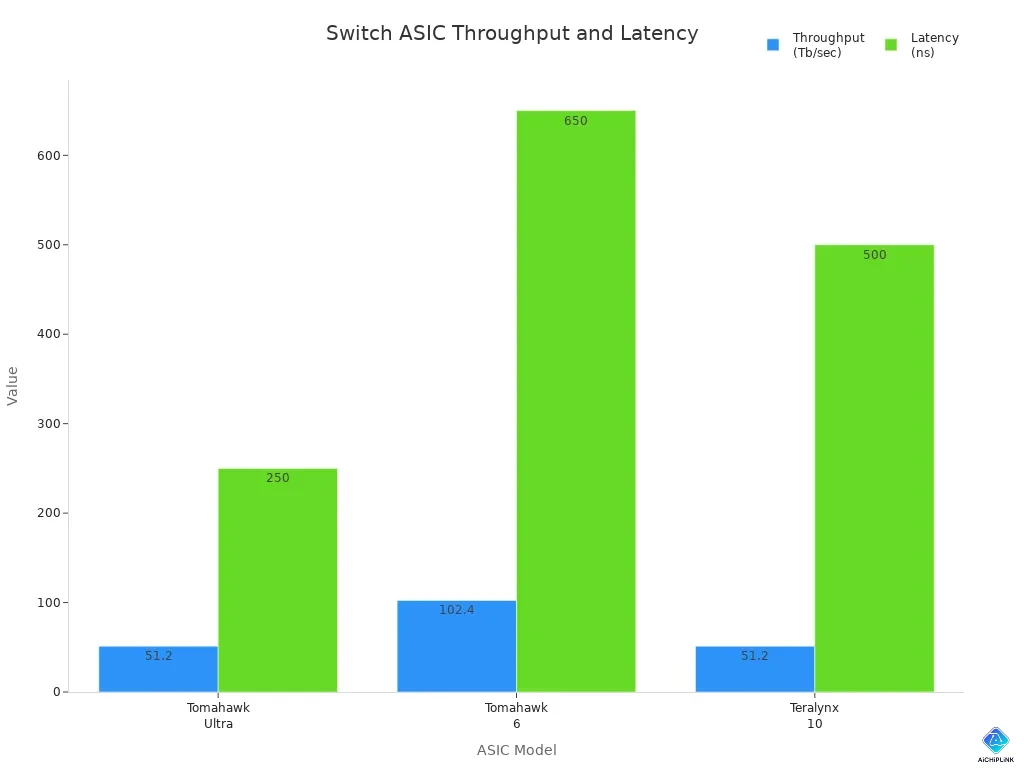
Broadcom Tomahawk Ultra can send 51.2 Tb/sec and has only 250 nanoseconds of latency. This means it moves a lot of data very fast. Tomahawk 6 can send twice as much data, but its latency is higher at 600-700 nanoseconds. Marvell Teralynx 10 matches Tomahawk Ultra in speed but has 500 nanoseconds of latency. If you need the lowest latency, Tomahawk Ultra is best. If you want the most throughput, Tomahawk 6 is the top choice.
Buffering and Port Density
Buffering helps your network when there is a lot of traffic at once. Port density means how many devices you can plug into one switch. Both features are important for building your network.
Here is a table that shows how broadcom and marvell compare:
| Feature | Broadcom (Tomahawk 5) | Marvell (Teralynx 10) |
|---|---|---|
| Bandwidth | 51.2 Tbps | 51.2 Tbps |
| Port Configuration | 64 × 800G or 256 × 200G ports | 512 logical ports |
| Latency | Approximately 250 ns | As low as 500 ns |
| Buffering | On-chip shared buffer | Modular VoQ with external HBM memory |
| Programmability | Limited programmability | Programmable forwarding pipeline |
Broadcom Tomahawk 5 can have up to 256 ports at 200G or 64 ports at 800G. Marvell Teralynx 10 gives you up to 512 logical ports. This means you can connect more devices with Marvell. Broadcom uses on-chip shared buffers, which work well for most data centers. Marvell uses modular VoQ with outside HBM memory. This helps handle big bursts of traffic and surprises better. If you want to change how the switch works, Marvell lets you program the forwarding pipeline.
Power Efficiency
Power efficiency is important for big networks. Using less power means less heat and lower bills. You want switches that save energy but still work well.
-
Marvell makes asics for special AI jobs. This means they use less power than regular chips.
-
These asics use 30% to 40% less power than GPUs. You get better results for AI and cloud work.
-
Broadcom Tomahawk 6 is known for high speed and good power savings in AI networks.
When you look at broadcom vs marvell, both try to save power. Broadcom gives you strong performance with less energy. Marvell focuses on AI and custom jobs with even lower power use. You should pick based on what your network needs and what you want to do.
Tip: If you build a big data center, check both power efficiency and port density. These features help you save money and grow your network.
You can see broadcom and marvell both have strong asic features. Broadcom is best for speed and low latency. Marvell is better for more ports, buffering, and programmability. Your choice depends on what your network needs most.
Real-World Performance
Benchmark Comparisons
When you look at Broadcom vs Marvell in real tests, you see clear differences. These differences matter for your datacenter networking choices. Broadcom ASICs often lead in speed and low delay. For example, Broadcom’s Tomahawk Ultra can reach 51.2 Tbps with a delay as low as 250 nanoseconds. This speed is great for big datacenters that need fast and steady data flow.
Marvell’s ASICs, like the Teralynx 7, focus on balancing speed with saving power and easy programming. They use new 3nm technology to cut power use by up to 30% compared to older chips. Marvell also has lower delay than many others, about 500 nanoseconds, which helps with AI tasks that need quick answers.
Here is a quick benchmark summary:
| Metric | Broadcom Tomahawk Ultra | Marvell Teralynx 7 |
|---|---|---|
| Throughput (Tbps) | 51.2 | 51.2 |
| Latency (ns) | 250 | 500 |
| Power Efficiency | Moderate | High |
Note: If your datacenter needs the fastest speed and lowest delay, Broadcom ASICs are the best choice. For energy-saving networks with good speed, Marvell offers strong options.
Deployment Examples
Broadcom ASICs power most of the world’s biggest datacenters. Companies like Google, Meta, and Amazon use Broadcom chips for their networks. These chips handle huge traffic and support complex routing with proven trust. Broadcom’s wide ecosystem and long partnerships make it a safe choice for large setups.
Marvell is growing in special datacenter areas. Buying Innovium helped Marvell enter cloud-optimized switch markets. You will find Marvell ASICs in AI-focused datacenters and new hyperscale places. These setups benefit from Marvell’s programmable pipelines and power-saving designs, which help cut running costs.
Tip: When picking between Broadcom and Marvell, think about your datacenter’s needs. Broadcom is great for big, well-known networks. Marvell is best for new, power-smart uses.
Business Strategies
Customer Base
Broadcom works with the biggest tech companies in the world. Google’s parent, Alphabet, is Broadcom’s top customer. This helps Broadcom stay ahead in the switch ASIC market. Broadcom also works with Meta and Amazon. These companies trust Broadcom for their data centers. Broadcom focuses on fast networking and AI software. This gives Broadcom a big advantage.
Marvell does things differently. Marvell tries to get more customers and lower its risks. Marvell wants to win more Tier-1 hyperscaler customers. This way, Marvell does not depend on just one company like Amazon Web Services. This plan gives you more choices and better solutions for your network.
Mergers and Acquisitions
Marvell grows by buying other companies. These deals help Marvell get new technology and more customers. The table below lists some important acquisitions and what they did:
| Year | Acquisition | Impact on Growth Strategy |
|---|---|---|
| 2018 | Cavium | Helped Marvell move into networking and infrastructure processing. |
| 2019 | Avera Semiconductor | Gave Marvell custom ASIC skills for cloud and infrastructure customers. |
| 2019 | Aquantia | Added Ethernet and multi-gig connections for cars and businesses. |
| 2021 | Inphi | Grew Marvell’s electro-optics and high-speed links for data centers and AI. |
| 2021 | Innovium | Made Marvell stronger in cloud-optimized Ethernet switches for big data centers. |
You can see Marvell uses these deals to get stronger in semiconductors. Each company Marvell buys helps it reach new markets and make better products.
Growth Metrics
Broadcom is growing fast in both money and market share. In Q2 of 2025, Broadcom expects $14.9 billion in revenue. This is 19.3% more than last year. Its infrastructure software sales should be $6.5 billion, up 23%. The semiconductor solutions part should reach $8.4 billion, a 16.6% increase. Broadcom’s focus on AI and its wide business model give it a strong lead.
Marvell also has strong numbers. In Q4 2026, Marvell made $2.22 billion, up 22% from last year. For the whole year, Marvell earned $8.2 billion. Over $6 billion came from data center sales. Marvell’s price-to-earnings ratio is 49.1x. This high number means investors think Marvell will keep growing fast in ASICs.
Broadcom is a leader because it is strong with money and infrastructure. Marvell’s smart deals and growth in data center tech help it compete and give you more choices.
Future Outlook for Broadcom and Marvell
Custom Silicon Trends
You will see custom silicon become more important in the switch ASIC market. Companies want chips that fit their own needs. This trend helps you get better performance and lower costs. Broadcom and Marvell both invest in custom silicon for AI and cloud networks.
Here is a table that shows how both companies work with big cloud providers and what they have achieved:
| Vendor | AI Revenue (2024) | Key Partnerships | Notable Developments |
|---|---|---|---|
| Broadcom | $8 billion | Google, AWS, Microsoft, Meta | Co-developing Meta’s MTIA training accelerators; contracted by OpenAI for high-end AI ASICs. |
| Marvell | $1.2 billion | Amazon, Microsoft | Five-year agreement with AWS for multi-generation ASICs; Maia 100 for Azure LLM training. |
You can see Broadcom leads in AI revenue and works with more partners. Marvell grows fast by making deals with Amazon and Microsoft. Both companies focus on AI and custom chips for large data centers. This means you will have more choices for your network in the future.
Note: Analysts say Broadcom holds about 55% to 60% of the market. Marvell has 13% to 15% but grows faster. Broadcom uses a closed-loop system for high profits. Marvell aims for cost-effective solutions and long-term growth.
Technology Roadmaps
You should watch new product launches from both companies. Marvell has released the Teralynx 10 ASIC. This chip supports 51.2 Tb/sec and targets 800 Gb/sec Ethernet switches. Marvell also plans to use the Nova PAM-4 digital signal processor. This will help future Ethernet modules reach 200 Gb/sec per lane.
-
Marvell’s Teralynx 10 ASIC is one of the first to support 800 Gb/sec Ethernet.
-
The Nova PAM-4 DSP will boost speed for next-generation Ethernet modules.
Broadcom does not share a public roadmap for the next five years. You can expect Broadcom to keep improving its chips for speed and AI. Both companies will likely push for higher bandwidth and lower power use.
Tip: If you plan your network for the future, look for chips that support 800 Gb/sec and advanced AI features. Both Broadcom and Marvell will offer strong options as technology moves forward.
In the Broadcom vs Marvell race, Broadcom is ahead with a big market share. It made $4.1 billion from AI and has a $301 price target showing growth. Marvell’s data center sales are growing fast but future design wins are not certain. When picking, think about:
-
Broadcom for trusted performance and steady growth
-
Marvell for new solutions that have some risk
Expect both companies to keep improving and changing the market as they develop new technology.

Written by Jack Elliott from AIChipLink.
AIChipLink, one of the fastest-growing global independent electronic components distributors in the world, offers millions of products from thousands of manufacturers, and many of our in-stock parts is available to ship same day.
We mainly source and distribute integrated circuit (IC) products of brands such as Broadcom, Microchip, Texas Instruments, Infineon, NXP, Analog Devices, Qualcomm, Intel, etc., which are widely used in communication & network, telecom, industrial control, new energy and automotive electronics.
Empowered by AI, Linked to the Future. Get started on AIChipLink and submit your RFQ online today!
Frequently Asked Questions
What makes Broadcom the top choice for data centers?
You get high speed, low latency, and strong reliability with Broadcom. Big companies trust Broadcom for their networks. Broadcom also leads in new technology and works with top cloud providers.
Why do some buyers pick Marvell over Broadcom?
You may choose Marvell for its lower power use and flexible design. Marvell lets you program the switch more. It also offers more ports and better buffering for busy networks.
How do Broadcom and Marvell differ in programmability?
Broadcom gives you basic programmability with P4 and eBPF. Marvell lets you change the forwarding pipeline more. You can adjust Marvell switches for special tasks.
Which ASIC is better for AI workloads?
You should look at your needs. Broadcom works well for large AI clusters and fast data. Marvell uses less power and fits custom AI jobs. Both offer strong options for AI.