Broadcom Tomahawk vs Trident vs Jericho: Which Switch ASIC Is Better?
You cannot find one answer for the best switch ASIC. The best choice depends on your network needs. Broadcom Tomahawk is good for big data centers. Trident is great for enterprise networks because it can be programmed. Jericho is special for service providers with big memory buffers. Each chip is best in its own way. The market share shows all three have about 60-65% each. When you compare them, you look at throughput, programmability, and memory. These things help you decide which one to pick.
Key Takeaways
-
Pick Tomahawk if you need fast data centers. It gives the highest speed, up to 102.4 Tbps.
-
Choose Trident if you want more options and control. You can change network features and protocols easily.
-
Go with Jericho if your network needs big buffers. It works well with lots of traffic and big routing tables.
-
Think about what your network needs before picking an ASIC. Each chip is best at something, like speed or memory.
-
Try out different ASICs in a lab first. This helps you see which one works best for your network.
ASIC Overview
Broadcom Tomahawk Series
Many big data centers use the broadcom tomahawk series. These chips are known for being fast and efficient. The newest tomahawk chips, like Tomahawk 5, can move up to 51.2 Tbps of data. One chip can connect up to 256 ports at 200GbE. The tomahawk family uses advanced tech, with Tomahawk 4 having over 31 billion transistors. These chips have shared-buffer design and smart routing. This helps with AI and machine learning jobs. The tomahawk series also has hardware link failover. This keeps the network working if a link fails.
| Model | Maximum Throughput | Port Density |
|---|---|---|
| Tomahawk 1 | 6.4 Tbps | 64 x 100G ports |
| Tomahawk 3 | 12.8 Tbps | 256 x 50G ports |
| Tomahawk 4 | 25.6 Tbps | Up to 512 SerDes |
| Tomahawk 5 | 51.2 Tbps | Up to 256 ports at 200G |
| Tomahawk 6 | 102.4 Tbps | Up to 64 ports at 1.6 Tbps |
Note: The broadcom tomahawk series is made for speed and size. It is a top pick for big cloud networks.
Trident Series
Pick the Trident series if you want more control and flexibility. The broadcom Trident chips let you program how packets are handled. They support many protocols like VXLAN, MPLS, and Geneve. Trident 4 can reach 12.8 Tbps and has up to 128 ports at 100 Gb/sec. The Trident series has big match-action databases and can change how flows move. You can add new features with software updates. This helps your network change fast. The Trident series is good for enterprise networks that need smart features and easy upgrades.
-
Pipelines you can program
-
Works with many overlay protocols
-
Better telemetry and smart routing
-
One software model for all
Jericho Series
The broadcom Jericho series is used in service provider and core networks. These chips have deep buffers and strong memory. Jericho 2 gives 9.6 Tbps of bandwidth and supports big routing tables. The Jericho chips use both on-chip and off-chip buffers. Some platforms have 16 MB on-chip and 4 GB off-chip buffers. You can store up to 2.2 million routing prefixes. The Jericho series is best for networks with lots of traffic and big routing tables.
| Platform | On-Chip Buffers | Off-Chip Buffers | LPM Memory Capacity |
|---|---|---|---|
| NCS-55A1-24Q6H-S/-SS | 16 MB | 4 GB | 1M to 1.5M prefixes |
| NCS-55A1-24H | 16 MB | 4 GB | Up to 2.2M prefixes |
Tip: Pick the broadcom Jericho series if your network needs deep buffers and lots of memory for routing.
Main Features
Performance Metrics
You want your network to be fast and work well. Each Broadcom ASIC has different performance levels. Tomahawk chips are made for high throughput. For example, Tomahawk 4 can move 25.6 Tbps. This is great for big data centers that need to move lots of data. Trident chips also have strong performance. Trident 4 can reach 12.8 Tbps. Jericho chips can go up to 10 Tbps. But Jericho is better at other things. When you look at these chips, Tomahawk is the fastest. Trident and Jericho mix speed with other features.
Programmability
If you want to control your network traffic, programmability is important. Trident ASICs are best for this. You can program them to use new protocols and do advanced packet jobs. This lets you update your network with software. You do not need to change hardware. Tomahawk chips are made for speed and low cost. They do not have as many programmability choices. Jericho chips can do advanced networking. But they are not as flexible as Trident. Here is a quick table:
| ASIC Type | Programmability Features |
|---|---|
| Trident | Fully programmable, advanced protocol support |
| Tomahawk | Limited programmability, optimized for speed |
| Jericho | Supports advanced networking, less flexible than Trident |
Tip: Pick Trident if you want to add new features or protocols to your network easily.
Buffering and Memory
Buffering and memory help your network with heavy or sudden traffic. Tomahawk and Trident chips use small to medium buffers. These are good when your traffic is steady. Jericho chips use deep shared buffers and VOQ. This helps with sudden traffic bursts and stops packet loss. If your network gets busy fast or needs to store lots of routes, Jericho is best.
| ASIC Type | Buffer Type | Best For |
|---|---|---|
| Tomahawk | Shallow/moderate | Predictable traffic |
| Trident | Shallow/moderate | Predictable traffic |
| Jericho | Deep shared, VOQ | Bursty traffic, congestion control |
Note: Jericho’s deep buffers help your network stay stable, even when traffic is heavy.
Target Markets
Data Center (Tomahawk)
Tomahawk chips are used in big data centers. These chips help build fast networks for cloud computing and AI. Tomahawk can move a lot of data very quickly. It also connects many servers and storage devices. Many companies use tomahawk for real-time data and low delays. This includes AI, phone companies, and banks. They need to process data fast and keep connections stable. The table below shows how different groups use tomahawk:
| Industry | Use Case Description |
|---|---|
| AI | Real-time data processing and analysis |
| Telecommunications | Handles increased data traffic from 5G networks |
| Financial Services | Delivers low latency and stable connections for trading and analytics |
Tomahawk is best when you need a fast and reliable data center.
Enterprise (Trident)
Trident chips are good for business and cloud networks. Trident helps save money and lets you design flexible networks. It supports many protocols and lets you program how traffic moves. This makes trident great for companies that want to grow or change fast. You can use trident in many places, like top-of-rack switches or campus networks. It also works for wireless edge stacking. The table below shows where trident is used:
| Deployment Scenario | ASIC Version | Description |
|---|---|---|
| Data Center | X4 | 10G Top-of-Rack (TOR) |
| Data Center | X5 | 25/50G Top-of-Rack (TOR) |
| Data Center | X7 | 100G ECMP spine |
| Campus | X2 | Lower density/speed (1/2.5/10G) |
| Wireless | X3 | Wireless and campus edge stacking |
Trident gives you choices and control for today’s business networks.
Service Provider (Jericho)
Jericho chips are found in service provider networks. They are also in big routing systems. Jericho has deep buffers and strong routing features. You can use Jericho to handle lots of traffic and connect faraway data centers. Service providers pick Jericho for high bandwidth and flexible routing. Jericho uses both on-chip and off-chip memory to manage packets well. Here are some ways Jericho helps service providers:
-
Handles high bandwidth and flexible routing for carrier networks.
-
Uses deep buffering to manage traffic bursts and congestion.
-
Supports lossless RoCE over long distances.
-
Stores millions of routing prefixes for large networks.
Jericho is the best pick if your network needs strong buffers and big routing tables.
Broadcom Tomahawk Performance
Throughput and Latency
You want your network to run fast and smooth. The tomahawk series stands out as one of the best high throughput network asics. You can build a switch chip that moves huge amounts of data. Tomahawk chips reach up to 51.2 terabits per second. This speed helps you connect hundreds of servers and devices. You see low latency, which means your data travels quickly. Tomahawk chips can deliver latency as low as 250 nanoseconds. This is important for AI and machine learning jobs. You get reliable performance even when your network is busy.
-
Tomahawk uses a shared-buffer design. This keeps tail latency low for critical workloads.
-
The tomahawk ultra series works well for AI and HPC tasks.
-
You can trust tomahawk to handle large data flows without slowing down.
If you need a switch chip for real-time applications, tomahawk gives you the speed and stability you want.
SerDes Technology
You need strong signal integrity when you build a fast switch chip. Tomahawk uses advanced SerDes technology to keep data moving at high speeds. The tomahawk 6 chip uses a multi-die design. This design needs special chip-to-chip interfaces. You see up to 1,000 SerDes lanes in tomahawk. These lanes help you connect many ports and keep the signal clean.
Tomahawk increases the number of channels and their speed. You get higher data rates with 100 Gb/sec PAM4-modulated SerDes lines. As you push for more speed, you need more power to keep the signal strong. Tomahawk uses extra re-timers to recover data and manage signal integrity. This makes your switch chip reliable even at high speeds.
You can build networks that support AI, cloud, and big data. Tomahawk gives you the tools to scale up without losing performance. You see tomahawk in many modern switch chip designs because it balances speed, signal quality, and manufacturability.
Note: Tomahawk’s SerDes technology helps you build networks that stay fast and stable as demands grow.
Comparison Table
You want to pick the right switch for your network. You need to see how Tomahawk, Trident, and Jericho compare. The table below shows the main features of these switch asics. You can check throughput, programmability, and memory. This helps you match the right chip to your needs.
| ASIC Family | Throughput | Programmability | Memory / Buffering | Typical Switch Configurations |
|---|---|---|---|---|
| Tomahawk | Up to 102.4 Tbps | Basic | 12MB–16MB buffer, 64k–72k IPv4, 20k–36k IPv6 | 64–256 ports at 100G/200G/400G, pizza box |
| Trident | Up to 12.8 Tbps | Advanced, flexible | 12MB buffer, 64k–72k IPv4, 20k–36k IPv6 | 48–128 ports at 10G/25G/100G, campus/core |
| Jericho | Up to 10 Tbps | Packet processor | Deep buffer (16MB+), expandable, >8GB ext. | Modular chassis, 24–48 ports at 100G/400G |
You can see Tomahawk gives you the highest throughput. Trident lets you program your network and add new features. Jericho gives you the deepest buffers and the most memory for big routing tables.
You also want to know how these switch asics fit into real ethernet switches. The next table shows common switch configurations for each family. You can see the port counts and speeds you get with each type.
| Family | Generation | Access Speeds | Uplinks | Primary Role |
|---|---|---|---|---|
| 7050 | X4 | 25G / 100G / 400G | 100G / 400G | 400G-era leaf and aggregation |
| 7060 | Ultra-low | 10G to 800G | N/A | High-density leaf, spine, AI/ML |
| 7060 | Moderate | 10G to 400G | N/A | Aggregation, spine, DCI, storage |
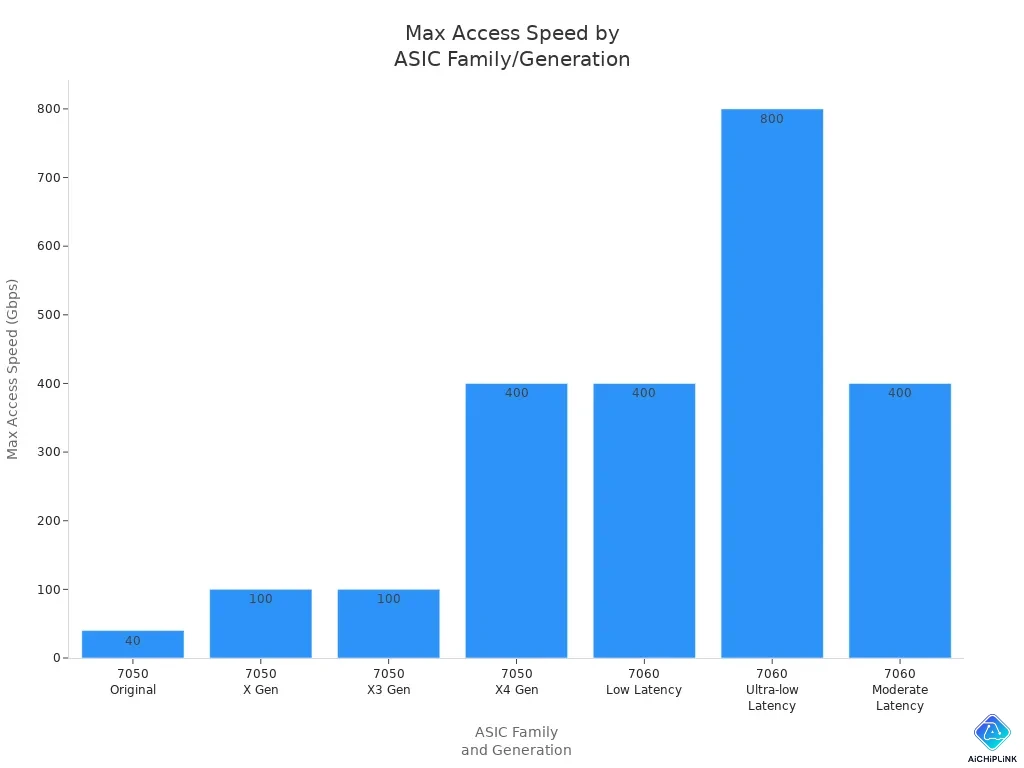
You use Tomahawk when you need a high-speed switch for your data center. You pick Trident for ethernet switches in your enterprise or campus. You choose Jericho when your switch must handle bursty traffic and large routing tables. Each switch asic has a special role. You get the best results when you match the chip to your network.
You see that switch asics shape the design of modern ethernet switches. You can build a switch for any job, from a simple pizza box to a modular chassis. You get the speed, programmability, or memory you need. Your network runs better when you choose the right switch asic.
Choosing the Right ASIC
Network Requirements
You should check your network needs before picking an asic. First, think about how big your network is. Also, think about what kind of traffic you will have. If you run a large data center, you need high bandwidth and low latency. Tomahawk asic models are best for these jobs. You can use them for spine switches in big data centers. These chips move lots of data fast and keep things running well.
If you work in a business network, you might want more control and flexibility. Trident asic models let you program your network for new features and protocols. You can use trident for leaf switches in your company. This helps you add things like VXLAN or MPLS as your network grows. Trident 3 and trident 4 both give you good programmability and bandwidth for business needs.
Service providers need deep buffers and big routing tables. Jericho asic models are best for these networks. You can use Jericho 2 for routers that need deep buffering. Jericho 3 is great for AI and high-performance jobs. These asics help you handle bursty traffic and keep your network stable when it gets busy.
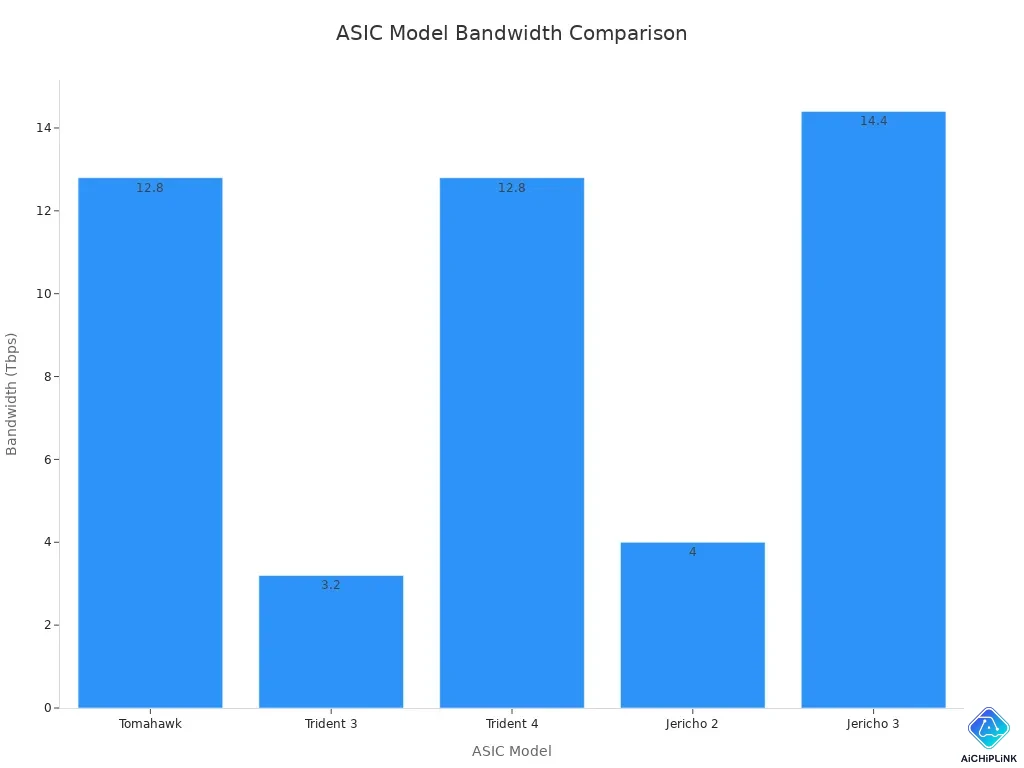
Here is a table to help you match your network needs to the right asic:
| ASIC Model | Bandwidth (Tbps) | Key Features | Suitable Use Case |
|---|---|---|---|
| Tomahawk | Up to 12.8 | High bandwidth, less feature-rich | Spine switches in large data centers |
| Trident 3 | 3.2 | Rich feature set (e.g., VXLAN) | Leaf switches in enterprise networks |
| Trident 4 | 12.8 | Enhanced features for enterprise applications | Leaf switches needing advanced features |
| Jericho 2 | 4 | Deep buffers, supports large routing tables | Router applications needing deep buffering |
| Jericho 3 | 14.4 | Optimized for AI, reduced buffering | AI applications and high-performance needs |
You also need to think about how well your network must perform. Some asics use split buffer designs. These can make latency higher and throughput lower. Deep-buffer switches, like Jericho, can make latency much higher. This can hurt storage jobs. Tests show deep-buffer switch latency is much higher than optimized switches. You should not use deep-buffer asics for high-performance jobs.
If you want flexibility, trident asics let you change your network as you need. If you want speed, tomahawk asics give you the highest throughput. Jericho asics help you handle heavy traffic and big routing tables.
Deployment Scenarios
You can find the right asic by looking at real-world examples. Each asic fits a different network and job.
-
Hyperscale Data Centers:
You need tomahawk asics for very big networks. These chips power pizza box switches with lots of ports. You get fast connections for AI, cloud, and storage. Tomahawk asics keep your network fast and steady. -
Enterprise Networks:
You want trident asics for business and campus networks. Trident gives you programmability and supports many protocols. You can use trident for top-of-rack switches or campus cores. Trident asics help you add new features with software updates. -
Service Provider Networks:
You need jericho asics for service provider and carrier networks. Jericho gives you deep buffers and strong routing. You can use jericho in modular chassis for core routers. Service providers use products like Cisco NCS 5500 and 5700 with jericho asics. These switches can buffer up to 50 ms of traffic during congestion.
| Product | Description |
|---|---|
| Cisco NCS 5500/5700 | Uses Jericho asics for high performance and buffering, up to 50 ms buffering |
When you pick an asic, you also need to balance programmability and throughput.
The trade-offs between programmability and raw throughput when choosing a switch asic mean you must balance flexibility and performance. Programmable asics let you change things but may not be as fast as fixed-function asics, which are made for speed.
You can see the main trade-offs in this list:
-
CPU: You get flexibility but lose some speed.
-
FPGA: You pay more for flexibility and speed.
-
ASIC: You get the best speed but less flexibility.
If you want to add new features later, trident asics are best. If you want the fastest network, tomahawk asics are the right choice. If you need deep buffers and big routing tables, jericho asics fit your needs.
You should also think about cost. Trident asics give you a good mix of features and price for business networks. Tomahawk asics cost more but give you top speed for big data centers. Jericho asics cost more because of their deep buffers and memory.
When you match your network needs to the right asic, you build a network that works well for your business. You get the speed, flexibility, or stability you need.
You can pick the right application specific integrated circuit by looking at what your network needs. Each ASIC has its own strengths. The table below shows which chip is best for different kinds of traffic.
| ASIC Family | Optimal Use Case | Traffic Profile |
|---|---|---|
| Tomahawk (7060) | East-west traffic with minimal congestion | Predictable traffic |
| Trident (7050) | East-west traffic with minimal congestion | Predictable traffic |
| Jericho (7280) | High burst traffic, storage, and DCI workloads | Bursty traffic, high fan-in ratios |
You should use jericho if your network has bursty traffic or needs lots of storage. Tomahawk and Trident are good for networks with steady traffic.
To keep going:
-
Write down what your network needs.
-
Get tools and labs for testing and design.
You can try out different ASICs in your lab. You can also ask vendors to help you find the best one.

Written by Jack Elliott from AIChipLink.
AIChipLink, one of the fastest-growing global independent electronic components distributors in the world, offers millions of products from thousands of manufacturers, and many of our in-stock parts is available to ship same day.
We mainly source and distribute integrated circuit (IC) products of brands such as Broadcom, Microchip, Texas Instruments, Infineon, NXP, Analog Devices, Qualcomm, Intel, etc., which are widely used in communication & network, telecom, industrial control, new energy and automotive electronics.
Empowered by AI, Linked to the Future. Get started on AIChipLink and submit your RFQ online today!
Frequently Asked Questions
What makes broadcom chips different from others?
You see broadcom chips in many networks because they offer high speed, strong reliability, and wide support. These chips power most high speed ethernet asics. You get better performance and more features with broadcom compared to many other brands.
Why do data centers choose broadcom chips?
You find broadcom chips in data centers because they handle lots of data quickly. These chips support high speed ethernet asics. You can connect many servers and keep your network running smoothly. Broadcom chips also help reduce delays and improve stability.
Can you program broadcom chips for new features?
Yes, you can program some broadcom chips, like the Trident series. You add new protocols or change how your network works. This lets you update your network without changing the hardware. You get more control and flexibility with these chips.
How do broadcom chips handle network traffic bursts?
Broadcom chips like Jericho use deep buffers. You can manage sudden traffic bursts without losing data. These chips store extra packets until the network clears. This keeps your network stable during busy times.
Which broadcom chip should you pick for your network?
You should pick a broadcom chip based on your needs. Tomahawk chips work best for fast data centers. Trident chips fit enterprise networks that need programmability. Jericho chips help service providers with heavy traffic and big routing tables. > Tip: Write down your network needs before you choose a chip. This helps you match the right broadcom chip to your job.