Introduction
DDR5 represents the next generation of memory technology, offering significant improvements over DDR4 in bandwidth, capacity, power efficiency, and advanced features like on-die ECC. Since its introduction in 2020 and mainstream adoption starting in 2022 with Intel's 12th-gen Alder Lake and AMD's Ryzen 7000 series, DDR5 has gradually replaced DDR4 as the standard for new PC builds. This comprehensive comparison examines the technical differences between DDR5 and DDR4, real-world performance gains across gaming and productivity workloads, pricing trends in 2026, and whether upgrading to DDR5 makes sense for your specific use case.
Overview & Key Differences
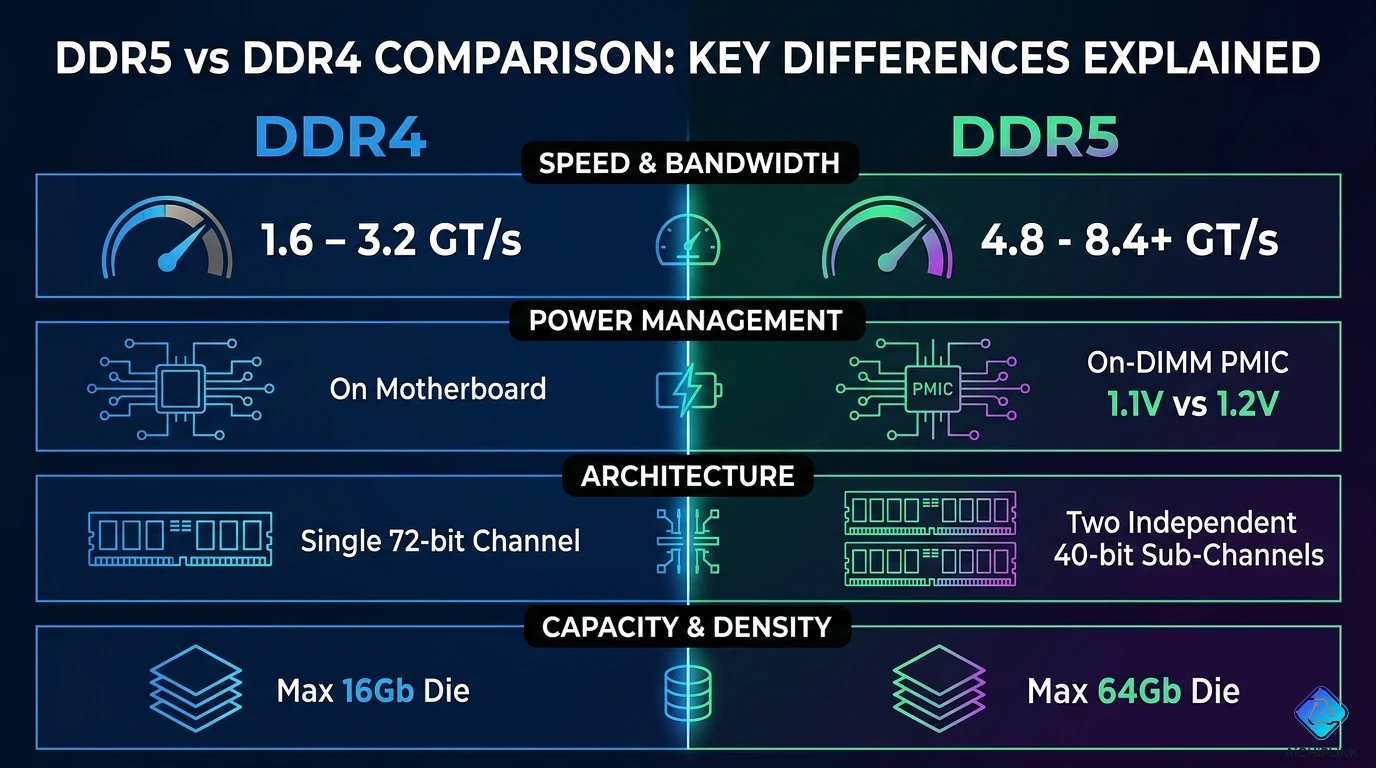
Quick Comparison Table
| Feature | DDR4 | DDR5 |
|---|---|---|
| Standard Release | 2014 | 2020 |
| Speed Range | 1600-3200 MT/s (JEDEC) 2133-5333 MT/s (OC) | 4800-6400 MT/s (JEDEC) 4800-8800 MT/s (OC) |
| Voltage | 1.2V | 1.1V |
| Channels per DIMM | Single 64-bit | Dual 32-bit (independent) |
| Max DIMM Capacity | 32GB (single-rank) | 64GB (single-rank), 128GB capable |
| Burst Length | BL8 (8 transfers) | BL16 (16 transfers) |
| On-Die ECC | No | Yes (built-in) |
| Power Management | On motherboard (PMIC) | On DIMM (PMIC integrated) |
| Prefetch | 8n | 16n |
| Pin Count | 288 pins | 288 pins (different notch position) |
| Price (32GB kit, 2026) | $50-100 (DDR4-3200) | $80-150 (DDR5-6000) |
Visual Comparison
Physical Differences:
DDR4 DIMM:
[=========|=========] ← Notch position (center-left)
 288 pins, single 64-bit channel

DDR5 DIMM:
[==========|========] ← Notch position (center, slightly offset)
 288 pins, dual 32-bit channels
 PMIC chip visible on module
Key Innovations in DDR5:
- Dual 32-bit channels per DIMM (vs single 64-bit) → better concurrency
- On-die ECC → improves reliability without performance penalty
- Integrated PMIC → cleaner power delivery, reduces motherboard complexity
- Higher burst length (BL16) → optimized for larger cache lines
Technical Specifications
Speed & Bandwidth
DDR4 Speeds:
JEDEC Standard: 1600, 1866, 2133, 2400, 2666, 3200 MT/s
Bandwidth: 12.8 GB/s (DDR4-1600) to 25.6 GB/s (DDR4-3200) per channel

Overclocked (XMP): 2666-5333 MT/s
Bandwidth: Up to 42.7 GB/s per channel (DDR4-5333, rare)
DDR5 Speeds:
JEDEC Standard: 4800, 5600, 6400 MT/s
Bandwidth: 38.4 GB/s (DDR5-4800) to 51.2 GB/s (DDR5-6400) per channel

Overclocked (XMP 3.0/EXPO): 4800-8800 MT/s
Bandwidth: Up to 70.4 GB/s per channel (DDR5-8800)
Bandwidth Advantage:
DDR4-3200: 25.6 GB/s per channel
DDR5-6400: 51.2 GB/s per channel

DDR5 advantage: +100% bandwidth (double) at comparable pricing
Latency
Important Note: Higher clock speed doesn't always mean lower latency in nanoseconds.
DDR4 Latency:
DDR4-3200 CL16:
Absolute latency = (CL / Frequency) × 2000
= (16 / 3200) × 2000 = 10 ns

DDR4-3600 CL18:
= (18 / 3600) × 2000 = 10 ns
DDR5 Latency:
DDR5-6000 CL36:
= (36 / 6000) × 2000 = 12 ns

DDR5-6400 CL32:
= (32 / 6400) × 2000 = 10 ns

DDR5-7200 CL34:
= (34 / 7200) × 2000 = 9.4 ns (better than most DDR4)
Reality: Early DDR5 had higher latency (~12-14 ns) than optimized DDR4 (~10 ns), but modern high-end DDR5 (7200+ MT/s) achieves lower latency while maintaining massive bandwidth advantage.
Power Consumption
DDR4:
Operating Voltage: 1.2V (standard), 1.35V (XMP overclocking)
Power per DIMM: ~3-5W (8GB-16GB module)
Motherboard PMIC: Handles voltage regulation
DDR5:
Operating Voltage: 1.1V (standard), 1.25-1.35V (XMP overclocking)
Power per DIMM: ~3-4W (16GB-32GB module, better efficiency)
On-DIMM PMIC: Each module self-regulates power
Efficiency Advantage:
DDR4: 1.2V, 25.6 GB/s → ~0.19 W per GB/s
DDR5: 1.1V, 51.2 GB/s → ~0.08 W per GB/s

DDR5: ~58% more efficient per bandwidth
Capacity
DDR4:
Single-rank: 8GB, 16GB per DIMM typical
Dual-rank: 32GB per DIMM (high-end)
Practical max: 128GB (4× 32GB DIMMs)
DDR5:
Single-rank: 16GB, 32GB per DIMM typical
Dual-rank: 64GB per DIMM available now
Future: 128GB per DIMM possible (JEDEC spec)
Practical max: 256GB (4× 64GB DIMMs) current, 512GB future
Use Case Impact:
- Content creators: 96GB+ RAM for 8K video editing → DDR5 enables higher capacities
- Servers/workstations: DDR5's higher density reduces DIMM slots needed
Performance Comparison
Synthetic Benchmarks
Memory Bandwidth (AIDA64):
DDR4-3200 CL16:
- Read: 48 GB/s
- Write: 46 GB/s
- Copy: 44 GB/s

DDR5-6000 CL36:
- Read: 82 GB/s
- Write: 78 GB/s
- Copy: 75 GB/s

Improvement: +70-75% bandwidth
Memory Latency:
DDR4-3200 CL16: 45 ns (total system latency)
DDR5-6000 CL36: 68 ns (early DDR5)
DDR5-7200 CL34: 50 ns (optimized DDR5)

Note: System latency includes CPU, fabric, memory—higher than absolute memory latency
Gaming Performance
1080p Gaming (CPU-Limited Scenarios):
Average FPS Gain (DDR5-6000 vs DDR4-3200):
Cyberpunk 2077: +8% FPS (DDR5 advantage)
Call of Duty: Warzone: +12% FPS
CS:GO: +15% FPS (bandwidth-sensitive)
Flight Simulator 2020: +18% FPS (cache thrashing scenarios)
Starfield: +10% FPS
Baldur's Gate 3: +6% FPS

Average: +10-12% FPS improvement at 1080p
4K Gaming (GPU-Limited Scenarios):
Most games: +0-3% FPS difference (GPU bottleneck)
Exception: CPU-heavy titles at 4K still show 3-5% gains
Conclusion: DDR5 provides noticeable gaming benefit at 1080p/1440p with high-end GPUs (RTX 4080+, RX 7900 XT+), minimal impact at 4K.
Productivity Workloads
Content Creation:
Video Encoding (Adobe Premiere Pro):
4K H.265 export (10-minute clip):
DDR4-3200: 6:45 minutes
DDR5-6400: 6:15 minutes

Improvement: ~7% faster (bandwidth helps)
3D Rendering (Blender Cycles):
CPU rendering (BMW scene):
DDR4-3200: 185 seconds
DDR5-6400: 179 seconds

Improvement: ~3% faster (compute-bound, minimal memory impact)
Compilation (Large C++ Project):
Full rebuild (Chromium, 36,000 files):
DDR4-3200: 42 minutes
DDR5-6400: 38 minutes

Improvement: ~9% faster (benefits from bandwidth, lower latency)
Machine Learning (Training):
ResNet-50 training (CPU-only):
DDR4-3200: 12.4 images/sec
DDR5-6400: 14.8 images/sec

Improvement: ~19% faster (very bandwidth-sensitive)
Real-World Considerations
Platform Support
CPU Compatibility:
Intel:
DDR4 only: 11th gen and earlier (Rocket Lake, Comet Lake)
DDR4 or DDR5: 12th/13th gen (Alder Lake, Raptor Lake) - motherboard-dependent
DDR5 only: 14th gen and newer (Meteor Lake refresh, Arrow Lake)
AMD:
DDR4 only: Ryzen 5000 series and earlier (Zen 3, Zen 2)
DDR5 only: Ryzen 7000/8000/9000 series (Zen 4, Zen 5)
Important: Cannot mix DDR4 and DDR5 on same system—requires different motherboard.
Pricing Trends (2026)
DDR4 Pricing:
16GB (2×8GB) DDR4-3200: $30-50
32GB (2×16GB) DDR4-3200: $50-80
32GB (2×16GB) DDR4-3600: $60-100

Market status: Mature, declining production, prices stable
DDR5 Pricing:
16GB (2×8GB) DDR5-5600: $50-70
32GB (2×16GB) DDR5-6000: $80-120
32GB (2×16GB) DDR5-7200: $120-180

Market status: Mainstream adoption, prices falling, approaching DDR4 parity at base speeds
Price Parity Achieved (2026):
- DDR5-5600 now comparable to DDR4-3600 pricing
- Premium for high-speed DDR5 (6400+) still exists but narrowing
Upgrade Path Considerations
Upgrading Existing DDR4 System:
Cost breakdown:
DDR4 system: No upgrade cost
DDR5 upgrade: $150-300 motherboard + $80-150 RAM + possible CPU upgrade

Total: $230-450+ (significant investment)
When DDR5 Upgrade Makes Sense:
- Building new system: Choose DDR5—future-proof, similar cost
- High-refresh gaming (1080p/1440p): 10-15% FPS gains justify cost
- Memory-intensive work: Video editing, ML training benefit significantly
- Long upgrade cycle: Investing now avoids future platform change
When to Stick with DDR4:
- Existing DDR4 system: Upgrade cost doesn't justify 10-15% gains
- 4K gaming: GPU-limited scenarios see minimal benefit
- Budget builds: DDR4 systems offer better value at entry level
- Casual use: Web browsing, office work—no noticeable difference
Future-Proofing
Technology Roadmap
DDR4 (End-of-Life):
Status: Mature, no new developments
Production: Declining, focus shifted to DDR5
Support: Current platforms last to support DDR4 (Intel 13th gen, AMD Zen 3)
Sunset: New platforms (2024+) DDR5-only
DDR5 (Current & Future):
Current (2026): 6400-8800 MT/s mainstream
Near-term (2027): 10,000+ MT/s overclocking achievable
Long-term (2028+): DDR5 standard until DDR6 (2028-2030 earliest)

Improvements:
- Higher speeds (8000+ MT/s becoming common)
- Lower latencies (optimized dies, better timings)
- Higher capacities (128GB DIMMs mass production)
DDR6 Preview:
Expected: 2028-2030 (sampling phase)
Target speeds: 12,000-17,000 MT/s
Features: Further improved power efficiency, higher density
Conclusion
DDR5 represents a significant generational leap over DDR4, offering double the bandwidth (50-100% faster), improved power efficiency (1.1V vs 1.2V), higher capacities (64GB+ per DIMM), and advanced features like on-die ECC. For new system builds in 2026, DDR5 is the clear choice—pricing has reached parity with DDR4 at mainstream speeds (5600-6000 MT/s), while performance benefits are substantial for gaming (10-15% at 1080p), content creation (7-19% faster), and future-proofing as DDR4 reaches end-of-life. Existing DDR4 users should weigh upgrade costs ($300-500+) against specific use case benefits, with high-refresh competitive gamers and professional creators seeing strongest justification.
Key Takeaways:
✅ Speed: DDR5 2× bandwidth of DDR4 (51 GB/s vs 26 GB/s typical)
✅ Gaming: 10-15% FPS gain at 1080p/1440p, minimal at 4K
✅ Productivity: 7-19% faster in memory-intensive workloads
✅ Efficiency: 58% more power efficient per bandwidth unit
✅ Capacity: 64GB+ per DIMM (vs DDR4's 32GB practical max)
✅ Pricing (2026): Parity achieved—DDR5-6000 comparable to DDR4-3600
✅ New builds: Choose DDR5 (future-proof, similar cost)
✅ Existing systems: Upgrade only if targeting high-performance use cases
✅ Sweet spot: DDR5-6000 to DDR5-6400 (best price-performance)
Planning PC upgrade or new build? Visit AiChipLink.com for memory recommendations, DDR5 sourcing, and system configuration consultation.

Written by Jack Elliott from AIChipLink.
AIChipLink, one of the fastest-growing global independent electronic components distributors in the world, offers millions of products from thousands of manufacturers, and many of our in-stock parts is available to ship same day.
We mainly source and distribute integrated circuit (IC) products of brands such as Broadcom, Microchip, Texas Instruments, Infineon, NXP, Analog Devices, Qualcomm, Intel, etc., which are widely used in communication & network, telecom, industrial control, new energy and automotive electronics.
Empowered by AI, Linked to the Future. Get started on AIChipLink.com and submit your RFQ online today!
Frequently Asked Questions
Is DDR5 faster than DDR4?
Yes—DDR5 delivers significantly higher bandwidth than DDR4, typically 50–100% more at similar price points. For example, DDR5-6000 provides around 82 GB/s compared to DDR4-3200’s ~48 GB/s, resulting in measurable gains in gaming (especially at 1080p/1440p) and productivity tasks like video editing or machine learning. While early DDR5 had higher latency, modern high-speed kits (7200 MT/s+) now achieve comparable latency to DDR4 while maintaining a clear bandwidth advantage and better power efficiency.
Should I upgrade from DDR4 to DDR5?
Upgrading depends on whether you’re building new or improving an existing system. DDR5 is the clear choice for new builds due to price parity, better performance, and future compatibility, especially for gaming at high refresh rates or professional workloads. However, upgrading an existing DDR4 system is often not cost-effective since it requires a new motherboard and possibly CPU, while delivering relatively modest performance gains in most everyday use cases.
Can I use DDR5 on a DDR4 motherboard?
No—DDR5 and DDR4 are completely incompatible both physically and electrically. They have different notch positions, voltages (1.1V vs 1.2V), and internal power management designs, meaning DDR5 requires a compatible motherboard and CPU. Some platforms support either DDR4 or DDR5 depending on the motherboard model, but they cannot be mixed or used interchangeably.
What's the best DDR5 speed for gaming?
DDR5-6000 to DDR5-6400 is the optimal range for gaming in 2026, offering the best balance of performance, stability, and cost. These speeds deliver most of the achievable FPS gains while remaining affordable and easy to run without extensive tuning. Higher speeds (7200 MT/s and above) provide only marginal improvements for significantly higher cost, making them more suitable for enthusiasts rather than mainstream gamers.
Does DDR5 improve FPS in games?
Yes, DDR5 can improve FPS, but the impact depends on resolution and system configuration. At 1080p (CPU-limited scenarios), gains of 10–15% are common, while 1440p sees smaller improvements around 5–8%, and 4K shows minimal difference due to GPU bottlenecks. DDR5 also improves frame consistency (1% lows), reducing stuttering. The benefits are most noticeable with high-end CPUs and GPUs, making DDR5 particularly valuable for competitive gaming setups.