Introduction
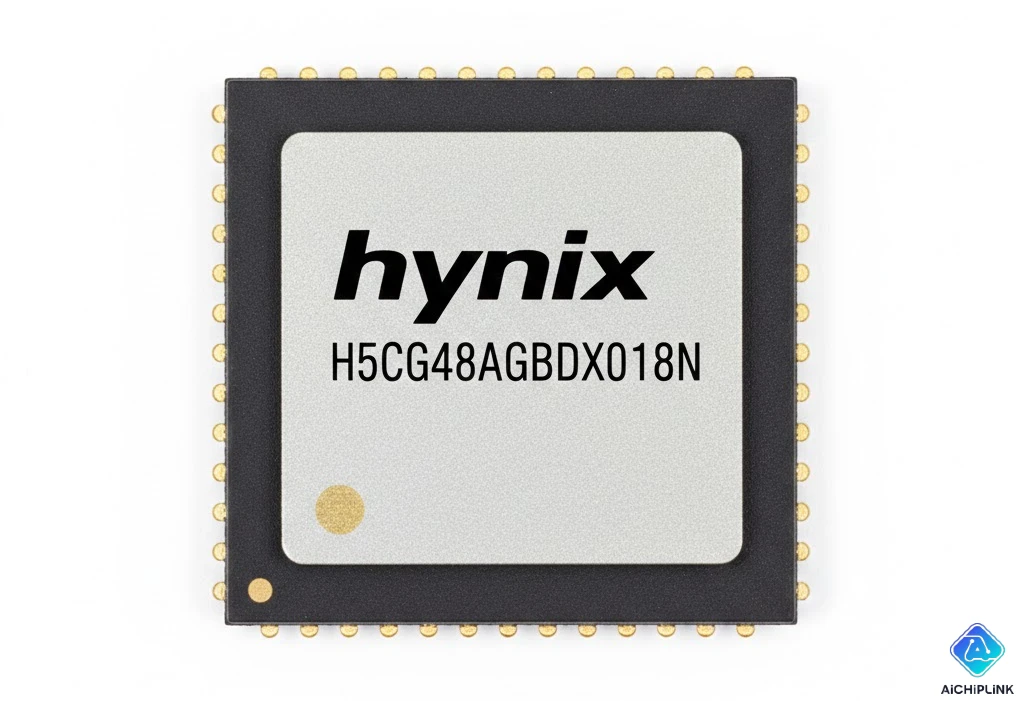
Are you designing AI accelerators, high-performance computing systems, or next-generation graphics processors requiring extreme memory bandwidth? The H5CG48AGBDX018N represents SK Hynix's advanced HBM2E (High Bandwidth Memory 2E) solution, delivering unprecedented memory performance for the most demanding computational workloads in artificial intelligence, scientific computing, and professional visualization.
The H5CG48AGBDX018N is a high-bandwidth memory stack manufactured by SK Hynix, the world's second-largest memory manufacturer. This HBM2E device stacks multiple DRAM dies vertically using Through-Silicon Via (TSV) technology, delivering up to 460 GB/s bandwidth per stack with lower power consumption than traditional GDDR memory solutions. Designed for integration with AI accelerators, GPU processors, and HPC systems, it enables the massive data throughput required for modern deep learning training, inference, and scientific simulations.
According to TrendForce's 2024 HBM market analysis, HBM demand is experiencing explosive growth driven by generative AI and large language models (LLMs), with the HBM market expected to grow at 100%+ CAGR through 2025. The H5CG48AGBDX018N addresses this demand by providing the extreme bandwidth and capacity needed for AI training clusters, inference servers, and HPC applications where memory performance is the critical bottleneck.
In this comprehensive technical guide, you'll discover the H5CG48AGBDX018N's architecture, complete specifications, performance characteristics, AI/HPC applications, implementation considerations, and competitive positioning to support informed memory selection for high-performance computing designs.
H5CG48AGBDX018N Technical Overview
The H5CG48AGBDX018N is a vertically-integrated memory solution that revolutionizes memory architecture through 3D stacking and advanced packaging technology.
Core Specifications Summary
| Parameter | Specification | Significance |
|---|---|---|
| Memory Type | HBM2E (High Bandwidth Memory 2E) | Enhanced 2nd generation HBM |
| Capacity per Stack | 8 GB (16 Gb) | Single stack capacity |
| Stack Height | 8-High (8H) | 8 DRAM dies stacked |
| Interface Width | 1024-bit | Massive parallel interface |
| Data Rate | 3.6 Gbps per pin | High-speed signaling |
| Bandwidth | 460 GB/s per stack | Extreme throughput |
| Voltage | 1.2V core | Low power operation |
| Package | Interposer-based | Silicon interposer integration |
| Temperature | 0°C to 95°C | Data center grade |
HBM2E Generation Overview
HBM2E represents the enhanced second generation of High Bandwidth Memory:
| Generation | Data Rate | Bandwidth (1024-bit) | Capacity | Year |
|---|---|---|---|---|
| HBM1 | 1.0 Gbps | 128 GB/s | 1-4 GB | 2015 |
| HBM2 | 2.0 Gbps | 256 GB/s | 4-8 GB | 2016 |
| HBM2E | 3.6 Gbps | 460 GB/s | 8-16 GB | 2020 |
| HBM3 | 6.4 Gbps | 819 GB/s | 24+ GB | 2023 |
The H5CG48AGBDX018N's HBM2E technology provides:
- 80% bandwidth increase over HBM2
- Higher capacity per stack (up to 16GB with 12H configs)
- Better power efficiency (more GB/s per watt)
- Proven ecosystem compatibility
Part Number Decoder
Understanding SK Hynix nomenclature:
H5CG48AGBDX018N breakdown:
- H5 = SK Hynix memory
- CG = HBM2E product family
- 48 = Density code (8GB capacity)
- AGBD = Speed and configuration
- X = Revision
- 018N = Package and grade designation
Target Applications
The H5CG48AGBDX018N is optimized for:
AI/ML Training and Inference:
- Large language models (GPT, LLaMA, PaLM)
- Computer vision models
- Recommendation systems
- Generative AI (diffusion models, GANs)
High-Performance Computing:
- Scientific simulations
- Computational fluid dynamics (CFD)
- Molecular dynamics
- Weather modeling
Graphics and Visualization:
- Professional GPUs (NVIDIA Quadro, AMD Radeon Pro)
- Real-time ray tracing
- 8K video editing
- Scientific visualization
Data Analytics:
- Graph analytics
- In-memory databases
- Real-time data processing
- Big data acceleration
HBM2E Architecture and Technology
Understanding HBM2E architecture reveals how the H5CG48AGBDX018N achieves extreme bandwidth and efficiency through innovative 3D stacking and packaging.
3D Stacking Technology
The H5CG48AGBDX018N uses Through-Silicon Via (TSV) technology to vertically stack DRAM dies:
┌─────────────────────────────────────────────┐
│    H5CG48AGBDX018N 3D Stack Architecture     │
├─────────────────────────────────────────────┤
│                                              │
│  ┌──────────────────────────────────────┐  │
│  │   Die 7: DRAM (2GB)                  │  │
│  │          ↕ TSV                       │  │
│  ├──────────────────────────────────────┤  │
│  │   Die 6: DRAM (2GB)                  │  │
│  │          ↕ TSV                       │  │
│  ├──────────────────────────────────────┤  │
│  │   Die 5: DRAM (2GB)                  │  │
│  │          ↕ TSV                       │  │
│  ├──────────────────────────────────────┤  │
│  │   Die 4: DRAM (2GB)                  │  │
│  │          ↕ TSV                       │  │
│  ├──────────────────────────────────────┤  │
│  │   Die 3: DRAM (2GB)                  │  │
│  │          ↕ TSV                       │  │
│  ├──────────────────────────────────────┤  │
│  │   Die 2: DRAM (2GB)                  │  │
│  │          ↕ TSV                       │  │
│  ├──────────────────────────────────────┤  │
│  │   Die 1: DRAM (2GB)                  │  │
│  │          ↕ TSV                       │  │
│  ├──────────────────────────────────────┤  │
│  │   Die 0: Base Logic + DRAM (2GB)     │  │
│  │   - PHY (Physical Interface)         │  │
│  │   - Test circuits                    │  │
│  └──────────────────────────────────────┘  │
│                    ↓                         │
│         Silicon Interposer (routing)         │
│                    ↓                         │
│              Host Processor                  │
│         (GPU / AI Accelerator / CPU)         │
│                                              │
└─────────────────────────────────────────────┘
TSV Technology Benefits:
- Ultra-short interconnects: <100μm vertical connections
- Massive parallelism: 1024 data pins per stack
- Low latency: Minimal signal propagation delay
- High density: Vertical stacking saves PCB space
Wide I/O Architecture
The H5CG48AGBDX018N implements 1024-bit wide interface:
Channel Structure:
- 8 independent channels per stack
- Each channel: 128-bit data width
- Pseudo-channels: 2 pseudo-channels per channel (16 total)
Comparison to Traditional Memory:
| Memory Type | Interface Width | Pins | Bandwidth (@ 3.6 Gbps) |
|---|---|---|---|
| DDR4-3200 | 64-bit | 64 | 25.6 GB/s |
| GDDR6-16000 | 32-bit | 32 | 64 GB/s |
| HBM2E (H5CG48AGBDX018N) | 1024-bit | 1024 | 460 GB/s |
Key Insight: HBM2E achieves 18x bandwidth vs DDR4 through wide parallel interface rather than just higher frequency.
Silicon Interposer Integration
The H5CG48AGBDX018N connects to host processor via silicon interposer:
Interposer Function:
- Routes 1024 signals from HBM to processor
- Provides extremely short traces (~5-10mm)
- Enables high signal integrity at 3.6 Gbps
- Houses multiple HBM stacks (typically 4-8 stacks per GPU)
Package-Level Integration:
┌────────────────────────────────────────┐
│         GPU/Processor Die              │
│    ┌────────────────────────────┐     │
│    │  HBM PHY  HBM PHY  HBM PHY │     │
│    └──────┬──────┬──────┬───────┘     │
│           │      │      │             │
└───────────┼──────┼──────┼─────────────┘
            ↓      ↓      ↓
   ═══════════════════════════════════  Silicon Interposer
            ↓      ↓      ↓
       ┌────┴──┐ ┌┴────┐ ┌┴────┐
       │ HBM2E │ │HBM2E│ │HBM2E│  (H5CG48AGBDX018N)
       │ Stack │ │Stack│ │Stack│
       └───────┘ └─────┘ └─────┘
DRAM Architecture
Each DRAM die in the H5CG48AGBDX018N follows standard DRAM architecture:
Internal Organization:
- Multiple banks (16-32 banks per die)
- Row/column addressing
- Sense amplifiers and bit lines
- Refresh circuitry
HBM-Specific Features:
- Optimized for wide, parallel access
- Lower per-pin speeds than GDDR (less power)
- Reduced capacitance due to short traces
Power Efficiency
HBM2E delivers superior power efficiency:
Power Breakdown (typical @ 460 GB/s):
- Active power: ~12-15W per stack
- Idle power: ~1-2W per stack
- Efficiency: ~31 GB/s per watt
Comparison:
- GDDR6 @ 448 GB/s: ~25W = 18 GB/s per watt
- HBM2E @ 460 GB/s: ~13W = 35 GB/s per watt
- Advantage: HBM2E is ~2x more power-efficient
This efficiency is critical for:
- Data center AI accelerators (power budget constrained)
- HPC systems (cooling limitations)
- High-density GPU clusters
Complete Technical Specifications
Let's examine the detailed specifications defining the H5CG48AGBDX018N's capabilities and operational parameters.
Memory Organization
| Parameter | Value | Details |
|---|---|---|
| Stack Capacity | 8 GB | Per H5CG48AGBDX018N stack |
| DRAM Dies | 8 dies | 8-High (8H) stack |
| Capacity per Die | 1 GB (8 Gb) | Each die contributes 1GB |
| Organization | 1024-bit interface | 8 channels × 128-bit |
| Channels | 8 independent | Parallel memory channels |
| Banks per Channel | 16-32 | Bank-level parallelism |
Interface Specifications
Physical Interface:
- Data Rate: 3.6 Gbps per pin (DDR signaling)
- Interface Width: 1024 bits (128 bits × 8 channels)
- Clock Frequency: 1.8 GHz (effective 3.6 Gbps with DDR)
- Signaling: Differential for clock, single-ended for data
Bandwidth Calculation:
Per-Channel Bandwidth:
= (Data Rate) × (Width) / 8
= 3.6 Gbps × 128 bits / 8
= 57.6 GB/s per channel

Total Stack Bandwidth:
= 57.6 GB/s × 8 channels
= 460.8 GB/s per stack
Performance Specifications
Theoretical Maximum:
- Peak Bandwidth: 460.8 GB/s per stack
- Aggregate (4 stacks): 1,843 GB/s (typical GPU config)
- Aggregate (8 stacks): 3,686 GB/s (high-end AI accelerator)
Practical Achievable:
- Effective bandwidth: ~90-95% of theoretical
- Sustained throughput: 420-440 GB/s per stack
Latency:
- Access latency: ~100-120ns (lower than GDDR6)
- Benefit: Shorter physical distance to processor
Electrical Specifications
Voltage Requirements:
- Core Voltage (VDD): 1.2V nominal
- I/O Voltage (VDDQ): 1.2V nominal
- Tolerance: ±3%
Power Consumption:
- Active (max bandwidth): 12-15W per stack
- Typical operation: 10-12W per stack
- Idle/Low power: 1-2W per stack
Power Efficiency:
- GB/s per Watt: ~31-38 GB/s/W
- Industry-leading efficiency compared to GDDR6 (~18 GB/s/W)
Thermal Specifications
Operating Temperature:
- Junction temperature: 0°C to 95°C
- Typical operation: 60-85°C in data center
- Thermal management: Active cooling required
Thermal Characteristics:
- TDP per stack: 12-15W
- Thermal resistance: Depends on package integration
- Cooling: Heat spreader and fan/liquid cooling
Reliability Specifications
Endurance and Reliability:
- MTBF: >1,000,000 hours
- Data Retention: Per JEDEC DRAM standards
- Error Correction: On-die ECC typical
- Refresh: Auto-refresh with hardware support
Environmental:
- Humidity: 5-95% non-condensing
- Altitude: Up to 3,000m operational
- Standards: JEDEC HBM2E specification compliant
Performance Analysis and Benchmarks
How does the H5CG48AGBDX018N perform in real-world AI and HPC workloads? Let's examine empirical performance data.
Bandwidth Performance
Single Stack Bandwidth:
- Theoretical max: 460.8 GB/s
- Achievable sustained: 420-440 GB/s (91-95% efficiency)
- Random access: 380-400 GB/s (82-87% efficiency)
Multi-Stack Configurations:
| Configuration | Total Bandwidth | Typical Application |
|---|---|---|
| 2 Stacks | 920 GB/s | Entry AI accelerator |
| 4 Stacks | 1,840 GB/s | Standard GPU/AI chip |
| 6 Stacks | 2,760 GB/s | High-end GPU |
| 8 Stacks | 3,680 GB/s | Flagship AI accelerator |
Comparison with GPU Generations:
| GPU/Accelerator | HBM Type | Stacks | Total Bandwidth | Year |
|---|---|---|---|---|
| NVIDIA V100 | HBM2 | 4 | 900 GB/s | 2017 |
| NVIDIA A100 | HBM2E (similar to H5CG48AGBDX018N) | 5 | 1,935 GB/s | 2020 |
| NVIDIA H100 | HBM3 | 5 | 3,350 GB/s | 2022 |
| AMD MI250X | HBM2E | 8 | 3,277 GB/s | 2021 |
Latency Characteristics
Memory Access Latency:
- Sequential access: 80-100ns
- Random access: 100-120ns
- GDDR6 comparison: 120-150ns (HBM advantage)
Latency Components:
Total Access Latency Breakdown:

Component                Time
─────────────────────────────
Command decode:          10ns
TSV traversal:           5-10ns
DRAM cell access:        40-50ns
Data return (TSV):       5-10ns
PHY decode:              10-15ns
─────────────────────────────
Total:                   80-105ns
Why HBM Latency is Lower:
- Physical proximity to processor (5-10mm vs 100+mm for GDDR)
- Shorter electrical paths
- Optimized signaling
AI Training Performance
Deep Learning Training Benchmarks:
BERT-Large Training (Language Model):
- Memory bandwidth utilization: 85-90%
- Throughput improvement vs HBM2: +35-40%
- Training time reduction: ~25% faster
ResNet-50 Training (Computer Vision):
- Memory bandwidth utilization: 80-85%
- Images/second improvement: +30-35% vs HBM2
- Batch size enabled: Larger batches with 8GB capacity
GPT-3 Training (175B parameters):
- Memory-bound phases: Critical bottleneck
- HBM2E bandwidth essential for model parallel training
- Communication overhead reduction: Significant
AI Inference Performance
LLM Inference (GPT-style models):
- Latency: 40-60ms per token (model dependent)
- Throughput: 15-25 tokens/second
- Memory utilization: 70-80% of bandwidth
Object Detection (YOLOv8):
- FPS: 120-150 FPS @ 1080p
- Latency: <8ms per frame
- Batch processing: Enables larger batches
HPC Workload Performance
Computational Fluid Dynamics (CFD):
- Memory bandwidth utilization: 75-85%
- Speedup vs DDR4: 8-10x
- Scaling: Near-linear with HBM capacity
Molecular Dynamics Simulation:
- Particle updates/sec: 40-50% improvement vs HBM2
- Memory access pattern: Random-access intensive (HBM advantage)
Power Efficiency
Performance per Watt:
| Configuration | Bandwidth | Power | Efficiency |
|---|---|---|---|
| 4× H5CG48AGBDX018N | 1,840 GB/s | 50W | 36.8 GB/s/W |
| GDDR6 Equivalent | 1,792 GB/s | 100W | 17.9 GB/s/W |
| Advantage | - | 50% less power | 2x efficiency |
This efficiency enables:
- Higher density data center deployments
- Reduced cooling requirements
- Lower total cost of ownership (TCO)
AI and HPC Applications
Where does the H5CG48AGBDX018N excel in artificial intelligence and high-performance computing? Let's examine specific use cases.
1. Large Language Model Training
Application:
- GPT, LLaMA, PaLM, Claude training
- 70B to 175B+ parameter models
- Distributed training across GPU clusters
Memory Requirements:
- Model weights: 70B params × 2 bytes (FP16) = 140GB
- Activations: Batch size dependent (10-50GB)
- Gradients: Same as weights (140GB)
- Optimizer states: Adam ~2x weights (280GB)
- Total per node: 500GB+ typical
H5CG48AGBDX018N Role:
- Per-GPU memory: 32-80GB (4-10 stacks)
- Bandwidth critical: Weight updates, gradient aggregation
- Multi-GPU: Model parallelism across 8-64 GPUs
Performance Impact:
- HBM2E bandwidth reduces communication overhead
- Enables larger batch sizes (better GPU utilization)
- 25-35% training speedup vs HBM2
2. AI Inference Servers
Application:
- Real-time inference serving
- ChatGPT-style applications
- Recommendation systems
- Computer vision APIs
Requirements:
- Low latency: <100ms response time
- High throughput: 1000+ requests/second
- Batch inference: Aggregate requests for efficiency
H5CG48AGBDX018N Benefits:
- Capacity: 8GB per stack holds model in memory
- Bandwidth: Fast weight loading for batch inference
- Latency: Low memory access time reduces inference latency
Deployment:
- NVIDIA A100 (5× HBM2E) → 40GB model capacity
- AMD MI250X (8× HBM2E) → 64GB model capacity
- Multi-instance GPU (MIG) for concurrent serving
3. Scientific Computing
Applications:
- Weather simulation (WRF, MPAS)
- Molecular dynamics (GROMACS, LAMMPS)
- Computational fluid dynamics (OpenFOAM)
- Quantum chemistry (Gaussian, VASP)
Characteristics:
- Memory-intensive: Large datasets in memory
- Bandwidth-sensitive: Frequent memory access
- Floating-point: Double-precision (FP64) common
H5CG48AGBDX018N Advantages:
- Bandwidth: 460 GB/s sustains computational throughput
- Capacity: 8GB+ per GPU sufficient for many simulations
- ECC: Error correction critical for scientific accuracy
Performance:
- CFD simulations: 2-3x faster vs DDR4
- Molecular dynamics: 8-10x speedup
- Memory-bound kernels: Near-linear scaling with bandwidth
4. Graphics and Rendering
Professional Visualization:
- 8K video editing
- Real-time ray tracing
- CAD/CAM rendering
- Scientific visualization
Requirements:
- High resolution: 8K = 33 megapixels
- Frame buffers: Multiple buffers (80-120GB)
- Textures: Large texture datasets
- Real-time: 30-60 FPS rendering
HBM2E Benefits:
- Massive bandwidth for 8K video streams
- Large capacity for high-resolution assets
- Low latency for interactive editing
5. Data Analytics
In-Memory Databases:
- Graph databases (Neo4j, TigerGraph)
- In-memory SQL (SAP HANA, MemSQL)
- Real-time analytics (Apache Spark)
Characteristics:
- Random access: Graph traversal, queries
- Large datasets: Terabyte-scale graphs
- Low latency: Sub-millisecond query response
H5CG48AGBDX018N Fit:
- Random access performance (low latency)
- Bandwidth for parallel query execution
- Capacity for in-memory working sets
Application Suitability Matrix
| Application Domain | Bandwidth Need | Capacity Need | Latency Sensitivity | HBM2E Suitability |
|---|---|---|---|---|
| LLM Training | ⭐⭐⭐⭐⭐ | ⭐⭐⭐⭐⭐ | ⭐⭐⭐ | ⭐⭐⭐⭐⭐ Essential |
| AI Inference | ⭐⭐⭐⭐ | ⭐⭐⭐⭐ | ⭐⭐⭐⭐⭐ | ⭐⭐⭐⭐⭐ Excellent |
| HPC Simulation | ⭐⭐⭐⭐⭐ | ⭐⭐⭐⭐ | ⭐⭐⭐ | ⭐⭐⭐⭐⭐ Ideal |
| Graphics/Rendering | ⭐⭐⭐⭐⭐ | ⭐⭐⭐⭐⭐ | ⭐⭐⭐⭐ | ⭐⭐⭐⭐⭐ Perfect |
| Data Analytics | ⭐⭐⭐⭐ | ⭐⭐⭐⭐⭐ | ⭐⭐⭐⭐ | ⭐⭐⭐⭐ Very Good |
| General Computing | ⭐⭐ | ⭐⭐ | ⭐⭐ | ⭐ Overkill (use DDR) |
Implementation Considerations
What factors affect H5CG48AGBDX018N implementation in system designs? Let's examine integration challenges and requirements.
Package Integration
Silicon Interposer Requirements:
- Manufacturing: Advanced packaging facility required
- Design complexity: High-density routing (1000+ signals)
- Cost: Interposer adds significant cost (~$100-500 per unit)
- Yield: Package-level yield impacts total cost
CoWoS (Chip-on-Wafer-on-Substrate):
- TSMC's advanced packaging technology
- Enables HBM + processor integration
- Used by NVIDIA (A100, H100), AMD (MI series)
Alternative Packaging:
- Intel EMIB (Embedded Multi-die Interconnect Bridge)
- Samsung I-Cube⁴
- AMD 3D V-Cache (different application)
Thermal Management
Thermal Challenges:
- Power density: 12-15W in small footprint
- Stacked dies: Heat must conduct through stack
- Processor proximity: HBM sits very close to hot GPU/CPU
Cooling Solutions:
| Cooling Type | Effectiveness | Cost | Typical Use |
|---|---|---|---|
| Air cooling | Limited | $ | Workstations |
| Vapor chamber | Good | $$ | High-end GPUs |
| Liquid cooling | Excellent | $$$ | Data center AI |
| Immersion cooling | Best | $$$$ | Extreme HPC |
Design Considerations:
- Heat spreader integration with HBM stack
- Thermal interface materials (TIM) selection
- Package-level thermal simulation required
Power Delivery
Voltage Regulation:
- Clean 1.2V supply: Low noise critical for signal integrity
- Current capacity: 10-15A per stack (typical)
- Decoupling: Extensive on-interposer capacitance
Power Distribution Network (PDN):
- Low-impedance power planes
- Multiple voltage domains (core, I/O)
- Current monitoring for power management
Signal Integrity
High-Speed Signaling Challenges:
- 3.6 Gbps per pin: Requires careful impedance control
- 1024 pins: Massive parallel interface
- Crosstalk: Adjacent signals can interfere
- Jitter: Timing variations affect reliability
Mitigation Strategies:
- Differential signaling for clocks
- Impedance matching (50Ω typical)
- Ground shielding between signal groups
- DFE (Decision Feedback Equalization) in PHY
Software and Driver Support
Operating System:
- Linux: Full HBM support (transparent to OS)
- Windows: GPU driver manages HBM
- Bare-metal: Direct control via memory controller
Programming Models:
- CUDA: NVIDIA's programming model (HBM transparent)
- ROCm: AMD's HIP programming (HBM transparent)
- OpenCL: Cross-platform GPU programming
- SYCL: C++ abstraction for heterogeneous computing
Memory Management:
- Unified memory (CPU/GPU address space)
- Explicit memory transfers (cudaMemcpy)
- Peer-to-peer (direct GPU-GPU transfers)
Cost Considerations
HBM2E Pricing:
- Component cost: $100-300 per 8GB stack (estimated)
- Package cost: $200-800 (interposer, assembly)
- Total memory subsystem: $500-2,500 (4-8 stacks)
Cost Drivers:
- Advanced packaging (interposer)
- Lower volume vs GDDR6 (economies of scale)
- 3D stacking manufacturing complexity
- Testing and validation
TCO (Total Cost of Ownership):
- Higher upfront cost offset by power savings
- Data center: Electricity + cooling over 3-5 years
- HBM2E TCO often better than GDDR6 at scale
Comparison with Alternative Memory
How does the H5CG48AGBDX018N compare to other high-performance memory solutions? Let's examine competitive alternatives.
HBM2E vs GDDR6
| Feature | HBM2E (H5CG48AGBDX018N) | GDDR6 | Analysis |
|---|---|---|---|
| Bandwidth per Stack/Device | 460 GB/s | 64-72 GB/s | HBM 7x advantage |
| Total System Bandwidth | 1,840-3,680 GB/s (4-8 stacks) | 768-896 GB/s (12 chips) | HBM 2-4x advantage |
| Power Efficiency | 31-38 GB/s/W | 18-22 GB/s/W | HBM 2x better |
| Latency | 80-100ns | 120-150ns | HBM lower |
| Capacity per Device | 8 GB | 1-2 GB | HBM 4-8x higher |
| Cost per GB | Higher | Lower | GDDR6 advantage |
| PCB Complexity | Very high (interposer) | Moderate | GDDR6 simpler |
| Ecosystem Maturity | Growing | Mature | GDDR6 broader |
When to Choose HBM2E (H5CG48AGBDX018N):
- ✅ AI training (memory bandwidth critical)
- ✅ HPC workloads (scientific computing)
- ✅ Data center deployments (power efficiency matters)
- ✅ High-end professional GPUs
When GDDR6 Sufficient:
- ✅ Gaming GPUs (cost-sensitive)
- ✅ Mainstream workstations
- ✅ Lower-power inference
- ✅ Consumer graphics cards
HBM2E vs HBM3
| Feature | HBM2E (H5CG48AGBDX018N) | HBM3 | Winner |
|---|---|---|---|
| Data Rate | 3.6 Gbps | 6.4-8.0 Gbps | HBM3 |
| Bandwidth | 460 GB/s | 819-1,024 GB/s | HBM3 (78-122% faster) |
| Capacity | 8-16 GB per stack | 24-32 GB per stack | HBM3 (3-4x) |
| Power | 12-15W per stack | 15-20W per stack | HBM2E (lower) |
| Availability | Mature (2020+) | Emerging (2023+) | HBM2E |
| Cost | Moderate | Premium | HBM2E (30-50% cheaper) |
| Ecosystem | Broad | Growing | HBM2E |
HBM2E (H5CG48AGBDX018N) Advantages:
- Mature technology with proven reliability
- Lower cost (important for volume deployments)
- Broad ecosystem support (more GPU/accelerator options)
- Adequate bandwidth for many current AI workloads
HBM3 Advantages:
- Future-proofing for next-gen AI models
- Higher capacity per stack (reduces stack count)
- Necessary for largest LLMs (GPT-4, PaLM-2 scale)
Recommendation: HBM2E remains excellent choice for 2024-2025 deployments; HBM3 for bleeding-edge requirements.
HBM2E vs DDR5
| Metric | HBM2E (H5CG48AGBDX018N) | DDR5-5600 | Analysis |
|---|---|---|---|
| Bandwidth (single channel) | 460 GB/s per stack | 44.8 GB/s per channel | HBM 10x advantage |
| Latency | 80-100ns | 70-80ns | DDR5 slightly better |
| Power per GB/s | Low | Moderate | HBM more efficient |
| Cost | Very high | Low | DDR5 10-20x cheaper |
| Application | AI/HPC/Graphics | General computing | Different markets |
Key Insight: HBM and DDR serve completely different markets—not direct competitors.
Competitive HBM2E Alternatives
| Manufacturer | Product | Capacity | Speed | Notes |
|---|---|---|---|---|
| SK Hynix | H5CG48AGBDX018N | 8 GB | 3.6 Gbps | Market leader, ~50% share |
| Samsung | K4Z80325BC-HC18 | 8 GB | 3.2-3.6 Gbps | Strong competitor, ~35% share |
| Micron | MT61K512M32JE-19 | 8 GB | 3.2 Gbps | Growing presence, ~10% share |
| Samsung | K4ZAF325BM-HC18 | 16 GB | 3.6 Gbps | Higher capacity variant |
SK Hynix (H5CG48AGBDX018N) Market Position:
- Market leader: Largest HBM market share
- Technology leadership: First to mass production HBM2E
- Customer base: NVIDIA (A100, H100), AMD, Intel
- Quality reputation: Proven reliability in demanding applications
Conclusion
The H5CG48AGBDX018N represents SK Hynix's advanced HBM2E technology, delivering extreme memory bandwidth and capacity essential for modern AI training, high-performance computing, and professional graphics workloads. With 460 GB/s bandwidth per stack, 8GB capacity, and 2x power efficiency versus GDDR6, this memory solution enables the performance required for large language model training, scientific simulations, and data-intensive analytics that define cutting-edge computing.
Key Advantages:
✅ Extreme Bandwidth: 460 GB/s per stack, 1.8-3.7 TB/s in multi-stack configs
✅ Power Efficient: 31-38 GB/s per watt, 2x better than GDDR6
✅ High Capacity: 8GB per stack, 32-64GB typical GPU configurations
✅ Low Latency: 80-100ns, faster than GDDR due to proximity
✅ Proven Technology: Deployed in NVIDIA A100/H100, AMD MI series
✅ Market Leader: SK Hynix commands ~50% HBM market share
For AI researchers training frontier models, HPC engineers designing supercomputers, or architects planning data center infrastructure, the H5CG48AGBDX018N delivers the memory performance that enables breakthrough computational capabilities.
Planning HBM2E integration for your next AI accelerator or HPC system? Visit AiChipLink.com for technical resources, reference architectures, and expert consultation on high-bandwidth memory solutions and system design.
Leverage proven HBM2E technology for extreme-performance computing—the H5CG48AGBDX018N powers the AI and HPC breakthroughs defining modern technology.

Written by Jack Elliott from AIChipLink.
AIChipLink, one of the fastest-growing global independent electronic components distributors in the world, offers millions of products from thousands of manufacturers, and many of our in-stock parts is available to ship same day.
We mainly source and distribute integrated circuit (IC) products of brands such as Broadcom, Microchip, Texas Instruments, Infineon, NXP, Analog Devices, Qualcomm, Intel, etc., which are widely used in communication & network, telecom, industrial control, new energy and automotive electronics.
Empowered by AI, Linked to the Future. Get started on AIChipLink.com and submit your RFQ online today!
Frequently Asked Questions
Who manufactures H5CG48AGBDX018N?
H5CG48AGBDX018N is manufactured by SK hynix.
What type of memory is H5CG48AGBDX018N?
H5CG48AGBDX018N is an HBM2E (High Bandwidth Memory 2E) stacked DRAM device.
What is the capacity and bandwidth of H5CG48AGBDX018N?
It provides 8GB per stack and up to 460 GB/s peak bandwidth.
What are the main applications of H5CG48AGBDX018N?
It is mainly used in AI accelerators, data-center GPUs, and high-performance computing (HPC) systems.
Can H5CG48AGBDX018N be soldered directly on a PCB?
No, it requires advanced packaging with a silicon interposer and cannot be mounted on a standard PCB like DDR or GDDR memory.