Introduction
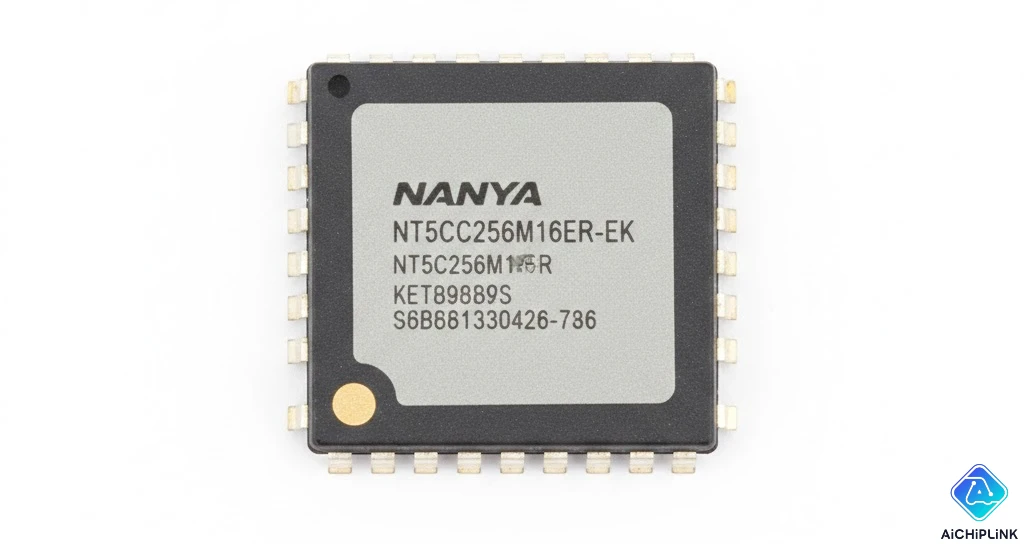
Are you designing embedded systems, industrial equipment, or cost-sensitive electronics requiring reliable DDR3L memory? The NT5CC256M16ER-EK represents Nanya Technology's proven solution for applications demanding low-power operation, proven reliability, and competitive economics in the mature DDR3L ecosystem.
The NT5CC256M16ER-EK is a 4-gigabit (4Gb) DDR3L SDRAM memory chip manufactured by Nanya Technology, a Taiwan-based memory manufacturer and subsidiary of Formosa Plastics Group. This chip features a 256-megaword by 16-bit organization (256M x 16), operates at DDR3L-1866 speed (1866 MT/s), and delivers low-voltage (1.35V) operation optimized for power-sensitive applications in embedded systems, industrial controllers, and consumer electronics.
According to industry analysis, DDR3L continues to serve critical roles in embedded and industrial markets despite DDR4/DDR5 adoption in consumer segments. The NT5CC256M16ER-EK addresses this sustained demand with cost-effective performance, proven reliability, and broad compatibility with established platforms requiring long-term component availability.
In this technical guide, you'll discover the NT5CC256M16ER-EK's architecture, complete specifications, performance characteristics, real-world applications, implementation guidance, and competitive positioning to support informed component selection for your designs.
NT5CC256M16ER-EK Technical Overview
The NT5CC256M16ER-EK is a cost-optimized DDR3L SDRAM component designed for embedded, industrial, and value-oriented consumer applications where mature technology provides advantages in cost, compatibility, and long-term availability.
Core Specifications
| Parameter | Specification | Significance |
|---|---|---|
| Density | 4 Gb (512 MB) | 4 gigabit chip capacity |
| Organization | 256M x 16 | 256 million words × 16-bit width |
| Data Rate | 1866 MT/s (DDR3L-1866) | 1.866 billion transfers/second |
| Speed Grade | DDR3L-1866 (PC3L-14900) | Standard designation |
| Voltage | 1.35V nominal | Low-voltage DDR3L |
| CAS Latency | CL13 | 13 clock cycles |
| Operating Temp | 0°C to 95°C | Commercial grade |
| Package | 96-ball FBGA | 9mm × 13.5mm footprint |
Part Number Decoder
Understanding Nanya's nomenclature:
NT5CC256M16ER-EK breakdown:
- NT = Nanya Technology
- 5 = DDR3 SDRAM family
- CC = Product series
- 256M = Density (256 megabit organization)
- 16 = Data width (x16 configuration)
- ER = Speed grade (DDR3L-1866)
- -EK = Package and temperature grade
Market Position
Nanya Technology occupies a tier-2 supplier position in the DRAM market, offering:
Cost Advantages:
- Typically 10-20% lower cost than tier-1 (Samsung, Micron, SK Hynix)
- Competitive for cost-sensitive designs
- Good value for mature technology applications
Target Markets:
- Embedded systems and industrial controllers
- Consumer electronics (value segment)
- Networking equipment (enterprise/SMB)
- Automotive infotainment (non-critical)
- Legacy system support
Strategic Value:
- Supply chain diversification (non-big-3 source)
- Long-term availability commitment
- Proven compatibility with established platforms
x16 Organization Benefits
The NT5CC256M16ER-EK's 256M x 16 organization offers:
Design Simplification:
- Requires only 4 chips for 64-bit interface (vs 8 for x8)
- Reduces PCB routing complexity
- Fewer components = simpler assembly
Reliability:
- Lower component count improves overall reliability
- Fewer solder joints reduce failure points
- Better for harsh environments
Cost-Effectiveness:
- Reduced assembly costs
- Simpler PCB design (fewer layers)
- Lower testing complexity
DDR3L Architecture and Design
Understanding DDR3L architecture reveals how the NT5CC256M16ER-EK achieves power efficiency and performance for embedded applications.
DDR3L Technology Overview
DDR3L represents the low-voltage variant of DDR3 SDRAM:
| Parameter | DDR3 | DDR3L (NT5CC256M16ER-EK) | Benefit |
|---|---|---|---|
| Voltage | 1.5V | 1.35V | 10% power reduction |
| Compatibility | DDR3 only | Backward compatible | Flexible deployment |
| Speed Range | Up to 2133 MT/s | Up to 2133 MT/s | Same performance |
| Power (Active) | ~1.35W/chip | ~1.2W/chip | Lower heat |
Key DDR3L Advantage: The 1.35V operation delivers measurable power savings critical for:
- Battery-powered devices
- Thermally-constrained enclosures
- Dense embedded deployments
- Industrial equipment (reduced cooling needs)
Internal Architecture
The NT5CC256M16ER-EK implements standard DDR3 architecture:
Bank Structure:
- 8 internal banks (Bank 0-7)
- Each bank: 512 megabits (64MB)
- Enables concurrent operations
- Improves random access performance
Organization:
- Row Address: 15 bits (32,768 rows per bank)
- Column Address: 10 bits (1,024 columns)
- Bank Address: 3 bits (8 banks)
- Capacity: 2^15 × 2^10 × 8 × 16 = 4Gb
Key Features:
- 8n prefetch architecture (same as DDR4)
- Burst length: BL8 (burst of 8)
- Write leveling support
- On-die termination (ODT)
DDR3L-1866 Speed Grade
The 1866 MT/s data rate represents:
Performance Positioning:
- Above DDR3-1600: +16.6% bandwidth improvement
- Below DDR3-2133: Mature, widely-compatible speed
- Sweet Spot: Good performance without premium pricing
Timing Characteristics:
- Clock frequency: 933 MHz (1866 MT/s DDR)
- CL13 latency: 13 cycles = 13.93ns absolute latency
- Competitive latency: Similar to DDR3-1600 CL11 (13.75ns)
Manufacturing Process
Nanya manufactures the NT5CC256M16ER-EK using proven 30nm-class process technology:
Process Advantages:
- Mature yield: Years of production optimization
- Cost-effective: Depreciated tooling and R&D
- Reliable: Extensive field validation
- Stable supply: Established manufacturing
Complete Technical Specifications
Let's examine the detailed specifications defining the NT5CC256M16ER-EK's operational parameters.
Memory Organization
| Parameter | Value | Details |
|---|---|---|
| Density | 4 Gb | 4,294,967,296 bits |
| Configuration | 256M x 16 | 268,435,456 words × 16 bits |
| Banks | 8 | Independent memory banks |
| Rows per Bank | 32,768 | 15-bit row address |
| Columns | 1,024 | 10-bit column address |
| Data Width | 16 bits | DQ0-DQ15 |
Timing Specifications (DDR3L-1866)
| Parameter | Symbol | Cycles | Time (ns) |
|---|---|---|---|
| Clock Cycle | tCK | - | 1.071 |
| CAS Latency | CL | 13 | 13.93 |
| RAS to CAS | tRCD | 13 | 13.93 |
| Row Precharge | tRP | 13 | 13.93 |
| Row Active | tRAS | 35 | 37.5 |
| Row Cycle | tRC | 48 | 51.4 |
| Refresh Cycle | tRFC | 280ns | 4Gb density |
Electrical Specifications
Voltage Requirements:
- VDD/VDDQ: 1.283V min, 1.35V nom, 1.45V max
- Tolerance: ±70mV from nominal
- VTT: VDDQ/2 (termination reference)
Current Draw (typical @ 1.35V, DDR3L-1866):
- Active (one bank): 70mA
- Active (all banks): 90mA
- Precharge standby: 32mA
- Active standby: 38mA
- Burst read: 145mA
- Burst write: 140mA
- Self-refresh: 8mA
Power Consumption:
- Active operation: ~1.2W per chip
- Idle: ~0.25W per chip
- Self-refresh: ~0.015W per chip
Physical Specifications
Package:
- Type: 96-ball FBGA
- Dimensions: 9mm × 13.5mm × 1.0mm
- Ball pitch: 0.8mm
- Ball diameter: 0.35mm
Environmental:
- Operating temp: 0°C to 95°C junction
- Storage temp: -55°C to 150°C
- Humidity: Non-condensing
- MSL rating: MSL 3
Performance and Application Scenarios
Where does the NT5CC256M16ER-EK excel in real-world deployments? Let's examine performance characteristics and ideal applications.
Bandwidth and Latency
Per-Chip Performance:
- Clock: 933 MHz
- Data width: 16 bits
- Bandwidth: 933 MHz × 2 × 16 bits = 3.73 GB/s per chip
For 64-bit Interface (4 chips):
- Total bandwidth: 14.9 GB/s
- Effective (with overhead): ~13.5 GB/s
Latency:
- CL13 @ 1866 MT/s: 13.93ns absolute latency
- Random access: ~42ns (worst case, different row)
- Page hit: 13.93ns (same row)
Comparison with DDR4
| Metric | NT5CC256M16ER-EK (DDR3L-1866) | DDR4-2400 |
|---|---|---|
| Bandwidth | 14.9 GB/s (64-bit) | 19.2 GB/s |
| Latency | 13.93ns | 16.67ns (CL20) |
| Voltage | 1.35V | 1.2V |
| Power | 1.2W/chip | 1.0W/chip |
| Cost | Lower | 20-30% higher |
Key Insight: DDR3L offers comparable latency and lower cost than DDR4, making it attractive for cost-sensitive applications.
Target Applications
1. Embedded Industrial Controllers
Use Cases:
- PLCs (Programmable Logic Controllers)
- Motion controllers
- HMI (Human-Machine Interface) systems
- Industrial PCs
Why NT5CC256M16ER-EK Works:
- Low power (1.35V) for fanless designs
- Proven reliability for 24/7 operation
- Wide temperature range
- Cost-effective for volume production
Typical Configuration:
- 1-2GB total memory (4-8 chips)
- SO-DIMM modules for compact form factor
- ECC optional (industrial applications)
2. Networking Equipment
Applications:
- SMB switches and routers
- Access points
- Network appliances
- VPN concentrators
Requirements Met:
- Adequate bandwidth for gigabit networking
- Low power for fanless operation
- Cost-effective for competitive pricing
3. Set-Top Boxes and Smart TVs
Consumer Electronics:
- Digital TV receivers
- Streaming media players
- Smart TV main memory
- Gaming consoles (value segment)
NT5CC256M16ER-EK Benefits:
- Cost optimization for consumer pricing
- Low power for compact designs
- Adequate performance for media playback
4. Automotive Infotainment
Applications:
- In-vehicle entertainment systems
- Navigation systems
- Digital instrument clusters
- Rear-seat displays
Considerations:
- Commercial grade: Suitable for infotainment (not ADAS)
- Extended temperature operation possible
- Cost-effective for volume automotive
Note: Critical automotive applications requiring AEC-Q100 qualification need automotive-grade variants.
5. Legacy System Support
Maintenance Applications:
- Replacement for obsolete chips
- Production support for existing designs
- Repair of fielded equipment
- Long-lifecycle product support
Implementation and Integration
How do you properly implement the NT5CC256M16ER-EK in hardware designs? Let's examine integration requirements and best practices.
Module Design Considerations
Building SO-DIMM Modules:
4GB SO-DIMM Configuration:
- 8x NT5CC256M16ER-EK chips (4 front, 4 back)
- Single-rank (1Rx16) organization
- 204-pin SO-DIMM form factor
- Optional ECC with 9th chip
PCB Requirements:
- 6-8 layer design
- Controlled impedance: 50-60Ω single-ended
- Trace length matching: ±25 mils
- Power planes for VDD/VDDQ distribution
System Integration
Memory Controller Compatibility:
Intel Platforms:
- Bay Trail, Apollo Lake SoCs
- Embedded platforms with DDR3L support
- Maximum speed: DDR3L-1866 supported
ARM Processors:
- iMX 6/7 series (NXP)
- Rockchip RK3288/3399
- Allwinner H-series
- Qualcomm Snapdragon (older generations)
Other:
- MediaTek SoCs
- Broadcom networking chips
- Many industrial SoC platforms
Configuration Guidelines
BIOS/Firmware Settings:
- Speed: Set to DDR3L-1866 or auto-detect
- Voltage: Ensure 1.35V (not 1.5V DDR3)
- Timing: Auto (CL13-13-13) or manual
- Training: Allow full memory training
Recommended Timings:
CAS Latency: 13
tRCD: 13
tRP: 13
tRAS: 35
Command Rate: 2T (stable) or 1T (performance)
Design Best Practices
Signal Integrity:
- Match DQ group lengths within ±5 mils
- Match DQS to DQ within ±2 mils
- Use ground planes as return paths
- Minimize vias in signal paths
Power Delivery:
- 10μF bulk + 100nF ceramic per chip
- Place decaps within 5mm of power pins
- Separate VDD and VDDQ planes when possible
- Low-ESR capacitors recommended
Thermal Management:
- Ensure adequate airflow (passive cooling often sufficient)
- Monitor junction temperature (<85°C recommended)
- Consider heatspreaders for dense configurations
- Maintain DIMM slot spacing for airflow
Validation and Testing
Memory Testing Procedure:
- POST Verification: Confirm BIOS detects correct capacity
- MemTest86: Run 4+ complete passes
- Stress Testing: Prime95, stress-ng (8-24 hours)
- Temperature Monitoring: Verify thermal performance
- ECC Testing: If applicable, inject errors and verify correction
Common Issues and Solutions:
Issue: System Won't Boot
- Check voltage (1.35V, not 1.5V)
- Verify proper seating
- Try slower speed (DDR3L-1600)
- Check trace integrity
Issue: Instability/Crashes
- Increase voltage slightly (within spec)
- Relax timings (CL14 or CL15)
- Check for thermal issues
- Verify power supply stability
Comparison with Alternatives
How does the NT5CC256M16ER-EK compare to competitive DDR3L solutions? Let's examine alternatives and positioning.
Tier-1 vs Tier-2 Comparison
| Manufacturer | Part Number | Density | Speed | Relative Cost | Availability |
|---|---|---|---|---|---|
| Nanya | NT5CC256M16ER-EK | 4Gb x16 | 1866 | Baseline | Good |
| Samsung | K4B4G1646E-BCMA | 4Gb x16 | 1866 | +15-20% | Excellent |
| Micron | MT41K256M16HA-125 | 4Gb x16 | 1866 | +10-15% | Very Good |
| SK Hynix | H5TC4G63CFR-PBA | 4Gb x16 | 1866 | +12-18% | Good |
When to Choose Nanya (NT5CC256M16ER-EK):
- ✅ Cost-sensitive designs (consumer, industrial)
- ✅ Volume production requiring competitive pricing
- ✅ Supply chain diversification (tier-2 source)
- ✅ Applications where tier-1 premium not justified
When Tier-1 Preferred:
- ✅ Mission-critical applications
- ✅ Automotive (AEC-Q100 required)
- ✅ Medical devices (stringent quality)
- ✅ Customer specification mandates tier-1
Speed Grade Alternatives
| Speed | Bandwidth (64-bit) | Latency | Cost Impact | Best For |
|---|---|---|---|---|
| DDR3L-1333 | 10.6 GB/s | 13.5ns | -15% | Budget systems |
| DDR3L-1600 | 12.8 GB/s | 13.75ns | -8% | Mainstream |
| DDR3L-1866 | 14.9 GB/s | 13.93ns | Baseline | Performance |
Recommendation: DDR3L-1866 offers best performance for minimal cost premium over 1600.
Organization Comparison
x16 (NT5CC256M16ER-EK) vs x8:
| Factor | x16 Organization | x8 Organization |
|---|---|---|
| Chips (64-bit) | 4 chips | 8 chips |
| PCB Complexity | Simpler | More complex |
| Cost per Module | Similar | Slightly lower |
| Reliability | Better (fewer parts) | Good |
| Best Use | Embedded, industrial | High-density servers |
Verdict: For embedded/industrial applications, x16 organization is preferred for simplicity and reliability.
DDR3L vs DDR4 Decision
Stay with DDR3L (NT5CC256M16ER-EK) if:
- ✅ Existing platform investment
- ✅ Cost is primary driver
- ✅ Performance adequate for application
- ✅ Long-term availability not concern (5-7 years)
- ✅ Mature ecosystem benefits (proven designs)
Migrate to DDR4 if:
- ✅ New platform design
- ✅ Long product lifecycle (10+ years)
- ✅ Need higher bandwidth
- ✅ Future-proofing priority
- ✅ Platform supports both (choose newer)
Current Market (2024-2025):
- DDR3L remains viable for embedded/industrial
- Cost advantage: 30-40% vs DDR4
- Adequate performance for many applications
- Good availability through 2027-2028
Conclusion
The NT5CC256M16ER-EK delivers proven DDR3L technology at competitive economics, serving embedded systems, industrial equipment, and cost-optimized consumer electronics where mature technology offers advantages in cost, compatibility, and availability. With DDR3L-1866 performance (14.9 GB/s for 64-bit interface), low-voltage 1.35V operation, and x16 organization simplifying design, this chip provides excellent value for applications prioritizing cost-effectiveness over cutting-edge specifications.
Key Advantages:
✅ Cost-Effective: 10-20% lower cost than tier-1 alternatives
✅ Low Power: 1.35V operation reduces power consumption
✅ Design Simplicity: x16 organization requires only 4 chips
✅ Proven Technology: Mature DDR3L with extensive field validation
✅ Good Availability: Continued production for embedded markets
For engineers designing embedded controllers, product managers specifying memory for consumer electronics, or procurement teams optimizing component costs, the NT5CC256M16ER-EK represents a practical choice balancing performance, power efficiency, and economic value.
Ready to implement NT5CC256M16ER-EK? Visit AiChipLink.com for technical resources, design guides, and expert consultation on memory architecture and component selection for embedded systems.
Leverage proven DDR3L technology with cost optimization—the NT5CC256M16ER-EK delivers reliable performance for today's cost-conscious designs.

Written by Jack Elliott from AIChipLink.
AIChipLink, one of the fastest-growing global independent electronic components distributors in the world, offers millions of products from thousands of manufacturers, and many of our in-stock parts is available to ship same day.
We mainly source and distribute integrated circuit (IC) products of brands such as Broadcom, Microchip, Texas Instruments, Infineon, NXP, Analog Devices, Qualcomm, Intel, etc., which are widely used in communication & network, telecom, industrial control, new energy and automotive electronics.
Empowered by AI, Linked to the Future. Get started on AIChipLink.com and submit your RFQ online today!
Frequently Asked Questions
What type of memory is NT5CC256M16ER-EK?
It is a 4Gb DDR3L SDRAM memory chip designed for low-power embedded and industrial systems.
What is the organization of NT5CC256M16ER-EK?
The device uses a 256M × 16 (x16) organization.
What is the operating voltage of NT5CC256M16ER-EK?
It operates at a nominal 1.35 V (DDR3L).
What is the maximum supported speed?
The maximum data rate is DDR3L-1866 (1866 MT/s).
Is NT5CC256M16ER-EK suitable for industrial and embedded applications?
Yes. It is widely used in industrial controllers, networking equipment, and embedded platforms.


.png&w=256&q=75)