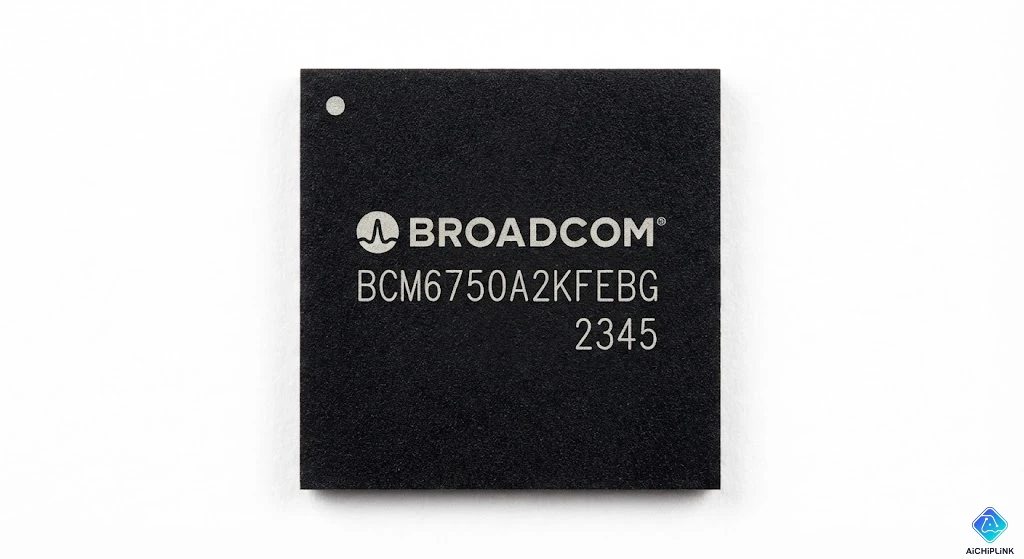
If you bought a mid-range Wi-Fi 6 router in the last 3 years—specifically an AX3000 or AX5400 model—there is a very high chance this chip is running the show.
The Broadcom BCM6750A2KFEBG is a System-on-Chip (SoC) that defined the "Sweet Spot" of the Wi-Fi 6 transition.
It combines a powerful 1.5 GHz Tri-Core CPU with native 802.11ax support, bringing enterprise-level OFDMA and MU-MIMO features to home users without the enterprise price tag. However, its architecture is unique (and often misunderstood) compared to its quad-core siblings.
This guide decodes the specs and explains why this chip is the heartbeat of modern connectivity.
Table of Contents
- 1. Decoding the Part Number
- 2. Technical Specs: The Power of Tri-Core
- 3. BCM6750 vs. BCM6755: The "Single Radio" Twist
- 4. Thermal & Hardware Considerations
- 5. Sourcing & Replacements
- 6. Conclusion
1. Decoding the Part Number
Broadcom part numbers tell a story about performance and generation. Here is the breakdown for BCM6750A2KFEBG:
| Code Segment | Meaning | Detail |
|---|---|---|
| BCM | Brand | Broadcom. (The networking giant). |
| 6750 | Family | Wi-Fi 6 (802.11ax) SoC. Entry/Mid-Range Performance. |
| A2 | Revision | Silicon Rev A2. (Improved yield/bug fixes over A0). |
| K | Temp | Commercial Grade (0°C to +70°C). |
| FE | Package | Fine-Pitch BGA. (Likely 21x21mm footprint). |
| BG | Material | Green / RoHS Compliant. |
2. Technical Specs: The Power of Tri-Core
While competitors (like Qualcomm) were pushing dual-core chips, Broadcom went big with the BCM6750.
- CPU: Tri-Core (3-Core) ARM Cortex-A7 @ 1.5 GHz.
- Benefit: Dedicated cores can be assigned to different tasks (e.g., Core 0 for OS, Core 1 for VPN encryption, Core 2 for Wi-Fi scheduling), reducing latency during heavy gaming.
- Wi-Fi Capability: 2x2 802.11ax.
- Supports 1024-QAM modulation for higher throughput.
- OFDMA (Orthogonal Frequency-Division Multiple Access): Allows the router to talk to multiple devices simultaneously in a single transmission window (the "Killer App" of Wi-Fi 6).
- Connectivity:
- 5x Gigabit PHYs: Built-in switch for LAN/WAN ports.
- USB 3.1: High-speed storage sharing (SAMBA/FTP server).
3. BCM6750 vs. BCM6755: The "Single Radio" Twist
This is the most common confusion for engineers and enthusiasts.
- BCM6755 (Quad Core): Has TWO internal radios (one for 2.4GHz, one for 5GHz). It is a true "Router on a Chip."
- BCM6750 (Tri-Core - This Part): Has only ONE internal radio.
- How it works in routers: Manufacturers use the internal radio for the 2.4GHz band, and add a powerful external chip (like the BCM43684) to handle the 5GHz band.
- Why? This hybrid approach allows for higher performance on 5GHz (4x4 MIMO) than a single chip could support, making the BCM6750 the choice for "Performance" routers (like ASUS RT-AX58U), while BCM6755 is for "Budget" routers.
4. Thermal & Hardware Considerations
The BCM6750 is known to run warm.
- Heat Dissipation: With a 1.5 GHz clock speed on an older manufacturing process, it generates significant heat.
- Design Tip: Look at teardowns of the ASUS TUF-AX3000. You will see massive aluminum heatsinks and thermal pads covering the BCM6750. If designing a custom board, active cooling or a large passive sink is mandatory.
- Memory: Supports DDR3 (16-bit). It does not support DDR4, which helps keep the BOM cost low.
5. Sourcing & Replacements
The BCM6750 is an active, high-volume component.
- Availability: Generally available through major distributors, but often sold in high-volume trays.
- Alternatives:
- BCM6755: If you need a simpler, lower-power, all-in-one chip (but with lower 5GHz performance).
- BCM4906/4908: If you need Quad-Core processing power for enterprise applications (used in GT-AX6000).
6. Conclusion
The Broadcom BCM6750A2KFEBG is the unsung hero of the Wi-Fi 6 revolution. By offering a potent Tri-Core CPU and flexible radio architecture, it enables routers that are fast enough for Gigabit fiber and responsive enough for low-latency gaming.
Sourcing Broadcom Wi-Fi SoCs? Need verified stock for your networking hardware production? Visit Aichiplink.com to search for BCM6750A2KFEBG and accompanying RF front-end modules.

Written by Jack Elliott from AIChipLink.
AIChipLink, one of the fastest-growing global independent electronic components distributors in the world, offers millions of products from thousands of manufacturers, and many of our in-stock parts is available to ship same day.
We mainly source and distribute integrated circuit (IC) products of brands such as Broadcom, Microchip, Texas Instruments, Infineon, NXP, Analog Devices, Qualcomm, Intel, etc., which are widely used in communication & network, telecom, industrial control, new energy and automotive electronics.
Empowered by AI, Linked to the Future. Get started on AIChipLink.com and submit your RFQ online today!
Frequently Asked Questions
Q1: What routers commonly use the BCM6750A2KFEBG?
It is widely used in AX3000–AX5400 Wi-Fi 6 routers, including models like the ASUS RT-AX58U / TUF-AX3000.
Q2: Is BCM6750 a quad-core processor?
No. BCM6750 features a tri-core ARM Cortex-A7 CPU at 1.5 GHz, not quad-core.
Q3: Does BCM6750 support dual-band Wi-Fi by itself?
Partially. It has one internal radio; most routers pair it with an external 5 GHz Wi-Fi 6 radio chip.
Q4: Does BCM6750 support Wi-Fi 6 features like OFDMA?
Yes. It supports 802.11ax (Wi-Fi 6) features including OFDMA, MU-MIMO, and 1024-QAM.
Q5: What memory type is supported by BCM6750?
BCM6750 supports DDR3 memory and does not support DDR4.