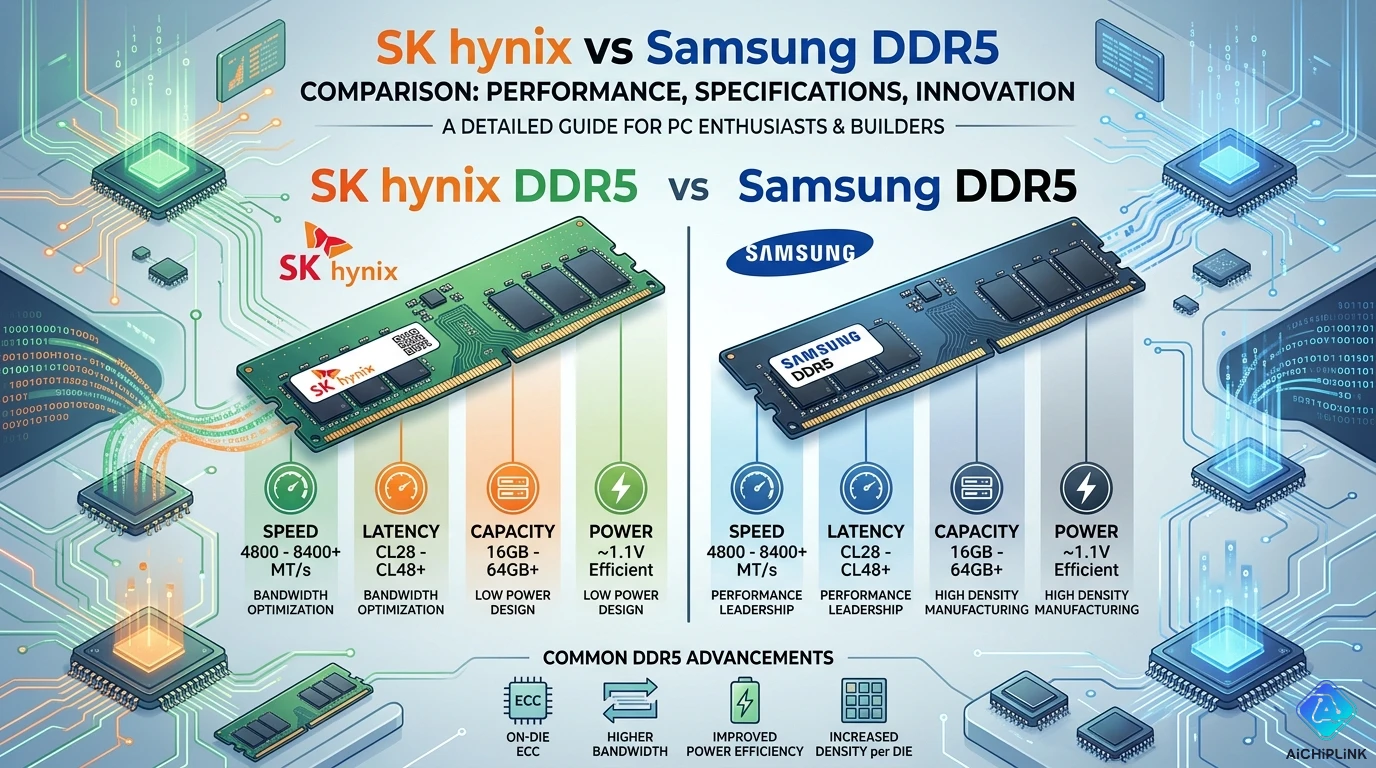
Here is something the marketing materials will not tell you: Samsung — the company whose name is synonymous with memory semiconductors, the inventor of DDR, the company that coined the term "B-die" and turned it into an overclocking religion — is currently behind SK Hynix on DDR5 process technology. Not slightly behind. On the most advanced node currently in DDR5 production, SK Hynix shipped the industry's first 1c-node DDR5 in 2024 while Samsung was still ramping 1b. On the metric that matters most to data centers in 2025 — HBM for AI — SK Hynix supplies the chips in NVIDIA's flagship accelerators while Samsung's HBM has been cutting prices to compete.
This does not mean Samsung makes bad DDR5. It makes excellent DDR5. But the question "which is better, SK Hynix or Samsung DDR5?" has a different answer in 2025 than it did in 2022 — and a different answer depending on whether you are configuring a gaming PC, a workstation, or a rack of AI inference servers.
This guide cuts through the brand mythology and gives you the actual technical picture: what the die types mean, where each manufacturer leads, and how to make the right choice for your specific use case.
1.0 The 2025 DDR5 Landscape: Why This Comparison Matters Now
DDR5 crossed from "enthusiast premium" to "mainstream standard" in 2024. Intel's LGA1851 (Arrow Lake) and AMD's AM5 platform are both DDR5-only. Cloud server procurement has shifted to DDR5 RDIMMs as the default. The question is no longer whether to buy DDR5 — it is which vendor's DDR5 to specify.
The complication is that the RAM sticks consumers and system integrators buy are almost never made entirely by Samsung or SK Hynix. Corsair, G.Skill, Kingston, Crucial, and TeamGroup assemble DDR5 modules using bare DRAM dies purchased from one of the three major DRAM manufacturers: Samsung, SK Hynix, and Micron. The die inside a "Corsair Vengeance DDR5" kit might be SK Hynix H10; the die inside a "G.Skill Trident Z5" might be Samsung M-die. The module brand is the integrator; the die manufacturer is the real story.
Why the die manufacturer matters:
- It determines maximum stable frequency and minimum achievable latency
- It determines power consumption and thermal output under load
- It determines which CPU memory controller it pairs best with
- It determines the cost trajectory as yields improve over the process node's lifecycle
The current die landscape (as of early 2026):
| Manufacturer | Consumer Die | Server Die | Process Node |
|---|---|---|---|
| SK Hynix | A-die, M-die, H10 | H5C (1b), 1c RDIMM | 1c (6th gen 10nm, industry-first) |
| Samsung | B-die (DDR4 legacy), M-die (DDR5) | K4R series | 1b (5th gen 10nm), 1c in development |
| Micron | C-die, E-die | Various | 1z/1a (slightly older) |
2.0 Die Types Decoded: What B-Die, M-Die, H10, and 1c Actually Mean
The memory industry uses cryptic internal die designations that are never printed on the chip. Here is what they actually mean:
Samsung DDR5 dies:
B-die — This is a DDR4 die, not DDR5. Samsung's legendary B-die that drove the entire DDR4 overclocking community was a DDR4 component. It does not exist as a DDR5 product. Anyone claiming to sell "Samsung B-die DDR5" is either misinformed or deceptive. The DDR5-era Samsung die names are different.
M-die (DDR5) — Samsung's current mainstream DDR5 production die, used in the majority of Samsung-branded and OEM DDR5 modules shipping in 2024–2025. Built on Samsung's 1a/1b node with HKMG (High-K Metal Gate) process. Capable of stable operation at 6,400–7,200 MT/s with good voltage headroom. Performs best on AMD Ryzen platforms due to favorable IMC (Integrated Memory Controller) compatibility.
SK Hynix DDR5 dies:
A-die — SK Hynix's first mainstream DDR5 die. Excellent overclocking headroom, notably good voltage-to-frequency ratio. Well-established in the market; found in many mid-to-high-end DDR5 kits from Corsair, Kingston, and others.
M-die (Hynix) — Note: confusingly, both Samsung and SK Hynix use "M-die" as a designation, but they refer to completely different silicon from different manufacturers. Context (or Thaiphoon Burner readout) is required to distinguish them.
H10 — SK Hynix's current premium DDR5 die, used in high-end consumer kits targeting 7,200+ MT/s. Built on the 1b node. Known for superior thermal characteristics — running 3–5°C cooler than equivalent Samsung dies under sustained load, attributed to lower leakage current and optimized refresh algorithms. Strong on Intel platforms.
Process nodes — what 1a, 1b, 1c mean:
DRAM manufacturers use a proprietary naming scheme for their process technology generations. Samsung, SK Hynix, and Micron all use the "1x nm class" designation, with successive generations labeled 1x, 1y, 1z, 1a, 1b, 1c. Each generation represents a die shrink and process improvement — smaller transistors, denser bit arrays, lower power per bit, higher achievable operating speed.
SK Hynix announced the industry's first 1c-node DDR5 in August 2024, with volume shipments beginning in 2025. The 1c node delivers 8 Gbps operating speed (11% faster than 1b) and over 9% improvement in power efficiency, with SK Hynix claiming data center electricity cost reductions of up to 30% from the combination of density and efficiency gains. Samsung was in 1b production at the time of SK Hynix's 1c announcement, with 1c development ongoing.
3.0 Head-to-Head Specifications
Both Samsung and SK Hynix DDR5 comply fully with JEDEC JESD79-5 (DDR5 standard). All JEDEC-compliant DDR5 is electrically interchangeable from a board and controller compatibility standpoint — the differences are in performance headroom, power, and reliability, not in basic compatibility.
| Parameter | SK Hynix H10 | Samsung M-die | JEDEC DDR5 Baseline |
|---|---|---|---|
| JEDEC base speed | DDR5-4800 | DDR5-4800 | DDR5-4800 (minimum) |
| Typical XMP/EXPO rating | DDR5-6400 to 7200 MT/s | DDR5-6400 to 7200 MT/s | N/A (platform-specific) |
| Max stable OC (enthusiast) | 7,600–8,000 MT/s reported | 6,800–7,400 MT/s typical | N/A |
| Operating voltage (JEDEC) | 1.1V | 1.1V | 1.1V |
| OC voltage (typical) | 1.35–1.45V | 1.35–1.45V | N/A |
| Process node | 1b / 1c (current) | 1b (current), 1c (developing) | N/A |
| Thermal under sustained load | Better (3–5°C cooler) | Reference | Depends on module design |
| AMD Ryzen compatibility | Good | Excellent | Platform-dependent |
| Intel platform compatibility | Excellent | Good | Platform-dependent |
| Server RDIMM availability | Yes — 1c RDIMM, MRDIMM | Yes — RDIMM, MRDIMM | Per server platform QVL |
| HBM leadership (AI) | NVIDIA H100/H200/B200 | Competing (HBM3E passing cert) | N/A |
4.0 Process Node Race: SK Hynix 1c vs Samsung 1b
This is where the story diverges most sharply from conventional wisdom.
SK Hynix's 1c advantage:
SK Hynix announced the industry's first 16Gb DDR5 built on the 1c node in August 2024 — beating Samsung and Micron to the industry's most advanced DRAM process. The 1c node is the sixth generation of the 10nm-class DRAM process, developed by extending SK Hynix's proven 1b platform with new EUV process materials. Key improvements over 1b: operating speed increases to 8 Gbps (an 11% gain), power efficiency improves by more than 9%, and manufacturing productivity increases by more than 30% through design innovation. Volume shipments of 1c DDR5 for server applications — RDIMMs and MRDIMMs — were targeted for 2025, with SK Hynix showcasing 1c-based server products at SC25 (Supercomputing 2025) and OCP Global Summit 2025.
Samsung's 1b position:
Samsung commenced mass production of 1b DDR5 in May 2024, using its HKMG (High-K Metal Gate) process — a transistor gate dielectric technology Samsung pioneered in GDDR6 in 2018 before applying it to DDR5. HKMG enables lower leakage current and better drive strength at a given node, which translates to lower operating voltage for the same speed grade. Samsung's 1b DDR5 server products are shipping into the data center market, with 64GB RDIMMs priced at approximately $450 per module in Q4 2025 with gross margins reported above 75%. Samsung is also shifting significant DRAM production capacity toward DDR5 RDIMMs, redirecting approximately 80,000 wafers per month from HBM production in response to the more favorable margin profile of DDR5 versus the highly competitive HBM market where SK Hynix dominates.
What this means in practice:
For consumer DDR5 modules shipping today, the difference between 1b Samsung and 1b/early-1c SK Hynix is measurable but not dramatic — you are looking at a generation of process technology, not a generational leap in end-user performance. Where the 1c advantage becomes more significant is in server deployment economics: a 9% power efficiency improvement on a rack of 100+ DIMMs translates to real electricity and cooling cost savings at hyperscale. This is why SK Hynix is specifically marketing 1c DDR5 to data center operators rather than desktop consumers.
5.0 Consumer DDR5 — Gaming and Workstation
For desktop and laptop users, the Samsung vs SK Hynix question reduces to three practical dimensions: platform compatibility, overclocking headroom, and thermals.
AMD Ryzen 7000/9000 (AM5 platform):
Samsung M-die DDR5 generally reaches optimal performance on AMD platforms with less manual tuning. The Ryzen IMC's timing relaxation at high frequencies pairs well with Samsung's tighter command timing execution, reducing micro-stutters in CPU-bound workloads. In gaming benchmarks — particularly titles leveraging AMD's 3D V-Cache architecture like the Ryzen 7 7800X3D — Samsung-based kits at 6,400–7,200 MT/s typically show measurable advantages in 1% low frame rates.
SK Hynix H10 kits are fully compatible with AM5 but may require slightly more BIOS tuning to achieve maximum stable frequency. At rated XMP speeds (5,600–6,400 MT/s), the real-world gaming difference is minimal — typically under 3 FPS average. The SK Hynix advantage emerges at extreme overclock targets above 7,200 MT/s, where H10's better thermal characteristics and higher frequency ceiling give it an edge.
Intel 14th/15th Gen (LGA1700/LGA1851):
SK Hynix H10 and A-die DDR5 show strong compatibility with Intel's IMC, with many reviewers reporting that SK Hynix kits achieve their rated XMP profiles more reliably on Intel platforms out of the box. Samsung M-die kits are fully compatible but may occasionally require manual timing adjustments for maximum stability.
For workstation applications (content creation, 3D rendering, simulation):
The memory bandwidth and latency difference between well-configured Samsung and SK Hynix DDR5 at the same rated speed is below 3% in most content creation workloads. For a content creator deciding between a $130 SK Hynix-based kit and a $155 Samsung-based kit with identical XMP ratings, the SK Hynix option typically delivers equivalent real-world performance — the $25 premium for Samsung branding buys very little measurable improvement outside extreme overclocking scenarios.
6.0 Server DDR5 — RDIMM, MRDIMM, and Data Center
The server story is substantially different from the consumer story, and this is where SK Hynix's technical leadership is most apparent.
SK Hynix server DDR5 lineup (2025):
SK Hynix is shipping 1c-node DDR5 RDIMMs and MRDIMMs for server applications, including: 96 GB DDR5 RDIMM, 256 GB 3DS (3D Stacked, using TSV technology) DDR5 RDIMM, DDR5 MRDIMM in 96 GB and 256 GB capacities, and CXL Memory Module-DDR5 (CMM-DDR5) for compute express link memory expansion. The 1c-based MRDIMM achieves speeds beyond 8,000 MT/s through multiplexed rank operation, enabling higher effective bandwidth per DIMM slot than standard RDIMM configurations.
Samsung server DDR5 lineup (2025):
Samsung is aggressively ramping 1b-node DDR5 RDIMM production, with a 64 GB RDIMM priced at approximately $450 and reportedly carrying gross margins above 75%. Samsung has shifted 30–40% of its DRAM production capacity toward DDR5 modules as data center procurement accelerates. Samsung's server DDR5 is fully qualified on major server platforms (Intel Sapphire Rapids, AMD Genoa/Turin) and appears on QVLs for Dell, HPE, Lenovo, and Supermicro platforms.
For AI inference servers:
Both Samsung and SK Hynix DDR5 RDIMMs are appropriate for AI inference CPU memory (host memory in AI inference nodes). For the GPU accelerator memory — HBM — SK Hynix currently supplies the HBM3E in NVIDIA H100, H200, and Blackwell B200 accelerators. Samsung's HBM3E passed NVIDIA's certification in 2024 and is beginning to ship into AI accelerator supply chains, but SK Hynix maintains a significant lead in HBM market share.
Power efficiency at rack scale:
The 9% power efficiency improvement of SK Hynix's 1c DDR5 over 1b compounds significantly at rack scale. A 2U server with 24 DIMM slots running 24 × 64 GB DDR5 RDIMMs: if each DIMM draws approximately 5W at idle and 15W under load, a 9% power reduction saves 1.35W per DIMM, or 32.4W per server, or 32.4 kW per 1,000-server deployment — directly reducing both electricity costs and cooling infrastructure load. This is why SK Hynix's 1c efficiency improvements are marketed directly to hyperscale data center operators rather than end users.
7.0 ⚠️ Three Mistakes Buyers Make When Choosing Between Them
Mistake 1: Assuming the module brand tells you which die is inside The most common mistake: buying a "Samsung-branded" DIMM and assuming it contains Samsung DRAM, or buying a "G.Skill" kit and not knowing what die is inside. Most retail DDR5 modules do not disclose the underlying DRAM manufacturer on the packaging. A Corsair kit might contain SK Hynix H10; a G.Skill kit might contain Samsung M-die. The only reliable methods to identify the die are: (1) use Thaiphoon Burner (Windows) to read the SPD and identify the DRAM manufacturer and die revision; (2) check enthusiast forums and review sites where kits are routinely decoded before and after purchase. Do not assume die type based on module brand.
Mistake 2: Optimizing die type for overclocking on a platform that won't benefit Spending 20% more on premium Samsung M-die kits for maximum overclocking headroom on a system that will never be overclocked — because it runs 24/7 server workloads, because the platform BIOS does not support XMP/EXPO, or because the use case is a workstation where memory stability matters more than maximum frequency — wastes money. At JEDEC-rated speeds (DDR5-4800 to DDR5-5600), Samsung and SK Hynix perform identically. The die premium is only justified if you will actually push the memory beyond its rated XMP profile.
Mistake 3: Mixing Samsung and SK Hynix dies in a dual-channel kit Installing one Samsung-die DIMM and one SK Hynix-die DIMM in a dual-channel configuration is technically possible (both are JEDEC-compliant) but creates problems in practice. Different dies have different optimal timing parameters, different preferred operating voltages, and different stability characteristics at elevated frequencies. The result is either a system that boots at reduced speed (falling back to JEDEC 4800 MT/s), a system that is unstable at XMP speeds, or a system that requires extensive manual timing tuning to achieve stable dual-channel operation. Always use matched kits — both DIMMs from the same manufacturer, same die, same batch, same part number.
8.0 The Decision Guide: Which to Choose for Your Use Case
Gaming PC (AMD Ryzen AM5, budget-conscious): → SK Hynix H10 or A-die — typically 10–15% cheaper than equivalent Samsung-rated kits, performs within 2–3 FPS at matched XMP speeds. SK Hynix H10 at DDR5-6000 CL30 is the sweet spot for AM5 gaming builds.
Gaming PC (AMD Ryzen AM5, extreme overclocker targeting 7,200+ MT/s): → Samsung M-die — Samsung's tighter command timing at very high frequencies gives measurable 1% low frame rate improvements on AMD's X3D CPUs under extreme OC.
Gaming PC or workstation (Intel LGA1851): → SK Hynix H10 — better out-of-box XMP compatibility on Intel platforms, lower thermals, excellent stability at rated speeds without manual tuning.
Server procurement (RDIMM, single vendor QVL-qualified): → Either — both Samsung and SK Hynix RDIMM are qualified on major server platforms. Make the decision based on: (1) which appears on your specific server's QVL, (2) current pricing, (3) supply lead time from your authorized distributor.
Data center, power-efficiency-sensitive, willing to be early on new node: → SK Hynix 1c RDIMM — the 9% power efficiency improvement and higher density of 1c-node DDR5 provides real TCO reduction at scale. Verify QVL status before deployment.
AI inference server (CPU memory, not GPU): → Either — both are appropriate for host-side CPU memory in AI inference nodes. For the GPU memory (HBM), SK Hynix currently supplies NVIDIA's leading accelerators; Samsung is shipping HBM to competing platforms.
When NOT to pay the Samsung premium: For any non-overclocked, non-extreme workload — home NAS, office workstation, light gaming, general server deployment — the performance difference between Samsung and SK Hynix DDR5 at rated speeds is below the margin of measurement in real applications. Prioritize compatibility (QVL), price, and warranty length over brand.
9.0 Sourcing and Identifying Die Types
How to identify which die is in your DDR5 kit:
Thaiphoon Burner (Windows): The most reliable consumer tool. Reads the SPD (Serial Presence Detect) EEPROM on the DIMM and reports the DRAM manufacturer, die revision, and manufacturing date. Free to use. Identifies SK Hynix A-die, M-die, H10, and Samsung M-die accurately.
HWiNFO64: Reports basic SPD information including DRAM manufacturer in the Memory panel. Less detailed than Thaiphoon Burner but integrated into a broader system monitoring tool many users already have installed.
Community databases: Reddit's r/overclocking wiki and sites like buildzoid's reviews consistently identify which die is present in specific module part numbers. Search the full module part number (including SKU suffix) before purchasing.
Where to buy: For bare DDR5 DRAM components (server DRAM dies, RDIMM modules from Samsung or SK Hynix for system integration), authorized distribution channels include Arrow Electronics, Avnet, and Samsung's own enterprise sales channel for bulk server RDIMM procurement. For consumer-grade DDR5 kits (Corsair, G.Skill, Kingston, Crucial using Samsung or SK Hynix dies), any major electronics retailer carries stock with verified authenticity.
For server-grade Samsung and SK Hynix DDR5 RDIMM components with verified traceability and competitive pricing, visit aichiplink.com.
10.0 Quick Reference Card
Die Type Quick Reference:
| Die | Manufacturer | DDR Generation | Best Platform | OC Ceiling | Notes |
|---|---|---|---|---|---|
| H10 | SK Hynix | DDR5 | Intel | 7,600–8,000 MT/s | Cooler thermals, premium |
| A-die | SK Hynix | DDR5 | Both | 7,200 MT/s | Mid-range sweet spot |
| M-die (Hynix) | SK Hynix | DDR5 | Both | 6,400–7,200 MT/s | Entry-level DDR5 |
| M-die (Samsung) | Samsung | DDR5 | AMD | 6,800–7,400 MT/s | Best for Ryzen at extreme OC |
| B-die | Samsung | DDR4 only | — | — | Does NOT exist in DDR5 |
Process Node Timeline:
| Node | Generation | SK Hynix | Samsung | Speed |
|---|---|---|---|---|
| 1a | 4th gen 10nm | ✅ Shipped | ✅ Shipped | ~6,400 MT/s |
| 1b | 5th gen 10nm | ✅ Volume | ✅ Volume | ~7,200 MT/s |
| 1c | 6th gen 10nm | ✅ First (Aug 2024) | 🔄 Developing | 8,000+ MT/s |
Use Case Decision Matrix:
| Use Case | Recommended | Reason |
|---|---|---|
| AMD Ryzen gaming, stock speeds | SK Hynix H10/A-die | Better price for same performance |
| AMD Ryzen extreme OC (>7200) | Samsung M-die | Tighter command timing at high freq |
| Intel DDR5 (any speed) | SK Hynix H10 | Better out-of-box XMP compatibility |
| Server RDIMM (general) | Either (check QVL) | Both fully qualified; price decides |
| Data center, power-sensitive | SK Hynix 1c RDIMM | 9% lower power per DIMM |
| AI inference CPU memory | Either | No meaningful difference |
| HBM (GPU accelerator memory) | SK Hynix | Dominant in NVIDIA AI GPU supply |
For sourcing Samsung and SK Hynix DDR5 DRAM components and server RDIMM modules, visit aichiplink.com for verified inventory and competitive pricing.

Written by Jack Elliott from AIChipLink.
AIChipLink, one of the fastest-growing global independent electronic components distributors in the world, offers millions of products from thousands of manufacturers, and many of our in-stock parts is available to ship same day.
We mainly source and distribute integrated circuit (IC) products of brands such as Broadcom, Microchip, Texas Instruments, Infineon, NXP, Analog Devices, Qualcomm, Intel, etc., which are widely used in communication & network, telecom, industrial control, new energy and automotive electronics.
Empowered by AI, Linked to the Future. Get started on AIChipLink.com and submit your RFQ online today!
Frequently Asked Questions
Why does my kit show SK Hynix instead of Samsung?
Because manufacturers change DRAM dies without updating product listings—SPD tools like Thaiphoon Burner are more accurate than retailer descriptions.
Should I choose Samsung or SK Hynix for EPYC servers?
Either is fine if on the QVL, but SK Hynix may offer slightly better power efficiency at scale.
Is Samsung still best for overclocking like DDR4 B-die?
No—SK Hynix (A-die/H10) generally leads DDR5 overclocking, though Samsung M-die is still strong.
Does SK Hynix HBM leadership mean better DDR5 for AI?
No—HBM and DDR5 are different technologies; both Samsung and SK Hynix DDR5 perform similarly for CPU-side AI workloads.