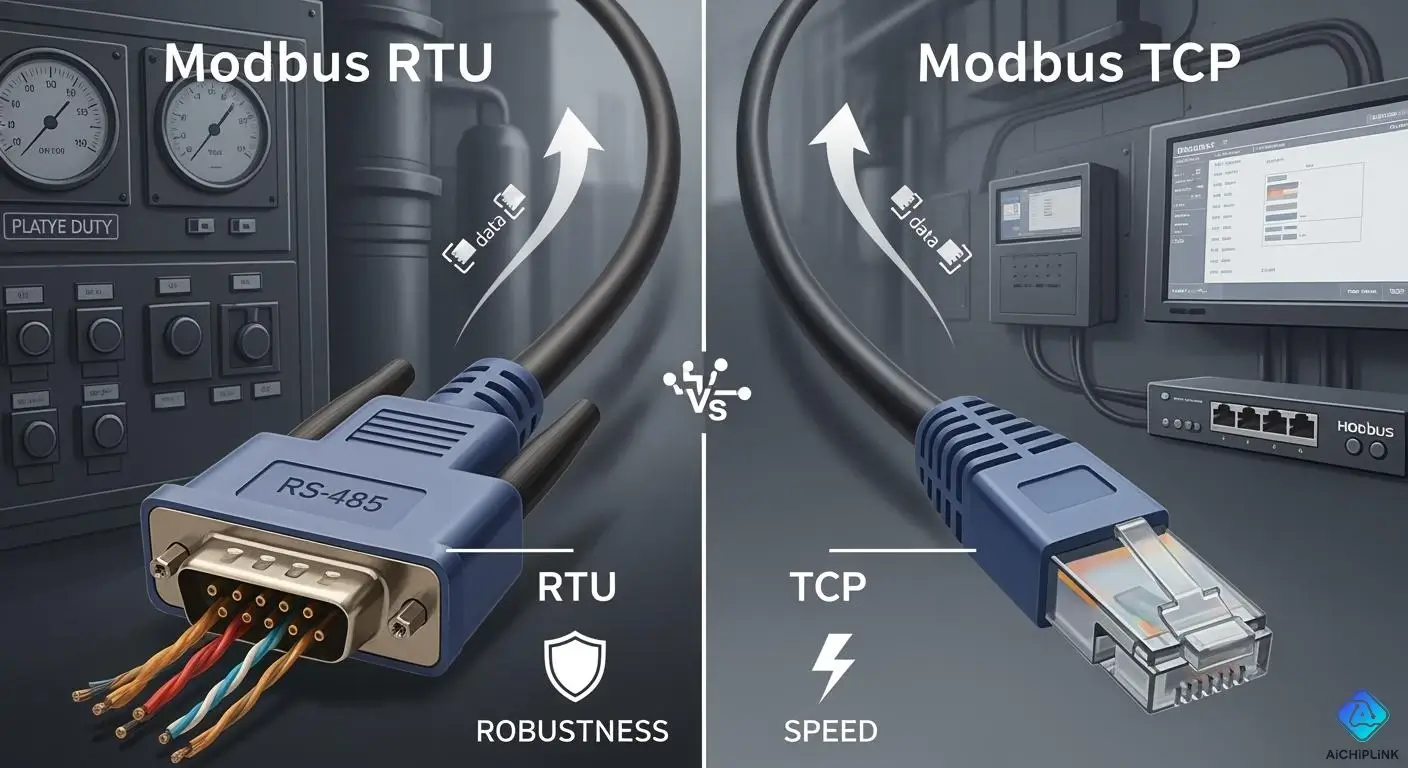
The biggest difference between Modbus RTU vs Modbus TCP is how they connect devices. Modbus RTU uses serial communication, while Modbus TCP utilizes Ethernet. The protocol you choose impacts speed, cost, and the scalability of your system.
Imagine a fast packaging line. An RTU network checks many sensors and actuators, but it might be too slow and cause delays. In contrast, Modbus TCP is faster and has low wait times, allowing it to handle large amounts of data simultaneously. This ensures the line operates efficiently.
-
RTU networks only allow you to connect 32 devices per segment, requiring complex wiring to add more.
-
Modbus TCP, on the other hand, makes it easy to add devices; you simply use a switch and assign IP addresses.
Choosing the right protocol between Modbus RTU vs Modbus TCP is crucial. This decision helps you achieve optimal speed, save costs, and facilitate future upgrades.
Key Takeaways
-
Modbus RTU uses serial communication. It works well for local control. It is good when you have fewer devices. It does not cost much. It is reliable for small networks.
-
Modbus TCP uses Ethernet. It can send data faster. It is easy to add more devices. It works well for big networks. It is good for remote monitoring.
-
Pick Modbus RTU for simple setups. Use it when you connect only a few devices. Choose Modbus TCP if you need speed. Pick it if you want more flexibility.
-
Both protocols can work together with gateways. This lets old and new devices connect. You do not need to change your whole system.
-
Think about what your project needs. Look at speed, cost, and how many devices you have. This helps you pick the best protocol for your automation system.
Modbus RTU vs Modbus TCP: Key Differences
Summary Table
You can use this table to see how Modbus RTU and Modbus TCP are different. It shows how fast they are, how you set them up, how much they cost, how many devices you can add, and where you might use each one.
| Feature | Modbus RTU | Modbus TCP |
|---|---|---|
| Communication Mechanism | Serial (RS-232/RS-485) | TCP/IP over Ethernet |
| Data Transmission Method | Binary encoding via serial ports | Encapsulated in TCP/IP packets |
| Maximum Speed | Up to 128,000 bit/s | 10/100 Mbit/s |
| Network Architecture | Point-to-point or multi-drop serial lines | Ethernet networks with switches/routers |
| Scalability | Limited (up to 32 devices per segment) | High (easily add devices via network) |
| Error Detection | CRC (Cyclic Redundancy Check) | TCP/IP error handling |
| Implementation Cost | Lower (simple wiring, less equipment) | Higher (network hardware, cybersecurity) |
| Typical Use Cases | Local device control, legacy systems | Remote monitoring, modern automation |
Main Contrasts
When you compare Modbus RTU and Modbus TCP, you see some big differences that matter for your project.
-
Modbus RTU uses serial communication. This means you connect devices with wires. Modbus TCP uses Ethernet. You connect devices with network cables and switches.
-
Modbus TCP is much faster than Modbus RTU. It can send data at up to 100 megabits per second. Modbus RTU only goes up to 128,000 bits per second.
-
Modbus RTU is good for local connections. You can link a few machines in the same room or building. Modbus TCP lets you connect devices over big networks or even between different places.
-
You can only connect a small number of devices to a Modbus RTU network. Modbus TCP lets you add lots of devices easily with network switches.
-
Modbus RTU usually costs less to set up. You just need simple wires and basic tools. Modbus TCP costs more because you need Ethernet gear and extra security.
-
Many factories still use Modbus RTU for older machines. Newer systems often use Modbus TCP because it is faster and easier to connect.
-
Modbus RTU is often used for things like controlling motors or updating old PLCs. Modbus TCP is better when you want to watch devices from far away or connect many devices in a new plant.
Tip: If you have both old and new equipment, you might need both protocols. Many factories use gateways to connect Modbus RTU and Modbus TCP networks.
Knowing these differences helps you pick the right one for your project. Modbus RTU vs Modbus TCP is not just about speed. It is also about how you want your system to grow, how much you want to spend, and how you plan to connect your devices.
Modbus RTU Overview
How Modbus RTU Works
Modbus RTU connects devices using a master-slave setup. The master device asks the slave devices for information or tells them what to do. Each slave listens for its own address. When it hears its address, it answers or does the command. Every message has a set format. It includes an address, a function code, some data, and a CRC for checking mistakes. This setup helps make sure messages are clear and correct in factories. Modbus RTU is trusted to send the right data and control signals.
Tip: If you want something simple and reliable for local control, Modbus RTU is a good choice.
Serial Communication and Topology
Modbus RTU links devices using serial communication. RS-485 is often used as the physical layer. This setup uses differential signaling and half-duplex communication. You can wire devices in different ways, like daisy-chained or multipoint. With a two-wire setup, you can connect up to 256 devices on one bus. You can also send signals over long distances, even thousands of feet, if you install it right. The system is strong against interference, so it works well in tough places.
| Feature | Description |
|---|---|
| Communication Model | Master-slave setup where the master asks and slaves answer. |
| Physical Layer | RS-485, which uses differential signaling and half-duplex communication. |
| Topologies Supported | Many wiring options, like daisy-chained and multipoint. |
| Device Limitations | Up to 256 devices on one bus with two wires. |
| Transmission Distance | Can reach thousands of feet if set up well. |
| Immunity to Interference | Strong against interference in industrial places. |
| Application Scenarios | Used a lot in factories for monitoring and control. |
Typical Applications
Modbus RTU is used in many industries. It works in manufacturing, process industries, and utilities. You can also find it in building automation, power utilities, transportation, and oil and gas. Each use gets reliable data and real-time control from Modbus RTU.
| Industrial Application | Description |
|---|---|
| Manufacturing | Uses Modbus RTU for fast and steady communication in production. |
| Process Industries | Uses Modbus RTU for safe data exchange in process control. |
| Utilities | Uses Modbus RTU for substation and grid monitoring, helping update old systems. |
| Building Automation | Connects HVAC, lights, and energy systems into one system. |
| Power Utilities | Helps add renewable energy and smart meters with real-time data. |
| Transportation | Watches and controls traffic and tracks vehicles. |
| Oil & Gas | Connects field tools and safety systems for better control. |
When you look at Modbus RTU vs Modbus TCP, Modbus RTU is best when you need simple wiring, strong reliability, and local control. You can trust it for many jobs in automation.
Modbus TCP Overview
How Modbus TCP Works
Modbus TCP connects devices using Ethernet cables. It uses a client/server setup. The client asks for something. The server gives an answer. Each message is separate. This means you can do many things at once. Data moves in packets. Each packet has a clear format. You see registers, addresses, and function codes. These tell the server what job to do.
Here is a table that shows the main ideas of Modbus TCP:
| Principle | Description |
|---|---|
| Client/Server Architecture | Modbus uses a command/response system. The client asks for data. The server handles requests. |
| Register-based Communication | Data is grouped in things like Discrete Inputs, Coils, Input Registers, and Holding Registers. |
| Addressing | Simple numbers help find registers for access. |
| Function Codes | Function codes in the packet say what action to take. |
| Transaction-oriented | Each request stands alone. This lets you use Modbus TCP for many jobs. |
Note: Modbus TCP lets you connect lots of devices. It helps you manage data quickly.
Ethernet Communication and Topology
Modbus TCP devices use regular Ethernet cables and switches. This setup is more flexible than serial networks. You can add or remove devices anytime. You do not need to stop the system. Maintenance is easier. You can build big networks with many devices.
The table below compares Ethernet and serial communication:
| Feature | Ethernet Communication | Serial Communication (RS232/RS485) |
|---|---|---|
| Configuration | Flexible and easy; you can connect many devices | Limited by slots; needs extra hardware |
| Hot Plug Support | Add devices without stopping the system | Must shut down to add devices |
| Maintenance | Easy to fix; supports backup servers | Hard to fix; only one server |
| Scalability | Can grow big; wiring is flexible | Can’t grow much; wiring is limited |
Ethernet lets you connect devices far away. You can even link buildings. This makes Modbus TCP great for new automation systems.
Typical Applications
Modbus TCP is used in many fields. It helps you watch and control machines in real time. You can use it for energy, buildings, and transport.
Here are some common ways Modbus TCP is used:
| Industry Sector | Application Description |
|---|---|
| Industrial Automation | Used for real-time monitoring and sharing data. This helps work go faster. |
| Energy and Power | Watches important equipment. It helps fix problems before they happen. |
| Oil and Gas | Keeps pumps, compressors, and pipes safe. It works well in tough places. |
| Building Automation | Connects smart tools for saving energy and managing buildings. |
| Transportation | Makes trains, airports, and shipping safer and more efficient. |
When you look at Modbus RTU vs Modbus TCP, Modbus TCP is best for fast data, easy growth, and remote control. You can build smart systems that change as you need.
Modbus RTU vs Modbus TCP: Detailed Comparison
Speed and Performance
You want your system to be fast and work well. Both Modbus RTU and Modbus TCP do a good job if the network is strong. Tests show they work about the same when things are stable.
-
Modbus TCP can be slower than Modbus UDP if the network is weak.
-
If everything is perfect, both Modbus RTU and Modbus TCP work just as well.
-
It is hard to say which one is better for moving lots of data because people do not compare them often.
If you need to send a lot of data fast, Modbus TCP is usually quicker. Modbus RTU is better for small and local jobs.
Scalability and Flexibility
If your project gets bigger, you need a protocol that can grow too. Modbus TCP makes it simple to add more devices and systems.
-
Modbus TCP lets many clients talk to one server at the same time.
-
You can use different network shapes, like star, tree, ring, or mesh.
-
Modbus TCP can have up to 247 devices with their own IP addresses.
-
You can make your system bigger or better quickly with Ethernet cables.
Modbus RTU only lets you have one master. If you want to add more systems, you need gateways, and that can be tricky. For big projects, Modbus TCP helps you connect SCADA, HMI, and databases all together.
Cost and Implementation
How much you spend is important when you build or change your system. Modbus RTU is usually cheaper to start. You just need simple wires and basic gateways. Here is a table that shows what things cost:
| Device | Price Range |
|---|---|
| Modbus RTU Gateway | $199.00 - $939.00 |
| Modbus TCP Controller | $896.72 - $1,251.75 |

Modbus TCP costs more because you need Ethernet gear and better security. You pay more at first, but upgrades and new features are easier.
Security Considerations
You want your data to be safe. Modbus RTU uses serial lines, so it is harder for strangers to get in. Modbus TCP uses Ethernet, so you need to think about network safety. You should use firewalls and strong passwords to keep your system safe. Always plan for safety when you use Modbus TCP in your factory.
Integration and Compatibility
When you make your system bigger or better, you might need both protocols. Modbus RTU vs Modbus TCP can cause problems when you try to connect them. You may need special converters or gateways to link them. This can make upgrades cost more and be harder. Plan ahead so your system works well and does not have problems.
Choosing the Right Protocol
When to Use Modbus RTU
Pick Modbus RTU if you want something simple and reliable. It works best for local control. You use serial cables to connect devices. Many factories use it to watch machines and collect data. It is also good for controlling pumps and valves in water systems. Modbus RTU helps connect old PLCs and smart energy meters. It is strong and works well over long wires. For example, a wastewater plant uses Modbus RTU RS-485 to link pump stations in a loop.
Checklist for Modbus RTU:
-
You need to connect a few devices.
-
Your devices are close or in one building.
-
You want to spend less money at the start.
-
You need strong protection from electrical noise.
-
Your system already uses serial communication.
When to Use Modbus TCP
Choose Modbus TCP if you want fast data and easy growth. Modbus TCP uses Ethernet, so you can add devices quickly. It is great for new factories and smart energy systems. You can use it to watch machines and fix problems before they happen. Modbus TCP helps share data in real time. For example, a factory uses Modbus TCP to connect PLCs and sensors. It also helps collect data with IoT gateways and smart meters.
Checklist for Modbus TCP:
-
You need fast communication.
-
You want to connect many devices far apart.
-
Your system uses Ethernet networks.
-
You plan to make your system bigger later.
-
You need remote access or to use new software.
| Criteria | Modbus RTU | Modbus TCP |
|---|---|---|
| Communication Medium | Serial (RS-232, RS-485, RS-422) | Ethernet |
| Protocol Layer | Binary format with CRC | TCP/IP packet |
| Speed & Performance | Up to 115.2 kbps | Up to 1 Gbps or more |
Real-World Scenarios
You see Modbus RTU vs Modbus TCP used in many places. In oil and gas, Modbus RTU is used at remote wells where Ethernet does not work. In packaging plants, Modbus RTU stops data loss with shielded cables. In smart factories, Modbus TCP connects PLCs and sensors for fast data. Energy companies use Modbus TCP to link smart meters and watch equipment. Modbus TCP is also good for fixing machines before they break and for IoT data.
Tip: Think about speed, network size, device fit, safety, and cost before you choose.
Key factors to help you decide:
-
How fast you need data
-
How big your network is
-
If your devices work with the protocol
-
How safe your system must be
-
How much you can spend
Picking the right protocol helps your system work well and grow with your needs.
Migration and Hybrid Systems
Upgrading from RTU to TCP
Sometimes, you want to make your system better. You can upgrade from Modbus RTU to Modbus TCP. This upgrade gives you faster data and stronger network security. It also makes adding new devices easier. Many factories do this to keep up with new technology. When you switch to Modbus TCP, you get more speed and save money. Setting up is simple, and your network is safer. You can grow your system easily.
Here is a table that shows what is good and what is hard when you upgrade:
| Benefits | Challenges |
|---|---|
| Enhanced Speed of development | Simplicity |
| Cost-Effectiveness | Efficiency |
| Ease of Configuration | Versatility |
| Network Security and Integration | Ease of Use |
| Scalability and Network Topology | N/A |
| DIN Rail Mounting | N/A |
Note: Upgrading is easy if you plan ahead. Sometimes, you need to teach your team new things. You may also need to update your devices for Ethernet.
Using Gateways and Mixed Networks
You do not have to change all your devices right away. Many factories use Modbus RTU and Modbus TCP together. Gateways help connect both networks. These devices work like translators. They let old serial devices talk to new Ethernet devices.
Here are some devices that help you build a mixed network:
| Device Type | Description |
|---|---|
| Serial to Ethernet/Modbus Converters | Let Modbus RTU and Modbus TCP devices share data in your system. |
| Modbus Converters & Gateways | Make sure different Modbus protocols can work together. |
| tGW-700 Modbus to RTU/ASCII Device Servers | Convert Modbus TCP to RTU/ASCII, making your network more flexible. |
Tip: Gateways help you keep old equipment working. You can add new Ethernet devices without stopping your system. This saves money and keeps your factory running.
Mixing both protocols makes your system strong and flexible. You can upgrade slowly and keep everything working well.
You now know Modbus RTU uses serial lines for local systems. Modbus TCP uses Ethernet and is fast and easy to grow. Pick the protocol that fits your project best. Think about how fast you need data. Think about how much money you want to spend. Count how many devices you need to connect. If you want to upgrade or mix old and new devices, use gateways. Look at your system goals before you choose.

Written by Jack Elliott from AIChipLink.
AIChipLink, one of the fastest-growing global independent electronic components distributors in the world, offers millions of products from thousands of manufacturers, and many of our in-stock parts is available to ship same day.
We mainly source and distribute integrated circuit (IC) products of brands such as Broadcom, Microchip, Texas Instruments, Infineon, NXP, Analog Devices, Qualcomm, Intel, etc., which are widely used in communication & network, telecom, industrial control, new energy and automotive electronics.
Empowered by AI, Linked to the Future. Get started on AIChipLink.com and submit your RFQ online today!
Frequently Asked Questions
What is the main reason to choose Modbus RTU?
Pick Modbus RTU if you want a simple setup. It costs less and works for local control. It is good for small networks. It handles electrical noise better than Ethernet.
Can you use Modbus RTU and Modbus TCP together?
Yes, you can use both with a gateway. The gateway helps old serial devices talk to new Ethernet devices. You do not have to change all your equipment at once.
Is Modbus TCP more secure than Modbus RTU?
Modbus TCP needs extra security because it uses Ethernet. You should use firewalls and strong passwords. Modbus RTU is safer from hackers since it uses serial cables.
How many devices can you connect to each protocol?
· Modbus RTU: You can connect up to 32 devices per segment. If you use repeaters, you can add more. · Modbus TCP: You can connect hundreds of devices. The limit depends on your network.
Do you need special software to use Modbus TCP?
You do not need special software for basic things. Most PLCs and SCADA systems work with Modbus TCP. You might need extra tools for advanced features or better security.