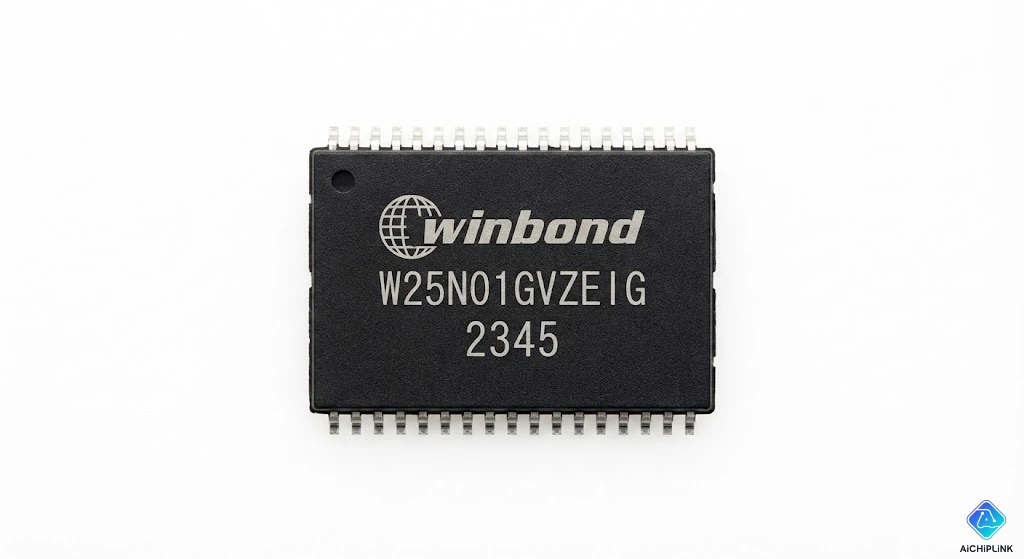
For decades, embedded engineers followed a simple rule: use NOR Flash for code (bootloaders) and NAND Flash for data (storage).
But as IoT devices grew more complex, running full Linux kernels and rich GUIs, the code size exploded. Storing a 64MB Linux image on a NOR Flash (like the W25Q series) became prohibitively expensive.
Enter the Winbond W25N01GVZEIG.
This is a 1 Gigabit (128MB) Serial NAND Flash. It uses the same compact 8-pin package as your familiar NOR flash but offers 4x to 8x the density at a fraction of the cost per bit. If you are designing an embedded gateway, a smart display, or an industrial controller, this chip is likely the most cost-effective storage solution on your BOM.
This guide decodes its specs and explains the critical software differences you need to know when switching from NOR to NAND.
Table of Contents
- 1. Decoding the Part Number
- 2. Technical Specs: The "Continuous Read" Advantage
- 3. Hardware: WSON-8 Package & Pinout
- 4. Firmware & Linux Support (The Tricky Part)
- 5. Cross Reference & Replacements
- 6. Conclusion
1. Decoding the Part Number
Winbond part numbers tell a complete story. Here is the breakdown for W25N01GVZEIG:
| Code Segment | Meaning | Detail |
|---|---|---|
| W | Manufacturer | Winbond Electronics. |
| 25N | Series | Serial NAND Flash. (Note: 25Q is NOR Flash). |
| 01G | Density | 1 Gigabit (128 Megabytes). |
| V | Voltage | 2.7V - 3.6V (Standard 3V). |
| Z | Package | WSON-8 (8mm x 6mm). Compact footprint. |
| E | Temp/Mode | Industrial (-40°C to +85°C) & Buffer Read Default. |
| IG | Green | Lead-Free / RoHS Compliant. |
Crucial Warning: Do not confuse this with W25N01GW, which is the 1.8V version. Connecting the "V" version (3V) to a 1.8V rail will not work, and vice-versa.
2. Technical Specs: The "Continuous Read" Advantage
Why is the W25N series so popular? It bridges the gap between NOR and NAND behavior.
- Continuous Read Mode: Standard NAND requires reading page-by-page (complex). The W25N01GV supports a mode that allows it to stream data continuously across page boundaries, behaving almost like a NOR flash. This makes Code Shadowing (copying the OS from Flash to RAM at boot) extremely fast and simple.
- On-Chip ECC: NAND flash inherently develops bit errors. This chip includes internal 1-Bit ECC (Error Correction Code). It detects and fixes errors automatically, so your host MCU doesn't need a complex ECC engine.
- Speed: Supports 104MHz Quad SPI (QSPI), delivering up to 50MB/s continuous data transfer rates.
3. Hardware: WSON-8 Package & Pinout
The WSON-8 (8x6mm) package is physically compatible with common 64Mb/128Mb NOR Flash chips.
- Pin 1: /CS (Chip Select)
- Pin 2: DO (Data Out / IO1)
- Pin 3: /WP (Write Protect / IO2)
- Pin 4: GND
- Pin 5: DI (Data In / IO0)
- Pin 6: CLK (Clock)
- Pin 7: /HOLD (IO3)
- Pin 8: VCC (3.3V)
Design Tip: Because this is a high-speed QSPI device, keep traces short and matched in length. Place a 0.1µF decoupling capacitor as close to Pin 8 as possible.
4. Firmware & Linux Support (The Tricky Part)
You cannot simply swap a NOR chip for this NAND chip without updating your firmware.
- Bad Block Management (BBM): Unlike NOR, NAND ships with "Bad Blocks" and develops more over time. Your bootloader (U-Boot) must read the Bad Block Table (BBT) and skip broken areas.
- No XIP (Execute in Place): While technically possible on some controllers, it is slow. The standard practice is Shadowing: The CPU copies the boot image from W25N to RAM, then executes it from RAM.
- Linux Driver: The chip is well-supported in the Linux kernel via the
spinandframework.- Driver Path:
drivers/mtd/nand/spi/winbond.c - Device Tree: Define it as a generic
spi-nanddevice.
- Driver Path:
5. Cross Reference & Replacements
Supply chains are tight. If you cannot find the Winbond part, these are the industry-standard alternatives (always verify datasheets for command compatibility):
- GigaDevice: GD5F1GQ4UAYIG (1Gb SPI NAND, WSON8, 3V). Extremely popular and often drop-in compatible in terms of footprint.
- Macronix: MX35LF1GE4AB (1Gb SPI NAND). Note: Macronix sometimes uses different ECC status register bits, so check your driver support.
- Micron: MT29F1G01 series (Ensure you select the SPI interface version, not parallel).
6. Conclusion
The Winbond W25N01GVZEIG is the champion of cost-effective embedded storage. By packing 128MB of reliable, ECC-protected storage into a tiny 8-pin package, it allows designers to build feature-rich Linux devices without the bulk and cost of parallel NAND or eMMC.
Sourcing Winbond SPI NAND? Need verified stock for your next build? Visit Aichiplink.com to search for W25N01GVZEIG and compatible GigaDevice/Macronix alternatives.

Written by Jack Elliott from AIChipLink.
AIChipLink, one of the fastest-growing global independent electronic components distributors in the world, offers millions of products from thousands of manufacturers, and many of our in-stock parts is available to ship same day.
We mainly source and distribute integrated circuit (IC) products of brands such as Broadcom, Microchip, Texas Instruments, Infineon, NXP, Analog Devices, Qualcomm, Intel, etc., which are widely used in communication & network, telecom, industrial control, new energy and automotive electronics.
Empowered by AI, Linked to the Future. Get started on AIChipLink.com and submit your RFQ online today!
Frequently Asked Questions
1. What type of flash is W25N01GVZEIG?
W25N01GVZEIG is a 1Gb (128MB) SPI NAND Flash from Winbond, designed for embedded systems.
2. What voltage does W25N01GVZEIG operate at?
It operates at 2.7V–3.6V (3.3V nominal). It is not compatible with 1.8V systems.
3. Does W25N01GVZEIG support built-in ECC?
Yes. It features on-chip ECC, which automatically detects and corrects bit errors.
4. Can W25N01GVZEIG replace SPI NOR flash directly?
No. Unlike NOR flash, SPI NAND requires bad block management and cannot reliably support XIP without firmware changes.
5. Is W25N01GVZEIG supported by Linux?
Yes. It is supported by the Linux SPI NAND (spinand) framework, including U-Boot and mainline Linux kernels.