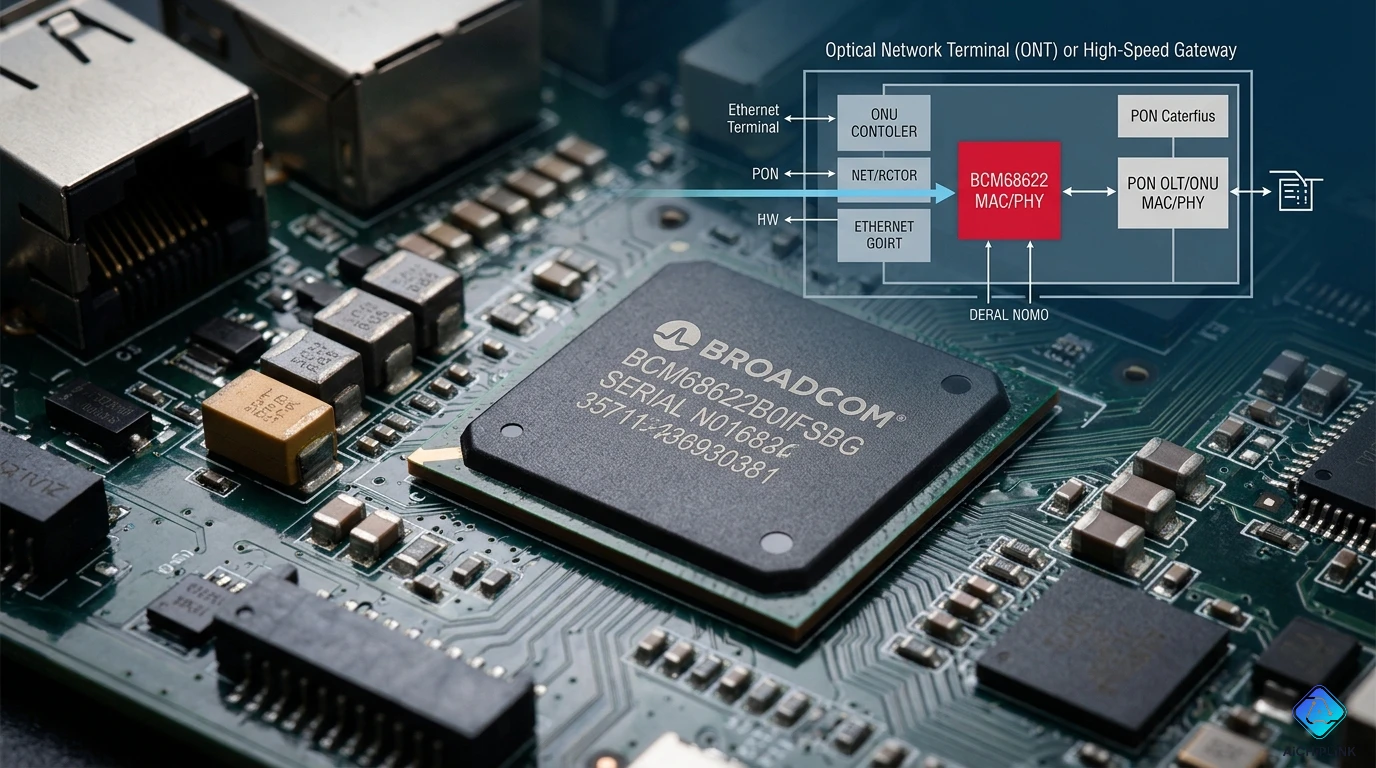
Product Quick Card
╔══════════════════════════════════════════════════════╗
║ BCM68622B0IFSBG - At a Glance                       ║
╠══════════════════════════════════════════════════════╣
║ Manufacturer:  Broadcom Inc.                        ║
║ Type:          Network Processor SoC                ║
║ CPU:           Quad-core ARM Cortex-A53 @ 1.5 GHz  ║
║ Architecture:  64-bit ARMv8                         ║
║ Networking:    2.5G Ethernet capable                ║
║ Ports:         Multiple GbE + 2.5GbE support        ║
║ Packet Engine: Hardware packet processing           ║
║ Interfaces:    PCIe, USB 3.0, RGMII, SGMII         ║
║ Memory:        DDR4 controller (up to 4GB)          ║
║ Package:       484-ball FCBGA (19×19mm)             ║
║ Temperature:   0°C to +85°C (commercial)            ║
║ Voltage:       1.0V core, 1.8V/3.3V I/O            ║
║ Status:        Active production (2026)             ║
╚══════════════════════════════════════════════════════╝
One-Line Summary: BCM68622B0IFSBG is a quad-core ARM network processor designed for high-performance home routers, small business gateways, and enterprise networking equipment with advanced packet processing capabilities.
Part Number Decoder
B C M 6 8 6 2 2 B 0 I F S B G
│ │ │ │ │ │ │ │ │ │ │ │ │ │ └─ G = Green (RoHS 6/6 compliant)
│ │ │ │ │ │ │ │ │ │ │ │ │ └─── B = Ball Grid Array
│ │ │ │ │ │ │ │ │ │ │ │ └───── S = Speed grade
│ │ │ │ │ │ │ │ │ │ │ └─────── F = Feature set
│ │ │ │ │ │ │ │ │ │ └───────── I = Industrial temp grade
│ │ │ │ │ │ │ │ │ └─────────── 0 = Revision/stepping
│ │ │ │ │ │ │ │ └───────────── B = Process variant
│ │ │ │ │ │ │ └─────────────── 2 = Sub-family
│ │ │ │ │ │ └───────────────── 2 = Configuration
│ │ │ │ │ └─────────────────── 6 = Port count/capability
│ │ │ │ └───────────────────── 8 = Product line (686xx)
│ │ │ └─────────────────────── 6 = Generation
│ │ └───────────────────────── M = Mixed signal
│ └─────────────────────────── C = Communications
└───────────────────────────── B = Broadcom

Result: Quad-core network processor, 2.5GbE capable, Industrial grade, FCBGA package
System Architecture
High-Level Block Diagram
┌─────────────────────────────────────────────────────────┐
│                  BCM68622B0IFSBG                        │
├─────────────────────────────────────────────────────────┤
│                                                          │
│  ┌────────────────────────────────────────┐             │
│  │  Quad-Core ARM Cortex-A53 Cluster      │             │
│  │  - 4× cores @ 1.5 GHz                  │             │
│  │  - 64-bit ARMv8 architecture           │             │
│  │  - 32KB L1 I/D cache per core          │             │
│  │  - 512KB shared L2 cache               │             │
│  └────────────┬───────────────────────────┘             │
│               │                                         │
│  ┌────────────▼───────────────────────────┐             │
│  │     System Interconnect (AXI)          │             │
│  └────┬──────┬──────┬──────┬──────┬───────┘             │
│       │      │      │      │      │                     │
│  ┌────▼──┐ ┌─▼────┐ ┌▼────┐ ┌▼───┐ ┌▼────┐             │
│  │Packet │ │Memory│ │PCIe │ │USB │ │Periph│             │
│  │Engine │ │Ctrl  │ │Gen2 │ │3.0 │ │Logic │             │
│  └───┬───┘ └──┬───┘ └─────┘ └────┘ └──────┘             │
│      │        │                                         │
│  ┌───▼────────▼──────────────────────────┐              │
│  │    Ethernet Switch Fabric             │              │
│  │    - Line-rate packet processing      │              │
│  │    - VLAN, QoS, ACL support           │              │
│  │    - Hardware NAT/routing             │              │
│  └───┬────┬────┬────┬────┬────┬──────────┘              │
│      │    │    │    │    │    │                         │
│  ┌───▼┐ ┌─▼─┐ ┌▼──┐ ┌▼──┐ ┌▼─┐ ┌▼──┐                   │
│  │GbE │ │GbE│ │GbE│ │GbE│ │GbE│ │2.5G│ ← PHY interfaces │
│  │#0  │ │#1 │ │#2 │ │#3 │ │#4 │ │WAN │                  │
│  └────┘ └───┘ └───┘ └───┘ └───┘ └────┘                  │
│                                                          │
│  ┌──────────────────────────────────────┐               │
│  │  DDR4 Memory Controller              │               │
│  │  - Up to 4GB DDR4-2400               │               │
│  │  - 16-bit interface                  │               │
│  └──────────────────────────────────────┘               │
└─────────────────────────────────────────────────────────┘
Core Processor Specifications
ARM Cortex-A53 Cluster
CPU Configuration:
- Cores: 4× ARM Cortex-A53
- Clock: 1.5 GHz (typical)
- Architecture: ARMv8-A (64-bit)
- ISA: AArch64 + AArch32 compatibility

Cache Hierarchy:
L1 Instruction: 32 KB per core (2-way)
L1 Data:        32 KB per core (4-way)
L2 Unified:     512 KB shared (16-way)

Performance:
- DMIPS/MHz: 2.3 per core
- Total DMIPS: ~13,800 (4 cores × 1.5 GHz × 2.3)
- Floating Point: NEON SIMD engine
- Crypto: ARM Crypto Extensions (AES, SHA)
CPU Features:
✅ Out-of-order execution pipeline
✅ Branch prediction
✅ Hardware virtualization
✅ TrustZone security
✅ Power management (DVFS)
✅ ECC on caches
Networking Capabilities
Ethernet Interfaces
Port Configuration (typical):
┌──────────────────────────────────────┐
│ 5× Gigabit Ethernet (1000BASE-T)    │
│  └─ Ports 0-4: 10/100/1000 Mbps     │
│                                      │
│ 1× 2.5 Gigabit Ethernet (optional)  │
│  └─ WAN port: 2500BASE-T capable    │
│                                      │
│ Total throughput: 10+ Gbps aggregate │
└──────────────────────────────────────┘

PHY Interface Options:
- RGMII: Reduced Gigabit MII
- SGMII: Serial Gigabit Media Independent
- HSGMII: High-Speed SGMII (2.5G)
- SERDES: 1G/2.5G capable
Switching Features:
✅ Layer 2 switching (802.1Q VLAN)
✅ Layer 3 routing (IPv4/IPv6)
✅ Hardware NAT (Network Address Translation)
✅ Quality of Service (QoS)
  - 8 priority queues per port
  - Weighted Round Robin (WRR)
  - Strict Priority scheduling

✅ Access Control Lists (ACLs)
  - MAC/IP/Port filtering
  - Rate limiting
  - Storm control

✅ Link Aggregation (802.3ad LACP)
✅ Spanning Tree Protocol (STP/RSTP/MSTP)
✅ IGMP/MLD Snooping (multicast)
Packet Processing Engine
Hardware Acceleration:
The integrated packet engine handles:
┌────────────────────────────────────┐
│ Offloaded Functions:               │
│ ✅ Packet forwarding (line-rate)   │
│ ✅ VLAN tagging/untagging          │
│ ✅ NAT translation                 │
│ ✅ Checksum calculation            │
│ ✅ IPsec acceleration (optional)   │
│ ✅ QoS classification              │
│ ✅ Deep Packet Inspection (DPI)    │
└────────────────────────────────────┘

Throughput:
- Bridging: 10 Gbps full-duplex
- Routing: 8 Gbps with NAT
- IPsec: 1-2 Gbps (AES-256)
- DPI: 2-4 Gbps (application dependent)

CPU Offload:
→ 90%+ of packet processing in hardware
→ CPU handles control plane only
→ Enables advanced features without CPU bottleneck
Memory Subsystem
DDR4 Controller
Memory Interface:
- Type: DDR4 SDRAM
- Speed: DDR4-2400 (1200 MHz)
- Width: 16-bit data bus
- Capacity: Up to 4GB (single rank)

Supported Configurations:
- 1GB: 1× 8Gb (1GB) chip
- 2GB: 2× 8Gb or 1× 16Gb
- 4GB: 2× 16Gb chips

Performance:
Bandwidth: 2400 MT/s × 16 bits = 38.4 Gb/s
         = 4.8 GB/s theoretical
         ~ 4.0 GB/s practical

ECC Support: Optional (SECDED)
Memory Map (Typical):
0x0000_0000 - 0x0FFF_FFFF: DDR4 (256 MB boot/kernel)
0x1000_0000 - 0x7FFF_FFFF: DDR4 (remaining user space)
0x8000_0000 - 0x8FFF_FFFF: PCIe memory space
0x9000_0000 - 0x9FFF_FFFF: Device registers
0xF000_0000 - 0xFFFF_FFFF: Boot ROM (internal)
Peripheral Interfaces
PCIe Interface
PCIe Gen2 (5.0 GT/s):
- Lanes: 1× ×2 or 2× ×1 (configurable)
- Speed: 5 Gb/s per lane
- Bandwidth: 500 MB/s per lane (×1)
           1000 MB/s (×2 mode)

Typical Use:
- WiFi module (×1): 802.11ax/ac radio
- NVMe SSD (×2): Optional storage expansion
- Additional network card
- Hardware crypto accelerator
USB 3.0
USB Interfaces:
- USB 3.0: 1 port (5 Gbps)
- USB 2.0: 1-2 ports (480 Mbps)

Controller Features:
✅ xHCI compliant (extensible host controller)
✅ SuperSpeed (SS) + High-Speed (HS)
✅ Bus-powered device support
✅ USB mass storage (for firmware, logs)

Typical Applications:
- External storage (USB flash, HDD)
- 4G/5G modem dongles
- Network printer sharing
- Firmware recovery
Serial & Control Interfaces
UART:
- Count: 2× full UART
- Speed: Up to 115200 baud (typical)
- Use: Console, debug, external modem

SPI:
- Master/Slave capable
- Speed: Up to 50 MHz
- Use: SPI flash, external sensors

I2C:
- Count: 2× I2C controllers
- Speed: 100 kHz, 400 kHz
- Use: Temperature sensors, EEPROMs, RTC

GPIO:
- Count: 30+ general-purpose I/O
- Voltage: 3.3V or 1.8V (configurable)
- Features: Interrupt capable, pull-up/down
- Use: LEDs, buttons, control signals
Technical Specifications
Electrical Characteristics
Power Supply Requirements:
VDDC (Core):
- Voltage: 1.0V ± 5%
- Current: 3-5A typical (depends on load)
- Ripple: <50 mV p-p

VDDA (Analog/PHY):
- Voltage: 1.0V ± 5%
- Current: 1-2A
- Ripple: <30 mV p-p (stricter for PHY)

VDD_IO (1.8V I/O):
- Voltage: 1.8V ± 5%
- Current: 0.5-1A
- Use: DDR4, PCIe, USB

VDD_IO (3.3V I/O):
- Voltage: 3.3V ± 5%
- Current: 0.3-0.5A
- Use: Ethernet PHY, GPIO

Total Power Consumption:
- Idle: 4-6W
- Typical: 8-12W (routing, WiFi active)
- Maximum: 15W (full load, all ports)
Power Sequencing:
Critical Sequence:
1. VDDC (1.0V core) → First
2. VDDA (1.0V analog) → 0-10 ms
3. VDD_IO (1.8V, 3.3V) → 0-10 ms
4. Release POR# (Power-On Reset)
5. Boot from SPI/NAND flash

Power-off: Reverse order
Violating sequence → Possible latch-up or damage
Thermal Specifications
Junction Temperature (TJ):
- Operating: 0°C to +100°C
- Maximum: 105°C (absolute)
- Recommended: <85°C typical operation

Thermal Resistance:
- θJA (junction-to-ambient): 15°C/W (with airflow)
- θJC (junction-to-case): 2°C/W

Cooling Requirements:
For 12W typical power at 50°C ambient:
ΔT = 12W × 15°C/W = 180°C rise (no heatsink) ❌
TJ = 50°C + 180°C = 230°C (overheats!)

With heatsink (5°C/W) + fan (200 LFM):
θJA effective = 2°C/W + 5°C/W = 7°C/W
ΔT = 12W × 7°C/W = 84°C rise
TJ = 50°C + 84°C = 134°C (still marginal)

Required: Active cooling essential
- Heatsink: 30×30mm minimum
- Fan: 200+ LFM airflow
- Thermal pad: High-quality TIM
Package Information
484-Ball FCBGA
Package Specifications:
- Type: FCBGA (Flip-Chip Ball Grid Array)
- Dimensions: 19mm × 19mm × 1.2mm
- Ball pitch: 0.8mm
- Ball count: 484 balls
- Ball diameter: 0.4mm (typical)

Ball Grid: 22 × 22 (484 balls total)

Top View:
   A B C D E ... V W
1  ● ● ● ● ●  ... ● ●
2  ● ● ● ● ●  ... ● ●
3  ● ● ● ● ●  ... ● ●
...
22 ● ● ● ● ●  ... ● ●

Thermal Pad:
- Exposed die pad in center
- Connect to GND with thermal vias
- Critical for heat dissipation
Ball Assignment (Approximate):
Power/Ground: ~150 balls (31%)
Ethernet PHY: ~80 balls (16%)
DDR4 Interface: ~60 balls (12%)
PCIe/USB: ~40 balls (8%)
GPIO/Control: ~50 balls (10%)
No Connect: ~104 balls (22%)
Application Examples
Application 1: WiFi 6 Router (Consumer)
System Configuration:
BCM68622B0 (Network Processor)
    │
    ├─ 4× GbE LAN ports (RGMII)
    ├─ 1× 2.5GbE WAN port (HSGMII)
    ├─ PCIe ×1 → WiFi 6 chip (BCM6710x)
    ├─ USB 3.0 → External storage
    ├─ SPI → 128MB NAND flash (firmware)
    └─ DDR4 → 1GB DRAM

Features:
- WiFi 6 (AX3000): 2.4 GHz + 5 GHz
- MU-MIMO, OFDMA support
- Gigabit wired throughput
- USB file sharing (Samba)
- Parental controls, QoS

Target Market: Home users, small office
Price Point: $100-150 USD
Application 2: Enterprise Gateway
System Configuration:
BCM68622B0
    │
    ├─ 5× GbE LAN ports (managed switch)
    ├─ 1× 2.5GbE WAN port (fiber SFP+)
    ├─ PCIe ×2 → Hardware crypto accelerator
    ├─ USB 3.0 → 4G/5G modem (failover)
    ├─ eMMC → 8GB (OS + config)
    └─ DDR4 → 2GB DRAM

Features:
- VPN (IPsec, OpenVPN): 1+ Gbps
- VLAN segmentation (guest, IoT, corporate)
- Advanced firewall (stateful inspection)
- Traffic shaping (per-user QoS)
- Centralized management (SNMP, REST API)
- Dual-WAN failover

Target Market: SMB (20-100 employees)
Price Point: $300-500 USD
Application 3: Industrial IoT Gateway
System Configuration:
BCM68622B0
    │
    ├─ 4× GbE ports (PoE+) → IP cameras, sensors
    ├─ 1× GbE uplink (fiber)
    ├─ USB 3.0 → Local storage (edge analytics)
    ├─ Serial (UART) → Modbus RTU/Industrial protocols
    ├─ PCIe → LTE modem (cellular backup)
    └─ DDR4 → 2GB

Features:
- Edge computing (local data processing)
- Protocol conversion (Modbus, OPC UA)
- Time-sensitive networking (TSN)
- Redundant connectivity (Ethernet + LTE)
- Harsh environment (-40 to +75°C version)

Target Market: Factory automation, smart cities
Design Guidelines
PCB Layout Recommendations
Layer Stackup (8-layer minimum):
Layer 1:  Top signals (high-speed)
Layer 2:  Ground plane (solid)
Layer 3:  Signal routing
Layer 4:  Power (VDDC, VDDA)
Layer 5:  Power (VDD_IO 1.8V, 3.3V)
Layer 6:  Signal routing
Layer 7:  Ground plane (solid)
Layer 8:  Bottom signals

Critical: Multiple ground planes
Reduces return path inductance
Better signal integrity for GHz signals
High-Speed Signal Routing:
DDR4 Signals:
- Impedance: 40-60Ω single-ended
- Length matching: ±10 mils per byte lane
- Serpentine routing for equalization
- Address/command: Match to clock length
- Avoid vias on data signals if possible

PCIe Differential Pairs:
- Impedance: 100Ω ± 10% differential
- Intrapair skew: <5 ps (<0.7 mm)
- Via count: Minimize (max 2 per trace)
- Reference: Solid GND, no plane splits

Ethernet RGMII:
- Impedance: 50Ω single-ended
- Length matching: ±500 µm within group
- Clock-to-data: Minimal skew
Power Supply Design
Multi-Rail Power Tree:
12V Input (from adapter)
    │
    ├─ Buck 1 → 1.0V @ 6A (VDDC + VDDA)
    │   └─ TPS54360 or similar
    │
    ├─ Buck 2 → 1.8V @ 2A (VDD_IO)
    │   └─ TPS62130 or similar
    │
    ├─ LDO 1 → 3.3V @ 1A (VDD_IO)
    │   └─ TPS74333 or similar
    │
    └─ Buck 3 → 5V @ 2A (USB, peripherals)
        └─ TPS54331 or similar

Key: Separate regulators for digital & analog
VDDA needs low noise for PHY performance
Decoupling Network:
VDDC (1.0V Core):
Near IC (<5mm):
- 20× 0.1µF (0402)
- 10× 4.7µF (0603)
- 4× 22µF (0805)

Medium distance:
- 2× 100µF (1206)

VDDA (1.0V Analog):
- Lower noise critical
- Add ferrite bead from VDDC
- 10× 0.1µF + 4× 10µF + 2× 47µF

Total capacitors: 60+ minimum
Boot Configuration
Boot Source Selection:
BCM68622B0 supports multiple boot sources:

1. SPI NOR Flash (most common):
   - Size: 16-128 MB
   - Speed: Quad SPI (up to 80 MHz)
   - Use: Bootloader + small firmware

2. NAND Flash:
   - Size: 128 MB - 1 GB
   - Use: Full Linux with rootfs
   - Requires NAND controller in SoC

3. eMMC:
   - Size: 4-32 GB
   - Speed: HS200/HS400
   - Use: Enterprise grade, large storage

Boot Sequence:
1. ROM bootloader (internal)
2. Load from SPI/NAND/eMMC
3. U-Boot secondary bootloader
4. Linux kernel
5. User space (OpenWrt, custom FW)
Software & Development
Operating System Support
Recommended OS: Linux-based

Popular Distributions:
1. OpenWrt:
   - Network-focused
   - Package manager (opkg)
   - LuCI web interface
   - Community support ✅

2. DD-WRT:
   - Feature-rich
   - Consumer-friendly GUI
   - Wireless optimization

3. Custom Linux (Buildroot/Yocto):
   - Full control
   - Minimal footprint
   - Enterprise deployments

Kernel Support:
- Mainline Linux: 5.10+ with patches
- Vendor BSP: Broadcom SDK
- Drivers: Ethernet switch, WiFi, etc.
Development Tools
SDK Components:
- Cross-compiler: GCC ARM64
- Bootloader: U-Boot (customized)
- Kernel: Linux with BCM68622 patches
- Drivers: Proprietary + open-source
- Tools: ethtool, switchctl, etc.

Debug Interfaces:
- UART: Serial console (115200 baud)
- JTAG: ARM debug (optional)
- Network: SSH, telnet
- Web: Diagnostic page
Troubleshooting Guide
Problem: System Won't Boot
Diagnostic Steps:
1. Check Power Rails:
   ☐ VDDC = 1.0V ± 5%
   ☐ VDDA = 1.0V ± 5%
   ☐ VDD_IO = 1.8V, 3.3V
   ☐ All rails stable (no drooping)

2. Verify Boot Flash:
   ☐ SPI flash present and programmed
   ☐ Connections: MISO, MOSI, CLK, CS
   ☐ Read flash with programmer (verify image)

3. Check UART Console:
   ☐ Connect serial adapter (115200, 8N1)
   ☐ Look for bootloader messages
   ☐ Note any error codes

4. Inspect Reset Signal:
   ☐ POR# released after power stable
   ☐ Not held low by external circuit

5. Verify Clock:
   ☐ 25 MHz reference clock present
   ☐ Clean square wave (oscilloscope)
Problem: Network Ports Not Working
Troubleshooting:
1. Check PHY Configuration:
   → Read PHY registers via MDIO
   → Verify auto-negotiation status
   → Check link LED indicators

2. Verify RGMII/SGMII Interface:
   → Clock present (125 MHz for GbE)
   → Data signals toggling
   → Proper voltage levels (3.3V or 1.8V)

3. Test Cable:
   → Try different Ethernet cable
   → Check continuity
   → Test with known-good device

4. Software Check:
   → Driver loaded? (dmesg | grep eth)
   → Interface up? (ifconfig -a)
   → IP configured?
   → Firewall rules blocking?
Problem: High Temperature / Overheating
Solutions:
1. Improve Cooling:
   ✅ Add heatsink (min 30×30mm)
   ✅ Increase airflow (add/upgrade fan)
   ✅ Verify thermal pad contact
   ✅ Check ambient temperature (<50°C)

2. Reduce Power:
   ✅ Disable unused Ethernet ports
   ✅ Lower CPU frequency (DVFS)
   ✅ Reduce TX power on PHY
   ✅ Put idle cores to sleep

3. PCB Design:
   ✅ Add thermal vias under package (100+)
   ✅ Large copper pour on bottom layer
   ✅ Thermal relief connects to GND plane
Alternative Parts & Cross-Reference
Broadcom Network SoC Family
Higher Performance:
BCM68702: Octa-core (8× A53), 5GbE WAN
BCM68752: Quad-core + NPU, 10GbE capable

Similar Performance:
BCM68620: Dual-core variant
BCM68632: Quad-core with different config

Lower Cost:
BCM63178: Dual-core, GbE only
BCM6756: Entry-level home router SoC
Competitor Products
Qualcomm:
- IPQ8074: Quad-core A53, WiFi integrated
- IPQ6018: Quad-core A53, dual-band WiFi

MediaTek:
- MT7988: Quad-core A73, 10GbE
- MT7986: Quad-core A53, WiFi 6E

Marvell:
- CN9130: Quad-core A72, enterprise focus
- 88F7040: Quad-core A72, NAS/storage

Note: BCM68622 competitive in performance/cost
Wide ecosystem support (OpenWrt, DD-WRT)
Summary & Design Checklist
Quick Reference
Key Features:
- CPU: Quad-core ARM A53 @ 1.5 GHz
- Networking: 5× GbE + 2.5GbE WAN
- Memory: DDR4-2400, up to 4GB
- Interfaces: PCIe Gen2, USB 3.0
- Package: 484-ball FCBGA (19×19mm)
- Power: 8-12W typical

Strengths:
✅ High packet throughput (10+ Gbps)
✅ Hardware NAT/routing offload
✅ Flexible port configuration
✅ Rich peripheral set
✅ Strong software ecosystem

Applications:
✅ WiFi 6/6E routers
✅ Enterprise gateways
✅ Industrial IoT gateways
✅ NAS devices
✅ Managed switches
Design Checklist
Hardware:
☑ 8-layer PCB minimum
☑ All power rails within ±5%
☑ Extensive decoupling (60+ caps)
☑ Heatsink + active cooling
☑ Thermal vias (100+) under package
☑ DDR4 layout per Broadcom guide
☑ Ethernet PHY magnetics proper

Software:
☑ Boot flash programmed (U-Boot + kernel)
☑ Device tree configured
☑ Ethernet switch initialized
☑ WiFi driver loaded (if PCIe card)
☑ Network interfaces configured

Testing:
☑ Throughput test (iperf3): >900 Mbps
☑ Routing/NAT performance verified
☑ WiFi coexistence (no interference)
☑ Thermal: Junction temp <85°C
☑ Power consumption within spec
☑ Stability test (72+ hours)
Conclusion
The BCM68622B0IFSBG is a powerful quad-core network processor designed for modern routers, gateways, and enterprise networking equipment. Its combination of ARM Cortex-A53 CPU performance, hardware packet processing acceleration, and flexible I/O makes it suitable for applications ranging from consumer WiFi 6 routers to industrial IoT gateways.
Successful implementation requires:
- High-quality multi-layer PCB (8+ layers)
- Careful power supply design with clean, sequenced rails
- Adequate thermal management (heatsink + fan)
- Proper DDR4 layout following design guidelines
- Understanding of Linux BSP and networking software stack
The extensive software ecosystem including OpenWrt, DD-WRT, and vendor SDKs provides excellent development support and accelerates time-to-market for networking products.
For detailed datasheets, reference designs, and Broadcom SDK documentation, visit AiChipLink.com.

Written by Jack Elliott from AIChipLink.
AIChipLink, one of the fastest-growing global independent electronic components distributors in the world, offers millions of products from thousands of manufacturers, and many of our in-stock parts is available to ship same day.
We mainly source and distribute integrated circuit (IC) products of brands such as Broadcom, Microchip, Texas Instruments, Infineon, NXP, Analog Devices, Qualcomm, Intel, etc., which are widely used in communication & network, telecom, industrial control, new energy and automotive electronics.
Empowered by AI, Linked to the Future. Get started on AIChipLink and submit your RFQ online today!
Frequently Asked Questions
What is BCM68622B0IFSBG?
BCM68622B0IFSBG is a quad-core ARM Cortex-A53 network processor SoC developed by Broadcom, designed for high-performance routers, gateways, and networking equipment, integrating CPU, switch fabric, hardware packet processing, and multiple high-speed interfaces into a single chip.
What applications is BCM68622B0IFSBG best suited for?
It is ideal for WiFi 6 routers, enterprise gateways, industrial IoT hubs, and NAS devices, where high throughput, multi-port Ethernet connectivity, and advanced networking features like VLAN, QoS, and hardware NAT are required.
Does BCM68622B0IFSBG support high-speed networking?
Yes, it supports multiple Gigabit Ethernet ports and up to 2.5GbE WAN connectivity, enabling total throughput exceeding 10 Gbps, making it suitable for modern broadband and enterprise networking environments.
What are the power and thermal considerations?
The chip typically consumes 8–12W under normal operation, which requires proper thermal management such as heatsinks and airflow, especially in compact router or embedded system designs to ensure long-term stability.
What makes BCM68622B0IFSBG different from traditional processors?
Unlike standard CPUs, it features a hardware-accelerated packet processing engine that offloads routing, NAT, QoS, and security tasks, significantly improving network performance while reducing CPU load.