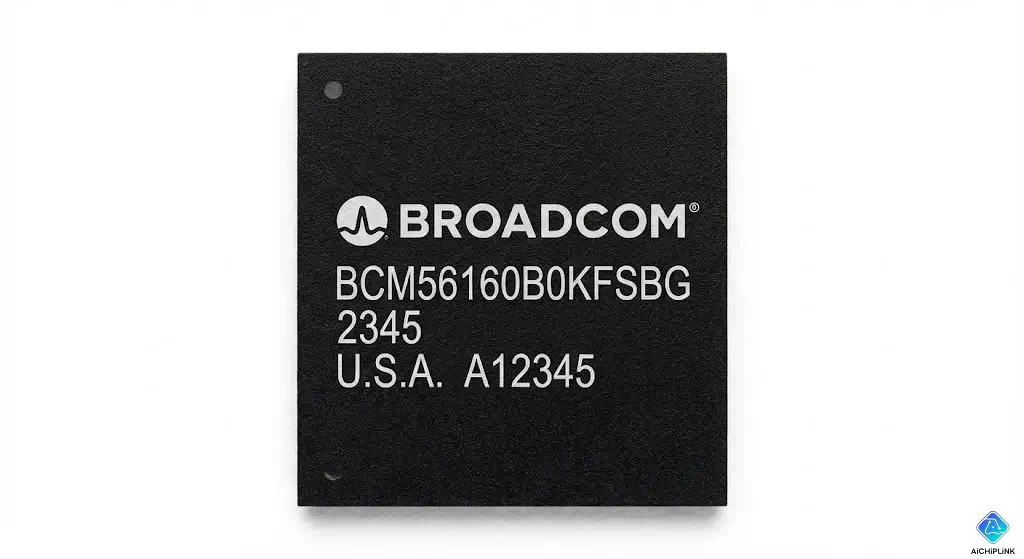
Every few years, a silicon chip comes along that resets the baseline for the entire internet infrastructure. In 2014, that chip was the Broadcom Tomahawk.
The BCM56160B0KFSBG is the specific part number for this legend. It was the first widely adopted merchant silicon to offer 3.2 Tbps of bandwidth on a single chip, effectively making 100GbE the standard connectivity for modern data centers.
If you are maintaining data center hardware, designing white-box switches, or sourcing components for network upgrades, understanding the BCM56160 is essential.
Table of Contents
- Decoding the Part Number: BCM56160B0KFSBG
- Architecture: The 3.2 Tbps Revolution
- Tomahawk vs. Trident: A Fork in the Road
- Key Features: 25G SerDes & Telemetry
- Applications & Availability
- Conclusion
1. Decoding the Part Number: BCM56160B0KFSBG
Broadcom part numbers are precise. Here is the breakdown for this specific SKU:
| Code Segment | Meaning | Detail |
|---|---|---|
| BCM56160 | Base Model | StrataXGS® Tomahawk (TH1). The 3.2 Tbps Switch Series. |
| B0 | Revision | Rev B0. The second silicon stepping. This is the mature, stable version that fixed initial errata found in the A0 samples. |
| K | Temp Grade | Commercial. Designed for standard data center environments (0°C to 70°C). |
| FSBG | Package | Flip-Chip BGA. A high-density package required to route the 128 SerDes lanes. |
2. Architecture: The 3.2 Tbps Revolution
Before the Tomahawk, 100GbE was expensive and required complex multi-chip setups. The BCM56160 changed that by integrating everything into one piece of silicon.
- Switching Capacity: 3.2 Terabits per second.
- Port Density: A single chip supports 32 ports of 100GbE (QSFP28) or 128 ports of 25GbE.
- The "Spine-Leaf" Enabler: This chip allowed network architects to move away from hierarchical 3-tier networks to flat, 2-tier "Spine-Leaf" (Clos) topologies, drastically reducing latency for East-West traffic (server-to-server communication).
3. Tomahawk vs. Trident: A Fork in the Road
Broadcom has two main product lines in the StrataXGS family. It is crucial not to confuse them.
| Feature | Trident II / II+ | Tomahawk (BCM56160) |
|---|---|---|
| Primary Goal | Feature Richness & Buffers | Raw Bandwidth & Radix |
| Max Bandwidth | 960G / 1.28T | 3.2 Tbps |
| Process Node | 40nm / 28nm | 28nm |
| Typical Role | Enterprise / Campus Core | Hyperscale Cloud / AI Fabric |
| Buffer Architecture | Rich, deep buffers | Lean, shared buffers |
Verdict: Choose BCM56160 (Tomahawk) when you need massive throughput for cloud workloads. Choose Trident if you need complex enterprise policy enforcement.
4. Key Features: 25G SerDes & Telemetry
The "Secret Sauce" of the BCM56160 was its SerDes (Serializer/Deserializer) technology.
25G NRZ SerDes
Previous chips used 10G lanes. To build a 100G port, you needed 10 lanes (10x10G), which was messy and power-hungry. The BCM56160 introduced 25G lanes.
- 100G Port = 4 x 25G Lanes.
- This matches the architecture of QSFP28 transceivers, making the entire ecosystem cheaper and more power-efficient.
BroadView™ Telemetry
In hyperscale networks, you can't fix what you can't see. The BCM56160 includes BroadView instrumentation:
- Packet Drop Monitoring: Tells you exactly why and where a packet was dropped.
- Buffer Statistics: Real-time visibility into microbursts, helping to tune QoS for AI and storage traffic.
5. Applications & Availability
Even though Tomahawk 3, 4, and 5 exist today, the Tomahawk 1 (BCM56160) remains a staple.
- Top-of-Rack (ToR) Switches: It is the perfect engine for connecting 25GbE servers to a 100GbE spine.
- White Box Switches: Used extensively in OCP (Open Compute Project) designs like the "Wedge 100".
- Cost-Effective 100G: For networks that don't need 400G/800G yet, the BCM56160 offers the best price-per-port ratio.
6. Conclusion
The Broadcom BCM56160B0KFSBG is the chip that democratized 100 Gigabit Ethernet. Its 3.2T capacity and native 25G SerDes architecture defined the physical layer of the modern cloud. Whether you are repairing legacy gear or deploying cost-effective white-box switches, this silicon remains the gold standard for reliable, high-bandwidth switching.
Sourcing Broadcom Tomahawk Silicon Supply for specific StrataXGS revisions can be tight. Visit Aichiplink.com to check stock and lead times for BCM56160B0KFSBG.

Written by Jack Elliott from AIChipLink.
AIChipLink, one of the fastest-growing global independent electronic components distributors in the world, offers millions of products from thousands of manufacturers, and many of our in-stock parts is available to ship same day.
We mainly source and distribute integrated circuit (IC) products of brands such as Broadcom, Microchip, Texas Instruments, Infineon, NXP, Analog Devices, Qualcomm, Intel, etc., which are widely used in communication & network, telecom, industrial control, new energy and automotive electronics.
Empowered by AI, Linked to the Future. Get started on AIChipLink.com and submit your RFQ online today!
Frequently Asked Questions
1. What is the BCM56160B0KFSBG used for?
It is used in data center Ethernet switches, especially 100GbE top-of-rack (ToR) and spine switches.
2. What does 3.2 Tbps mean in the BCM56160?
It refers to the chip’s total switching capacity, supporting up to 32×100GbE or 128×25GbE ports.
3. Is BCM56160 the same as Broadcom Trident?
No. Tomahawk focuses on maximum bandwidth and port density, while Trident targets enterprise features and deeper buffers.
4. What is special about the 25G SerDes in BCM56160?
The 25G SerDes allows 4×25G lanes to form one 100G port, improving power efficiency and simplifying QSFP28 designs.
5. Is BCM56160B0KFSBG still relevant today?
Yes. Although newer Tomahawk generations exist, it is still widely used for cost-effective 100GbE deployments and legacy data center upgrades.