Executive Summary
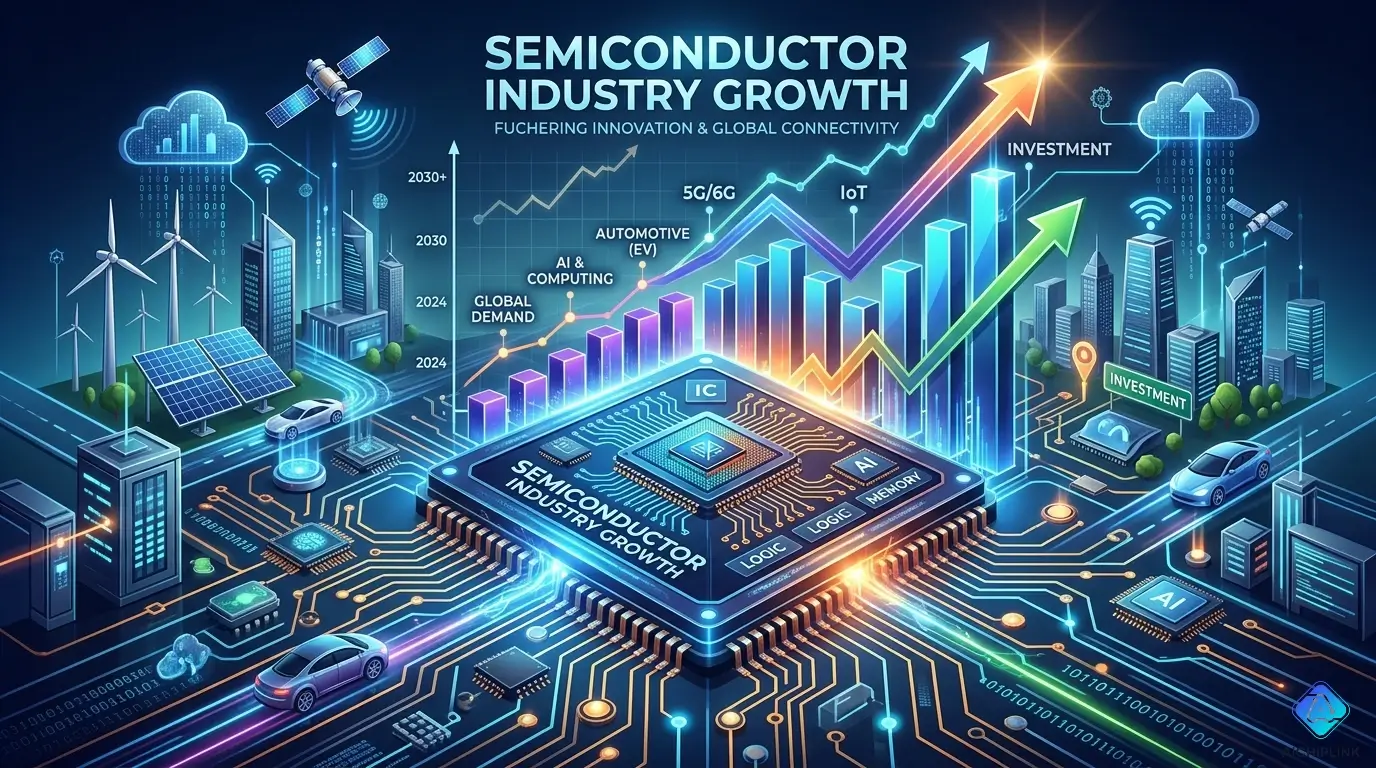
The semiconductor industry is experiencing unprecedented growth in 2026, driven by AI, 5G, automotive electrification, and edge computing.
Key Numbers:
- Market Size: $611 billion (2026) → $1 trillion (2030)
- Growth Rate: 12.8% CAGR (2026-2030)
- AI Chips: Fastest growing segment (+35% YoY)
- Regional Leader: Asia-Pacific (62% market share)
Quick Answer: Best investment opportunities = AI accelerators, advanced packaging, automotive semiconductors, and manufacturing equipment.
Market Overview 2026
Global Semiconductor Revenue
| Year | Revenue | YoY Growth |
|---|---|---|
| 2023 | $527B | -8.2% (downturn) |
| 2024 | $560B | +6.3% (recovery) |
| 2025 | $585B | +4.5% |
| 2026 | $611B | +4.4% ← Current |
| 2027 (est) | $655B | +7.2% |
| 2030 (est) | $1,000B+ | +12% avg |
Key Insight: Post-2023 correction, industry entering sustained growth phase.
Market Drivers 2026
1. AI & Machine Learning (35% YoY growth)
- ChatGPT/LLMs driving GPU demand
- Edge AI chips for smartphones
- Data center buildout accelerating
2. Automotive Electrification (28% YoY)
- EV adoption: 18M units (2026) → 40M (2030)
- ADAS/autonomous driving chips
- In-vehicle computing platforms
3. 5G Infrastructure (15% YoY)
- Global 5G rollout continues
- Network equipment upgrades
- IoT device proliferation
4. High-Performance Computing (22% YoY)
- Cloud computing expansion
- Quantum computing R&D
- Supercomputer upgrades
5. Consumer Electronics (3% YoY)
- Smartphone refresh (modest)
- PC/laptop stabilization
- Wearables growth
Investment Opportunities by Segment
Opportunity 1: AI Accelerators ⭐ HOTTEST
Market Size: $65B (2026) → $175B (2030) CAGR: 28%
Key Players:
- NVIDIA: Dominant (80% data center GPU share)
- AMD: Growing alternative (MI300 competitive)
- Google: TPU v5 for cloud AI
- Intel: Gaudi 3 AI chips
- Startups: Cerebras, Graphcore, SambaNova
Investment Thesis:
AI training demand: Exponential growth
ChatGPT-4 training: 25,000 GPUs
GPT-5 estimate: 50,000+ GPUs needed

Inference at edge: Every smartphone getting AI chip
Apple A18: 35 TOPS AI performance
Qualcomm 8 Gen 4: 45 TOPS
Risks:
- High competition
- NVIDIA dominance hard to displace
- Export controls (US-China)
Verdict: High risk, high reward. ⭐⭐⭐⭐⭐
Opportunity 2: Advanced Packaging
Market Size: $45B (2026) → $85B (2030) CAGR: 17%
Technology Trends:
- Chiplet architecture: Disaggregated designs
- 3D stacking: HBM memory, logic layers
- Advanced interconnect: UCIe standard adoption
Key Players:
- TSMC: CoWoS, SoIC packaging
- Intel: Foveros, EMIB
- Samsung: X-Cube, I-Cube
- ASE, Amkor: OSAT leaders
Why Hot:
Moore's Law slowing → Packaging becomes differentiator
AMD MI300: 8 chiplets + 8 HBM stacks
Apple M3 Ultra: 2 dies interconnected

Cost: 30% cheaper than monolithic
Performance: Same or better
Verdict: Lower risk, steady growth. ⭐⭐⭐⭐
Opportunity 3: Automotive Semiconductors
Market Size: $82B (2026) → $135B (2030) CAGR: 13%
Sub-Segments:
- Power semiconductors (EV inverters, chargers)
- MCUs (vehicle control, ADAS)
- Sensors (LiDAR, radar, cameras)
- Connectivity (V2X, cellular)
Key Players:
- Infineon: Market leader (power semis)
- NXP: MCU specialist
- Texas Instruments: Analog dominance
- STMicroelectronics: Diversified portfolio
- ON Semi: SiC power devices
Investment Thesis:
EV penetration: 12% (2023) → 25% (2026) → 50% (2030)
Semiconductor value per car:
- ICE vehicle: $500
- Hybrid: $1,200
- Full EV: $2,000+
- Autonomous EV: $3,500+

Market expansion: Price × Volume both growing
Risks:
- EV adoption slower than expected
- Chinese competition (BYD, CATL vertical integration)
Verdict: Moderate risk, strong fundamentals. ⭐⭐⭐⭐
Opportunity 4: Manufacturing Equipment
Market Size: $108B (2026) → $125B (2030) CAGR: 4%
Key Players:
- ASML: EUV lithography monopoly
- Applied Materials: Deposition, etching
- Lam Research: Etch specialist
- Tokyo Electron: Coating, develop
- KLA: Inspection, metrology
Why Still Hot (Despite Mature Market):
Advanced nodes: 3nm → 2nm → A14 (1.4nm equivalent)
Each node: New equipment generation needed

ASML EUV machines:
- Price: $350M each
- Lead time: 18 months
- Backlog: 2+ years

China capacity expansion: Despite restrictions, buying mature tools
Investment Thesis:
- ASML: Safe bet, monopoly position
- Applied Materials: Diversified, China exposure
- KLA: Growing importance (yield critical at advanced nodes)
Verdict: Low risk, steady dividends. ⭐⭐⭐
Opportunity 5: Memory (Selective)
Market Size: $155B (2026) → $195B (2030) CAGR: 6%
Segments:
- DRAM: Cyclical, avoid for now ⚠️
- NAND: Oversupplied, weak pricing ⚠️
- HBM (High-Bandwidth Memory): ⭐ STRONG BUY
HBM Focus:
AI demand driving HBM:
- H100 GPU: 80GB HBM3 required
- MI300: 128GB HBM3
- TPU v5: 96GB HBM2e

HBM Market:
2023: $4B
2026: $15B ← Current
2030: $35B (projected)

Suppliers (limited):
- SK Hynix: 50% share (leader)
- Samsung: 40% share
- Micron: 10% share (ramping)
Investment Thesis: HBM only, avoid commodity DRAM/NAND.
Verdict: HBM = ⭐⭐⭐⭐⭐, Commodity = ⭐⭐
Regional Analysis
Asia-Pacific: 62% Market Share
China ($215B market):
- Strengths: Huge demand, government support
- Weaknesses: Technology lag, export restrictions
- Opportunities: Mature node capacity, domestic substitution
- Key Players: SMIC, Hua Hong, YMTC
Taiwan ($85B market):
- Strengths: TSMC dominance (60% foundry share)
- Weaknesses: Geopolitical risk
- Opportunities: Advanced packaging, 2nm leadership
- Key Players: TSMC, MediaTek, ASE
South Korea ($95B market):
- Strengths: Memory leadership (Samsung, SK Hynix)
- Weaknesses: Commodity cycle exposure
- Opportunities: HBM, foundry growth (Samsung)
- Key Players: Samsung, SK Hynix
Japan ($45B market):
- Strengths: Materials, equipment
- Weaknesses: Fab competitiveness declining
- Opportunities: Partnerships (Rapidus 2nm), materials innovation
- Key Players: Tokyo Electron, Sony, Renesas
Americas: 22% Market Share
United States ($135B market):
- Strengths: Design leadership (fabless), equipment
- Weaknesses: Manufacturing mostly offshore
- Opportunities: CHIPS Act reshoring, AI leadership
- Key Players: Intel, NVIDIA, AMD, Qualcomm, Broadcom
CHIPS Act Impact:
$52B funding allocation (2022-2026):
- Intel: $8.5B (Ohio, Arizona fabs)
- TSMC: $6.6B (Arizona fab)
- Samsung: $6.4B (Texas fab)
- Micron: $6.1B (NY fab)

Expected outcome:
- 20 new fabs by 2030
- US fab share: 12% → 18%
Europe: 10% Market Share
Market Size: $61B (2026)
Strengths: Automotive, power semiconductors Weaknesses: Limited advanced logic, small market Opportunities: EU Chips Act (€43B), strategic autonomy
Key Players:
- Infineon (Germany): Power semis leader
- STMicroelectronics (France/Italy): Diversified IDM
- NXP (Netherlands): Automotive MCUs
- ASML (Netherlands): EUV monopoly
EU Chips Act Projects:
- Intel fab in Germany (€30B investment)
- TSMC fab in Dresden (€10B)
- Bosch expansion (power semis)
Technology Trends Driving Growth
Trend 1: AI Everywhere
Impact: Every device getting AI capabilities
Examples:
Smartphones:
- Apple A18: 35 TOPS neural engine
- Snapdragon 8 Gen 4: 45 TOPS AI
- Use: Real-time translation, photo enhancement, voice

PCs:
- Intel Meteor Lake: NPU integrated
- AMD Ryzen AI: Dedicated AI block
- Use: Windows Copilot, creative apps

Edge Devices:
- Smart cameras: Object recognition
- Drones: Navigation AI
- Wearables: Health monitoring
Semiconductor Demand: +$25B annually from AI edge chips
Trend 2: Chiplet Disaggregation
What: Breaking monolithic chips into smaller "chiplets"
Benefits:
- Lower cost (higher yield)
- Mix-and-match technologies
- Faster innovation cycles
Adoption:
AMD EPYC: Up to 12 chiplets
Intel Sapphire Rapids: 4 tiles
Apple M3 Ultra: 2-die design

UCIe Standard: Universal Chiplet Interconnect
- Intel, AMD, TSMC, Samsung backing
- Enables cross-vendor chiplets
Investment Angle: Advanced packaging companies (TSMC, ASE, Amkor)
Trend 3: Automotive Silicon Content Explosion
2026 Average Semiconductor Value per Vehicle:
Entry Car: $450
Mid-Range: $850
Luxury ICE: $1,200
Hybrid: $1,500
EV (Tesla Model 3): $2,100
Luxury EV (Mercedes EQS): $2,800
Autonomous (Waymo): $3,500+
Growth Drivers:
- Electrification: Inverters, DC-DC, chargers
- ADAS: Radar, cameras, LiDAR, computing
- Connectivity: 5G, V2X, WiFi, Bluetooth
- Infotainment: Displays, audio, processors
Trend 4: Geopolitical Reshoring
US-China Decoupling:
Export controls tightening:
- Advanced GPUs (A100, H100) banned to China
- EUV tools banned
- Advanced fab equipment restricted

China response:
- Domestic substitution push
- Mature node capacity expansion
- Stockpiling legacy chips
Investment Impact:
- US/Allied fabs: Capacity expansion
- China: Mature node glut risk
- Equipment: Bifurcated market
Risk Factors
Risk 1: Cyclicality
Historical Pattern:
Boom-Bust Cycles:
2000-2001: Dot-com crash (-32%)
2008-2009: Financial crisis (-12%)
2018-2019: Trade war slowdown (-12%)
2022-2023: Inventory correction (-8%)

2026: Mid-cycle (moderate growth)
Mitigation: Diversify across segments, avoid commodity memory
Risk 2: Geopolitical Tensions
Taiwan Risk:
- 60% of world's chips made in Taiwan
- China reunification tensions
- Supply chain vulnerability
Mitigation: Geographic diversification (US, Europe, Japan fabs)
Risk 3: Technology Disruption
Moore's Law Slowing:
- 2nm node: $20B development cost
- Gate-all-around transistors (GAA): Complex
- EUV multi-patterning: Expensive
Alternative Approaches:
- Chiplets (already happening)
- 3D stacking (emerging)
- New materials (graphene, carbon nanotubes - far future)
Investment Impact: Favor packaging over pure-play foundries
Risk 4: Demand Volatility
2023 Correction Lessons:
Post-COVID demand normalization:
- PC shipments: -28% (2023)
- Smartphone: -12% (2023)
- Inventory buildup: 6 months excess

Recovery: 2024-2025
Stabilization: 2026 ← Current
2026 Demand Outlook: Stable but modest consumer, strong AI/auto
Investment Strategies
Strategy 1: Pure AI Play (High Risk/Reward)
Portfolio:
- 40% NVIDIA (dominant position)
- 30% AMD (growing alternative)
- 20% Broadcom (custom AI chips, networking)
- 10% AI startups (Cerebras, SambaNova via VC)
Expected Return: 25-35% annually Risk Level: High ⚠️
Strategy 2: Picks and Shovels (Moderate Risk)
Portfolio:
- 30% ASML (EUV monopoly)
- 25% Applied Materials (diversified equipment)
- 20% Lam Research (etch leader)
- 15% KLA (inspection growing importance)
- 10% Tokyo Electron (Japan exposure)
Expected Return: 12-18% annually Risk Level: Moderate
Strategy 3: Automotive Focus (Moderate-Low Risk)
Portfolio:
- 30% Infineon (power semiconductor leader)
- 25% NXP (automotive MCU specialist)
- 20% Texas Instruments (analog strength)
- 15% ON Semiconductor (SiC devices)
- 10% STMicroelectronics (diversified)
Expected Return: 10-15% annually Risk Level: Moderate-Low
Strategy 4: Diversified Foundry (Low-Moderate Risk)
Portfolio:
- 50% TSMC (technology leader, 60% foundry share)
- 30% Samsung (memory + foundry)
- 20% GlobalFoundries (mature nodes, automotive)
Expected Return: 8-12% annually Risk Level: Low-Moderate
Strategy 5: Index/ETF (Lowest Risk)
Options:
- SOXX: iShares Semiconductor ETF (broad)
- SMH: VanEck Semiconductor ETF (top holdings)
- PSI: Invesco Dynamic Semiconductors
Expected Return: 10-14% annually Risk Level: Low (diversified)
2026-2030 Forecast
Market Projections
| Segment | 2026 | 2030 | CAGR |
|---|---|---|---|
| AI Chips | $65B | $175B | 28% ⭐ |
| Automotive | $82B | $135B | 13% |
| Memory | $155B | $195B | 6% |
| Analog/Power | $78B | $95B | 5% |
| Logic | $142B | $210B | 10% |
| Sensors | $32B | $48B | 11% |
| Discretes | $28B | $35B | 6% |
| Optoelectronics | $49B | $62B | 6% |
| TOTAL | $611B | $1,000B | 13% |
Key Predictions
By 2030:
- AI chips = #1 growth segment (28% CAGR)
- Automotive = 15% of total market (up from 13% in 2026)
- Advanced packaging = Standard for high-performance chips
- China = 30% global capacity (up from 22%, mostly mature nodes)
- HBM = $35B market (from $15B in 2026)
- 2nm node = Mainstream in smartphones
- Chiplet architecture = 50% of high-end processors
- US fab share = 18% (from 12% in 2023)
Conclusion
The semiconductor industry in 2026 stands at an inflection point, transitioning from post-correction recovery to sustained AI-driven growth. With market size projected to reach $1 trillion by 2030, strategic investment opportunities abound.
Top Investment Priorities:
- ⭐⭐⭐⭐⭐ AI accelerators (highest growth, highest risk)
- ⭐⭐⭐⭐ Advanced packaging (strong growth, lower risk)
- ⭐⭐⭐⭐ Automotive semiconductors (steady growth, demographic tailwind)
- ⭐⭐⭐⭐ HBM memory (niche but explosive growth)
- ⭐⭐⭐ Manufacturing equipment (stable, defensive)
Risk Management:
- Diversify across segments (AI + automotive + equipment)
- Geographic spread (US, Taiwan, Europe)
- Balance growth vs. value (NVIDIA + Infineon)
- Monitor geopolitical developments (Taiwan, China)
2026 Outlook: Positive fundamentals, moderate growth, AI as primary catalyst.
For investment analysis, market reports, and semiconductor insights, visit AiChipLink.com.

Written by Jack Elliott from AIChipLink.
AIChipLink, one of the fastest-growing global independent electronic components distributors in the world, offers millions of products from thousands of manufacturers, and many of our in-stock parts is available to ship same day.
We mainly source and distribute integrated circuit (IC) products of brands such as Broadcom, Microchip, Texas Instruments, Infineon, NXP, Analog Devices, Qualcomm, Intel, etc., which are widely used in communication & network, telecom, industrial control, new energy and automotive electronics.
Empowered by AI, Linked to the Future. Get started on AIChipLink.com and submit your RFQ online today!
Frequently Asked Questions
What is driving semiconductor industry growth in 2026?
The main drivers are AI chips, automotive electrification, 5G infrastructure, and cloud computing, with AI alone growing over 30% annually.
Which semiconductor segment has the highest investment potential?
AI accelerators and HBM memory offer the highest growth potential, while advanced packaging and automotive semiconductors provide more stable long-term returns.
Is the semiconductor industry still cyclical in 2026?
Yes, the industry remains cyclical, but AI demand and automotive growth are reducing volatility, creating a more stable long-term growth trend.
What are the biggest risks for semiconductor investors?
Key risks include geopolitical tensions (U.S.–China, Taiwan), market cyclicality, supply chain disruptions, and technology cost escalation at advanced nodes.
Which companies dominate the semiconductor industry in 2026?
Leaders include NVIDIA (AI chips), TSMC (manufacturing), ASML (equipment), and Samsung Electronics (memory & logic).