Introduction
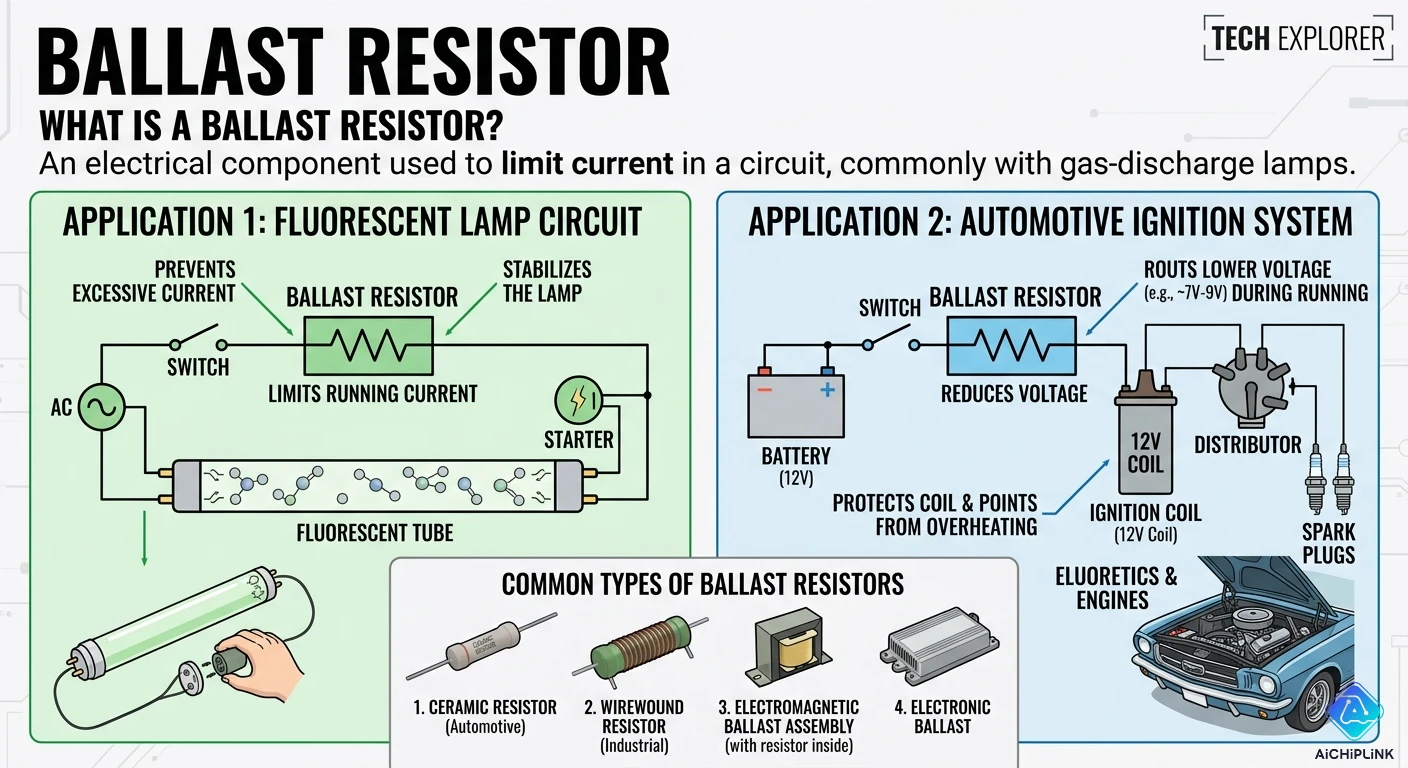
A ballast resistor is a resistor used to limit current flow in a circuit, preventing excessive current that could damage components or cause unstable operation. Unlike standard resistors that simply drop voltage, ballast resistors are specifically designed to maintain stable current despite variations in supply voltage or load characteristics. Common applications include LED current limiting, automotive ignition systems, fluorescent lamp ballasts, and transistor bias circuits. This comprehensive guide explains what ballast resistors are, how they function, their types, practical applications, and how to calculate the correct value for your circuit.
Definition & Basic Function
What is a Ballast Resistor?
A ballast resistor is a current-limiting resistor that stabilizes current flow in a circuit by compensating for variations in supply voltage or load resistance.
Key Characteristics:
- Primary function: Current regulation (not just voltage drop)
- Behavior: Resistance increases with temperature (positive temperature coefficient in some types)
- Purpose: Prevent runaway current, stabilize operation
- Common values: 10Ω - 10kΩ (application-dependent)
Simple Analogy: Think of a ballast resistor as a speed governor on a car—it prevents the engine (current) from running too fast regardless of how much you press the gas pedal (voltage).
Ballast Resistor vs Regular Resistor
| Feature | Ballast Resistor | Regular Resistor |
|---|---|---|
| Primary Purpose | Current stabilization | Voltage division, signal conditioning |
| Temperature Effect | Often positive coefficient (increases with heat) | Usually negative or neutral |
| Power Rating | Typically higher (2W-50W) | Lower (1/4W-2W typical) |
| Application | Current limiting circuits | General electronics |
| Self-Regulation | Yes (in some types) | No |
How Ballast Resistors Work
Basic Operating Principle
Ohm's Law Application:
I = (V_supply - V_load) / R_ballast

Where:
I = Current through circuit
V_supply = Supply voltage
V_load = Voltage across load
R_ballast = Ballast resistance
Current Limiting Mechanism:
Circuit without ballast:
V_supply ──→ [Load] → High current (potentially damaging)

Circuit with ballast:
V_supply ──→ [Ballast Resistor] ──→ [Load] → Controlled current
Self-Regulating Behavior (Positive Temperature Coefficient)
Some ballast resistors use positive temperature coefficient (PTC) material:
How it works:
- Increased current → Resistor heats up
- Higher temperature → Resistance increases (PTC effect)
- Higher resistance → Current decreases
- System stabilizes at equilibrium point
Benefit: Automatic current regulation without active control
Example Material: Tungsten wire (used in incandescent lamp ballasts)
Voltage Drop & Power Dissipation
Voltage Drop:
V_drop = I × R_ballast

Example:
I = 20mA, R = 100Ω
V_drop = 0.02A × 100Ω = 2V
Power Dissipation:
P = I² × R_ballast

Example:
I = 20mA, R = 100Ω
P = (0.02)² × 100 = 0.04W = 40mW

Select resistor rated ≥2× calculated power (safety margin)
→ Use 1/8W (125mW) or 1/4W (250mW) resistor
Types of Ballast Resistors
1. Fixed Ballast Resistors
Description: Standard resistors with constant resistance value
Materials:
- Carbon composition
- Metal film
- Wire-wound (high power)
Applications:
- LED current limiting
- Transistor base bias
- Voltage regulator loads
Example:
5V ──[220Ω]── LED (2V, 20mA) ── GND

Calculation:
R = (5V - 2V) / 0.02A = 150Ω (use 220Ω standard value)
2. PTC (Positive Temperature Coefficient) Ballast Resistors
Description: Resistance increases with temperature
Operation:
- Cold: Low resistance → Higher current
- Hot: High resistance → Lower current
- Self-limiting behavior
Applications:
- Automotive ignition systems (classic cars)
- Motor starting circuits
- Lamp ballasts
Advantages:
- Self-regulating current
- Automatic overcurrent protection
3. Wire-Wound Ballast Resistors
Description: High-power resistors using resistive wire (often tungsten)
Characteristics:
- Power handling: 5W-100W+
- Positive temperature coefficient (tungsten)
- Rugged construction
Applications:
- High-current circuits
- Industrial equipment
- Power supply loads
Common Applications
Application 1: LED Current Limiting
Most Common Ballast Resistor Use
Circuit:
V_supply ──[R_ballast]── LED ── GND

Calculation:
R = (V_supply - V_LED) / I_LED

Example (Red LED):
V_supply = 12V
V_LED = 2.0V (typical red LED forward voltage)
I_LED = 20mA (desired current)

R = (12V - 2V) / 0.02A = 500Ω
P = (0.02A)² × 500Ω = 0.2W

Select: 510Ω (standard E12 value), 1/2W resistor
Multiple LEDs:
Series connection:
12V ──[R]── LED1 ── LED2 ── LED3 ── GND

R = (12V - 3×2V) / 0.02A = (12V - 6V) / 0.02A = 300Ω
Use: 330Ω, 1/2W
Parallel connection (each needs own resistor):
      ┌─[R1]─ LED1 ─┐
12V ──┼─[R2]─ LED2 ─┼── GND
      └─[R3]─ LED3 ─┘
Application 2: Automotive Ignition Systems
Classic car ignition coils (pre-1980s)
Function:
- Limits current to ignition coil
- Protects points from burning
- Voltage compensation during cranking
Typical Value: 0.8Ω - 2.0Ω (wire-wound, high power)
Circuit:
+12V ── [Ballast Resistor 1.5Ω] ── [Ignition Coil] ── [Points] ── GND
Modern systems: Electronic ignition modules replace ballast resistors
Application 3: Fluorescent Lamp Ballasts
Traditional magnetic ballasts use inductive + resistive elements
Function:
- Limits starting current
- Regulates operating current
- Provides high starting voltage
Modern alternative: Electronic ballasts (more efficient, no resistive ballast needed)
Application 4: Transistor Bias Circuits
Base resistor acts as ballast
Circuit:
V_supply ──[R_ballast]── Base (NPN transistor)
                          │
                       Emitter ── GND

Function: Limits base current, sets operating point
Application 5: Voltage Regulator Dummy Load
Ensures minimum load current for stability
Circuit:
[Voltage Regulator] ──┬── [R_ballast to GND]
                      │
                      └── Output (to actual load)

Purpose: Prevent regulator instability with no load
Typical value: 100Ω - 1kΩ
Calculation & Selection Guide
Step-by-Step Calculation
Example: LED Current Limiting
Given:
- Supply voltage: V_s = 9V
- LED forward voltage: V_f = 2.2V (typical green LED)
- Desired LED current: I_LED = 15mA
Step 1: Calculate Required Resistance
R = (V_s - V_f) / I_LED
R = (9V - 2.2V) / 0.015A
R = 6.8V / 0.015A
R = 453Ω
Step 2: Select Standard Value
Standard E12 values: ..., 390Ω, 470Ω, 560Ω, ...
Closest: 470Ω (within 5%)
Step 3: Calculate Actual Current (with 470Ω)
I_actual = (9V - 2.2V) / 470Ω = 14.5mA ✓
(Close to desired 15mA)
Step 4: Calculate Power Rating
P = I² × R
P = (0.0145A)² × 470Ω
P = 0.099W ≈ 100mW

Safety margin (2×): 200mW minimum
Select: 1/4W (250mW) resistor ✓
Selection Criteria
1. Resistance Value:
- Calculate based on desired current
- Choose nearest standard value (E12 or E24 series)
2. Power Rating:
- Calculate P = I² × R
- Select resistor rated ≥2× calculated power
3. Tolerance:
- ±5% (E12 series) sufficient for most applications
- ±1% (E96 series) for precision circuits
4. Temperature Coefficient:
- Standard resistors: ±100 ppm/°C typical
- Precision resistors: ±25 ppm/°C or better
5. Physical Size:
- Through-hole: 1/4W typical, 1/2W for higher power
- SMD: 0805, 1206 common; 2512 for high power
Advantages & Disadvantages
Advantages
✅ Simple: No active components, easy design
✅ Reliable: Passive component, no failure modes
✅ Inexpensive: Pennies per resistor
✅ Universal: Works with any DC voltage
✅ No EMI: No switching noise (vs switching regulators)
Disadvantages
❌ Inefficient: Power wasted as heat (P = I² × R)
❌ Voltage-dependent: Current changes if supply voltage varies
❌ Poor regulation: ±10-20% current variation typical
❌ Heat dissipation: Requires thermal management for high power
❌ Not scalable: Inefficient for high-current applications
Ballast Resistor vs Alternatives
| Method | Efficiency | Complexity | Cost | Best For |
|---|---|---|---|---|
| Ballast Resistor | Low (50-80% loss) | Simple | $ | Low current (<100mA), non-critical |
| Linear Regulator | Medium (60-90%) | Medium | $$ | Regulated voltage, low noise |
| Switching Regulator | High (85-95%+) | Complex | $$$ | High current, battery-powered |
| Constant Current Driver | High (90%+) | Medium | $$ | Precise LED control, multi-LED |
When to Use Ballast Resistor:
- Simple, low-cost circuits
- Low-current applications (<100mA)
- Non-critical current tolerance (±10-20% acceptable)
- Minimal component count preferred
When to Use Alternatives:
- High current (>100mA) → Switching regulator
- Precise current control → Constant current driver
- Battery-powered → Linear or switching regulator (efficiency matters)
Conclusion
A ballast resistor is a current-limiting resistor used to stabilize current flow in circuits, preventing component damage and ensuring stable operation. While simple and inexpensive, ballast resistors are inefficient due to power dissipation as heat—making them ideal for low-current applications (LEDs, bias circuits) but poor choices for high-power or efficiency-critical designs where switching regulators or constant-current drivers are superior.
Key Takeaways:
✅ Function: Limits current by dropping excess voltage
✅ Calculation: R = (V_supply - V_load) / I_desired
✅ Power rating: Select ≥2× calculated power dissipation
✅ Common uses: LED current limiting, ignition systems, lamp ballasts
✅ Advantages: Simple, cheap, reliable
✅ Disadvantages: Inefficient, poor regulation, heat dissipation
✅ Alternatives: Linear/switching regulators for efficiency, constant-current drivers for precision
Designing circuits with ballast resistors? Visit AiChipLink.com for resistor selection guidance, circuit design consultation, and component sourcing.

Written by Jack Elliott from AIChipLink.
AIChipLink, one of the fastest-growing global independent electronic components distributors in the world, offers millions of products from thousands of manufacturers, and many of our in-stock parts is available to ship same day.
We mainly source and distribute integrated circuit (IC) products of brands such as Broadcom, Microchip, Texas Instruments, Infineon, NXP, Analog Devices, Qualcomm, Intel, etc., which are widely used in communication & network, telecom, industrial control, new energy and automotive electronics.
Empowered by AI, Linked to the Future. Get started on AIChipLink.com and submit your RFQ online today!
Frequently Asked Questions
What is a ballast resistor used for?
A ballast resistor is used to limit and stabilize current in an electrical circuit, protecting components from overcurrent and ensuring stable operation. It is commonly used in LED circuits, automotive ignition systems, fluorescent lighting, and transistor biasing, where controlling current is essential for performance and reliability.
How do you calculate a ballast resistor for an LED?
A ballast resistor for an LED is calculated using the formula R = (V_supply − V_LED) / I_LED, which determines the resistance needed to safely limit current. By selecting the correct resistance and power rating, the resistor ensures the LED operates within its safe current range.
What's the difference between a ballast resistor and a regular resistor?
There is no physical difference between a ballast resistor and a regular resistor, as “ballast” refers to the function of limiting current rather than a specific component type. However, ballast resistors are typically chosen with higher power ratings and sometimes special characteristics for stability.
Why do ballast resistors fail?
Ballast resistors usually fail due to excessive heat, overcurrent, or environmental stress. Common causes include insufficient power rating, voltage spikes, poor cooling, mechanical damage, or moisture, all of which can lead to overheating and eventual failure.
Can I use a resistor instead of a ballast resistor?
Yes, any resistor can function as a ballast resistor if it has the correct resistance value and power rating. The key requirement is that it can safely handle the current and power dissipation in the circuit, making standard resistors suitable for most applications like LED current limiting.