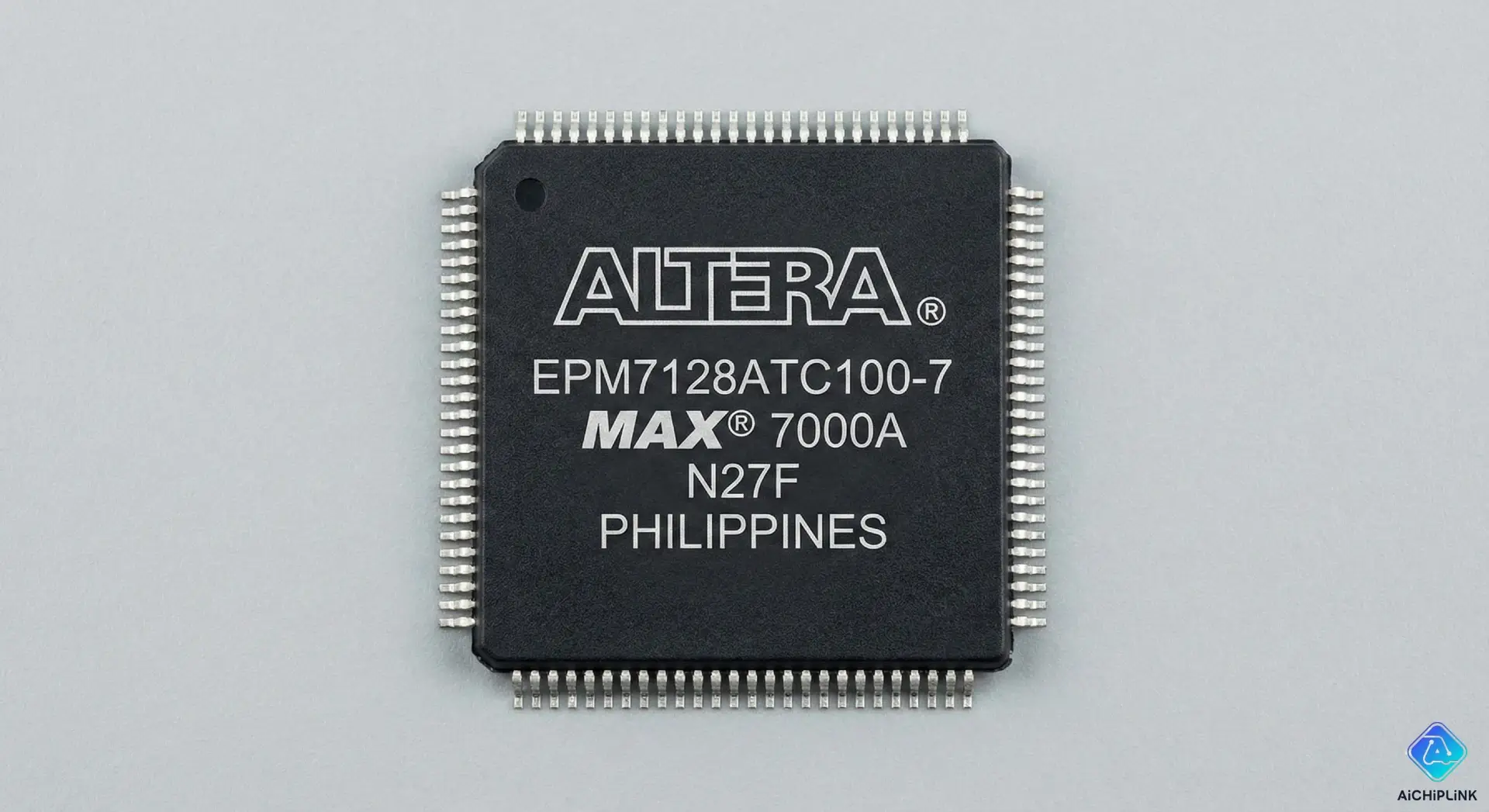
In the landscape of programmable logic, the Altera (now Intel) MAX® 7000A series occupies a crucial sweet spot. Bridging the gap between legacy 5V systems and modern 3.3V low-power designs, the EPM7128ATC100-7 is one of the most versatile CPLDs (Complex Programmable Logic Devices) ever produced.
With 128 Macrocells and a fast 7.5ns propagation delay, this chip is widely used in industrial controllers, communication backplanes, and legacy system replication. This guide provides a comprehensive technical breakdown of the EPM7128ATC100-7, helping you navigate its datasheet, pinout, and programming requirements.
EPM7128ATC100-7 Datasheet & Key Specs
The part number EPM7128ATC100-7 reveals the device's core characteristics:
- EPM7: MAX 7000 Family.
- 128: 128 Macrocells (Logic Capacity).
- A: 3.3V High-Performance Core.
- T: TQFP (Thin Quad Flat Pack) package.
- C: Commercial Temperature range (0°C to 70°C).
- 100: 100 Pins.
- -7: 7.5 ns Speed Grade (fastest in the series).
Key Specifications Table
| Feature | Specification |
|---|---|
| Macrocells | 128 |
| Logic Array Blocks (LABs) | 8 |
| Usable Gates | ~2,500 |
| Max User I/O | 84 |
| Core Voltage ($V_{CCINT}$) | 3.3V |
| I/O Voltage ($V_{CCIO}$) | 3.3V or 2.5V |
| Prop. Delay ($t_{PD}$) | 7.5 ns |
| Package | 100-pin TQFP |
The "A" Series Advantage: 3.3V Core & 5V Tolerance
The "A" suffix is critical. Unlike the older "S" series (which required a 5V core), the MAX 7000A operates on a 3.3V core.
- 5V Tolerant Inputs: Crucially, the inputs can safely accept 5V signals. This makes the EPM7128A an excellent level shifter or glue logic interface between modern 3.3V MCUs (like STM32) and legacy 5V peripherals.
- MultiVolt I/O: The I/O pins can be powered by 3.3V or 2.5V ($V_{CCIO}$), allowing flexibility in interface standards. For a deeper understanding of logic levels, refer to the EEPower Guide on Logic Voltage Levels.
Price Analysis & Stock Availability
As a legacy component, stock can be volatile.
Note: Sourcing verified CPLDs is essential to ensure programming reliability. [Check Stock for EPM7128ATC100-7 at Aichiplink] to view inventory from global distributors.
TQFP100 Package Pinout & PCB Design
The TQFP100 is a surface-mount package offering a high I/O count in a 14x14mm body size (16x16mm with leads).
Power Management: VCCINT vs VCCIO
Designing the power distribution network (PDN) requires attention to two distinct voltage rails:
- $V_{CCINT}$ (Pins 3, 18, 34, etc.): Must be connected to a clean 3.3V supply for the internal logic.
- $V_{CCIO}$ (Pins 11, 26, 43, etc.): Powers the output drivers. Connect to 3.3V for 5V/3.3V systems, or 2.5V for lower voltage systems.
- Grounding: Ensure all GND pins connect to a solid ground plane to minimize ground bounce during high-speed switching (7.5ns).
TQFP100 Footprint Dimensions
- Pitch: 0.5 mm.
- Handling: The 0.5mm pitch requires precise soldering. If hand-soldering, use plenty of flux and a drag-soldering technique.
Comparison: EPM7128A vs. EPM7128S
Engineers often confuse the "A" and "S" variants. They are not drop-in replacements.
| Feature | EPM7128S (Standard) | EPM7128A (Advanced) |
|---|---|---|
| Core Voltage | 5.0V | 3.3V |
| Process | 0.5/0.65 micron | 0.35 micron (EEPROM) |
| Speed Grade | Slow (typically -10, -15) | Fast (up to -5, -7) |
| Power | High | Low (Reduced) |
Warning: If you place an EPM7128A into a socket designed for an EPM7128S (supplied with 5V), you will destroy the chip. The board must regulate the core voltage down to 3.3V.
Programming Guide: JTAG & Software
The EPM7128A utilizes EEPROM technology, making it non-volatile (retains configuration after power loss) and "Instant-On."
Required Software: Quartus II 13.0sp1
Modern Intel Quartus Prime versions (v17, v21, etc.) removed support for the MAX 7000 series.
- Solution: You must download Quartus II Web Edition 13.0sp1. This is the last version to support legacy CPLDs. It is available for free on the Intel website (requires account).
JTAG Chain Setup
Programming is done via the 4-wire JTAG interface (TCK, TMS, TDI, TDO).
- Hardware: Use an Altera USB-Blaster (or compatible clone).
- Pin Connections:
- TCK: Pin 62
- TDO: Pin 73
- TMS: Pin 15
- TDI: Pin 4
- Pull-ups: Ensure weak pull-up resistors (1k-10k) are on TMS and TDI to prevent floating during startup.
Conclusion
The EPM7128ATC100-7 remains a legendary component for engineers needing a robust, instant-on logic solution that plays nicely with both 5V and 3.3V worlds. Its combination of 128 macrocells and 7.5ns speed makes it perfect for interface bridging and complex glue logic.
Securing Legacy CPLDs Don't let obsolescence stop your maintenance or production. Visit Aichiplink.com to search for EPM7128ATC100-7 and other Altera MAX 7000 series CPLDs.

Written by Jack Elliott from AIChipLink.
AIChipLink, one of the fastest-growing global independent electronic components distributors in the world, offers millions of products from thousands of manufacturers, and many of our in-stock parts is available to ship same day.
We mainly source and distribute integrated circuit (IC) products of brands such as Broadcom, Microchip, Texas Instruments, Infineon, NXP, Analog Devices, Qualcomm, Intel, etc., which are widely used in communication & network, telecom, industrial control, new energy and automotive electronics.
Empowered by AI, Linked to the Future. Get started on AIChipLink.com and submit your RFQ online today!
Frequently Asked Questions
Can I use the EPM7128ATC100-10 instead of -7?
Yes, the "-10" is the slower speed grade (10ns delay vs 7.5ns). It is functionally identical but slower. If your design timing is critical (e.g., high-speed counters \> 100MHz), stick with the -7. If timing is relaxed, the -10 is a suitable, often cheaper substitute.
Does this chip require an external configuration memory?
No. The MAX 7000A series uses internal EEPROM. It stores its own configuration and is ready immediately upon power-up, unlike FPGAs (like Cyclone) which need external EPCS flash.
What is the maximum frequency ($f_{MAX}$)?
For the -7 speed grade, the global clock setup time supports internal frequencies up to approximately **125-150 MHz**, depending on the complexity of the logic (counters vs complex state machines).
Is the pinout compatible with EPM7128S?
The signal pins are largely compatible, but the **power pins differ in voltage requirements**. You cannot swap them without modifying the power supply circuit on the PCB.
Can I program it with Verilog?
Yes, Quartus II 13.0sp1 supports full Verilog and VHDL entry for the MAX 7000A series, as well as schematic capture (Block Design File).