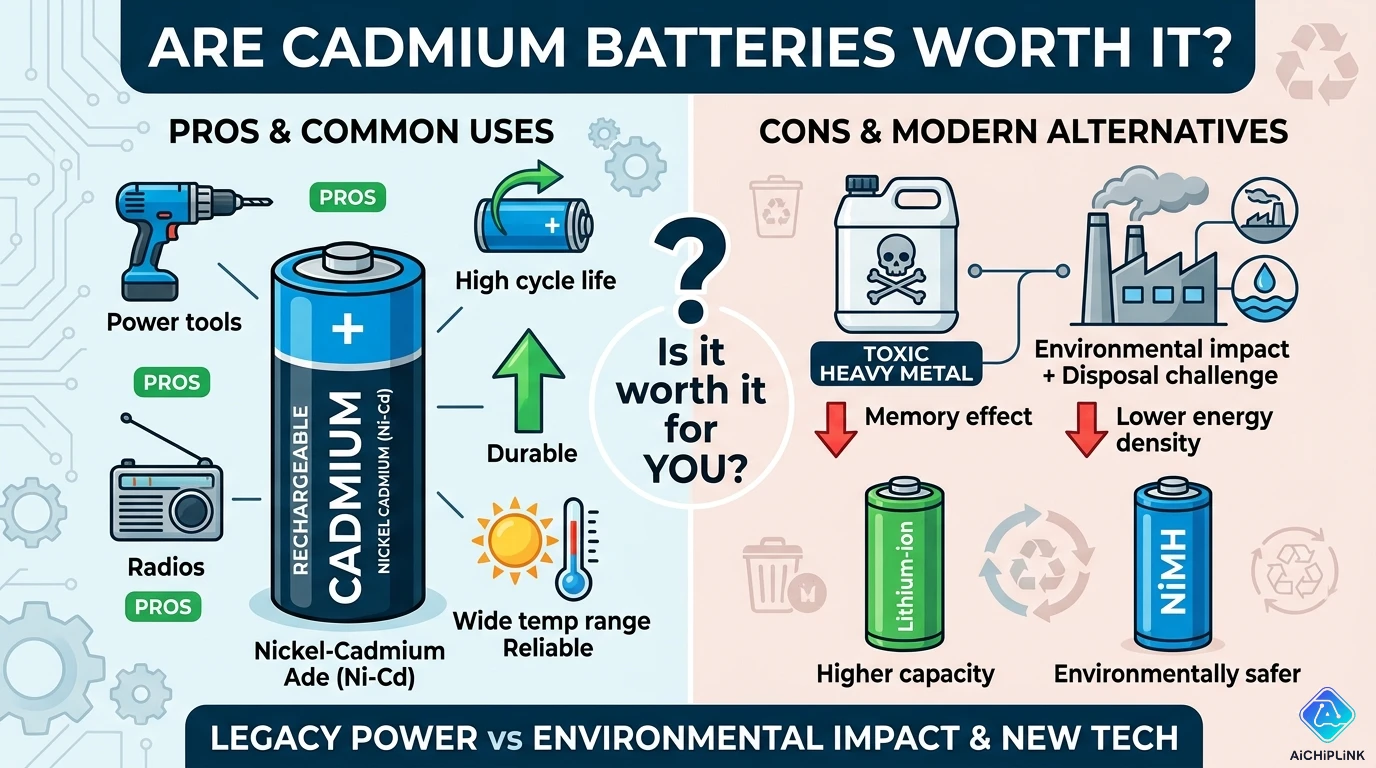
Are Cadmium Batteries Worth It? The EU Just Banned Them — But Aviation Still Requires Them
The European Union's Regulation 2023/1542, signed in July 2023, bans nickel-cadmium batteries in portable devices starting from August 2025. If you use NiCd AA cells in consumer devices, this matters: the chemistry is being regulated out of mainstream use. If you are reading this article because you encountered NiCd batteries in an aviation maintenance manual, an emergency lighting specification, or an industrial power tool service guide and wondering whether they are still the right choice — the answer is more complicated.
NiCd batteries remain suitable for many aircraft applications, including main aircraft batteries, valued for their reliability, wide operating temperature range, and relatively low maintenance requirements. Emergency lighting standards in many countries still specify NiCd. Some industrial environments explicitly require it because of its proven behavior under conditions where lithium-ion creates problems — sustained high-rate discharge, extreme cold, decades-long service life with controlled maintenance cycles, and environments where a thermal runaway event would be catastrophic.
The question "are cadmium batteries worth it?" has two different answers depending on which end of this spectrum you sit on. For the person replacing AA cells in a cordless phone: no, they have not been worth it since NiMH overtook them in the mid-1990s. For the engineer maintaining a Boeing 737 ground power battery or designing a −40°C industrial emergency lighting system: the answer requires a technical evaluation, not a simple yes or no.
This guide provides the framework for that evaluation.
1.0 What Is at Stake: The Regulatory Picture in 2025
The regulatory environment for NiCd has diverged sharply between consumer and industrial/aerospace applications, and understanding this split is the first step in any NiCd evaluation.
Where NiCd is being phased out or banned:
EU Regulation 2023/1542 prohibits NiCd batteries in portable applications from August 2025, replacing the earlier Battery Directive 2006/66/EC. This is a regulation — not a directive — meaning it takes immediate effect without needing transposition into national law by member states. In practice, this means NiCd AA, AAA, C, D, and 9V cells for consumer devices sold in the EU are being discontinued. Major manufacturers have been transitioning away since well before the deadline: ETAP, a leading emergency lighting manufacturer, stopped producing emergency lighting devices with NiCd batteries as far back as 2011, providing retrofit kits to switch existing units to NiMH.
Beyond the EU, many countries impose strict cadmium disposal regulations — cadmium is a heavy metal classified as a hazardous waste that requires special handling at end-of-life.
Where NiCd remains in active use and specification:
Aviation is the clearest example. NiCd batteries are approved for aircraft applications including main aircraft batteries, recognized in FAA Advisory Circular AC00-33A which specifically addresses NiCd battery operational and maintenance guidelines. The reason is not inertia — it is that aircraft certification requires a battery chemistry with a decades-long reliability track record in the specific thermal, vibration, and discharge profile of aircraft use. Introducing a new chemistry into a certified aircraft system requires a full re-certification process.
Emergency lighting, industrial uninterruptible power supplies, and certain power tool applications in harsh environments (below −20°C ambient) also continue to specify NiCd where the alternative chemistries have not yet demonstrated equivalent performance in the specific use case.
2.0 Three Questions That Determine Whether NiCd Is the Right Choice
Question 1: What is your operating temperature range, and does it include sustained below −20°C?
This is the single most important technical differentiator for NiCd in 2025. NiCd batteries are characterized by stability at temperatures down to −40°C, enabling reliable operation in extremely cold conditions. Lithium-ion cells experience significant capacity reduction below 0°C (typically losing 20–40% capacity at −20°C) and face safety concerns at very low temperatures during charging. NiCd batteries excel in durability, high discharge rates, and wide temperature tolerance, making them suitable for industrial equipment in harsh environments.
NiMH performs similarly to NiCd at moderate cold but degrades more sharply below −20°C than NiCd. LiFePO4 (lithium iron phosphate) has improved cold-temperature performance compared to other lithium chemistries but still lags NiCd at the extreme end (below −30°C).
If your application operates in sustained −30°C to −40°C ambient: NiCd has a genuine technical advantage that no current mass-market alternative fully matches.
Question 2: Is this application safety-certified, type-approved, or otherwise locked to a specific battery chemistry?
Aviation (FAA, EASA), medical devices (FDA, CE), nuclear power instrumentation, railway signaling, and military systems often have type approvals or certification documents that specify the battery chemistry explicitly. Changing from NiCd to any alternative — even a technically superior one — triggers a re-certification or re-validation process that can cost more than the battery replacement itself. In these cases, the answer to "is NiCd worth it?" is "it is specified and changing it is not a simple engineering decision."
If your application is in a certified system that specifies NiCd: do not substitute without going through the formal change process, regardless of how technically equivalent the replacement appears.
Question 3: What is your primary performance priority — energy density, or cycle life and high-rate discharge?
Lithium-ion batteries have higher energy density than NiCd, alkaline, and NiMH batteries, making them lighter and more suitable for portable applications where runtime per unit weight is critical.
NiCd has lower energy density — a NiCd cell stores roughly 40–60 Wh/kg compared to 100–265 Wh/kg for lithium-ion. But NiCd batteries offer a longer cycle life and perform better in extreme temperatures, with lower susceptibility to damage from impacts or vibrations. In applications where the battery sits in a fixed installation, weight is not a constraint, and the device must deliver short, high-current bursts reliably after years of service, NiCd's durability profile matters more than its energy density.
Decision summary from the three questions:
| Condition | Recommendation |
|---|---|
| Temperature regularly below −20°C | NiCd justified |
| Safety-certified system specifying NiCd | NiCd required — do not substitute |
| High cycle count (>500) + vibration/shock | NiCd competitive |
| Consumer portable device, EU market | NiCd banned from August 2025 |
| Standard indoor industrial application | NiMH or LiFePO4 preferred |
| Weight/energy density is primary concern | Lithium-ion or LiFePO4 preferred |
3.0 Comparison Matrix: NiCd vs NiMH vs Lithium-Ion vs LiFePO4
| Parameter | NiCd | NiMH | Li-ion (NMC/NCA) | LiFePO4 |
|---|---|---|---|---|
| Nominal cell voltage | 1.2V | 1.2V | 3.6–3.7V | 3.2V |
| Energy density (Wh/kg) | 40–60 | 60–120 | 100–265 | 90–160 |
| Cycle life | 700–1,000 | 300–500 | 500–1,000+ | 2,000–5,000 |
| Self-discharge | ~20%/month | 25–30%/month | 1–2%/month | 2–3%/month |
| Low temp. performance | Excellent (−40°C) | Moderate (−20°C) | Poor (−20°C) | Good (−30°C) |
| Memory effect | Yes (manageable) | Minimal | None | None |
| Overcharge tolerance | High | Moderate | Low (dangerous) | Moderate |
| Thermal runaway risk | Low | Low | High | Low |
| Charge rate (C-rate) | Up to 1C fast, some up to 4C | 0.3–1C | 0.5–1C typical | 0.5–1C typical |
| Environmental concern | High (Cd is toxic HazMat) | Moderate | Moderate (Li, Co) | Lower |
| Cost per Wh | Moderate | Low–Moderate | Low–Moderate | Moderate |
| EU consumer ban (2025) | Yes (portable) | No | No | No |
| Aviation approved | Yes (long history) | Limited | Growing (with restrictions) | Limited |
Where NiCd wins outright: cold temperature operation, overcharge tolerance, vibration/shock resistance, and applications where certified chemistry is mandated.
Where NiCd loses outright: consumer portable devices (banned), weight-sensitive applications, anything where cadmium disposal cost and regulation is a burden, and stationary storage where LiFePO4's cycle life advantage compounds over years.
4.0 Total Cost of Ownership: Cycles, Disposal, and Maintenance
The sticker price of a NiCd battery pack is rarely the right number to use for a procurement decision. The total cost per cycle over the product's service life, including disposal, is what matters.
Cycle life cost example:
A NiCd battery pack for an industrial cordless tool: $45, rated 700 cycles. Cost per cycle = $45 / 700 = $0.064 per cycle
An equivalent NiMH pack: $35, rated 400 cycles. Cost per cycle = $35 / 400 = $0.088 per cycle
An equivalent LiFePO4 pack: $65, rated 2,000 cycles. Cost per cycle = $65 / 2,000 = $0.033 per cycle
On a per-cycle basis, LiFePO4 is substantially cheaper over the full service life despite higher upfront cost. NiMH is more expensive per cycle than NiCd if the application genuinely runs out to 700 cycles.
Disposal cost:
Cadmium is classified as hazardous waste in most jurisdictions. NiCd batteries cannot be placed in general waste. Industrial users must either collect and ship to an authorized recycler (typically $1–5 per battery pack in volume, depending on region and pack size) or pay for collection services. For applications with large battery fleets, disposal logistics add to total cost. NiMH disposal is simpler (still requires recycling but cadmium is not present); lithium batteries have their own disposal complexity.
Maintenance for aircraft/industrial NiCd:
NiCd batteries require relatively low maintenance and are reliable, but aviation NiCd specifically requires periodic deep-cycle maintenance (equalizing charge/discharge to counteract memory effect and electrode sulfation) per the aircraft manufacturer's maintenance manual. This maintenance adds operational cost and requires trained personnel with appropriate equipment. Lithium aircraft batteries, by contrast, require less manual maintenance but more complex battery management electronics.
5.0 ⚠️ Five Field-Killing Mistakes With NiCd Batteries
Mistake 1: Storing NiCd batteries fully charged for extended periods
NiCd batteries stored at full charge for months or years develop a pronounced memory effect and are prone to internal short circuits from cadmium dendrite growth. The correct storage procedure for NiCd is to partially discharge to approximately 40% state of charge, store in a cool (10–15°C), dry environment, and perform a conditioning cycle (full discharge/recharge) before returning to service. Batteries returned from long-term storage without conditioning may show drastically reduced capacity that is partially but not fully recoverable.
Mistake 2: Charging NiCd at high rates without temperature monitoring
NiCd batteries may experience thermal runaway if overcharged. Fast charging (above 0.3C rate) requires a charger with proper charge termination — either negative delta-V (NDV) detection (a voltage drop signal that indicates full charge), temperature monitoring (dT/dt), or both. A simple constant-voltage or timed charger with no termination logic can overcharge a NiCd cell, causing electrolyte venting, case deformation, and in severe cases thermal runaway. For aviation-grade NiCd batteries, only chargers approved in the aircraft maintenance documentation may be used.
Mistake 3: Substituting NiMH or lithium directly into a NiCd charger circuit
NiCd and NiMH have similar nominal voltage (both 1.2V/cell) and are often physically interchangeable, but their charge characteristics differ. NiCd's NDV signature at full charge is more pronounced than NiMH's; a NiCd charger using NDV termination may fail to detect NiMH full charge reliably, overcharging the NiMH cells. Conversely, charging lithium cells on a NiCd charger is directly dangerous — a 1.2V/cell NiCd charger will vastly overcharge a 3.6V/cell lithium cell if connected. Always verify charger compatibility before any chemistry substitution.
Mistake 4: Treating "memory effect" as an insurmountable capacity loss
NiCd batteries are subject to a memory effect — if they are repeatedly discharged to the same partial level, they may only charge to that lower maximum capacity. This is a genuine limitation, but it is manageable with periodic reconditioning: a full discharge to near-zero followed by a complete recharge resets the memory effect in most cases. Modern NiCd chargers with automatic conditioning cycles largely eliminate memory effect as a practical concern in maintained applications. Dismissing NiCd entirely based on "memory effect" without considering whether the application uses conditioning cycles is an overly simplified analysis.
Mistake 5: Replacing a certified NiCd battery with a "drop-in" alternative without re-certification
In any safety-certified system — aircraft, emergency lighting per IEC 60598-2-22, medical devices — the battery chemistry is part of the certification. A visually compatible replacement using NiMH or lithium chemistry that has not been formally tested and approved for the specific system is not a compliant replacement, even if it fits the connector and delivers similar voltage. The liability exposure from an uncertified battery substitution in a safety-critical system is significant. Always verify certification status before substituting chemistry in a regulated application.
6.0 Decision Checklist
Before specifying or purchasing NiCd batteries, verify:
- Regulatory compliance check: Is NiCd banned or regulated in your market/application? (EU portable device ban: August 2025; check local regulations for industrial exceptions)
- Certification check: Is the application in a safety-certified system that specifies NiCd? If yes, follow the change process — do not substitute without re-certification
- Temperature check: Does the application operate below −20°C regularly? If yes, NiCd has genuine technical advantage; verify NiMH or LiFePO4 performance at your actual minimum temperature
- Cycle life check: Will the application run more than 500 full cycles? Calculate cost-per-cycle for NiCd vs alternatives using your actual pack price and rated cycles
- Disposal plan: Have you accounted for cadmium hazardous waste disposal cost and logistics in your total cost of ownership?
- Charger compatibility: If replacing NiCd with another chemistry, verify charger compatibility — do not use a NiCd charger for NiMH (risk of overcharge) or any charger for lithium without chemistry-specific termination
- Storage procedure: If batteries will be stored for extended periods, verify storage SoC and conditioning cycle procedure is documented and followed
- Maintenance requirements: If aviation or industrial NiCd, verify maintenance interval and conditioning cycle requirements are incorporated into the asset management schedule
7.0 Real Questions About NiCd Battery Selection
Q: I have an older cordless power drill with NiCd batteries. The batteries are worn out. Should I replace with NiCd, NiMH, or convert to lithium?
A: For a consumer cordless drill, NiCd is no longer the recommended choice for new batteries. NiMH drop-in replacements (same physical format, same 1.2V/cell nominal voltage) are widely available, offer higher capacity per cell (20–30% more runtime), have lower self-discharge than NiCd, and contain no toxic cadmium. For most users, NiMH is the correct replacement. Lithium conversion kits exist for some tool brands but require matching the battery management circuit to the charger — verify compatibility before purchasing a conversion kit. If the drill is a high-quality professional tool worth maintaining, a quality NiMH replacement pack is the most straightforward upgrade. If the drill is older consumer-grade equipment, the cost of a replacement battery pack may approach the cost of a new lithium-platform drill.
Q: I work in facilities maintenance and we have emergency lighting units that use NiCd batteries. The manufacturer says to replace with NiMH. Is this safe?
A: Leading emergency lighting manufacturers like ETAP have been providing retrofit kits for old NiCd-equipped devices to switch to NiMH since 2011, stating that NiMH batteries in emergency lighting have a lifespan that can exceed more than double that of NiCd. If your specific fixture manufacturer has issued an approved NiMH replacement kit for your fixture model, following that recommendation is both safe and compliant. The key requirements are: (1) the replacement pack must be approved by the fixture manufacturer for that specific model; (2) the replacement chemistry must be compatible with the fixture's charging circuit (NiMH charges slightly differently than NiCd — the fixture's charger must have been designed or validated for NiMH); (3) the replacement must comply with the emergency lighting standard applicable in your jurisdiction (IEC 60598-2-22, BS EN 50172, or equivalent). Do not substitute any battery pack that is not explicitly approved for the specific fixture model, even if it physically fits.
Q: We are maintaining a fleet of industrial UPS systems rated for operation in a −30°C cold storage facility. The original NiCd packs are being discontinued by the supplier. What alternatives should we evaluate?
A: At −30°C, your alternatives are limited. Standard NiMH performance at −30°C is marginal — expect significant capacity reduction. NiCd batteries demonstrate stability at temperatures down to −40°C, which is why they were originally specified. For genuine −30°C operation with full rated capacity, evaluate: (1) find an alternative NiCd supplier — the batteries are not banned in industrial applications, only in portable consumer devices, and industrial NiCd remains available; (2) evaluate LiFePO4 with low-temperature cells specifically rated for −30°C to −40°C operation (some manufacturers produce cells rated for this range, though at reduced capacity); (3) evaluate heated battery enclosures that maintain the battery above −10°C using a small resistive heater, which can make standard NiMH or LiFePO4 viable without the NiCd cold-temperature dependency. Get actual capacity data at −30°C from any proposed alternative supplier before committing to a fleet replacement.
8.0 Quick Reference Card
The Core Regulatory Split:
| Application | NiCd Status in 2025 |
|---|---|
| Consumer portable devices (EU) | Banned from August 2025 |
| Industrial non-portable (EU) | Permitted (with disposal requirements) |
| Aviation (FAA/EASA approved systems) | Active use, maintained specification |
| Emergency lighting (certified systems) | Case-by-case; NiMH replacing in most |
| Military/aerospace certified | Follows system certification |
Three Questions — One-Line Answers:
- Below −20°C regular operation? → NiCd still has a genuine advantage
- Safety-certified system specifying NiCd? → Cannot substitute without re-certification
- High cycle count in vibration/shock? → NiCd competitive; compare cost-per-cycle
Key NiCd Specifications:
| Parameter | NiCd |
|---|---|
| Cell voltage | 1.2V nominal |
| Energy density | 40–60 Wh/kg |
| Cycle life | 700–1,000 cycles |
| Self-discharge | ~20% per month |
| Low temp limit | −40°C |
| Memory effect | Yes — manageable with conditioning |
| Hazardous material | Yes — cadmium is HazMat |
Cost Per Cycle Comparison:
| Chemistry | Pack cost | Rated cycles | Cost/cycle |
|---|---|---|---|
| NiCd | $45 | 700 | $0.064 |
| NiMH | $35 | 400 | $0.088 |
| LiFePO4 | $65 | 2,000 | $0.033 |
When NiCd is still the right answer: Sustained operation below −30°C, FAA/EASA certified aircraft batteries, legacy certified systems where re-certification cost exceeds battery replacement savings.
When NiCd is not worth it: Consumer devices, EU portable market, applications above 0°C where LiFePO4 provides lower lifecycle cost, any new design where lithium or NiMH can be validated.

Written by Jack Elliott from AIChipLink.
AIChipLink, one of the fastest-growing global independent electronic components distributors in the world, offers millions of products from thousands of manufacturers, and many of our in-stock parts is available to ship same day.
We mainly source and distribute integrated circuit (IC) products of brands such as Broadcom, Microchip, Texas Instruments, Infineon, NXP, Analog Devices, Qualcomm, Intel, etc., which are widely used in communication & network, telecom, industrial control, new energy and automotive electronics.
Empowered by AI, Linked to the Future. Get started on AIChipLink and submit your RFQ online today!
Frequently Asked Questions
Are NiCd batteries still worth buying in 2025?
Yes, but mainly for aviation, emergency lighting, and extreme cold industrial use. For consumer electronics, NiMH or lithium batteries are usually better choices.
Why are NiCd batteries banned in the EU?
Because cadmium is toxic and creates hazardous waste. EU Regulation 2023/1542 restricts NiCd use in portable consumer devices starting from 2025.
Can I replace a NiCd battery with NiMH?
Usually yes for some devices like power tools or emergency lighting, but charger compatibility and certification must be checked first.
Are NiCd batteries better than lithium batteries in cold weather?
Yes. NiCd performs much better in very low temperatures like −30°C to −40°C, where lithium batteries often lose significant capacity.
What is the biggest disadvantage of NiCd batteries?
The main drawbacks are lower energy density, memory effect, and cadmium toxicity, which increases disposal cost and environmental restrictions.