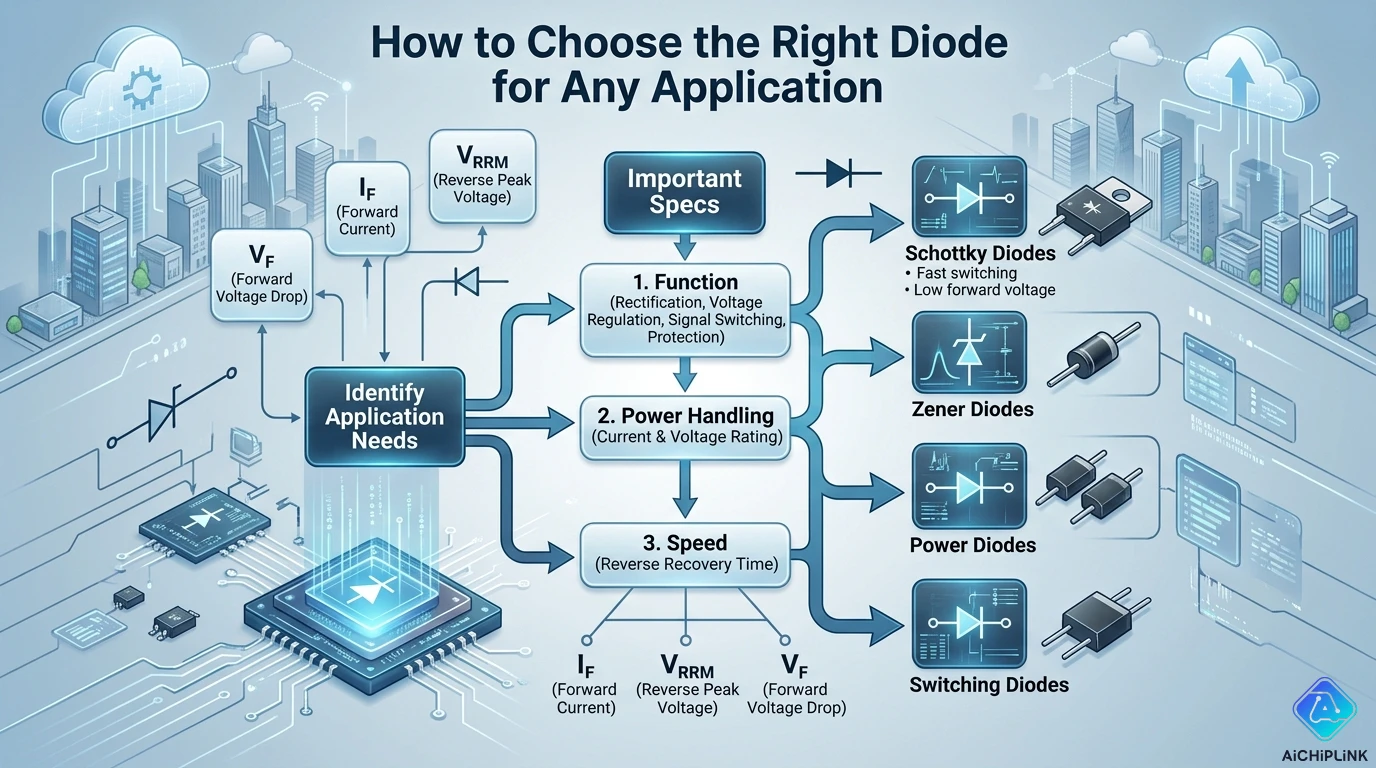
⚡ Quick Answer
Confused by 10,000+ diode types? Here's the shortcut:
| Your Application | Best Diode Type | Why | Price |
|---|---|---|---|
| Power supply rectifier | 1N4007 (1A) or 1N5408 (3A) | Cheap, reliable, proven | $0.05 |
| Fast switching | 1N4148 | 4ns recovery time ⚡ | $0.03 |
| Reverse polarity protection | Schottky (SS34) | Low voltage drop (0.3V) | $0.08 |
| High voltage (>1000V) | 1N4007 | 1000V rating | $0.05 |
| LED indicator | Standard LED | Just an LED! | $0.02 |
| High frequency (RF) | PIN diode | Designed for RF | $0.50 |
The Truth: 90% of hobbyist projects need just TWO types: 1N4007 + 1N4148.
Why This Guide Exists (The $500 Mistake)
Real story from 2025:
Engineer specs 1N4148 for 5V, 2A power supply.
- Cost: $0.03 per diode
- Quantity: 10,000 units
- Total "savings": $200
What happened:
- 1N4148 rated for 200mA (not 2A!)
- Heat: 10W dissipation per diode
- Result: Smoke, fire, 10,000 units recalled
- Real cost: $500,000 + brand damage
The problem? He didn't know the 5-question checklist.
This guide teaches you the exact process to prevent this nightmare.
The 5 Critical Questions (Master This, Never Fail)
Question 1: What's the Maximum Current?
Why it matters: Exceed this = instant magic smoke ☁️
How to find it:
Step 1: Measure or calculate your circuit current
Example: 12V LED with 470Ω resistor
Current = (12V - 2V) / 470Ω = 21mA

Step 2: Add 50% safety margin
21mA × 1.5 = 32mA required

Step 3: Choose diode rated ABOVE this
✅ 1N4148 (200mA) → Plenty of headroom
❌ 1N4001 (1A) → Overkill, more expensive
Common Current Ratings:
1N4148:  200mA   (signal/logic)
1N4001:  1A      (small power supply)
1N4007:  1A      (higher voltage version)
1N5400:  3A      (medium power)
6A10:    6A      (high current)
Pro Tip: Pulsed current ≠ continuous current!
LED circuit: 500mA pulses (1ms on, 9ms off)
Average: 50mA
Peak: 500mA ← Use this for diode rating!

Choose diode rated for peak, not average.
Question 2: What's the Maximum Reverse Voltage?
Why it matters: This is the "will it survive?" voltage.
Real Example:
12V car circuit (nominal)
Transients during alternator switching: 40V spikes!

Wrong: 1N4001 (50V rating)
→ 40V spikes get close to 50V limit
→ Degrades over time, fails after 6 months

Right: 1N4007 (1000V rating)
→ Massive safety margin
→ Lasts 10+ years
→ Only costs $0.02 more!
Voltage Ratings Decoded:
1N4001: 50V   (avoid in automotive)
1N4002: 100V  (minimum for 12V systems)
1N4004: 400V  (good for 120V AC rectifier)
1N4007: 1000V (best all-around choice)
Safety Margin Rule:
DC circuits: 2× your maximum voltage
AC rectifiers: 3× the peak voltage (not RMS!)

Example: 120V AC rectifier
Peak voltage = 120V × √2 = 170V
Required rating: 170V × 3 = 510V
→ Use 1N4004 (400V)? NO, too close!
→ Use 1N4007 (1000V)? YES! ✅
Question 3: How Fast Must It Switch?
Why it matters: Slow diode in fast circuit = heat + failure.
The Test:
Your circuit frequency: 100 kHz
Diode reverse recovery time: 2µs

At 100 kHz:
Period = 10µs
Diode OFF for: 2µs (20% of cycle!)
→ Massive power loss, overheating ❌

Use instead: 1N4148 (4ns recovery)
→ OFF time: 0.04% of cycle
→ Negligible loss ✅
Diode Speed Chart:
Application         Frequency    Best Diode        Recovery Time
─────────────────────────────────────────────────────────────────
50/60Hz rectifier   60Hz         1N4007            Slow (µs) OK
DC-DC converter     100kHz       1N4148            Fast (4ns) ✅
RF detector         10MHz        1N4148 or Schottky Sub-ns ✅
USB power           N/A          Schottky          Fast (ns)
Quick Rule:
< 1 kHz:   Any rectifier diode (1N400x)
1-100 kHz: Fast diode (1N4148) or Schottky
> 100 kHz: Schottky mandatory
> 1 MHz:   Specialized RF diode
Question 4: How Much Voltage Drop Can You Tolerate?
Why it matters: Voltage drop = wasted power = heat + inefficiency.
Real Example: USB Reverse Polarity Protection
Setup: 5V USB input, protect against reverse connection

Bad choice: 1N4007
→ Forward drop: 0.7V
→ Output: 5V - 0.7V = 4.3V
→ Many 5V devices need >4.5V to work
→ Circuit fails! ❌

Good choice: Schottky SS34
→ Forward drop: 0.3V
→ Output: 5V - 0.3V = 4.7V
→ Device works perfectly ✅

Extra cost: $0.03
Value: Circuit actually works
Voltage Drop Comparison:
Diode Type          Forward Drop (@ 1A)    When to Use
──────────────────────────────────────────────────────────
Silicon (1N4007)    0.7V                   Don't care about drop
Schottky (SS34)     0.3-0.4V               Low voltage (3-5V)
Germanium (1N34A)   0.3V                   Vintage radio repair
Ideal (theoretical) 0V                     Doesn't exist!
Power Loss Calculation:
Circuit: 5V, 2A

With 1N4007 (0.7V drop):
Power loss = 0.7V × 2A = 1.4W
Heat dissipated = 1.4W
Efficiency = (5V - 0.7V) / 5V = 86% ❌

With Schottky (0.3V drop):
Power loss = 0.3V × 2A = 0.6W
Heat dissipated = 0.6W (less than half!)
Efficiency = (5V - 0.3V) / 5V = 94% ✅

Extra $0.05 for Schottky saves 0.8W heat!
Question 5: What's the Operating Temperature?
Why it matters: High temp = derated current rating.
Temperature Derating:
1N4007 specs:
- 25°C (room temp): 1A full rating
- 75°C (warm): 0.7A (30% reduction!)
- 100°C (hot): 0.5A (50% reduction!)
- 175°C (max): Don't even try

Real scenario: Car dashboard in Texas summer
Ambient: 60°C (140°F)
Junction temp: 60°C + self-heating
→ Must derate significantly!
Thermal Management Tips:
1. Add heatsink:
   Small TO-220 diode on 10cm² aluminum
   → 20°C temperature drop

2. Increase airflow:
   Passive: Natural convection
   Active: 40mm fan (huge improvement)

3. Choose larger diode:
   Instead of: 1N4001 @ 1A stressed
   Use: 1N5400 @ 3A relaxed
   → Runs cooler, lasts longer

4. Use Schottky (if applicable):
   Lower voltage drop = less heat
Decision Tree (Follow This, Choose Correctly)
START: What are you building?

├─ Power Supply Rectifier?
│  ├─ Current < 1A? → 1N4007 (universal choice)
│  ├─ Current 1-3A? → 1N5400 series
│  └─ Current > 3A? → Bridge rectifier module
│
├─ Reverse Polarity Protection?
│  ├─ Low voltage (3-12V)? → Schottky (SS34)
│  └─ High voltage (>12V)? → 1N4007
│
├─ Fast Switching (>1kHz)?
│  ├─ < 100kHz? → 1N4148
│  └─ > 100kHz? → Schottky diode
│
├─ LED Indicator?
│  └─ Use an LED (that's what they're for!)
│
├─ Signal Detection?
│  ├─ Audio/low frequency? → 1N4148
│  └─ RF/high frequency? → 1N5711 Schottky
│
└─ Unsure?
   → Start with 1N4007 (works 80% of the time)
Common Diode Types Explained (The Top 10)
1. 1N4001-1N4007 Series (The Workhorses)
What they are: Standard silicon rectifier diodes
Specs:
Current: 1A continuous
Voltage: 50V (1N4001) to 1000V (1N4007)
Speed: Slow (µs recovery)
Drop: 0.7V @ 1A
Cost: $0.05

All same current rating (1A)
Only voltage differs!

Choose 1N4007 for everything → $0.02 more, way safer
Best For:
- ✅ 50/60Hz power supply rectifiers
- ✅ Reverse polarity protection (if voltage drop OK)
- ✅ General purpose DC blocking
- ❌ High frequency switching
- ❌ Low voltage drop needed
2. 1N4148 (The Speed Demon)
What it is: Fast switching signal diode
Specs:
Current: 200mA continuous, 500mA peak
Voltage: 100V
Speed: 4ns recovery (super fast!)
Drop: 0.7V @ 10mA
Cost: $0.03
Best For:
- ✅ High frequency circuits (>1kHz)
- ✅ Logic level signals
- ✅ Flyback diodes on relays/motors
- ✅ Signal detection
- ❌ Power rectification (too low current)
Common Mistake:
❌ Using 1N4148 for 12V, 500mA power supply
→ Rated for 200mA continuous
→ Overheats and fails

✅ Use 1N4007 instead
3. Schottky Diodes (The Efficient Ones)
What they are: Low voltage drop, fast diodes
Specs (SS34 example):
Current: 3A
Voltage: 40V (lower than silicon!)
Speed: <10ns (very fast)
Drop: 0.3V @ 1A (less than half of silicon!)
Cost: $0.08
Best For:
- ✅ Low voltage circuits (3-5V)
- ✅ Reverse polarity protection
- ✅ High frequency switching
- ✅ Efficiency-critical applications
- ❌ High voltage (>100V)
- ❌ High temperature (degrade faster)
USB Reverse Protection Example:
5V USB input
Load: 1A

Silicon 1N4007: 5V - 0.7V = 4.3V output ❌
Schottky SS34:  5V - 0.3V = 4.7V output ✅

That 0.4V difference = circuit works or doesn't!
4. Zener Diodes (The Voltage Regulators)
What they are: Diodes that conduct in reverse at specific voltage
How they work:
Normal diode: Block reverse current
Zener diode: Conduct at specific "zener voltage"

Example: 5.1V Zener
Forward: 0.7V drop (like normal diode)
Reverse: Conducts at 5.1V (voltage regulator!)

Use: Simple voltage regulation, overvoltage protection
Common Zener Voltages:
3.3V → For 3.3V regulation
5.1V → For 5V regulation (common!)
12V  → For 12V regulation
24V  → For 24V regulation

Available: 2.4V to 200V in standard series
Simple Voltage Regulator:
Schematic:
12V input ──[resistor 470Ω]──┬── Output (5.1V)
                              │
                           [Zener 5.1V]
                              │
                             GND

Output voltage = Zener voltage (5.1V)
Max current = ~20mA (for simple circuits)
When NOT to use:
❌ High current (>50mA) → Use LM7805 instead
❌ Precision (±5%) → Use voltage reference
✅ Simple protection → Perfect!
✅ Low current regulation → Good
5. TVS Diodes (The Protectors)
What they are: Transient Voltage Suppression (lightning/ESD protection)
How they work:
Normal operation: Open circuit (invisible)
Voltage spike: Clamp to safe voltage (< 1ns)

Example: 12V circuit with P6KE15A TVS
Normal: 12V on line, TVS does nothing
Spike: 100V transient appears
TVS: Clamps to 15V in <1ns
Circuit: Sees 15V max (protected!)
Best For:
- ✅ ESD protection (keyboard, USB)
- ✅ Lightning protection (outdoor sensors)
- ✅ Automotive transients
- ✅ Industrial noise suppression
Selection:
Step 1: Know your circuit voltage (12V example)
Step 2: Choose TVS with breakdown 20% above (15V)
Step 3: Verify clamping voltage safe for circuit
Step 4: Pick current rating for energy absorption

For 12V circuit → P6KE15A or SMAJ15A
6. LED (Light Emitting Diode)
Yes, it's a diode! Just happens to emit light.
Key Specs:
Forward Voltage:
- Red: 1.8V
- Green: 2.0V
- Blue/White: 3.0V

Current: 20mA typical

Reverse Voltage: 5V (low! Protect it!)
The Circuit Every Beginner Needs:
Schematic:
5V ──[Resistor]──[LED]── GND

Resistor value?
R = (Vsupply - Vled) / Current
R = (5V - 2V) / 0.02A = 150Ω
→ Use 220Ω (standard value)

Power in resistor:
P = (5V - 2V)² / 220Ω = 41mW
→ Use 1/4W resistor (safe)
Real-World Selection Examples
Example 1: Arduino 5V Power Supply
Requirements:
- Input: 9V battery
- Output: 5V for Arduino
- Current: 200mA max
Wrong Choice: 1N4148
Why wrong:
- Max current: 200mA (at the limit!)
- No safety margin
- Will run hot

Result: Works initially, fails after days/weeks
Right Choice: 1N4007
Why right:
- Rated 1A (5× safety margin)
- 1000V rating (huge margin for 9V)
- Runs cool
- Costs $0.02 more

Result: Reliable for years ✅
Example 2: Relay Flyback Protection
Problem: Relay coil generates voltage spike when turned off
Setup:
Arduino pin → Transistor → Relay coil (12V, 30mA)

When OFF: Coil collapses, generates -50V spike!
Without protection: Kills transistor instantly ❌
Solution: Flyback Diode
Schematic:
        ┌───Relay Coil───┐
        │                │
    Transistor         [Diode]
        │              (cathode up)
       GND              12V

Diode choice: 1N4148
Why:
- Fast recovery (catches spike quickly)
- 100V rating (handles 50V spike)
- 200mA >> 30mA (plenty of margin)

Result: Transistor protected ✅
Example 3: Solar Panel to Battery
Requirements:
- Solar: 18V, 5A max
- Battery: 12V lead-acid
- Prevent reverse current at night
Wrong: Standard Diode (1N5400)
Forward drop: 0.7V
Power loss: 0.7V × 5A = 3.5W
Heat: 3.5W dissipation
Efficiency: Lost 3.5W of 90W (4% waste)
Better: Schottky Diode (MBRF20100CT)
Forward drop: 0.4V
Power loss: 0.4V × 5A = 2W
Heat: 2W dissipation
Efficiency: Only 2.2% waste

Extra cost: $0.50
Annual savings (sunny climate): 1.5W × 2000 hours = 3 kWh
= $0.45/year saved electricity

Payback: ~1 year, then profit!
Best: Ideal Diode Controller
Uses MOSFET instead of diode
Forward drop: 0.02V (100× better!)
Power loss: 0.02V × 5A = 0.1W
Efficiency: 99.9%

Cost: $2-3 (IC + MOSFET)
For serious solar: Worth it ✅
Common Mistakes & How to Avoid Them
Mistake 1: "Close Enough" Voltage Rating
The Problem:
Circuit: 24V DC motor
Engineer: "30V diode should be fine"

What actually happens:
- Motor generates voltage spikes (inductive load)
- Spikes reach 50V during switching
- 30V diode avalanches (breakdown)
- Works... for a month, then fails

Fix: Always 2× safety margin
→ Use 60V or higher diode (1N4007 @ 1000V = overkill but safe)
Mistake 2: Ignoring Peak vs Average Current
The Problem:
LED strobe light:
- 1A pulses for 1ms
- Repeats every 100ms
- Average current: 10mA

Beginner: "10mA avg, 1N4148 (200mA) is fine"
Reality: Peak current is 1A!
1N4148 rated: 200mA continuous, 500mA peak
→ 1A exceeds peak rating
→ Diode degrades, fails

Fix: Use 1N4001 (1A rating) or larger
Mistake 3: Wrong Direction Installation
The Symptom:
Circuit doesn't work
OR
Circuit works until you reverse power, then dies

The Problem: Diode installed backwards!
How to Check Polarity:
Diode has two ends:
- Anode (+) : No marking
- Cathode (-): Stripe/band marking

Current flows: Anode → Cathode (arrow direction)

Physical markings:
[████████|█] ← Band marks cathode
 anode    cathode

In circuit:
Positive voltage → Anode
Negative/ground → Cathode
Mistake 4: No Heatsink on High Power
The Problem:
6A diode in 6A application
Math: "6A rated = 6A use, perfect!"

Reality:
- Junction temp rises: 25°C + self-heating
- At 75°C: Derated to 4.2A (30% less!)
- Actually running at 6A / 4.2A = 143% of derated capacity
- Result: Thermal runaway, failure

Fix: Either:
1. Add heatsink (drops temp 20-40°C)
2. Use larger diode (10A for 6A application)
3. Use multiple diodes in parallel
Quick Reference: The Essential 5 Diodes
Stock these, handle 95% of projects:
1. 1N4007 (qty: 100)
   Cost: $5 total
   Use: Power rectifiers, general purpose

2. 1N4148 (qty: 100)
   Cost: $3 total
   Use: Signal, fast switching, logic

3. Schottky SS34 (qty: 20)
   Cost: $2 total
   Use: Low voltage, reverse protection

4. 5.1V Zener (qty: 20)
   Cost: $2 total
   Use: 5V regulation, overvoltage protection

5. Assorted LEDs (qty: 50)
   Cost: $3 total
   Use: Indicators, testing, fun

Total investment: $15
Value: Never stuck on a project ✅
Testing Diodes (Is It Good or Bad?)
Method 1: Multimeter Diode Test Mode
Most multimeters have diode symbol (▶|)

Test procedure:
1. Set meter to diode mode
2. Red probe → Anode
   Black probe → Cathode
   Reading: 0.5-0.7V (silicon) or 0.3V (Schottky) ✅

3. Reverse probes
   Reading: OL or >1V (open) ✅

Bad diode readings:
- Both directions: 0V → Shorted ❌
- Both directions: OL → Open ❌
- Forward: >1V → Damaged ❌
Method 2: Simple LED + Resistor Test
Circuit:
9V battery ──[1kΩ]──[LED]──[Test Diode]── GND

Test:
1. LED lights → Diode conducts forward ✅
2. Reverse test diode
3. LED off → Diode blocks reverse ✅

If LED always on or always off → Bad diode ❌
Summary (The Essentials)
The 5-Question Checklist
Before choosing any diode, answer:

1. ☐ Maximum current? (Add 50% margin)
2. ☐ Maximum reverse voltage? (Add 2-3× margin)
3. ☐ Switching speed needed? (<1kHz or >1kHz)
4. ☐ Voltage drop acceptable? (<0.5V or don't care)
5. ☐ Operating temperature? (Derate if hot)

Answer all 5 → Pick from decision tree → Success ✅
The "When In Doubt" Defaults
90% of the time, one of these works:

Power supply / slow circuits → 1N4007
Fast switching / signals → 1N4148
Low voltage (3-5V) / efficiency → Schottky (SS34)
Voltage regulation → Zener (appropriate voltage)
Protection / ESD → TVS diode
Final Advice
Start conservative:
- Higher voltage rating than needed
- Higher current rating than calculated
- Add heatsink if power >0.5W
- Test before production
Iterate if needed:
- Working but hot? → Larger diode or heatsink
- Working but inefficient? → Try Schottky
- Working but expensive? → Downgrade cautiously
The goal: Reliable circuit that lasts years, not "barely works."
For detailed datasheets, diode selection tools, and circuit troubleshooting help, visit AiChipLink.com.

Written by Jack Elliott from AIChipLink.
AIChipLink, one of the fastest-growing global independent electronic components distributors in the world, offers millions of products from thousands of manufacturers, and many of our in-stock parts is available to ship same day.
We mainly source and distribute integrated circuit (IC) products of brands such as Broadcom, Microchip, Texas Instruments, Infineon, NXP, Analog Devices, Qualcomm, Intel, etc., which are widely used in communication & network, telecom, industrial control, new energy and automotive electronics.
Empowered by AI, Linked to the Future. Get started on AIChipLink and submit your RFQ online today!
Frequently Asked Questions
What is the safest “default” diode for general electronics projects?
For most low-frequency power supply and general protection circuits, the 1N4007 is the safest default choice because it offers 1A continuous current capability and up to 1000V reverse voltage rating, giving far more safety margin than lower-voltage versions like 1N4001. It is inexpensive, widely available, and reliable for rectification, reverse polarity protection, and general DC blocking, making it the go-to diode for beginners and professionals alike.
When should I choose a Schottky diode instead of a standard silicon diode?
You should choose a Schottky diode when your circuit operates at low voltage (such as 3V, 5V, or USB power systems) or when efficiency matters. Schottky diodes have a much lower forward voltage drop—typically 0.2V to 0.4V instead of 0.7V—which means less wasted power, less heat generation, and better performance in battery-powered devices, DC-DC converters, and reverse polarity protection circuits.
Why does my diode keep overheating and failing?
A diode usually overheats because its current rating, voltage rating, or switching speed is too low for the actual circuit conditions. Many failures happen when designers ignore startup surges, inductive spikes, pulsed current, or temperature derating. Even if average current looks safe, peak current may exceed the diode’s limit. Always apply safety margins—typically 50% for current and 2–3× for reverse voltage—to prevent thermal runaway and premature failure.
Can I use a 1N4148 as a replacement for a 1N4007?
Usually, no—because these two diodes serve very different purposes. The 1N4148 is a fast-switching signal diode rated for about 200mA, while the 1N4007 is a power rectifier rated for 1A with much higher surge tolerance. Using a 1N4148 in a power supply or motor circuit can quickly cause overheating and failure, while using a 1N4007 in high-frequency switching circuits may cause efficiency loss because it switches too slowly.
How do I know if a diode is installed in the correct direction?
You can identify diode polarity by locating the stripe or band marking, which indicates the cathode (negative side). Current normally flows from the anode to the cathode, meaning from the unmarked side toward the striped side. If installed backward, the circuit may not work at all or protection functions may fail. A multimeter in diode-test mode is the easiest way to verify correct orientation before powering the circuit.