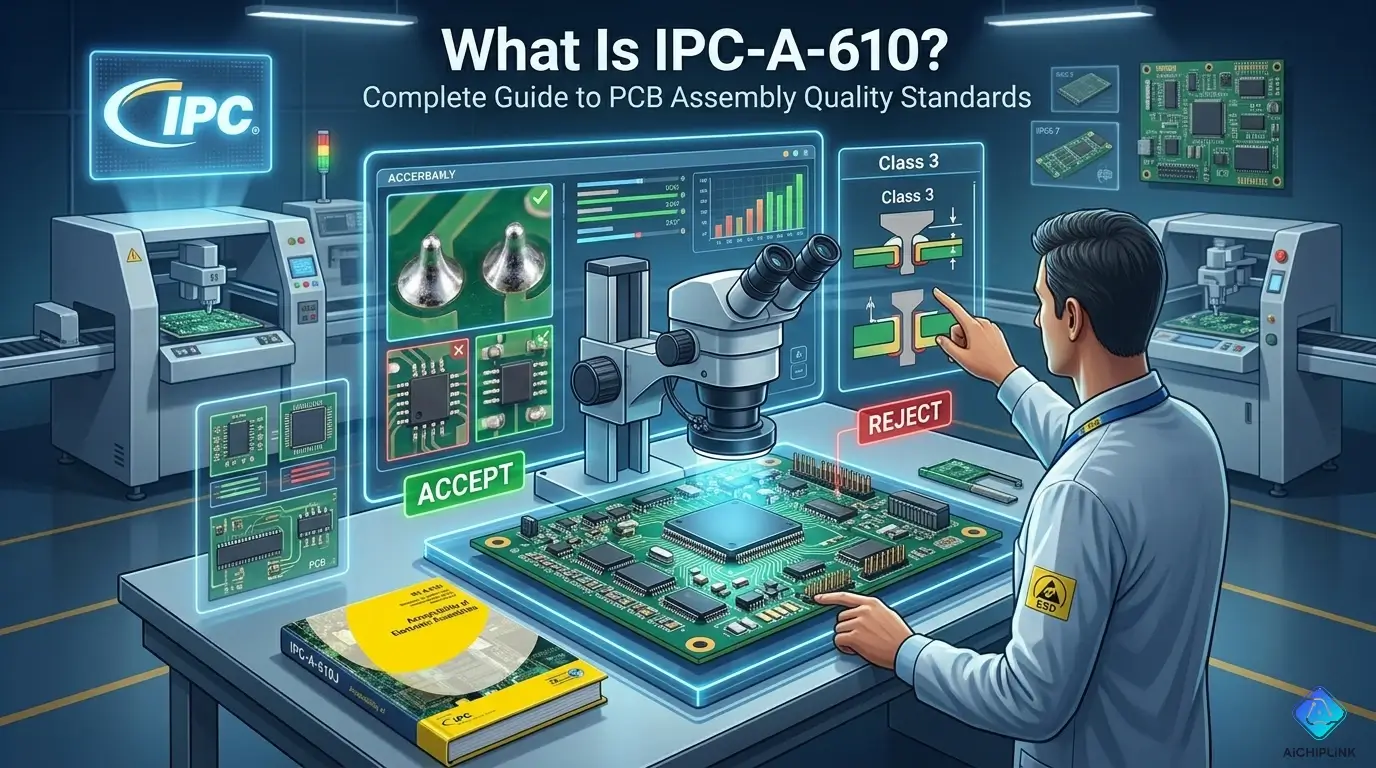
Here is the counterintuitive thing about IPC-A-610 that most introductions skip: the standard is not called "Requirements for Electronic Assemblies." It is called "Acceptability of Electronic Assemblies." That word — acceptability — is doing a lot of work. The standard does not tell a manufacturer how to build a perfect assembly. It tells an inspector which imperfections are allowed to leave the factory, and that determination depends entirely on what the assembly is going to do.
A solder joint with a modest void in its interior might be perfectly acceptable in the calculator on your desk. That same void condition in a pacemaker PCB is a defect that grounds the board. The joint looks identical. The materials are the same. What changed is the consequence of failure — and IPC-A-610 is a framework for encoding that consequence into the acceptance criteria through a three-class product classification system.
Understanding IPC-A-610 correctly requires grasping two things the simplified summaries miss: first, it has three judgment categories, not two — most people know "acceptable" and "defect," but the intermediate category, "process indicator," is where most of the practical quality management decisions happen. Second, IPC-A-610 evaluates the finished assembly; it says nothing about how the assembly was made. That is a different standard entirely. Getting these two distinctions clear explains most of the confusion that arises when contract manufacturers and OEMs quote the standard at each other in acceptance disputes.
1.0 What IPC-A-610 Actually Is
IPC-A-610, officially titled "Acceptability of Electronic Assemblies," is the global visual inspection standard for finished printed circuit board assemblies (PCBAs). It was first published in 1983 by IPC (now formally named the Association Connecting Electronics Industries, though universally referred to as IPC) and has been revised ten times since, with the current edition being IPC-A-610J, published in March 2024.
The standard provides illustrated criteria — photographs, diagrams, and dimensional tables — for evaluating what an assembled PCB looks like, covering solder joint quality, component placement, cleanliness, conformal coating, mechanical assembly, and board surface condition. It defines, for each of these inspection areas, what conditions are acceptable for shipment, what conditions require process investigation, and what conditions constitute outright defects that require rework or rejection.
Why it exists: Before a standardized acceptance framework, every OEM and every contract manufacturer had their own internal workmanship standards. Whether a solder joint with a small cold solder appearance was acceptable depended on which quality manager was looking at it and what their personal experience told them. IPC-A-610 creates a common language — a shared reference that a quality engineer in Texas, a contract manufacturer in Shenzhen, and an aerospace systems integrator in Munich can all reference when discussing whether a specific solder joint on a delivered board is acceptable.
Who uses it:
- Electronics Manufacturing Services (EMS) companies, as their production floor workmanship standard
- Original Equipment Manufacturers (OEMs), as the acceptance criterion specified in their purchase orders
- Quality inspectors and Automated Optical Inspection (AOI) system calibration teams
- Customer and supplier engineering teams resolving acceptance disputes
- Certification bodies for IPC inspector qualification training (CIS, CIT, CSE levels)
A note on the version numbering: The revision history runs A through J (2024), deliberately skipping "I" because the letter I could be confused with the number 1 or the letter l in certain typefaces — potentially turning "IPC-A-610I" into what looks like "IPC-A-6101" or "IPC-A-610L." This is a genuine standards-body decision that comes up in supplier quality conversations when someone's purchase order references "IPC-A-610H" (2020) and the manufacturer ships product built to "IPC-A-610J" (2024).
2.0 The Three Conditions: Acceptable, Process Indicator, and Defect
This is the most important structural feature of IPC-A-610 that most introductions underemphasize or skip entirely. The standard defines three judgment outcomes for any inspected condition, not two:
Acceptable: The condition meets all applicable requirements for the product class. The assembly may proceed — it can be shipped, installed, and placed into service. "Acceptable" does not mean "perfect." It means the observed condition, whatever its appearance, is within the defined tolerance for the product class and does not impair function, reliability, or service life in the intended application.
Defect: The condition does not meet the requirements for the product class. The assembly must be reworked, repaired, or rejected. A defect for Class 1 is automatically also a defect for Class 2 and Class 3 (the classes are nested — stricter classes include all the rejection criteria of less-strict classes plus their own additional requirements).
Process Indicator (PI): This is the category most quality guidance leaves out. A Process Indicator is a condition that does not by itself render the assembly defective or require rework, but indicates that the manufacturing process may be drifting or operating outside its intended parameters. A Process Indicator triggers a process investigation — not a board rejection. The assembly ships; the manufacturing engineer examines the process to understand why the condition appeared and whether it will become a defect in future lots if uncorrected.
The practical importance of the Process Indicator category: it is where most early-warning quality management happens. A single solder joint with a process indicator condition is acceptable; a lot of boards where the same PI condition appears on 40% of identical joints indicates a reflow profile drifting toward a defect condition. IPC-A-610's Process Indicator framework gives manufacturers a structured way to catch process drift before it produces defects, rather than only reacting after boards are rejected.
3.0 The Three Product Classes — and How to Choose the Right One
IPC-A-610 defines three product classes. The class is assigned by the OEM / end-product manufacturer based on the product's application, not by the contract manufacturer. The contract manufacturer's job is to build to the class specified in the purchase order.
Class 1 — General Electronic Products: Products where functionality is the primary concern and cosmetic appearance is secondary. Includes consumer goods, household electronics, basic toys, disposable devices, and similar applications where a shorter service life is expected and the consequence of failure is low. Class 1 criteria are the most permissive.
Examples: basic remote controls, disposable medical diagnostic devices, household appliance control boards, simple LED lighting drivers
Class 2 — Dedicated Service Electronic Products: Products where continued performance and extended service life are important, but uninterrupted service is not critical — meaning controlled downtime for repair or replacement is acceptable. The vast majority of mainstream electronics falls into Class 2: this is the default class for telecommunications equipment, computers, industrial controls, automotive non-safety electronics, and similar applications.
Examples: desktop computers, telecommunications infrastructure, industrial automation controllers, automotive infotainment, test and measurement instruments
Class 3 — High-Performance/High-Reliability Electronic Products: Products where uninterrupted service is required, or where failure consequences are severe (personal injury, loss of life, mission failure). Class 3 imposes the most stringent workmanship requirements — tighter dimensional tolerances on solder joints, stricter component placement criteria, more rigorous cleanliness requirements, and mandatory documentation of certain process parameters.
Examples: pacemakers and implantable medical devices, aircraft flight control computers, military communications systems, spacecraft electronics, automotive safety-critical systems (ABS, airbag controllers, autonomous driving ECUs)
Selecting the correct class:
The class selection is a design engineering and product liability decision, not a manufacturing decision. Selecting a lower class than the application requires to reduce manufacturing cost is a risk that falls on the OEM. Selecting a higher class than the application requires increases manufacturing cost and inspection time without improving functional performance.
Note that "Class 3" is not a binary guarantee of perfection — it is a guarantee of tighter acceptance criteria during visual inspection. A Class 3 assembly built to IPC-A-610J criteria can still contain functional defects not visible to optical inspection (latent die failures, internal via cracks, electrostatic damage). Class 3 is a workmanship standard, not a reliability guarantee.
4.0 What IPC-A-610 Covers: The Inspection Scope
IPC-A-610J organizes its inspection criteria into the following major areas:
Solder joint quality — the most detailed section: The standard provides explicit dimensional criteria for solder joint acceptability on SMT (surface mount) components, through-hole components, and specialty terminations. For SMT solder joints, it specifies minimum and maximum solder fillet dimensions as a percentage of land pad width, acceptable and unacceptable void conditions, and criteria for cold solder, insufficient solder, excessive solder, bridging, and dewetting. These criteria differ by product class.
Component placement: Orientation, alignment, spacing, and overhang criteria for SMT components on their land pads. The standard specifies how far a component may shift from its intended position (as a percentage of component lead or termination width) before the condition transitions from acceptable to process indicator to defect.
Component damage: Criteria for evaluating mechanical damage (cracks, chips, body fractures) to component packages, including chip resistors, ceramic capacitors, ICs, connectors, and through-hole components. A cracked chip capacitor that is invisible to functional testing may still be a defect under Class 3 criteria because of its implications for long-term reliability.
PCB laminate condition: Delamination, measling, crazing, blistering, and other board substrate damage conditions, with acceptance criteria by class.
Cleanliness: Criteria for flux residue, white residue, corrosion, and particulate contamination. The standard requires surface illumination of at least 1000 lux during inspection and a light color temperature of 3000–5000 K — specific requirements that are often not met in informal inspection setups.
Conformal coating: Coverage adequacy, thickness, adhesion, and defects (bubbles, dewetting, contamination inclusions) in applied conformal coatings.
Mechanical assembly: Connector installation, hardware fasteners, wire harness dress, strain relief, and other mechanical assembly features.
Marking: Component orientation markers, PCB reference designators, polarity indicators, and traceability markings.
5.0 IPC-A-610 in the Standards Ecosystem: What It Does Not Cover
IPC-A-610 is one document in a family of related IPC standards. Understanding its boundaries clarifies where other standards apply:
IPC-A-610 covers: The visual acceptability of the finished assembly — what it looks like after all manufacturing is complete.
IPC J-STD-001 ("Requirements for Soldering Electrical and Electronic Assemblies") covers: The process by which the soldering was done — flux types, solder alloys, temperature profiles, cleaning methods. J-STD-001 is the process standard; IPC-A-610 is the outcome standard. A joint can meet IPC-A-610 visual criteria regardless of whether J-STD-001 process requirements were followed during its manufacture — though in practice, following J-STD-001 makes meeting IPC-A-610 outcomes far more consistent.
IPC-A-600 ("Acceptability of Printed Boards") covers: The bare PCB before components are assembled — laminate quality, via quality, copper plating, surface finish. IPC-A-610 assumes the bare PCB already meets IPC-A-600 requirements.
IPC-2220 series covers: PCB design — land pattern dimensions, design rules, layer stackup requirements. IPC-A-610 assumes the design was done to IPC-2220 or equivalent standards.
IPC/WHMA-A-620 covers: Wire harness and cable assembly acceptability — the cable assembly equivalent of IPC-A-610.
IPC-7711/7721 covers: Rework and repair procedures for assemblies that do not meet IPC-A-610 criteria.
6.0 Five Misconceptions That Cause Real Contractual Problems
Misconception 1: "IPC-A-610 Class 3 means zero defects"
Class 3 means stricter acceptance criteria during visual inspection — not that every solder joint is perfect. A Class 3 assembly will still have process indicators, will still have joints at the acceptable-but-not-ideal end of the tolerance range, and can still contain latent defects invisible to optical inspection. What Class 3 guarantees is that every inspected condition was evaluated against the most stringent set of criteria in the standard and found acceptable. The frequent OEM expectation that "Class 3 means everything is perfect" leads to disputes when Class-3-certified assemblies exhibit field failures — because perfection was never what Class 3 defined.
Misconception 2: "Our product needs Class 3 because it is expensive and important to us"
Product cost and business importance are not the criteria for Class 3. The criteria are application environment and consequence of failure. A USD 50,000 industrial machine tool control system might correctly be specified to Class 2 if its failure only results in production downtime with no safety risk. A USD 20 hearing aid controller might correctly be specified to Class 3 because it is worn continuously, cannot be easily replaced by the user, and its failure affects health. Specifying Class 3 "because we want the best quality" without a genuine high-reliability application inflates manufacturing cost without improving actual reliability for the application.
Misconception 3: "A board that passes IPC-A-610 inspection is fully tested and qualified"
IPC-A-610 is a visual inspection standard. It covers what can be seen — solder joint external geometry, component alignment, surface cleanliness, mechanical assembly. It does not evaluate electrical function (that is functional testing), solder joint internal integrity (that is X-ray inspection, cross-sectioning), PCB via quality (that is IPC-A-600), component reliability (that is component qualification), or any form of environmental stress testing. A board that passes IPC-A-610 inspection and has never been electrically tested is not a qualified product — it is a visually acceptable product awaiting the rest of its qualification process.
Misconception 4: "The most recent IPC-A-610 revision is always required"
Purchase orders and contract terms specify which revision of the standard applies. A contract written against IPC-A-610H (2020) remains governed by that revision until the contract is modified to reference IPC-A-610J (2024). The contract manufacturer is not obligated to ship product to a newer revision than the one agreed in the purchase order, and the OEM cannot reject product to a criteria that was not in the agreed revision. In practice, most established EMS/OEM relationships specify "current revision" to avoid this issue, but individual purchase orders in competitive bidding environments frequently specify a specific revision. Verify which revision applies before production begins.
Misconception 5: "IPC-A-610 and J-STD-001 say the same things"
They are complementary, not redundant. A factory that uses only IPC-A-610 without J-STD-001 is inspecting outcomes without controlling process — meaning they will catch defects but have no structured method for preventing them. A factory that uses only J-STD-001 without IPC-A-610 is controlling process without defining what the acceptable outcome looks like — meaning their solder joints might be made by an excellent process but still fail to meet the customer's acceptance criteria. Best practice in electronics manufacturing uses both: J-STD-001 to qualify and control the soldering process, IPC-A-610 to define and verify the acceptable outcome.
7.0 How to Apply IPC-A-610 in Practice
For OEMs specifying quality requirements:
Include the specific IPC-A-610 revision and product class in the purchase order or supplier quality agreement. Do not simply write "IPC-A-610 compliant" without specifying the class and revision — "compliant" without a class specification defaults to whichever class the contract manufacturer chooses, which may not align with your application. Specify: "This assembly shall conform to IPC-A-610J (2024), Class 2" (or Class 3 as appropriate).
For EMS companies implementing IPC-A-610:
Ensure inspectors are trained to the IPC Certified IPC Specialist (CIS) level for their specific inspection function. The CIS certification requires demonstrated knowledge of the standard's criteria and the ability to correctly classify observed conditions. Higher-level certifications — Certified Subject Expert (CSE) for conflict resolution, Certified IPC Trainer (CIT) for internal training delivery — are appropriate for quality managers and training coordinators.
Inspection environment matters: the standard specifies minimum 1000 lux surface illumination and 3000–5000 K color temperature. A dimly lit inspection bench with incandescent lighting is not a compliant inspection environment. Use daylight-spectrum LED inspection lighting and verify the illumination level with a lux meter.
For process engineers using Process Indicators:
Establish a process monitoring system that tracks the frequency of Process Indicator conditions on a per-defect-category basis. A single occurrence of a PI condition on a resistor solder joint is normal process variation. A trend showing PI conditions increasing from 0.5% to 3% of joints over four production runs indicates a process drift that should be investigated and corrected before it produces defects. Use Statistical Process Control (SPC) charts for PI frequency as an early warning system.
8.0 Real Questions from Engineers and Quality Managers
Q: Our contract manufacturer says our board is "IPC-A-610 Class 2 compliant" but we see what looks like cold solder joints on delivered boards. How is this possible?
A: Several explanations are possible. First, verify which revision was referenced — some older revisions had less stringent criteria for certain solder joint conditions. Second, the classification of a "cold solder" appearance involves judgment: a joint that appears dull or grainy may be classified as acceptable (proper wetting with a matte finish from lead-free solder), a process indicator (suggesting a reflow profile issue), or a defect depending on the degree of wetting evidence. Request the specific IPC-A-610 criteria section and acceptance condition that the inspector applied to the joint in question. If you believe a defect condition was incorrectly classified as acceptable, escalate to a Certified Subject Expert (CSE) for independent evaluation — CSE-level personnel are specifically qualified for acceptance dispute resolution.
Q: We design medical devices. When does our PCB assembly need Class 3 vs Class 2?
A: The determinant is the consequence of failure and the service environment, not the product category. IPC-A-610 does not prescribe which class to use for medical devices as a category. For a hospital vital signs monitor used in non-critical observation (device failure triggers an alarm, clinical staff respond), Class 2 may be defensible with appropriate risk analysis documentation. For an implantable cardiac defibrillator where failure can cause immediate patient harm and field service is not possible, Class 3 is appropriate. The key regulatory input is ISO 14971 (risk management for medical devices) and IEC 62368-1 safety standard — your risk management documentation should cite the product class selection rationale. For FDA-cleared devices, the quality agreement with your contract manufacturer specifying the IPC-A-610 class is part of your Design History File.
Q: Can a contract manufacturer charge more for Class 3 work, or is IPC-A-610 compliance included in the standard assembly price?
A: Class 3 work legitimately costs more than Class 2 for several reasons: additional inspection time (more inspection steps, higher magnification, tighter tolerance checks), more frequent process qualification activities, stricter material traceability requirements, and the need for CIS/CSE-certified inspectors. A contract manufacturer offering Class 3 work at Class 2 prices is either cutting corners on the Class 3 requirements or cross-subsidizing from other work — neither is a stable arrangement. When soliciting quotes for Class 3 assemblies, specify the class explicitly and expect a meaningful price premium (typically 15–30% higher than equivalent Class 2 work, depending on assembly complexity and lot size). Request evidence of IPC-A-610 training certification for the inspection personnel who will be working on your boards.
9.0 Quick Reference Card
The Three Product Classes:
| Class | Name | Application | Consequence of Failure | Examples |
|---|---|---|---|---|
| Class 1 | General Electronic Products | Short service life, non-critical | Low — functional replacement | Toys, basic household electronics |
| Class 2 | Dedicated Service Electronic Products | Extended service life, controlled downtime OK | Moderate — repair/replacement | Computers, telecom, industrial controls |
| Class 3 | High-Performance/High-Reliability | Uninterrupted service required | High — injury, mission failure | Pacemakers, avionics, military, ADAS |
The Three Conditions:
| Condition | Meaning | Required Action |
|---|---|---|
| Acceptable | Meets all requirements for the class | Ship — no action required |
| Process Indicator | Does not require rework; indicates process drift | Ship + investigate manufacturing process |
| Defect | Does not meet requirements for the class | Rework, repair, or reject |
Class Nesting Rule: A defect for Class 1 is also a defect for Class 2 and Class 3. A defect for Class 2 is also a defect for Class 3. Criteria become more stringent as class number increases.
IPC-A-610 vs Related Standards:
| Standard | Covers | What it does NOT cover |
|---|---|---|
| IPC-A-610 | Visual acceptability of finished assembly | Process, design, bare PCB, electrical test |
| J-STD-001 | Soldering process requirements | Finished assembly acceptance criteria |
| IPC-A-600 | Bare PCB acceptability | Assembled board |
| IPC-2220 series | PCB design rules | Manufacturing or assembly |
| IPC-7711/7721 | Rework and repair | Original assembly requirements |
Inspection Environment Requirements (IPC-A-610J):
- Surface illumination: ≥ 1000 lux
- Light color temperature: 3000–5000 K
- Magnification: per Tables 1-2, 1-3, 1-4 in IPC-A-610J based on feature size
Current Revision: IPC-A-610J (March 2024) — previous revision was IPC-A-610H (2020). Letter "I" was skipped to prevent confusion with the numeral 1.

Written by Jack Elliott from AIChipLink.
AIChipLink, one of the fastest-growing global independent electronic components distributors in the world, offers millions of products from thousands of manufacturers, and many of our in-stock parts is available to ship same day.
We mainly source and distribute integrated circuit (IC) products of brands such as Broadcom, Microchip, Texas Instruments, Infineon, NXP, Analog Devices, Qualcomm, Intel, etc., which are widely used in communication & network, telecom, industrial control, new energy and automotive electronics.
Empowered by AI, Linked to the Future. Get started on AIChipLink and submit your RFQ online today!
Frequently Asked Questions
What is IPC-A-610?
IPC IPC-A-610 is the global standard for evaluating the visual quality of PCB assemblies (PCBAs). It defines what conditions are acceptable for shipment, rather than how the product should be manufactured.
What are the three classes in IPC-A-610?
IPC-A-610 defines three classes: Class 1 (general consumer electronics), Class 2 (industrial/commercial electronics, most common), and Class 3 (high-reliability applications such as medical and aerospace), each with increasing strictness in acceptance criteria.
What is the difference between Acceptable, Process Indicator, and Defect?
“Acceptable” means the product can be shipped, “Defect” requires rework or rejection, and “Process Indicator” allows shipment but signals a potential process issue that should be investigated.
How is IPC-A-610 different from J-STD-001?
IPC-A-610 defines whether the final assembly is acceptable, while J-STD-001 defines how the soldering process should be performed. One governs outcomes; the other governs process control.
How should IPC-A-610 be specified in contracts?
Always specify both the revision (e.g., IPC-A-610J) and the class (e.g., Class 2 or Class 3). Without this, acceptance criteria are ambiguous and can lead to disputes between OEMs and EMS providers.