The Impact of Integrated Circuits on Modern Electronics: It Was Never Just About Making Things Smaller
Every standard account of the integrated circuit's impact leads with miniaturization. Smaller components, smaller devices, smaller computers. And that account is correct — but it is incomplete in a way that misses the deeper transformation.
The vacuum tube computer that filled an entire room in 1950 was not inaccessible primarily because it was large. It was inaccessible because building, maintaining, and operating it required institutional infrastructure — a university, a government agency, a major corporation — with the resources to handle thousands of individual components, each of which could fail independently, each requiring skilled technicians to diagnose and replace. Miniaturization was the visible outcome of the IC. The less-visible outcome was something more fundamental: the radical compression of the knowledge, capital, and physical space required to create functional electronic systems.
Before integrated circuits, a single transistor radio required soldering dozens of discrete components by hand. Each transistor, resistor, and capacitor was a separate part that had to be sourced, placed, and connected. The people who designed these circuits needed deep expertise in component-level electronics. The factories that built them needed armies of assembly workers.
After integrated circuits, a single chip containing millions of transistors could be snapped into a socket by a child. The expertise required to use a microcontroller was compressed into a datasheet and a development board. The factory floor that once required hundreds of workers was replaced by automated pick-and-place machines placing chips at thousands of placements per hour.
This is the impact of integrated circuits that matters most: not that they made electronics smaller, but that they made electronics accessible to people, organizations, and applications that could never have existed with discrete component technology.
1.0 Before the IC: What Electronics Actually Required
To understand what integrated circuits changed, it helps to be precise about what the alternative was.
The vacuum tube era (1940s–early 1960s): Electronic computers and communications equipment used vacuum tubes as their active elements — glass devices the size of a small light bulb, each containing a heated cathode, control grid, and anode in a partial vacuum. The ENIAC computer (1945) contained 17,468 vacuum tubes, 7,200 crystal diodes, 1,500 relays, 70,000 resistors, and 10,000 capacitors. It occupied 1,800 square feet, consumed 150 kilowatts of power, and generated so much heat that the building required dedicated cooling. Crucially, it failed on average every two days — because with 17,468 tubes, even a very low individual failure rate produced frequent system outages.
The discrete transistor era (late 1950s–early 1960s): The transistor (invented 1947, Bell Labs) replaced vacuum tubes with a far more reliable solid-state device. Transistor radios and early transistor computers dramatically reduced size and power consumption. But each transistor was still an individual component requiring individual handling — each lead bent, each solder joint made by hand or by wave soldering equipment, each connection between components a discrete wire or PCB trace.
A transistor radio from 1960 required approximately 6–10 transistors, 20–30 resistors, 10–15 capacitors, and 5–10 coils and transformers — roughly 60–80 separate components for a device that could fit in a shirt pocket. Building this required genuine soldering skill, access to component suppliers, and a schematic designed by someone with expertise in RF electronics.
The fundamental limitation: Complexity was bounded by the number of components a human could assemble, and reliability was limited by the number of solder joints that could fail. Every doubling of a circuit's functional complexity required roughly a doubling of assembly time, assembly skill, and failure opportunity.
2.0 The Invention and the Core Concept
The integrated circuit was independently invented in 1958–1959 by two engineers working at different companies: Jack Kilby at Texas Instruments and Robert Noyce at Fairchild Semiconductor. Kilby demonstrated a working IC in September 1958; Noyce filed a patent with a more practical implementation using planar processing in 1959. Both are credited as co-inventors; Kilby received the Nobel Prize in Physics in 2000 (Noyce had died in 1990).
The core concept is conceptually simple but technically profound: instead of manufacturing transistors, resistors, and other components as individual devices and then connecting them with wires, manufacture all of them simultaneously on a single piece of semiconductor material (a "chip" or "die"), with the connections between them formed in the same manufacturing process.
What this changes in practice:
In discrete circuit manufacturing, each connection between components is a potential failure point — either a solder joint that can crack, a wire that can break, or a connector that can corrode. The connections between transistors and resistors inside an integrated circuit are metal traces deposited on silicon in a vacuum chamber. They do not have solder joints. They do not flex or vibrate. Their failure rate is orders of magnitude lower than discrete wired connections.
Additionally, the manufacturing cost of a transistor on a chip scales differently than discrete components. A single silicon wafer 300 mm in diameter can contain hundreds or thousands of individual chips depending on die size. Each chip might contain billions of transistors. The cost per transistor on a modern chip is a small fraction of a cent — compared to tens of cents for a discrete transistor in the 1960s. This cost compression, compounded over six decades, is what made the iPhone possible.
3.0 Moore's Law: The Mathematics of Compounding Improvement
In 1965, Gordon Moore (then at Fairchild, later co-founder of Intel) observed that the number of transistors on an integrated circuit had roughly doubled every year since the IC's invention. He predicted this trend would continue. In 1975, he revised the prediction to doubling every two years. This observation became known as Moore's Law.
The compounding mathematics:
Starting from Intel's 4004 processor in 1971 with 2,300 transistors, and applying a doubling every two years:
After 10 years (1981): 2,300 × 2⁵ = 73,600 transistors (Intel 8086 had ~29,000) After 20 years (1991): 2,300 × 2¹⁰ = ~2.4 million (Intel 486 had 1.2 million) After 30 years (2001): 2,300 × 2¹⁵ = ~75 million (Intel Pentium 4 had 42 million) After 40 years (2011): 2,300 × 2²⁰ = ~2.4 billion (Intel Sandy Bridge had ~1.16 billion) After 50 years (2021): 2,300 × 2²⁵ = ~77 billion (Apple M1 had 16 billion; TSMC N5 process)
The actual numbers track the prediction remarkably well across five decades. No other technology in human history has sustained a compounding improvement rate of this magnitude for this long.
What the transistor count increase actually delivered:
More transistors on a chip does not simply mean "more computing power" in a simple linear way. It means more architectural choices become possible: cache memory (fast, expensive SRAM close to the processor core) can be made larger, reducing the frequency with which the processor has to wait for slower DRAM; multiple processor cores can be placed on one die, enabling parallel computation; dedicated hardware blocks (video encoders, neural network accelerators, cryptographic engines) can be integrated that perform specific tasks far faster and more efficiently than general-purpose logic.
A modern smartphone's application processor does not run faster than a 1990s mainframe in the same way a car runs faster than a bicycle. It performs qualitatively different operations — real-time video encoding, face recognition, voice synthesis — that would have been physically impossible in 1990s technology regardless of how long the calculation ran.
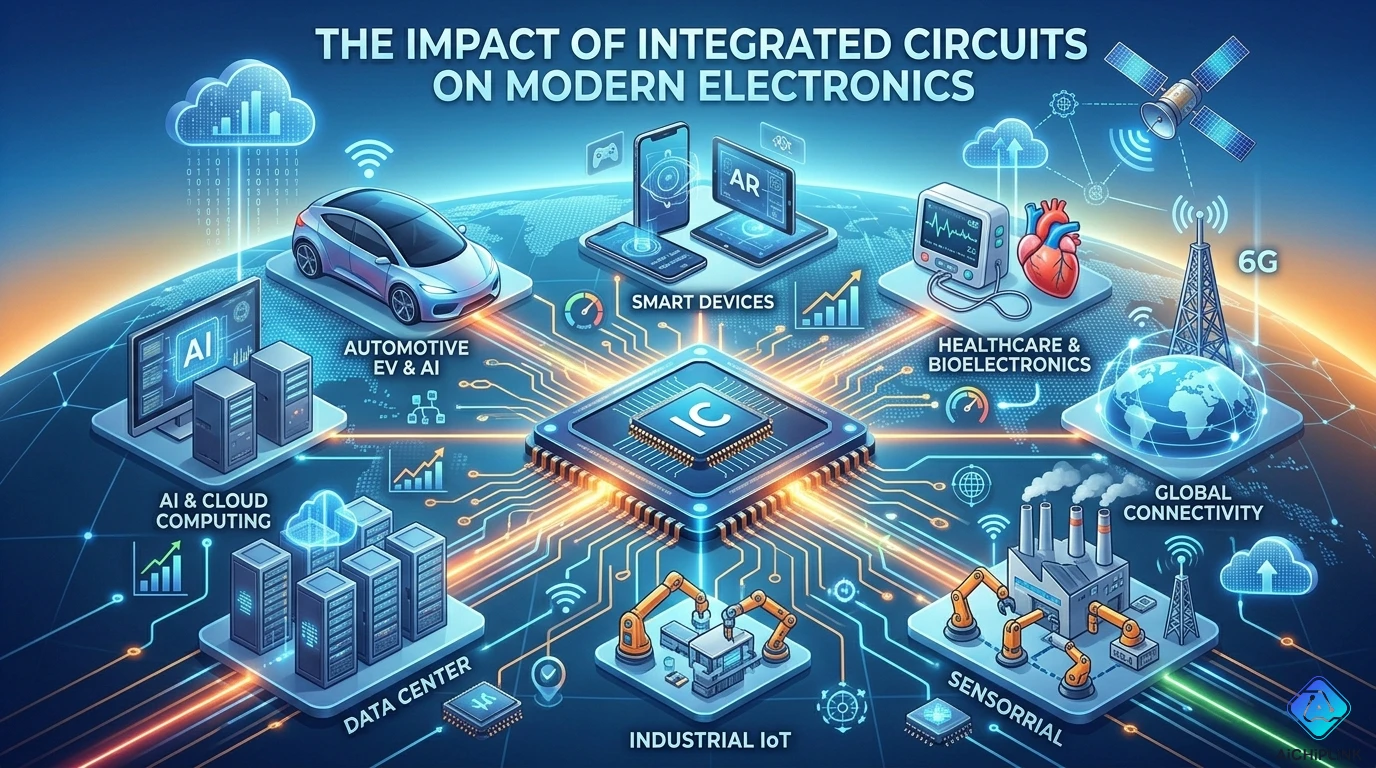
4.0 Four Domains Where ICs Changed Everything
Computing and information processing:
The most direct application. Before ICs, a computer was an institutional resource — something a company or government owned and time-shared across many users. After ICs, computers became personal (1970s–80s), then portable (1990s), then pocket-sized (2000s), then embedded in every device from refrigerators to door locks (2010s–present). The Apple II (1977) contained approximately 4,000 transistors in its CPU. A 2024 iPhone contains approximately 16 billion transistors in its main chip. The functionality gap between those two numbers represents the entire modern information economy.
Communications:
Mobile cellular networks could not exist in their current form without ICs. A 4G LTE base station processes hundreds of megabits per second of radio signal in real time — filtering, demodulating, decoding, error-correcting, and routing millions of simultaneous connections. The digital signal processing required would be physically impossible with discrete components. The baseband processor in a modern smartphone performs approximately 10¹² mathematical operations per second on received radio signals. The integrated circuit made wireless ubiquitous where vacuum tubes made it institutional.
Medicine and healthcare:
Implantable medical devices — cardiac pacemakers, cochlear implants, glucose monitors, neural stimulators — exist because ICs made it possible to put the necessary electronics into a package small enough to implant, at a power level that a small battery can sustain for years. The first implantable pacemaker (1958) was a primitive device the size of a hockey puck. Modern pacemakers contain sophisticated ICs that sense cardiac rhythms, adapt stimulation parameters, and transmit diagnostic data wirelessly to a physician, all within a titanium can roughly the size of a large wristwatch. None of this is possible with discrete components.
Industrial automation and sensing:
Manufacturing robots, precision machine tools, smart sensors, and distributed control systems depend on ICs for both the intelligence (microcontrollers, FPGAs, DSPs) and the interface (ADCs, DACs, communication transceivers). The precision of modern manufacturing — semiconductor fabrication requires positioning accuracy of nanometers over meters of travel — depends on closed-loop control systems implemented in silicon. The IC both builds itself and enables the machines that build it.
5.0 Four Misconceptions About ICs and Their Impact
Misconception 1: "The main impact of ICs was making things smaller"
Miniaturization is the visible manifestation, but it is not the primary impact. The primary impact is the reduction in the complexity barrier to building functional electronic systems. A microcontroller with 100,000 lines of firmware represents a functional complexity that would have required years of discrete-component circuit design in 1965. Today a student with a $4 Arduino board and a few weeks of learning can implement the same functionality. The IC compressed the skill and capital required to create electronics by roughly the same factor as it compressed physical size.
Misconception 2: "Moore's Law is about processor speed"
Moore's Law is specifically about transistor count per chip, not clock frequency or processing speed. Clock speeds plateaued at approximately 3–4 GHz around 2004 due to power density limitations — adding more transistors at the same clock speed produces more heat per unit area than can be dissipated. The response was to use the additional transistors for more cores, more cache, and more specialized hardware rather than faster clocks. Moore's Law continued through transistor count; clock speed did not.
Misconception 3: "Moore's Law has ended"
The original formulation — transistor count doubling every two years — has slowed but not stopped. Doubling periods have lengthened from 2 years to approximately 2.5–3 years for leading-edge nodes (TSMC N3, N2; Intel 18A). More significantly, the techniques used to continue scaling have shifted from simple transistor shrinkage to 3D stacking (FinFET to Gate-All-Around transistors), extreme ultraviolet (EUV) lithography, chiplet architectures connecting multiple dies in one package, and silicon photonics. The pace has slowed; the trajectory has not reversed.
Misconception 4: "Integrated circuits are just faster versions of discrete circuits"
An IC is not a shrunken discrete circuit. The design methodology, reliability characteristics, manufacturing process, and achievable functionality are categorically different. A discrete circuit's reliability is limited by its solder joints and wire connections. An IC's connections are deposited metal with failure rates so low that the relevant failure mechanism is atomic diffusion over decades, not mechanical fatigue over months. An IC can implement circuit topologies — matched differential pairs within microvolts of each other, transistors whose characteristics are identical to parts-per-million precision — that are impossible with discrete components at any size. ICs are a different category of technology, not a scaled version of what came before.
6.0 What an IC Actually Contains: The Architecture Inside
A modern integrated circuit is a structured hierarchy of components built on a silicon substrate using photolithographic processes.
The transistor: The fundamental active element. In modern CMOS (Complementary Metal-Oxide-Semiconductor) ICs, transistors are either NMOS (n-channel) or PMOS (p-channel) MOSFETs — voltage-controlled switches in which a gate voltage controls current flow between source and drain. At TSMC's 3nm process node, a single transistor gate length is approximately 3nm — about 15 silicon atoms across.
Logic gates: Transistors are combined into logic gates (AND, OR, NOT, NAND, NOR, XOR) which form the basis of digital computation. A CMOS NAND gate requires 4 transistors. Every digital function — addition, multiplication, comparison, memory access — is ultimately built from combinations of these gates.
Standard cells: Logic gates are grouped into standard cells — pre-designed, pre-characterized building blocks (flip-flops, multiplexers, adders, memory cells) that are placed and connected by automated design tools (Electronic Design Automation, EDA).
Functional blocks: Standard cells form higher-level functional blocks: ALUs, cache memories, bus interfaces, PLLs, ADCs. These blocks are designed once, verified extensively, and reused across multiple chips.
Metal interconnect layers: Modern chips have up to 15–20 layers of metal interconnects deposited on top of the transistor layer, separated by insulating dielectric. These layers carry signals and power between transistors and blocks. The lowest layers use very thin wires for local connections; upper layers use thicker wires for long-distance routing and power distribution.
7.0 Real Questions About Integrated Circuits
Q: If integrated circuits are so reliable, why do electronics still fail?
A: ICs themselves have extremely low intrinsic failure rates — a well-manufactured IC in normal operating conditions can run for decades without failure. Most electronics failures occur at the system level rather than the chip level: solder joint fatigue from thermal cycling, electrostatic discharge (ESD) damage during handling or use, overvoltage or overcurrent events from power supply failures or lightning, corrosion of PCB traces in humid environments, and firmware bugs that cause software-induced failures. The IC inside a failed device is often still functional — it is the surrounding system that failed. The shift from vacuum tube to IC improved intrinsic component reliability by orders of magnitude; it did not eliminate all the other failure modes in a complete electronic product.
Q: What would a smartphone cost if it had to be built from discrete components instead of ICs?
A: A rough calculation illustrates the scale difference. A modern smartphone application processor contains approximately 16 billion transistors. In the 1960s, discrete transistors cost approximately $5–$10 each in volume. At even $1 per transistor (an optimistic modern discrete pricing): 16 billion × $1 = $16 billion just for the transistors, before any resistors, capacitors, assembly, or enclosure. The actual iPhone application processor chip costs approximately $40–$80 to manufacture in volume. The ratio between discrete-component cost and IC cost for equivalent function is approximately eight to nine orders of magnitude — that is, ICs reduced the cost of transistors by roughly a billion times relative to equivalent discrete components.
Q: What is the difference between an IC and a chip?
A: The terms are used interchangeably in everyday usage. Technically, the "chip" or "die" is the bare piece of silicon containing the transistors and metal layers. The "integrated circuit" refers to the complete functional electronic circuit implemented in that silicon. When the die is packaged (mounted on a substrate, bonded to package leads or balls, and enclosed in epoxy or ceramic), the complete assembly is usually called an IC, chip, or package — all referring to the same device. In professional contexts, "die" refers specifically to the unpackaged silicon, "chip" is informal for the complete packaged device, and "integrated circuit" is the formal technical term.
8.0 Quick Reference Card
The Core Transformation:
| Era | Active Device | Transistors per System | Who Could Build Electronics |
|---|---|---|---|
| 1950s | Vacuum tube | Thousands | Governments, major institutions |
| 1960s | Discrete transistor | Tens of thousands | Large companies, universities |
| 1970s–80s | Early IC | Millions | Electronics companies |
| 1990s–2000s | Advanced IC | Hundreds of millions | Software developers (via microcontrollers) |
| 2010s–present | Modern IC (SoC) | Billions | Individuals (Arduino, Raspberry Pi, cloud) |
Moore's Law in Numbers:
| Year | Milestone chip | Transistor count |
|---|---|---|
| 1971 | Intel 4004 | 2,300 |
| 1993 | Intel Pentium | 3.1 million |
| 2006 | Intel Core 2 Duo | 291 million |
| 2017 | Apple A11 | 4.3 billion |
| 2022 | Apple M2 | 20 billion |
| 2024 | Apple M4 | ~28 billion |
Doubling time: approximately every 2 years (1965–2005), slowing to ~2.5–3 years (2005–present)
IC Types by Function:
| Category | Examples | Primary use |
|---|---|---|
| Digital logic | MCU, CPU, FPGA, DSP | Processing, control |
| Memory | DRAM, Flash, SRAM | Data storage |
| Analog | Op-amps, ADC/DAC, LDO | Signal conditioning, power |
| Mixed-signal | PMICs, codecs, transceivers | Interface between analog/digital |
| RF | Wi-Fi, Cellular, BT chips | Wireless communication |
The Four Impacts — One Line Each:
- Size: Room-sized computers → fingernail-sized chips
- Cost: $1/transistor (discrete) → $0.000000001/transistor (modern IC)
- Reliability: Thousands of solder joints → zero internal connections
- Accessibility: Institution-only → individual-accessible

Written by Jack Elliott from AIChipLink.
AIChipLink, one of the fastest-growing global independent electronic components distributors in the world, offers millions of products from thousands of manufacturers, and many of our in-stock parts is available to ship same day.
We mainly source and distribute integrated circuit (IC) products of brands such as Broadcom, Microchip, Texas Instruments, Infineon, NXP, Analog Devices, Qualcomm, Intel, etc., which are widely used in communication & network, telecom, industrial control, new energy and automotive electronics.
Empowered by AI, Linked to the Future. Get started on AIChipLink and submit your RFQ online today!
Frequently Asked Questions
Why are integrated circuits considered more important than just miniaturization?
Integrated circuits are more important than simple miniaturization because they dramatically reduced the cost, complexity, and expertise required to build electronic systems. Instead of manually connecting hundreds of separate components, engineers could use a single chip containing thousands or billions of transistors, making electronics more reliable, affordable, and accessible for individuals, startups, and small businesses rather than only governments and large corporations.
How did integrated circuits improve reliability compared to vacuum tubes and discrete components?
Integrated circuits improved reliability by eliminating thousands of physical solder joints, wires, and mechanical connections that commonly failed in older systems. Since transistors and interconnections are built directly onto silicon during manufacturing, ICs have far fewer failure points, lower heat generation, and much longer operational life compared to vacuum tubes and hand-assembled discrete transistor circuits.
What is Moore’s Law and why does it matter for integrated circuits?
Moore’s Law is the observation that the number of transistors on an integrated circuit roughly doubles every two years, leading to exponential improvements in performance and cost efficiency. This matters because it enabled continuous advances in computing power, memory capacity, mobile devices, artificial intelligence, and cloud infrastructure while making electronics smaller, faster, and cheaper over several decades.
What industries were most transformed by integrated circuits?
Integrated circuits transformed computing, telecommunications, healthcare, and industrial automation more than any other sectors. Personal computers, smartphones, pacemakers, factory robots, automotive control systems, and wireless communication networks all depend on IC technology because discrete components could never provide the size, speed, efficiency, and reliability required for these modern applications.
What is the difference between an integrated circuit and a chip?
In everyday use, integrated circuit and chip usually mean the same thing, but technically they are slightly different. The “chip” or “die” refers to the physical piece of silicon containing transistors and metal layers, while the “integrated circuit” refers to the complete electronic function created on that silicon. Once packaged for practical use, both terms are commonly used interchangeably in electronics and semiconductor industries.