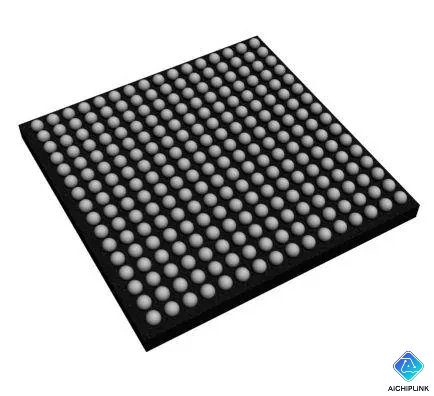
In the early 2000s, Xilinx released the Virtex®-II family, a pivotal generation that introduced high-performance embedded multipliers and shifted the core voltage standard to 1.5V.
The XC2V500-5FGG456C is one of the most common members of this family. Found in everything from legacy telecom switches to older ultrasound machines, this chip is still actively sourced for maintenance and repair.
However, replacing a 20-year-old FPGA isn't simple. You need the right power rails, the right software, and the right soldering profile. This guide covers the essentials.
Table of Contents
- 1. Decoding the Part Number: What "FGG" Means
- 2. Technical Specs: The 1.5V Evolution
- 3. Software Compatibility: ISE Is King
- 4. Hardware Considerations: FGG456 Package
- 5. Conclusion
1. Decoding the Part Number: What "FGG" Means
Understanding the suffix is crucial for environmental compliance and soldering profiles.
The Breakdown Matrix
| Segment | Code | Meaning |
|---|---|---|
| XC2V | Virtex-II | The 2nd Generation Virtex Family (1.5V Core). |
| 500 | Density | 500,000 System Gates (Approx. 6,000 Logic Cells). |
| -5 | Speed Grade | Standard Performance. (-6 is faster, -4 is slower). |
| FGG | Package | Pb-Free (RoHS) Fine-Pitch BGA. (Standard "FG" contains Lead). |
| 456 | Pin Count | 456 Balls (1.00mm pitch). |
| C | Temp | Commercial (0°C to 85°C). |
Important Distinction: If your Bill of Materials (BOM) calls for XC2V500-5FG456C (no extra 'G'), that is the Leaded version. The FGG version is the direct Lead-Free replacement. They are functionally identical, but require different soldering temperatures.
Price Analysis & Sourcing
This is an Obsolete part.
Procurement Tip: Be wary of re-marked chips in the market. [Check Stock for XC2V500-5FGG456C at Aichiplink] to find verified inventory from trusted legacy distributors.
2. Technical Specs: The 1.5V Evolution
The Virtex-II marked a major shift in FPGA power architecture compared to its predecessors.
- Core Voltage ($V_{CCINT}$): 1.5 V.
- History: Original Virtex was 2.5V. Virtex-E was 1.8V. Virtex-II dropped this to 1.5V to reduce power consumption and increase switching speed.
- I/O Voltage ($V_{CCIO}$): Supports 3.3V, 2.5V, 1.8V, and 1.5V standards (bank dependent).
- Multipliers: Features 18-bit x 18-bit dedicated hardware multipliers, making it the first Xilinx FPGA truly capable of heavy DSP tasks.
Power Rail Criticality
Do not supply 1.8V or 2.5V to the Core. Applying the voltages from an older Virtex-E design to this chip will permanently damage it. You must design the board with a dedicated 1.5V regulator.
3. Software Compatibility: ISE Is King
If you try to open a Virtex-II project in the modern Vivado Design Suite, it will fail. Vivado architecture support starts at the 7-Series.
Required Software: Xilinx ISE Design Suite.
- Version: ISE 14.7 is the final release supporting this chip.
- OS Compatibility: ISE 14.7 was designed for Windows 7. For Windows 10/11, you generally need to use the ISE 14.7 VM (Virtual Machine) version provided by Xilinx, or run it inside a Linux VM.
- Programming: Use a Platform Cable USB II (Model DLC10) with the legacy drivers included in the ISE install.
4. Hardware Considerations: FGG456 Package
The FGG456 is a Fine-Pitch Ball Grid Array with Pb-Free (SAC305) solder balls.
- Pitch: 1.00 mm. This is relatively easy to route compared to modern 0.8mm or 0.5mm BGAs.
- Size: 23mm x 23mm body.
Reflow Profile Warning
- FGG (Pb-Free): Requires a peak reflow temperature of ~245°C - 260°C.
- FG (Leaded): Requires a peak reflow temperature of ~215°C - 225°C.
- Danger: Do not use a Leaded profile for the FGG part; the balls won't melt properly (Cold Joint). Do not use a Pb-Free profile for the FG part; you might overheat and damage the die.
Handling Moisture (MSL)
Legacy chips are often New Old Stock (NOS) sitting on shelves for 10+ years. Mandatory Step: You MUST bake the chips (typically 125°C for 24 hours) before reflow to remove absorbed moisture. Skipping this step leads to "popcorning" (package cracking) during the soldering process due to steam expansion.
5. Conclusion
The Xilinx XC2V500-5FGG456C is a testament to the longevity of the Virtex architecture. While it lacks the massive capacity of today's Versal chips, its 1.5V core and embedded multipliers make it irreplaceable in specific legacy systems. By matching the correct ISE software environment and respecting strict reflow profiles, you can keep these systems running for another decade.
Sourcing Legacy Xilinx FPGAs Need to repair a critical system? Visit Aichiplink.com to search for Virtex-II XC2V500 and other obsolete FPGA components.

Written by Jack Elliott from AIChipLink.
AIChipLink, one of the fastest-growing global independent electronic components distributors in the world, offers millions of products from thousands of manufacturers, and many of our in-stock parts is available to ship same day.
We mainly source and distribute integrated circuit (IC) products of brands such as Broadcom, Microchip, Texas Instruments, Infineon, NXP, Analog Devices, Qualcomm, Intel, etc., which are widely used in communication & network, telecom, industrial control, new energy and automotive electronics.
Empowered by AI, Linked to the Future. Get started on AIChipLink.com and submit your RFQ online today!
Frequently Asked Questions
What is XC2V500-5FGG456C used for?
It is a Virtex-II FPGA commonly used in legacy telecom, industrial, and medical systems.
What core voltage does XC2V500 require?
The core voltage (VCCINT) is 1.5V, which is critical for proper operation.
Is XC2V500 supported by Vivado?
No. This FPGA requires Xilinx ISE Design Suite, with ISE 14.7 being the last supported version.
What does the FGG456 package mean?
FGG456 indicates a 456-ball lead-free (RoHS) BGA package with a 1.0 mm pitch.
Is XC2V500-5FGG456C obsolete?
Yes. It is an obsolete part, mainly sourced today for maintenance and replacement projects.