Introduction
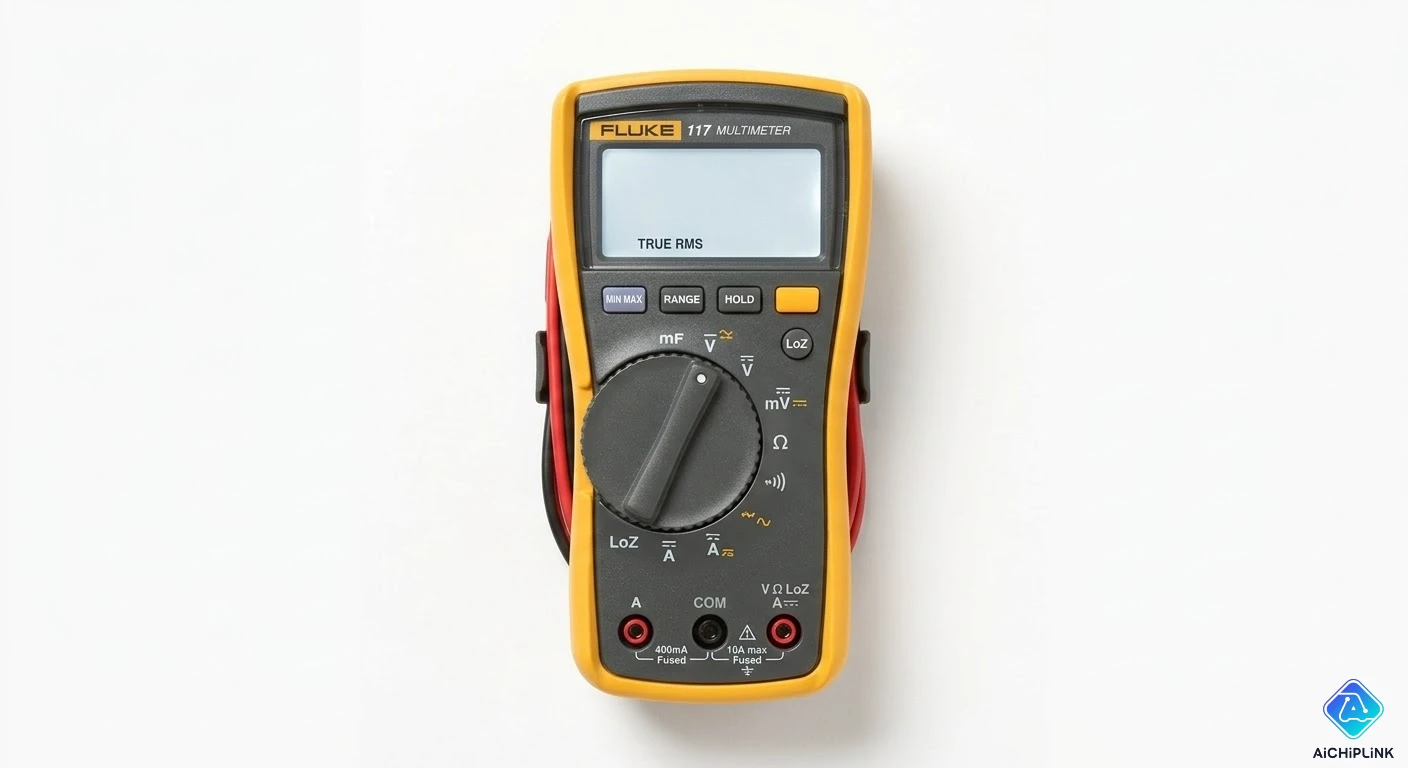
The Fluke 117 Electrician's Multimeter represents the sweet spot in Fluke's professional lineup—combining essential features for residential and commercial electrical work without the premium price of industrial models like the 87V. Priced around $200-250, it targets electricians, HVAC technicians, and maintenance professionals who need reliable measurements, integrated non-contact voltage (NCV) detection, and Fluke's legendary build quality. But is it worth the investment compared to the cheaper Fluke 115 ($150) or budget alternatives? This comprehensive review analyzes specifications, real-world performance, and value proposition.
Key Features & Specifications
Core Specifications
| Specification | Fluke 117 |
|---|---|
| DC Voltage | 600V (0.5% accuracy) |
| AC Voltage (True RMS) | 600V (1.0% accuracy) |
| DC Current | 10A (1.0% accuracy) |
| AC Current | 10A (1.5% accuracy) |
| Resistance | 40 MΩ (0.9% accuracy) |
| Capacitance | 1000 μF |
| Frequency | 50 kHz |
| Temperature | Not available |
| Display | 6000-count backlit LCD |
| Safety Rating | CAT III 600V |
| Battery | 9V (400+ hours typical) |
Unique Features
1. Non-Contact Voltage (VoltAlert™):
- Integrated NCV detection (90-600V AC)
- Audible and visual alerts
- No separate tool needed
- Critical safety feature for electricians
2. AutoVolt Function:
- Automatically selects AC or DC voltage
- Eliminates need to pre-select measurement type
- Speeds up troubleshooting workflow
3. Low Input Impedance (LoZ):
- Prevents false readings from ghost voltages
- Essential for troubleshooting residential wiring
- Eliminates stray capacitance issues
4. True RMS:
- Accurate measurements on non-sinusoidal waveforms
- Critical for modern electronic loads (VFDs, switching power supplies)
5. Min/Max/Average:
- Records fluctuations over time
- Useful for intermittent fault diagnosis
Performance Analysis
Accuracy & Reliability
DC Voltage (±0.5%):
- Excellent for automotive (12V: ±0.06V)
- Control circuit troubleshooting
- Battery testing
AC Voltage (±1.0% True RMS):
- Sufficient for 120/240V mains (±1.2V/2.4V)
- Good for HVAC and residential electrical
- Slightly less accurate than Fluke 87V (±0.7%)
Current Measurement:
- 10A max (adequate for branch circuits)
- Not suitable for >10A loads (use clamp meter)
- 1.5% AC accuracy typical for basic work
Non-Contact Voltage Detection
VoltAlert Performance:
- Detection range: 90-1000V AC (spec says 600V, real-world higher)
- Sensitivity: Excellent (detects through wire insulation)
- False positives: Rare in proper use
- Real-world value: Eliminates separate NCV tool ($20-40 savings)
Usage Tips:
- Hold meter tip near wire/outlet
- Audible beep + LED flash indicates voltage
- Not for precise voltage measurement (use probes)
Build Quality & Ergonomics
Construction:
- Rugged overmolded case
- Drop-resistant (1-meter rated)
- Sealed against dust/water (IP rating not specified, but good splash resistance)
- Field durability: Excellent (typical Fluke robustness)
User Interface:
- Large, backlit display (readable in dark enclosures)
- Tactile dial with positive detents
- Input jacks clearly labeled
- Ease of use: Intuitive for experienced users
Comparison with Competitors
Fluke 117 vs Fluke 115
| Feature | Fluke 117 | Fluke 115 |
|---|---|---|
| Price | $200-250 | $150-180 |
| VoltAlert (NCV) | ✅ Yes | ❌ No |
| LoZ Mode | ✅ Yes | ❌ No |
| AutoVolt | ✅ Yes | ❌ No |
| True RMS | ✅ Yes | ✅ Yes |
| Capacitance | 1000 μF | 1000 μF |
| Temperature | ❌ No | ✅ Yes (-200-1090°C) |
| Best For | Electricians | HVAC technicians |
Verdict: Fluke 117 worth $50-70 premium for electricians (VoltAlert + LoZ critical). Fluke 115 better for HVAC (temperature measurement).
Fluke 117 vs Fluke 87V
| Feature | Fluke 117 | Fluke 87V |
|---|---|---|
| Price | $200-250 | $400-450 |
| AC Voltage Accuracy | 1.0% | 0.7% |
| Frequency Range | 50 kHz | 200 kHz |
| Temperature | ❌ No | ✅ Yes |
| Min/Max Recording | Basic | Advanced (250 hrs) |
| Duty Cycle | ❌ No | ✅ Yes |
| Best For | Residential/commercial | Industrial/R&D |
Verdict: Fluke 87V overkill for most electricians. Choose 87V only for industrial environments requiring ±0.7% accuracy or advanced logging.
Fluke 117 vs Budget Alternatives
| Meter | Price | True RMS | NCV | Accuracy | Warranty |
|---|---|---|---|---|---|
| Fluke 117 | $220 | ✅ | ✅ | 0.5% DC | Lifetime |
| Klein MM600 | $80 | ✅ | ❌ | 0.5% DC | 2 years |
| Amprobe AM-530 | $120 | ✅ | ❌ | 0.5% DC | 3 years |
| Extech EX330 | $50 | ✅ | ❌ | 1.0% DC | 2 years |
Verdict: Budget meters save $100-170 but lack integrated NCV, LoZ mode, and Fluke's lifetime warranty/reliability.
Pros & Cons
Advantages
✅ Integrated VoltAlert (NCV): Eliminates separate tool, saves time and money
✅ LoZ Mode: Eliminates ghost voltage false readings
✅ True RMS: Accurate on modern electronic loads
✅ AutoVolt: Speeds troubleshooting workflow
✅ Fluke Build Quality: Rugged, reliable, lifetime warranty
✅ 6000-Count Display: Good resolution for electrical work
✅ Backlit Display: Essential for panel/attic work
✅ Long Battery Life: 400+ hours typical
Disadvantages
❌ No Temperature: Must use separate thermometer (Fluke 115 has it)
❌ 10A Current Limit: Inadequate for large loads (need clamp meter)
❌ No Min/Max Recording Time: Basic implementation vs 87V's 250-hour logging
❌ Price: $220 vs $80 budget alternatives
❌ No Duty Cycle/Pulse Width: Industrial features absent
❌ CAT III 600V Only: Not CAT IV rated (utility work needs higher)
Best Use Cases
Ideal For:
✅ Residential Electricians:
- Troubleshooting 120/240V circuits
- Outlet testing and wiring verification
- Panel diagnostics
- VoltAlert perfect for safety checks
✅ Commercial Electricians:
- Building maintenance
- Lighting troubleshooting
- Control circuit diagnosis
- HVAC electrical (though 115 better with temp)
✅ Maintenance Technicians:
- Facility electrical systems
- Basic HVAC electrical (no temp limits)
- Motor control troubleshooting
✅ Apprentices/Students:
- Learning electrical work with professional tool
- Lifetime warranty protects investment
- Proper safety ratings (CAT III 600V)
Not Ideal For:
❌ Industrial Electricians: Get Fluke 87V for ±0.7% accuracy and advanced features
❌ HVAC Specialists: Fluke 115 better (has temperature measurement)
❌ Automotive Technicians: Consider automotive-specific meter with RPM/dwell
❌ High-Current Work: Need clamp meter for >10A measurements
❌ Utility/Power Generation: Requires CAT IV rating (not CAT III)
Value Assessment
Price Analysis
Current Pricing (2024-2025):
- Fluke 117: $200-250 (typical: $220)
- Fluke 115: $150-180 (typical: $165)
- Fluke 87V: $400-450 (typical: $425)
Cost Breakdown:
- Premium over Fluke 115: $55 (+33%)
- Savings vs Fluke 87V: $205 (-48%)
Is It Worth It?
For Electricians: YES
- VoltAlert saves $30-40 (separate NCV tool)
- LoZ mode critical for residential troubleshooting
- Lifetime warranty vs 2-3 year alternatives
- Total value: $220 - $35 (NCV savings) = $185 effective cost
For HVAC: MAYBE
- Missing temperature measurement (need $20 separate thermometer)
- Fluke 115 ($165 + temp) better value
- Recommendation: Choose Fluke 115 unless you prioritize VoltAlert
For Hobbyists: MAYBE
- $220 expensive for occasional use
- Budget alternatives ($50-120) adequate for non-professional
- Recommendation: Start with Klein MM600 ($80), upgrade if needed
Total Cost of Ownership
5-Year TCO:
- Fluke 117: $220 + $10 batteries = $230
- Budget meter: $80 + $30 replacement (2-year warranty expires) + $10 batteries = $120
- Savings: $110 over 5 years with budget option
- Trade-off: Reliability, accuracy, integrated NCV worth $110 premium?
Professional Use (saves time = money):
- VoltAlert saves 30 seconds/check × 10 checks/day × 200 days/year = 1,000 minutes/year
- At $75/hr labor rate: $1,250/year time savings
- ROI: 2-month payback for professionals
Conclusion
The Fluke 117 Electrician's Multimeter delivers exceptional value for residential and commercial electricians at $220, combining integrated VoltAlert (NCV), LoZ mode for ghost voltage elimination, True RMS accuracy, and Fluke's legendary reliability. While it lacks temperature measurement (vs Fluke 115) and advanced industrial features (vs Fluke 87V), it hits the perfect balance for electrical professionals who prioritize safety, speed, and durability.
Bottom Line:
✅ Buy Fluke 117 if: Electrician needing VoltAlert + LoZ, professional reliability, lifetime warranty
⚠️ Consider Fluke 115 if: HVAC technician requiring temperature measurement
⚠️ Upgrade to Fluke 87V if: Industrial work demanding ±0.7% accuracy and advanced logging
❌ Skip for hobbyists: Budget alternatives ($50-120) adequate for occasional use
Ready to purchase? Visit AiChipLink.com for current pricing and multimeter comparison tools.

Written by Jack Elliott from AIChipLink.
AIChipLink, one of the fastest-growing global independent electronic components distributors in the world, offers millions of products from thousands of manufacturers, and many of our in-stock parts is available to ship same day.
We mainly source and distribute integrated circuit (IC) products of brands such as Broadcom, Microchip, Texas Instruments, Infineon, NXP, Analog Devices, Qualcomm, Intel, etc., which are widely used in communication & network, telecom, industrial control, new energy and automotive electronics.
Empowered by AI, Linked to the Future. Get started on AIChipLink.com and submit your RFQ online today!
Frequently Asked Questions
Is the Fluke 117 worth the money?
For professional electricians, the Fluke 117 offers strong value thanks to features like non-contact voltage detection and LoZ mode, along with the reliability and long-term durability associated with Fluke Corporation.
What is the difference between Fluke 115 and Fluke 117?
The Fluke 117 adds VoltAlert non-contact voltage detection, LoZ mode, and AutoVolt, while the Fluke 115 includes temperature measurement, making it more suitable for HVAC diagnostics.
Does the Fluke 117 measure temperature?
No, the Fluke 117 does not include temperature measurement, so technicians who need temperature readings may prefer the Fluke 115 or a separate thermometer.
How accurate is the Fluke 117?
The Fluke 117 provides approximately ±0.5% accuracy for DC voltage and ±1% for AC voltage, which is sufficient for most residential and commercial electrical troubleshooting.
Can the Fluke 117 measure AC and DC current?
Yes, the Fluke 117 can measure AC and DC current up to 10A, though higher-current applications typically require a clamp meter.