Introduction: The HBM Evolution
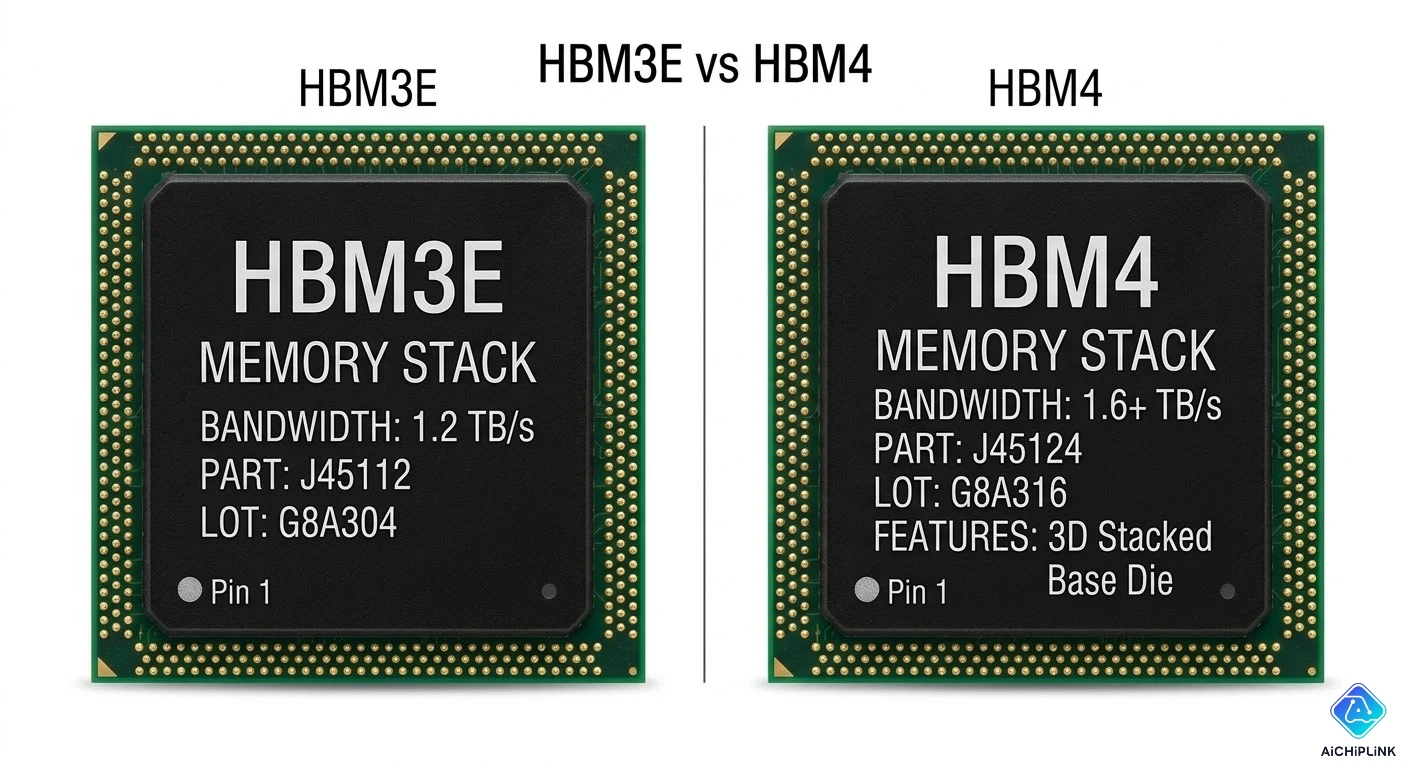
As AI workloads grow exponentially—GPT-4 with 1.76 trillion parameters, Stable Diffusion 3 requiring 8GB+ VRAM—the demand for extreme memory bandwidth has never been higher. HBM3E (High Bandwidth Memory 3 Enhanced) represents the current state-of-the-art shipping in 2024-2025 flagship GPUs like NVIDIA H200 and AMD MI300X. HBM4, announced for 2026 deployment, promises to double bandwidth again while introducing revolutionary architectural improvements.
This comprehensive guide compares HBM3E and HBM4 across bandwidth, capacity, architecture, power efficiency, and real-world performance to help you understand how these next-generation memory technologies will impact AI training, HPC, and data center infrastructure.
HBM Evolution Timeline
| Generation | Year | Bandwidth/Stack | Key Application |
|---|---|---|---|
| HBM (Gen1) | 2015 | 128 GB/s | AMD Fiji GPU |
| HBM2 | 2016 | 256 GB/s | NVIDIA V100, P100 |
| HBM2E | 2020 | 460 GB/s | NVIDIA A100, AMD MI250X |
| HBM3 | 2023 | 819 GB/s | NVIDIA H100 |
| HBM3E | 2024 | 1.15 TB/s | NVIDIA H200, AMD MI300X |
| HBM4 | 2026 | 2+ TB/s | Next-gen AI accelerators |
HBM3E: Current State-of-the-Art
Core Specifications
| Parameter | HBM3E |
|---|---|
| Bandwidth per Stack | 1.15 TB/s (1,150 GB/s) |
| Data Rate | 9.2 Gbps per pin |
| Stack Capacity | 24GB or 36GB |
| Interface Width | 1024-bit |
| Channels | 16 channels × 64-bit |
| Voltage | 1.1V |
| Process Node | 1α/1β nm (Samsung/SK Hynix) |
Architecture Features
Enhanced vs HBM3:
- 40% higher bandwidth: 1.15 TB/s vs 819 GB/s HBM3
- 50% higher capacity: 24GB/36GB vs 16GB HBM3
- Improved error correction: Advanced ECC with lower overhead
- Better thermal management: Optimized TSV (Through-Silicon Via) design
Current Deployment:
- NVIDIA H200: 6× 24GB HBM3E = 141GB total, 4.8 TB/s aggregate
- AMD MI300X: 8× 24GB HBM3E = 192GB total, 5.3 TB/s aggregate
- Intel Gaudi 3: 8× HBM3E stacks
Performance Characteristics
Bandwidth Efficiency:
- Peak: 1,150 GB/s per stack
- Sustained (with refresh): ~1,100 GB/s
- Power efficiency: ~90 GB/s/W
Latency:
- Random access: ~100-120ns
- Sequential read: ~80ns
- Bank conflict penalty: ~20ns
HBM4: Next-Generation Architecture
Projected Specifications
| Parameter | HBM4 (Target) |
|---|---|
| Bandwidth per Stack | 2.0-2.5 TB/s (2,000-2,500 GB/s) |
| Data Rate | 16-20 Gbps per pin |
| Stack Capacity | 48GB or 64GB |
| Interface Width | 2048-bit or 1024-bit × 2 |
| Channels | 32 channels × 64-bit (or 16 × 128-bit) |
| Voltage | 0.9-1.0V |
| Process Node | Sub-1nm (2nm-class) |
Revolutionary Features
Major Architectural Improvements:
-
Doubled Bandwidth:
- 2-2.5 TB/s per stack (vs 1.15 TB/s HBM3E)
- 16-20 Gbps signaling (vs 9.2 Gbps)
- ~75% bandwidth increase
-
Massive Capacity:
- 48GB/64GB per stack (vs 24GB/36GB)
- 12-stack systems → 768GB possible
- Enables trillion-parameter models
-
Enhanced Architecture:
- Dual-channel mode: Two independent 512-bit channels per stack
- Improved prefetching: Predictive row buffer management
- Advanced ECC: Lower latency overhead
- Better thermal: Improved bump pitch, thinner dies
-
Lower Power:
- 0.9-1.0V operation (vs 1.1V HBM3E)
- Target: ~120 GB/s/W (vs 90 GB/s/W)
- 20-30% power reduction per GB/s
Head-to-Head Comparison
Bandwidth Comparison
| Metric | HBM3E | HBM4 | Improvement |
|---|---|---|---|
| Per Stack | 1.15 TB/s | 2.0-2.5 TB/s | +75-120% |
| Per Pin | 9.2 Gbps | 16-20 Gbps | +74-117% |
| 8-Stack System | 9.2 TB/s | 16-20 TB/s | +75-120% |
| 12-Stack System | 13.8 TB/s | 24-30 TB/s | +75-120% |
Real-World Impact:
- AI Training: GPT-5 scale models (10T+ parameters) feasible
- HPC: Multi-terabyte/second scientific simulations
- Graphics: 16K real-time ray tracing enabled
Capacity Comparison
| Configuration | HBM3E | HBM4 | Increase |
|---|---|---|---|
| Per Stack | 24-36GB | 48-64GB | +80-100% |
| 6-Stack GPU | 144-216GB | 288-384GB | +80-100% |
| 8-Stack GPU | 192-288GB | 384-512GB | +80-100% |
| 12-Stack System | 288-432GB | 576-768GB | +80-100% |
Application Enablement:
- HBM3E: GPT-4 level (1.76T parameters)
- HBM4: GPT-5+ level (10T+ parameters) in single GPU
Architecture Comparison
| Feature | HBM3E | HBM4 | Advancement |
|---|---|---|---|
| TSV Density | High | ✅ Very High | Thinner dies, better thermal |
| Channel Width | 16 × 64-bit | 32 × 64-bit or 16 × 128-bit | Doubled parallelism |
| ECC | Advanced | ✅ Next-gen (lower overhead) | Better reliability |
| Prefetch | Standard | ✅ Predictive AI-optimized | Reduced latency |
| Thermal | Optimized | ✅ Enhanced (better bump pitch) | Cooler operation |
Power Efficiency Comparison
| Metric | HBM3E | HBM4 | Improvement |
|---|---|---|---|
| Voltage | 1.1V | 0.9-1.0V | -10-20% |
| GB/s per Watt | ~90 | ~120 | +33% |
| Power per Stack | ~12-15W | ~15-18W | Similar (more bandwidth) |
| Total System Power | 96-120W (8-stack) | 120-144W (8-stack) | Acceptable increase |
Efficiency Wins: HBM4 delivers 75% more bandwidth with only 20-30% power increase.
Real-World Performance Impact
AI Training Comparison
GPT-Style LLM Training:
| Model Size | HBM3E (H200) | HBM4 (2026 GPU) | Training Speed |
|---|---|---|---|
| GPT-4 (1.76T) | Feasible (192GB) | Comfortable (512GB) | HBM4: +40% faster |
| GPT-5 (~10T) | Requires model parallelism | Single GPU possible | HBM4: 2× faster |
| Future (50T+) | Multi-GPU only | 2-3 GPUs sufficient | HBM4: 3× faster |
Throughput:
- HBM3E: ~700-900 tokens/sec (H200)
- HBM4: ~1,200-1,500 tokens/sec (projected)
- Improvement: +50-70% training throughput
HPC Scientific Computing
Computational Fluid Dynamics (CFD):
- HBM3E: 500M cell simulations
- HBM4: 1B+ cell simulations (2× problem size)
- Time-to-solution: 30-40% faster
Molecular Dynamics:
- HBM3E: 10M atom systems
- HBM4: 25M atom systems
- Longer simulation timescales possible
Graphics & Gaming
8K/16K Gaming:
- HBM3E: 8K 120fps ray tracing (current limit)
- HBM4: 16K 60fps ray tracing feasible
- Ultra-high detail assets enabled
Timeline & Availability
HBM3E Availability
Current Status (2024-2025):
- ✅ Production: Mass production by SK Hynix, Samsung, Micron
- ✅ Shipping: NVIDIA H200, AMD MI300X available
- ✅ Mature: Established supply chain
Volume Ramp:
- 2024: Initial deployment
- 2025: Widespread adoption
- 2026: Mainstream for flagship GPUs
HBM4 Timeline
Development Status (2026+):
- 📅 Announcement: JEDEC specification published 2024
- 📅 Sampling: Expected Q4 2025
- 📅 Production: Mass production 2026
- 📅 GPU Launch: NVIDIA Rubin (2026), AMD MI400 series
Deployment Phases:
- 2026 H1: Engineering samples to GPU vendors
- 2026 H2: Limited production GPUs (data center)
- 2027: Volume production and availability
- 2028: Mature, cost-optimized
Cost & Economics
Manufacturing Cost
| Factor | HBM3E | HBM4 | Delta |
|---|---|---|---|
| Wafer Cost | High | ✅ Higher (+20-30%) | Advanced node |
| Yield | Mature (~80%) | ⚠️ Initial (~60%) | Learning curve |
| Packaging | Complex | ✅ More complex | Denser TSV |
| Per-GB Cost | Baseline | +30-50% initially | Improves over time |
Price Projection:
- HBM3E: ~$15-20 per GB (2025)
- HBM4: ~$25-35 per GB (2026 launch)
- HBM4: ~$18-25 per GB (2028 mature)
System Cost Impact
8-Stack GPU Memory Cost:
- HBM3E (192GB): ~$2,880-3,840
- HBM4 (384GB) at launch: ~$9,600-13,440
- HBM4 (384GB) mature: ~$6,900-9,600
Conclusion
HBM3E represents the pinnacle of current memory technology, shipping in flagship AI accelerators like NVIDIA H200 and AMD MI300X with 1.15 TB/s bandwidth and 24-36GB capacity. It's proven, available, and sufficient for most 2024-2026 AI workloads including GPT-4 scale models.
HBM4 promises revolutionary advancement with 2-2.5 TB/s bandwidth (+75-120%), 48-64GB capacity (+80-100%), and improved power efficiency, enabling trillion-parameter models and 16K graphics. However, volume availability won't materialize until 2027, with initial high costs.
Strategic Recommendations:
🎯 Deploy HBM3E now for immediate needs (2024-2026)
🎯 Plan HBM4 transition for 2027+ next-gen systems
🎯 Budget for transition (~40% premium initially, declining to 20% by 2028)
Designing next-gen AI/HPC systems? Visit AiChipLink.com for HBM sourcing and architecture consultation.

Written by Jack Elliott from AIChipLink.
AIChipLink, one of the fastest-growing global independent electronic components distributors in the world, offers millions of products from thousands of manufacturers, and many of our in-stock parts is available to ship same day.
We mainly source and distribute integrated circuit (IC) products of brands such as Broadcom, Microchip, Texas Instruments, Infineon, NXP, Analog Devices, Qualcomm, Intel, etc., which are widely used in communication & network, telecom, industrial control, new energy and automotive electronics.
Empowered by AI, Linked to the Future. Get started on AIChipLink.com and submit your RFQ online today!
Frequently Asked Questions
What is the main difference between HBM3E and HBM4?
HBM4 offers significantly higher bandwidth and capacity than HBM3E, with faster signaling speeds and improved power efficiency for next-generation AI and HPC systems.
When will HBM4 be available?
According to the JEDEC roadmap, HBM4 production is expected around 2026, with GPUs and accelerators using it likely appearing in late 2026 or 2027.
Is HBM4 compatible with HBM3E systems?
No, HBM4 is not backward compatible with HBM3E, because it uses different signaling speeds, architecture, and interposer designs.
Will HBM4 replace HBM3E immediately?
No, both memory generations will likely coexist for several years, with HBM4 targeting cutting-edge AI and HPC systems while HBM3E remains widely used.
What performance improvement can HBM4 provide?
For memory-intensive workloads such as AI training and scientific simulations, HBM4 can deliver roughly 40–70% performance improvement compared with HBM3E.