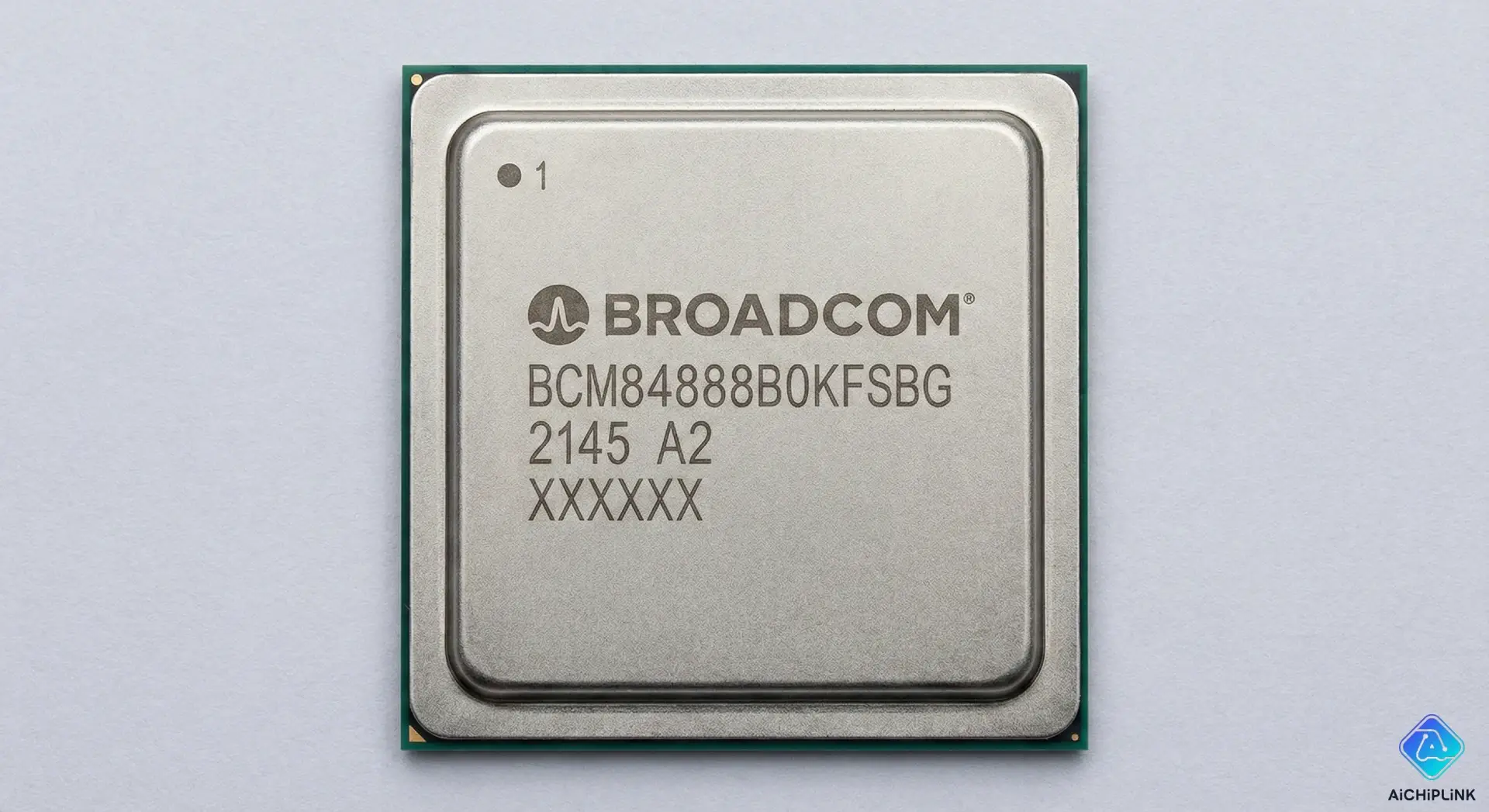
The transition from Gigabit to 10-Gigabit Ethernet in the enterprise campus has traditionally been slowed by cabling costs. However, the Broadcom BCM84888B0KFSBG shatters this barrier. As a high-performance Quad-Port 10GBASE-T Transceiver (PHY), it enables high-speed connectivity over existing twisted-pair copper cabling.
Designed for high-density switches and server network interface cards (NICs), the BCM84888 is not just about speed. It integrates advanced security via MACsec and supports NBASE-T standards (2.5G/5G), making it the ultimate bridge between legacy infrastructure and next-gen bandwidth.
Table of Contents
- BCM84888B0KFSBG Datasheet & Key Specifications
- Security Architecture: Integrated MACsec
- Interface & Hardware Design
- Energy Efficiency (EEE)
- Conclusion
BCM84888B0KFSBG Datasheet & Key Specifications
The BCM84888B0KFSBG belongs to Broadcom's latest generation of copper PHYs built on a highly efficient 28nm or smaller process node.
- BCM84888: Quad-Port (4-channel) 10GBASE-T PHY.
- B0: Silicon Revision.
- KFSBG: BGA Package.
Key Specifications Table
| Feature | Specification |
|---|---|
| Port Count | 4 Ports (Quad) |
| Supported Speeds | 10G, 5G, 2.5G, 1000BASE-T, 100BASE-TX |
| Standard Compliance | IEEE 802.3an (10G), 802.3bz (2.5G/5G), NBASE-T |
| Host Interface | XFI, USXGMII, 5G/2.5G-XFI |
| Security | IEEE 802.1AE MACsec (128/256-bit) |
| Cable Reach | 100m on Cat6a (10G) |
NBASE-T & Multi-Gigabit Support
A standout feature of the BCM84888 is its support for NBASE-T (IEEE 802.3bz).
- The Problem: Many older buildings have Cat5e or Cat6 cabling that cannot reliably support 10Gbps over long distances.
- The Solution: This PHY can negotiate speeds of 2.5 Gbps or 5 Gbps over these legacy cables. This allows IT managers to upgrade Wi-Fi 6 access point speeds without ripping and replacing miles of copper cabling.
Price Analysis & Stock Availability
Due to the complexity of mixed-signal silicon (analog front end + digital DSP), high-end PHYs like the BCM84888 are premium components.
Note: Sourcing reliable Broadcom networking silicon is critical for production continuity. [Check Stock for BCM84888B0KFSBG at Aichiplink] to browse inventory from verified global distributors.
Security Architecture: Integrated MACsec
In an era of Zero Trust networking, physical layer security is paramount.
Integrated IEEE 802.1AE MACsec
The BCM84888 integrates Media Access Control Security (MACsec) hardware engines on all four ports.
- Line-Rate Encryption: It performs AES-128 or AES-256 encryption/decryption at full wire speed (10Gbps) without adding significant latency.
- Edge Protection: This ensures that data is encrypted from the moment it leaves the server NIC or the access switch port, protecting against passive wiretapping or Man-in-the-Middle attacks within the LAN. For more on how this protocol protects layer 2, see the Wikipedia article on MACsec.
Interface & Hardware Design
USXGMII & XFI Host Interfaces
To connect to the switch ASIC (MAC), the BCM84888 offers flexible interfaces:
- XFI: A standard single-lane 10G serial interface.
- USXGMII (Universal Serial 10GE Media Independent Interface): Allows for single-lane connectivity that can auto-negotiate between 10M and 10G, simplifying the board layout by reducing trace counts compared to older XAUI interfaces.
Thermal Management for Quad-Port PHYs
10GBASE-T PHYs are notoriously power-hungry due to the complex DSP required to cancel crosstalk and echo over copper wires.
- Heat Dissipation: Although the BCM84888 is highly efficient (often <2.5W per port), a quad-port configuration concentrates ~10W of heat in a small BGA footprint.
- Design Consideration: A robust thermal solution is required. This typically involves a heatsink with a high-performance Thermal Interface Material (TIM) and possibly forced-air cooling. For fundamentals on managing power density, refer to EEPower's Thermal Management Guide.
Energy Efficiency (EEE)
The chip supports Energy Efficient Ethernet (IEEE 802.3az).
- Low Power Idle (LPI): When no data is being transmitted, the PHY enters a sleep mode, consuming significantly less power.
- Short Reach Mode: It can automatically detect shorter cable lengths (<30m) and reduce transmit power accordingly, further lowering the thermal budget.
Conclusion
The BROADCOM BCM84888B0KFSBG is a versatile workhorse for modern enterprise networks. By combining multi-gigabit flexibility with ironclad MACsec security, it enables network upgrades that are both future-proof and secure.
Sourcing Broadcom Networking Components Don't let component shortages stall your deployment. Visit Aichiplink.com to search for BCM84888B0KFSBG and other high-performance networking ICs from trusted suppliers.

Written by Jack Elliott from AIChipLink.
AIChipLink, one of the fastest-growing global independent electronic components distributors in the world, offers millions of products from thousands of manufacturers, and many of our in-stock parts is available to ship same day.
We mainly source and distribute integrated circuit (IC) products of brands such as Broadcom, Microchip, Texas Instruments, Infineon, NXP, Analog Devices, Qualcomm, Intel, etc., which are widely used in communication & network, telecom, industrial control, new energy and automotive electronics.
Empowered by AI, Linked to the Future. Get started on AIChipLink.com and submit your RFQ online today!
Frequently Asked Questions
Can BCM84888 run 10G over Cat5e?
Generally, no. 10GBASE-T requires Cat6a or Cat7 for full 100m reach. However, over very short distances of Cat5e (<30m), it *might* link up, but it is not guaranteed. For Cat5e/Cat6, the PHY will typically negotiate to 2.5G or 5G (NBASE-T).
Does this chip require external magnetics?
Yes, like all Ethernet PHYs, the BCM84888 requires discrete magnetic modules (transformers) or RJ45 connectors with integrated magnetics (MagJacks) to provide isolation and signal conditioning.
What is the difference between BCM84888 and BCM84848?
The BCM84848 is an older generation (28nm) Quad 10G PHY. The BCM84888 (often built on a newer process) adds robust support for 2.5G/5G (802.3bz) which was not fully standardized in earlier generations, and offers better power efficiency.
Is the B0 revision compatible with A0?
"B0" usually fixes errata found in "A0". While pin-compatible, firmware drivers (PHY firmware) often need to be updated to recognize the new revision ID and load the appropriate patches.
Does it support PTP (Precision Time Protocol)?
Most high-end Broadcom PHYs in this class support IEEE 1588v2 PTP timestamping, which is essential for synchronizing clocks in financial trading or telecom networks.