Introduction
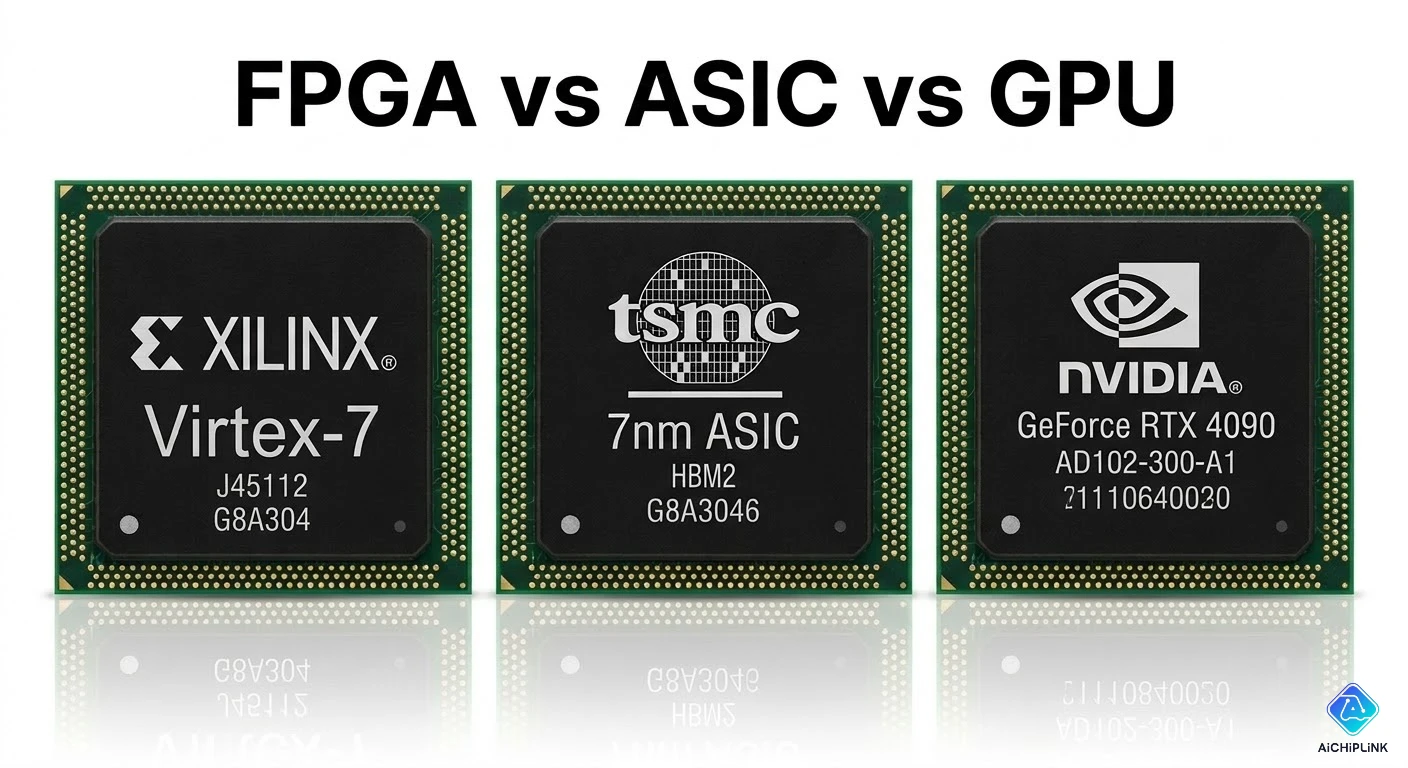
Choosing between FPGA (Field-Programmable Gate Array), ASIC (Application-Specific Integrated Circuit), and GPU (Graphics Processing Unit) is one of the most critical decisions in hardware acceleration projects. Each technology offers unique advantages for different workloads—from AI training and cryptocurrency mining to network processing and scientific computing. This comprehensive guide compares all three technologies across performance, cost, power efficiency, development time, and flexibility to help you make the optimal choice for your specific requirements.
Understanding Each Technology
FPGA: Field-Programmable Gate Array
What is FPGA? FPGAs are reconfigurable semiconductor devices containing programmable logic blocks and interconnects that can be configured "in the field" after manufacturing to implement custom digital circuits.
Core Characteristics:
- Reprogrammable hardware: Logic can be reconfigured unlimited times
- Parallel processing: Custom pipelines for specific algorithms
- Low latency: Deterministic execution with nanosecond response
- Flexibility: Adapt to changing standards/algorithms
Leading Manufacturers: Xilinx (AMD), Intel (Altera), Lattice, Microchip
ASIC: Application-Specific Integrated Circuit
What is ASIC? ASICs are custom silicon chips designed and optimized for one specific application, manufactured in high volume with fixed functionality.
Core Characteristics:
- Maximum performance: Purpose-built for single task
- Highest efficiency: Optimized power consumption
- Fixed function: Cannot be reprogrammed
- High NRE cost: Multi-million dollar development
Examples: Bitcoin mining chips (Antminer), Google TPU, Apple M-series neural engines
GPU: Graphics Processing Unit
What is GPU? GPUs are parallel processors originally designed for graphics rendering, now widely used for general-purpose computing (GPGPU) with thousands of cores executing identical operations on different data.
Core Characteristics:
- Massive parallelism: Thousands of cores (e.g., NVIDIA A100: 6,912 CUDA cores)
- Software programmable: CUDA, OpenCL, ROCm frameworks
- Mature ecosystem: Extensive libraries and tools
- General purpose: Single GPU serves multiple workloads
Leading Providers: NVIDIA (dominant), AMD, Intel
Head-to-Head Comparison
Performance Comparison
| Metric | FPGA | ASIC | GPU |
|---|---|---|---|
| Peak Performance | Moderate | ✅ Highest | High |
| Latency | ✅ Lowest (<1μs) | Very Low | Moderate (ms) |
| Throughput | Task-dependent | ✅ Maximum | Very High |
| Efficiency (OPs/W) | High | ✅ Highest | Moderate |
Performance Analysis:
- ASICs achieve 10-100× better performance/watt than GPUs for specific tasks (e.g., Bitcoin mining: ASIC ~100 TH/s/kW vs GPU ~0.1 TH/s/kW)
- FPGAs excel at low-latency streaming (network packet processing: 100ns FPGA vs 10ms GPU)
- GPUs dominate matrix multiplication (AI training: A100 delivers 312 TFLOPS FP16)
Cost Comparison
| Factor | FPGA | ASIC | GPU |
|---|---|---|---|
| Unit Cost | $1K-$10K | $10-$100 (volume) | $500-$30K |
| NRE (Development) | ✅ $100K-$500K | ❌ $5M-$100M+ | ✅ $0 (software only) |
| Time-to-Market | ✅ 3-12 months | ❌ 18-36 months | ✅ Weeks |
| Minimum Volume | ✅ 1 unit | ❌ 10K+ units | ✅ 1 unit |
Cost Analysis:
- GPUs win for <10K unit projects (zero NRE, off-the-shelf)
- FPGAs optimal for 100-10K units or evolving requirements
- ASICs economical only at >100K units due to $5M-$100M NRE
Power Efficiency Comparison
| Application | FPGA | ASIC | GPU |
|---|---|---|---|
| Cryptocurrency Mining | 50-100 MH/s/W | ✅ 1000+ MH/s/W | 2-5 MH/s/W |
| AI Inference | 50-200 GOP/W | ✅ 500-1000 GOP/W | 20-100 GOP/W |
| Network Processing | ✅ 100-500 Gbps/W | N/A | 10-50 Gbps/W |
Efficiency Ranking: ASIC > FPGA > GPU (for optimized tasks)
Flexibility & Adaptability
| Feature | FPGA | ASIC | GPU |
|---|---|---|---|
| Reprogrammability | ✅ Unlimited | ❌ None | ✅ Software updates |
| Algorithm Changes | ✅ Full support | ❌ Fixed | ✅ Full support |
| Multi-Application | ⚠️ Time-multiplexed | ❌ Single purpose | ✅ Native support |
| Update Mechanism | Firmware/bitstream | ❌ Hardware redesign | Software/drivers |
Flexibility Winner: GPU > FPGA > ASIC
Decision Framework
Choose FPGA When:
✅ Low latency critical (e.g., high-frequency trading: <1μs required)
✅ Custom protocols/interfaces (e.g., proprietary video codecs)
✅ Algorithm evolving (e.g., cryptographic standards changing)
✅ Medium volume (100-10,000 units)
✅ Deterministic timing (e.g., industrial control, aerospace)
✅ Unique I/O requirements (e.g., 400G Ethernet, custom sensors)
Example Use Cases:
- Network acceleration (firewalls, DPI, load balancers)
- HFT (high-frequency trading) systems
- 5G baseband processing
- Medical imaging (CT/MRI reconstruction)
- Video transcoding (broadcast equipment)
Choose ASIC When:
✅ Performance paramount (e.g., Bitcoin mining competition)
✅ Power efficiency critical (e.g., edge AI inference in battery devices)
✅ High volume (>100,000 units over 3-5 years)
✅ Mature, stable algorithm (e.g., SHA-256 hashing unchanged since 2008)
✅ Lowest cost per unit (e.g., consumer electronics)
✅ Long product lifecycle (5+ years with minimal changes)
Example Use Cases:
- Cryptocurrency mining (Bitcoin, Litecoin ASICs)
- AI inference at scale (Google TPU, Tesla FSD chip)
- Consumer electronics (smartphone SoCs)
- Networking switches (merchant silicon: Broadcom Trident)
- Automotive radar/ADAS
Choose GPU When:
✅ General-purpose computing (multiple workloads on same hardware)
✅ AI/ML training (rapidly evolving models)
✅ Fast development (rich software ecosystem: CUDA, PyTorch, TensorFlow)
✅ Small-medium volume (<10,000 units)
✅ Standard algorithms (matrix multiplication, convolutions)
✅ Flexible deployment (cloud, on-premise, edge)
Example Use Cases:
- AI model training (GPT, BERT, Stable Diffusion)
- Scientific computing (molecular dynamics, CFD)
- Data analytics (graph processing, databases)
- AI inference (when batch latency acceptable)
- Rendering and visualization
Real-World Application Matrix
AI/Machine Learning
| Phase | Best Choice | Rationale |
|---|---|---|
| Training | GPU (NVIDIA A100/H100) | Flexibility for model experimentation, mature ecosystem |
| Inference (Cloud) | GPU or ASIC (Google TPU) | GPU for mixed workloads, ASIC for dedicated serving |
| Inference (Edge) | ASIC or FPGA | ASIC for volume (smartphones), FPGA for custom models |
Cryptocurrency Mining
| Coin | Best Choice | Reasoning |
|---|---|---|
| Bitcoin | ASIC (Antminer S19) | SHA-256 stable, ASIC 1000× more efficient |
| Ethereum (pre-PoS) | GPU | Ethash ASIC-resistant, GPUs flexible post-merge |
| Emerging coins | GPU or FPGA | Algorithm changes, FPGA adaptability valuable |
Networking
| Application | Best Choice | Justification |
|---|---|---|
| Packet processing | FPGA (Xilinx Alveo) | Ultra-low latency, custom protocols |
| DPI (Deep Packet Inspection) | FPGA | Real-time analysis, line-rate processing |
| Load balancing | GPU or FPGA | GPU for software flexibility, FPGA for performance |
Video Processing
| Task | Best Choice | Why |
|---|---|---|
| Transcoding | FPGA or ASIC | FPGA for multiple codecs, ASIC for volume (YouTube) |
| Live streaming | GPU | Flexibility for formats, NVENC hardware acceleration |
| Broadcast equipment | FPGA | Custom workflows, low latency, reliability |
Conclusion
There is no universal "best" choice—FPGA, ASIC, and GPU each dominate specific scenarios. GPUs excel at AI training, general-purpose computing, and rapid development with mature software ecosystems. FPGAs win in low-latency networking, evolving standards, and medium-volume custom applications. ASICs deliver unbeatable performance and efficiency at scale for stable, mature algorithms.
Decision Guidelines:
🎯 Start with GPU for flexibility, fast iteration, and <10K units
🎯 Evolve to FPGA for 100-10K units, custom requirements, or <1μs latency
🎯 Commit to ASIC only at >100K units with proven, stable algorithms
Designing hardware acceleration? Visit AiChipLink.com for architecture consultation and component sourcing.

Written by Jack Elliott from AIChipLink.
AIChipLink, one of the fastest-growing global independent electronic components distributors in the world, offers millions of products from thousands of manufacturers, and many of our in-stock parts is available to ship same day.
We mainly source and distribute integrated circuit (IC) products of brands such as Broadcom, Microchip, Texas Instruments, Infineon, NXP, Analog Devices, Qualcomm, Intel, etc., which are widely used in communication & network, telecom, industrial control, new energy and automotive electronics.
Empowered by AI, Linked to the Future. Get started on AIChipLink.com and submit your RFQ online today!
Frequently Asked Questions
What is the main difference between FPGA and ASIC?
FPGA devices are reprogrammable, allowing hardware logic to be updated after manufacturing, while ASICs are fixed-function chips designed for a specific task with higher efficiency but no flexibility.
Why choose FPGA instead of GPU?
FPGAs are ideal for low-latency and real-time applications, offering deterministic performance and support for custom hardware interfaces that GPUs may not handle efficiently.
Is an ASIC faster than a GPU?
Yes, for the specific task it is designed for, an ASIC can be significantly faster and more power-efficient than a GPU, but it cannot adapt to other workloads.
Can an FPGA replace a GPU for AI?
FPGAs can perform AI inference with low latency and good power efficiency, but GPUs remain the preferred choice for AI training due to their massive parallel processing and mature software ecosystem.
What are the disadvantages of ASICs?
ASICs require very high development cost, long design cycles, and offer no post-manufacturing flexibility, making them suitable mainly for high-volume products with stable algorithms.