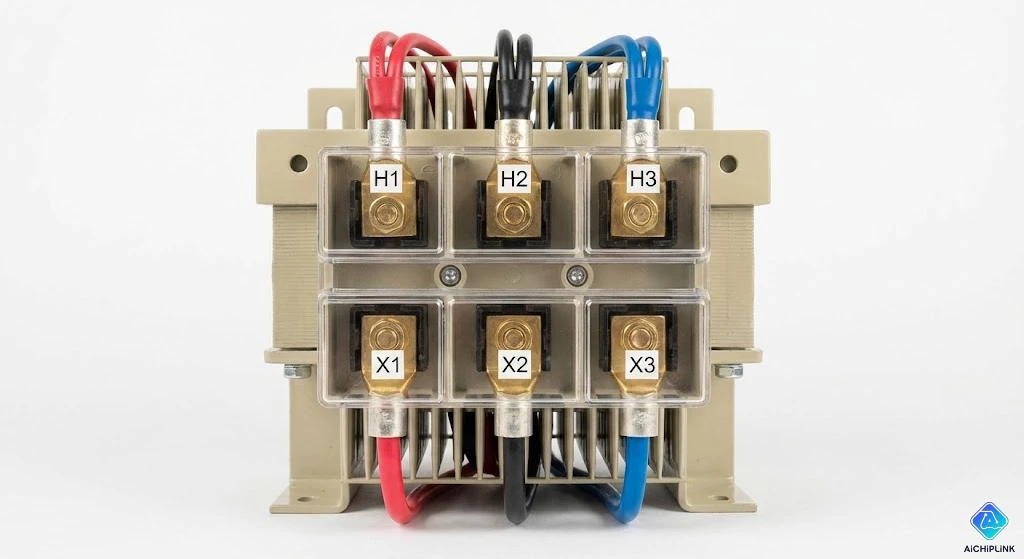
 In electrical power systems, the Three-Phase Transformer is the workhorse. But unlike a simple single-phase transformer with two wires in and two wires out, a three-phase unit offers a choice.
You can connect the three primary windings and the three secondary windings in different shapes: Star (Wye) or Delta (Mesh).
The way you pair them (e.g., Primary Delta, Secondary Star) dramatically changes how the transformer handles voltage, harmonics, grounding, and unbalanced loads. Choosing the wrong connection can lead to unstable neutral points or even telecommunication interference.
This guide breaks down the four standard connections and helps you understand where to use them.
1. Star-Star (Y-Y) Connection
In this configuration, both the primary and secondary windings are connected in a Star (Wye) formation.
Advantages
- Economical for High Voltage: The phase voltage is only $1/\sqrt{3}$ (or 57.7%) of the line voltage. This means the windings require less insulation, making it cheaper for Ultra High Voltage (UHV) applications.
- Neutral Availability: Provides a neutral point on both sides for grounding.
Limitations
- The Harmonic Problem: Without a Delta path, the third harmonic currents cannot circulate. This distorts the voltage waveform and can cause interference with nearby communication lines.
- Unbalanced Load Instability: If the neutral is not grounded, an unbalanced load shifts the neutral point ("Floating Neutral"), causing dangerous over-voltages on the lightly loaded phases.
Application: Rarely used in transmission unless provided with a Tertiary (Third) Winding in Delta to suppress harmonics.
2. Delta-Delta ($\Delta$-$\Delta$) Connection
Both primary and secondary windings form a closed loop (Delta).
[Image of Delta-Delta transformer connection]
Advantages
- No Harmonics: The closed Delta loop allows third harmonic currents to circulate internally, keeping the output voltage waveform sinusoidal (clean).
- Continuity of Service (Open Delta): This is a unique superpower. If one of the three single-phase transformers fails, the remaining two can continue to supply three-phase power in an Open Delta (V-V) configuration (albeit at 58% capacity). This is critical for critical industries.
Limitations
- No Neutral: You cannot easily supply single-phase loads (like lighting 277V) because there is no neutral wire.
- Expensive Insulation: Each winding must withstand the full line voltage.
Application: Industrial loads and older LV networks where no neutral is required.
3. Star-Delta (Y-$\Delta$) Connection
- Primary: Star (Wye)
- Secondary: Delta
[Image of Star-Delta transformer connection]
Advantages
- Harmonic Suppression: The secondary Delta trap harmonics.
- Grounding: The primary Star allows the neutral to be grounded, protecting the High Voltage line from earth faults.
Limitations
- Phase Shift: Introduces a $30^\circ$ phase shift between primary and secondary, meaning it cannot be paralleled with Y-Y or $\Delta$-$\Delta$ transformers.
Application: Step-Down Transmission Substations. It takes high voltage (Star side) and steps it down for sub-transmission (Delta side).
4. Delta-Star ($\Delta$-Y) Connection (The Most Common)
- Primary: Delta
- Secondary: Star (Wye)
Advantages
- Mixed Loading: The Secondary Star provides a Neutral. This allows the utility to supply 3-Phase Power (400V/480V) to motors and 1-Phase Power (230V/277V) to lights/outlets from the same transformer.
- Isolation: The Primary Delta isolates the high-voltage grid from unbalanced loads on the secondary side. Even if the secondary load is unbalanced, the primary currents remain relatively balanced.
Limitations
- Phase Shift: Like Y-$\Delta$, it introduces a $30^\circ$ lag/lead.
Application: Distribution Transformers. This is the transformer sitting on the pole outside your house or office. It steps down distribution voltage (e.g., 11kV) to utilization voltage (e.g., 400V/230V).
Summary Comparison
| Connection Type | Symbol | Phase Shift | Key Advantage | Primary Use |
|---|---|---|---|---|
| Star-Star | Y-Y | $0^\circ$ | Low Insulation Cost | Rare (needs tertiary winding) |
| Delta-Delta | $\Delta$-$\Delta$ | $0^\circ$ | Reliability (Open Delta) | Industrial Power |
| Star-Delta | Y-$\Delta$ | $30^\circ$ | Grounding Primary | HV Step-Down Substations |
| Delta-Star | $\Delta$-Y | $30^\circ$ | Neutral for Mixed Loads | Distribution (Step-Down) |
Conclusion
The choice of transformer connection dictates the stability and utility of the power grid.
- For Distribution (End users), Delta-Star is the king because it creates the Neutral wire we need for our homes.
- For Transmission (Grid), Star-Delta is preferred for grounding capabilities.
- For Critical Industry, Delta-Delta offers a backup plan if a winding blows.
Sourcing Power Transformers? Whether you need a massive Oil-Filled Substation Transformer or a Dry-Type Distribution unit, finding the right vector group is key. Visit Aichiplink.com to search for industrial transformers and power components.

Written by Jack Elliott from AIChipLink.
AIChipLink, one of the fastest-growing global independent electronic components distributors in the world, offers millions of products from thousands of manufacturers, and many of our in-stock parts is available to ship same day.
We mainly source and distribute integrated circuit (IC) products of brands such as Broadcom, Microchip, Texas Instruments, Infineon, NXP, Analog Devices, Qualcomm, Intel, etc., which are widely used in communication & network, telecom, industrial control, new energy and automotive electronics.
Empowered by AI, Linked to the Future. Get started on AIChipLink.com and submit your RFQ online today!
Frequently Asked Questions
1. What is the most commonly used three-phase transformer connection?
The Delta–Star (Δ–Y) connection is the most common, especially in distribution systems, because it provides a neutral for single-phase loads.
2. Why does a three-phase transformer have a 30° phase shift?
Connections like Star–Delta (Y–Δ) and Delta–Star (Δ–Y) introduce a 30° phase shift due to their winding arrangement.
3. Which transformer connection is best for handling harmonics?
Connections with a Delta winding (Δ–Δ, Y–Δ, Δ–Y) handle harmonics better because the Delta loop allows harmonic currents to circulate.
4. Can Delta–Delta transformers operate if one phase fails?
Yes. A Delta–Delta transformer can continue operating in Open Delta (V–V) mode at about 58% capacity.
5. Why is Star–Star (Y–Y) connection rarely used?
Because it suffers from harmonic distortion and neutral instability unless a tertiary Delta winding is added.