Why Energy Storage Demand Is Growing in 2026
You see energy storage demand going up quickly in 2026. Renewable energy is growing and causes this change. AI data centers use more power and need backup. More people use home energy storage. Battery prices drop a lot, from over $1,200 per kWh in 2010 to about $139 per kWh in 2026. Lithium Iron Phosphate technology helps more people use batteries. Global energy storage demand hits 450 GWh in 2026. Changes in energy economics and big investments push this growth. Grid resilience is more important now. Policy changes and price problems affect energy storage demand.
-
Energy storage demand goes up because:
-
Battery prices drop fast.
-
Home systems cost less.
-
Renewable sources need good storage.
-
AI data centers need steady power.
-
Key Takeaways
- Energy storage demand is going up because battery prices are dropping and more people use renewable energy. Home energy storage systems now cost less, so more people can buy them. This helps people save money and not depend on the grid as much. AI data centers need energy storage to handle more electricity and keep the grid steady. Government incentives are very important for helping people use energy storage and reach clean energy goals. New battery technologies are coming out, making energy storage systems cheaper and better for people.
Drivers of Energy Storage Demand
Renewable Growth & Storage Need
Every year, the world uses more renewable energy. Solar and wind now make a big part of our electricity. But these sources do not always make power. The sun is not out at night. The wind does not blow all the time. This makes it hard for the grid to work well. Energy storage helps keep the grid steady and safe.
-
Solar and wind are not always steady, so it is hard to keep energy supply even.
-
Energy storage helps balance when power goes up or down.
-
Most batteries today, like lithium-ion, are good for short times. We need better systems for longer times when renewables are low.
Energy storage lets us use more solar and wind by making their power less jumpy. It moves clean energy to times when people need it most. This makes the grid work better. Storage helps in many ways:
| Service Type | Description |
|---|---|
| Primary Frequency Response | Fast action in seconds to keep the grid at 60 Hz. |
| Secondary Frequency Control | Longer control using automatic generation. |
| Tertiary Reserves | Manual help during long outages or repairs. |
| Duck Curve Mitigation | Storage saves solar at noon and gives it back at night. |
| Load Leveling | Storage charges when demand is low and gives power when high. |
| Ramping Services | Storage smooths fast changes in renewables, helping other generators. |
Places with lots of renewables see more energy storage. In 2025, almost half of U.S. energy storage will be for renewables. Texas, California, and the Southwest Power Pool grow fast because of good policies and more renewables. Around the world, energy storage will grow from 17GW/34GWh in 2020 to 358GW/1,028GWh by 2030. This happens because of more renewables and government help.
AI Data Centers & Capacity Expansion
AI data centers now use much more electricity than before. This trend is growing fast. By 2025, data center servers will use about 7% of all business electricity. This could go up to 22%-33% by 2050. The AI boom, electric vehicles, and more air conditioning all make electricity demand rise. From 2024 to 2030, data center electricity use may double. This puts stress on the grid and means we need more energy storage.
-
Data center servers may use 446 to 818 billion kilowatt-hours by 2050.
-
Standalone data centers could use 581 billion kilowatt-hours if demand is high.
-
More electricity is needed because of AI, electric vehicles, and cooling.
-
Energy storage helps the grid stay flexible as data centers grow.
AI data centers have some problems:
-
High costs to install and keep energy storage working.
-
Hard to set up in faraway places.
-
Batteries can get too hot and wear out, especially lithium-ion.
AI changes how energy storage works. AI can make batteries work better, guess when they need fixing, and help design better cells. It also helps manage the supply chain and gives tips on how to use batteries. These things make batteries last longer and work better. AI energy storage can cut data center costs by up to 30%. Systems like Turbo Energy's Sunbox Industry use real-time data to plan charging and save money. This also helps the grid.
Home Energy Storage Goes Mainstream
Home energy storage was rare before. Now, it is common in many places. Battery prices are dropping. The average cost for lithium-ion battery packs for homes went from $250 per kWh in 2020 to $88 per kWh in 2025. This 65% drop comes from bigger factories in China, better battery chemistry, and better ways to make them. Experts think prices could fall to $58 per kWh by 2030 and $45 per kWh by 2034. Lower prices make home energy storage possible for more people.
-
Cheaper batteries, especially LFP, make home systems easier to get.
-
As prices fall, people use batteries for backup and to save money.
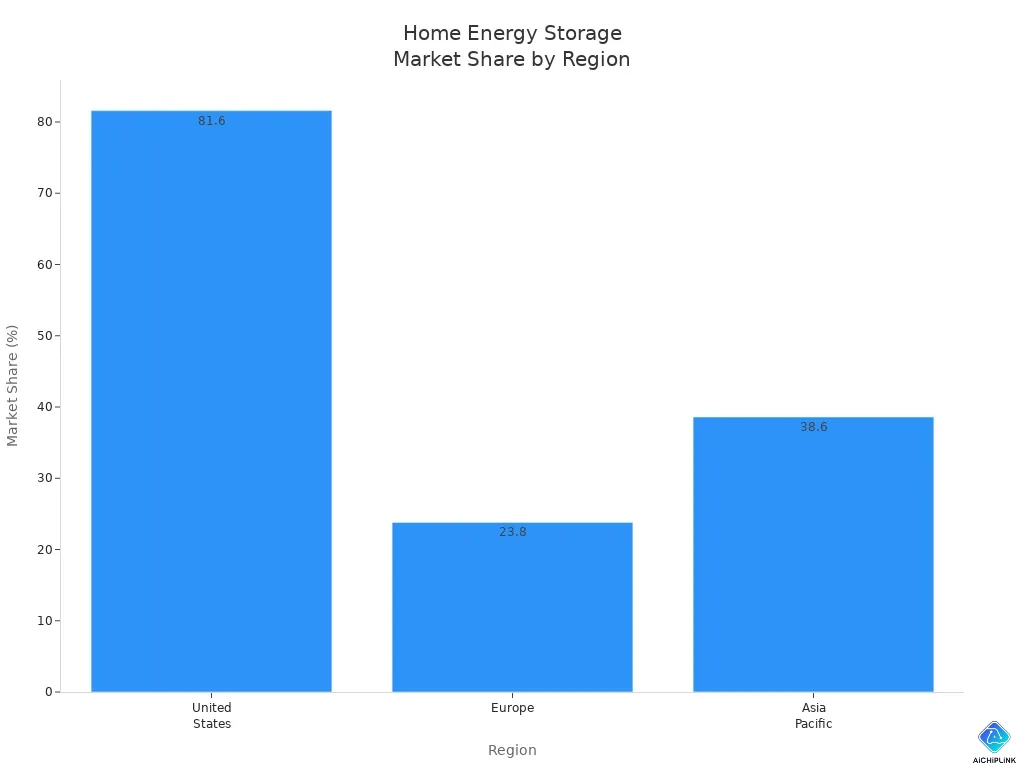
The United States, Europe, and Asia all use more home energy storage. In the U.S., 81.6% of the market comes from higher electricity bills, worries about outages, and government rules. Europe, led by Germany, has 23.8% of the market because of high prices and wanting energy freedom. Asia Pacific leads with 38.6% because of industry growth and renewable energy rules.
Home energy storage gives you more control over your power. You can save extra solar power for busy times. This means you use the grid less and save money. These systems also give backup power during outages, so your lights and appliances stay on. Many governments give rebates and help, so more people can buy these systems. Using more renewable energy at home helps lower carbon emissions and keeps the planet cleaner.
The home energy storage boom shows it is not just for a few people anymore. As more people get these systems, the battery market grows. This helps grid energy storage and balances lithium demand. Home systems also help with the bigger goal of more renewables and a stable grid.
Policy & Decarbonization Initiatives
Government Incentives for Energy Storage
Government incentives help the energy transition happen faster. Policies and rules push people to use clean energy instead of old sources. These actions make both public and private groups invest in energy storage. In 2026, the United States keeps tax breaks for storage, even when supply chains have problems. China uses market rules, so making money from storage is not always certain.
Asia Pacific leads because it supports renewable energy strongly. Countries like China, India, and Japan spend a lot to meet electricity needs and cut emissions. Their plans focus on clean energy goals and bringing power to rural areas. In the United States, strong policies help a lot. The Inflation Reduction Act gives lots of money to energy storage. States like California make utilities add storage, which helps you plan ahead.
Tip: If you use government rebates, your home battery system costs less. These programs can cut daily installations by 15%. Without them, storage use would be much lower.
| Finding | Description |
|---|---|
| Adoption Impact | A five-cent drop per watt hour lowers daily installations by about 15%. |
| Counterfactual | Without the program, installations would be 42% lower. |
| Cost of Rebates | $74 million of $177 million in rebates went to early adopters. |
| Cost-Effectiveness | The policy costs $182 per ton of CO2 saved under normal conditions. |
Decarbonization Targets & Grid Resilience
Decarbonization targets make countries invest more in energy storage. The European Union wants 42.5% of its electricity from renewables by 2030. This goal means more storage is needed as electricity demand rises. When coal and gas plants close, countries must use more renewables and storage to keep the grid reliable.
Energy storage helps manage demand swings and lowers peak loads. It absorbs extra power and makes the grid more stable. Community microgrids with storage give steady electricity, even in remote places. Storage-based transmission lines help reduce congestion and support grid upgrades.
-
Energy storage makes the grid more reliable by balancing supply and demand.
-
It helps modernize the grid by making it smarter and more flexible.
-
Utilities use storage to meet high electricity demand and keep the grid stable.
Decarbonization and grid reliability work together. As you move toward cleaner energy, storage and grid integration become very important.
Technology & Market Trends in Grid Energy Storage
Battery Cost Reductions & Tech Advances
Battery energy storage systems are changing quickly in 2026. New battery technology makes these systems better and cheaper. The price of battery energy storage systems has dropped a lot in ten years. Now, you can buy these systems for about $180 per kWh. Prices might go down to $135 per kWh by 2050. This means battery energy storage can compete with fossil fuels.
Companies make more batteries, so prices keep dropping. When factories build more, battery energy storage systems can replace old fossil-fuel plants. Lithium-based battery technology is the most common, but new types are coming soon. Here is a table that shows the newest battery advances:
| Advancement | Benefits |
|---|---|
| Solid-state batteries | Higher energy density, safer, faster charging, longer life, works in more temperatures |
| Sodium-ion batteries | Uses cheaper materials, easier to find, lowers costs |
| Advanced flow batteries | Stores energy longer, uses new chemicals, costs less |
| Iron-air batteries | Stores energy for 100+ hours, costs less than gas plants |
| AI integration | Makes storage smarter, predicts problems, runs systems automatically |
These new batteries last longer and work better for you. AI helps control energy storage systems, so you get fewer outages and more value.
Emerging Markets & Price Realignment
Emerging markets help stationary energy storage grow in 2026. The Asia Pacific region builds more solar and wind power. Energy storage is important for keeping the grid steady when power changes. India wants 500 GW of clean power by 2030. More than half of its power will come from non-fossil sources.
Strong decarbonization goals and electrification trends make energy storage very important for new projects.
Market trends show big changes now:
-
The market uses many types of energy storage, not just pumped hydro. Flow batteries and liquid air storage are growing fast.
-
Prices keep dropping, so long-duration storage is easier to use.
-
Governments help with new policies and money for storage.
-
Distributed energy storage gets more focus. You can use these systems at home or in your neighborhood to help the grid.
In North America, big stationary energy storage projects grow the fastest. Venture capital gives money for new ideas, and rules help build more projects. Stationary energy storage systems are now the cheapest choice, especially with LFP technology. The need for energy storage goes up as renewables become a bigger part of the energy mix.
Energy storage is changing quickly in 2026. Renewable energy, AI data centers, and home batteries make demand go up. Policy support and new battery technology help storage cost less and work better. The market grows as more countries use clean energy.
| Year | US Storage Capacity (GW) | Key Trends |
|---|---|---|
| 2025 | 37.4 | Solar-plus-storage, new tech |
| 2030 | 187 | Long-duration, diverse solutions |
-
More people use home energy storage now.
-
Better batteries let you use more clean power.
-
New policies make it easier to get storage.
You are part of making energy cleaner and smarter.

Written by Jack Elliott from AIChipLink.
AIChipLink, one of the fastest-growing global independent electronic components distributors in the world, offers millions of products from thousands of manufacturers, and many of our in-stock parts is available to ship same day.
We mainly source and distribute integrated circuit (IC) products of brands such as Broadcom, Microchip, Texas Instruments, Infineon, NXP, Analog Devices, Qualcomm, Intel, etc., which are widely used in communication & network, telecom, industrial control, new energy and automotive electronics.
Empowered by AI, Linked to the Future. Get started on AIChipLink and submit your RFQ online today!
Frequently Asked Questions
What is energy storage?
Energy storage means you can keep electricity for later. You might use batteries, pumped water, or other systems. This helps you use more renewable energy. It also keeps your power steady.
Why do AI data centers need energy storage?
AI data centers use lots of electricity. They need energy storage to work during power spikes or blackouts. Storage helps lower costs and keeps your data safe.
How does home energy storage help you?
Home energy storage lets you keep solar power for later. You can use it when the sun is not out or during blackouts. This saves you money and keeps your lights on.
Are battery prices still dropping?
Yes, battery prices keep going down every year. You can buy batteries for much less now. This makes energy storage easier for homes and businesses.
What are the main types of energy storage?
You can use batteries, pumped hydro, flywheels, or compressed air. Most people use lithium-ion batteries at home. Each type has its own uses and good points.