MOSFET vs Relay: Key Differences Explained
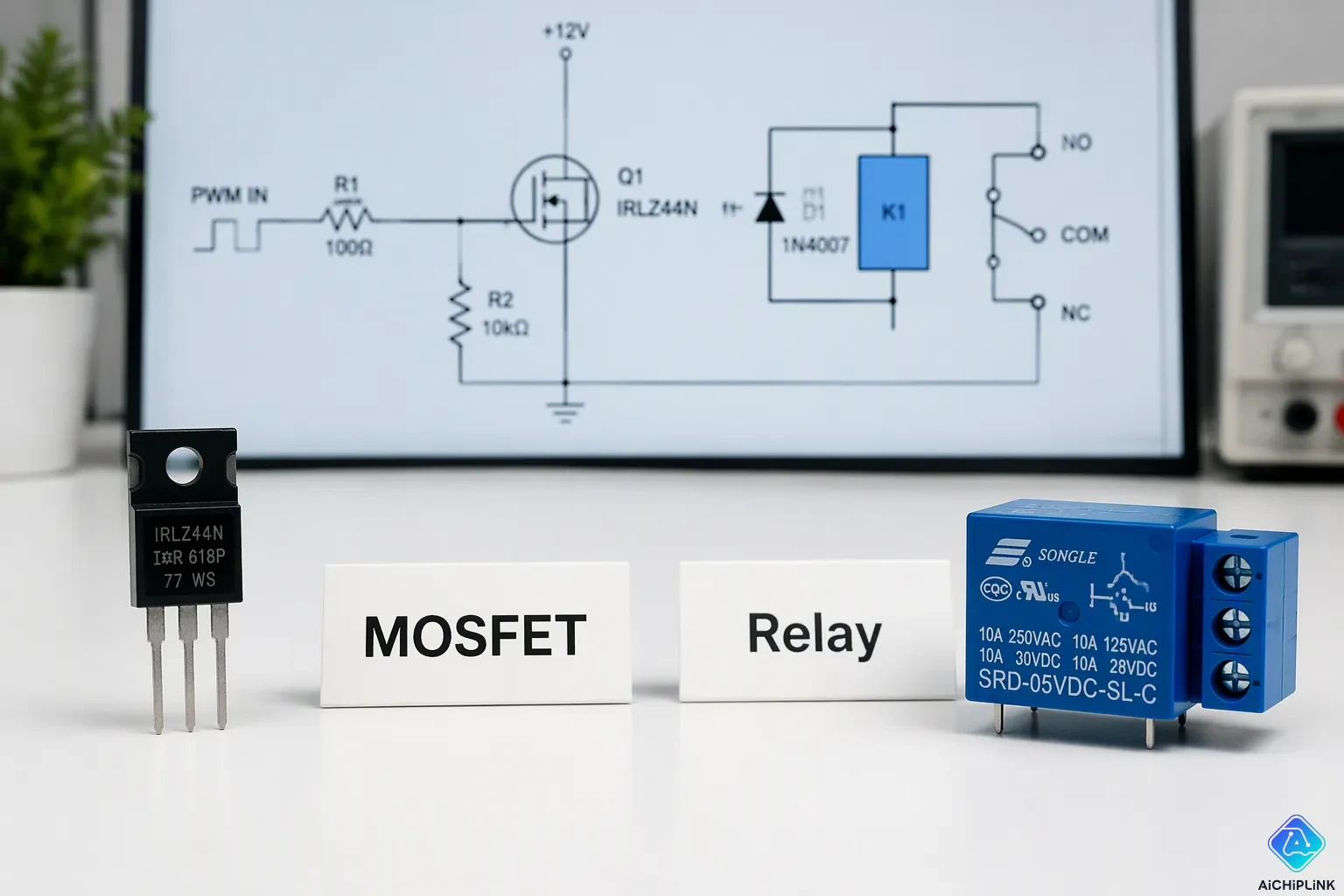
You have a real choice to make when your project needs to control electrical flow. A mosfet vs relay comparison often comes down to how each device handles switching. A mosfet uses voltage to control current with no moving parts. A relay uses an electromagnetic coil to physically open or close contacts. These different designs lead to big gaps in speed, lifespan, and isolation. Your choice depends on what your project demands. Do you need fast switching for a motor? Maybe you need a relay for high power AC loads. You must weigh voltage levels, current needs, and whether galvanic isolation matters. Each option shines in different situations.
Key Takeaways
-
MOSFETs turn on and off in microseconds, but relays take milliseconds.
-
MOSFETs can handle more than 100 million on/off cycles, while relays start to wear out after 100,000 to 1 million cycles.
-
Relays give complete electrical separation, but MOSFETs do not.
-
MOSFETs use almost no power to stay on, but relays draw steady current through their coil.
-
Use MOSFETs when you need fast, low-power DC switching. Pick relays for high-voltage AC and isolation.
MOSFET vs Relay: Basic Definitions
The MOSFET: A Solid-State Switch
A MOSFET is a semiconductor switch that has no moving parts and is run by voltage. You put a voltage on the gate terminal, and this controls how current flows between the drain and source. In an n-channel enhancement MOSFET, drain current only flows when the gate-source voltage goes above the threshold voltage. A positive gate voltage pulls electrons toward the oxide layer, which makes the channel thicker and lets more current through. This makes the MOSFET work like a normally-open switch.
What is a MOSFET and how does it work in real use? Think of it as a valve that opens wider as you raise the gate voltage. Most gate threshold voltages fall between 1 and 4 volts. For switching jobs, you should drive the gate with about 5 volts to get low on-resistance. Driving it with too low a voltage, like 3.3 volts, raises resistance and heat. Power MOSFETs usually have on-resistance below 0.01 ohms, which keeps power losses low while switching.
The Relay: An Electromechanical Switch
A relay is an electromechanical switch that uses an electromagnetic coil to open or close contacts by moving them. What is a relay and how does it work? When you put voltage on the coil, current flows through it and makes a magnetic field. This field pulls the armature toward the coil, which moves the electrical contacts. When you take the coil voltage away, a spring pulls the armature back to its default position.
Electromechanical relays give full galvanic isolation because the control and load circuits are kept apart physically. This isolation makes relays good for switching AC and DC loads, including high-voltage and high-current jobs. PCB relays usually use coil voltages from 5 to 24 Vdc or 120 Vac, with contact current ratings from 0.5 A to 2 A. The table below sums up the main structural differences between these two switching devices.
| Structural Feature | MOSFET | Electromechanical Relay |
|---|---|---|
| Device type | Semiconductor switch | Electromechanical switch |
| Control mechanism | Gate voltage controls current | Coil current pulls an armature |
| Moving parts | None | Contacts and armature move |
| Isolation | No built-in isolation | Full galvanic isolation |
| Load suitability | Mostly DC and low voltage | AC and DC, high power |
Difference Between a MOSFET and a Relay: Speed and Lifespan
Switching Speed and Frequency
The biggest difference between a mosfet and a relay shows up in how fast they switch. A MOSFET can finish a full on-off cycle in microseconds. A standard electromechanical relay needs over 10 milliseconds just to move its contacts. That gap is about 1,000 to 1,000,000 times faster in raw speed.
| Device Type | Switching Time |
|---|---|
| MOSFET-based SSR (SiC MOSFET) | Tens of nanoseconds (0.01–0.1 µs) |
| Standard MOSFET SSR | Microseconds (µs range) |
| Electromechanical Relay | >10 milliseconds (ms) |
This speed advantage matters for pulse-width modulation (PWM) and high-frequency applications. You can drive a MOSFET gate at thousands of cycles per second without any problem. A relay cannot keep up. Think about what happens at different frequencies:
| Frequency | Period | Mechanical Relay Implication |
|---|---|---|
| 10 Hz | 100 ms | There may be time to move, but 10 ops/sec is a harsh electrical-life and thermal duty |
| 100 Hz | 10 ms | The period is close to the motion time; the commanded state and physical state may not match |
| 1 kHz | 1 ms | Normal electromechanical contact modulation is not believable |
| 10 kHz | 0.1 ms | This belongs to semiconductor switching; contacts cannot follow |
At 100 Hz, the relay's period already equals its mechanical motion time. At 1 kHz, the next switching command comes before the mechanism finishes moving. Contact bounce makes things worse. When contacts hit, they split and reconnect several times before they settle. Each bounce under load causes arcing, erosion, and electromagnetic interference. This wear speeds up at higher frequencies, using up the relay's rated operations faster.
Solid-state relays achieve switching in microseconds to nanoseconds vs. milliseconds for mechanical contactors.
Lifespan and Mechanical Wear
The lifespan gap between these devices is just as striking. MOSFETs have no moving parts, so nothing wears out mechanically. Documented lifespans for MOSFET-based solid-state relays in high-cycling applications exceed 100 million operations. That endurance level is far beyond typical relay limits.
Relays, by contrast, wear out through several mechanisms:
-
Contact arcing degradation: Arcing during switching causes material erosion, carbon formation, and oxide layer buildup, which slowly raises contact resistance.
-
Mechanical wear of contacts: Repeated operation leads to physical wear, material transfer between surfaces, and eventual welding of contacts.
-
Cycle life limits: Most commercial relays are rated for only 100,000 to 1 million cycles, with premium models reaching 10 million under ideal conditions.
-
Environmental acceleration: High humidity, corrosive atmospheres, and elevated temperatures speed up contact degradation.
-
Vibration and shock susceptibility: Mechanical relays can false-trigger or bounce under vibration, which leads to premature failure.
-
Contact bounce and chatter: Unfiltered signals cause too much switching, which greatly reduces lifespan.
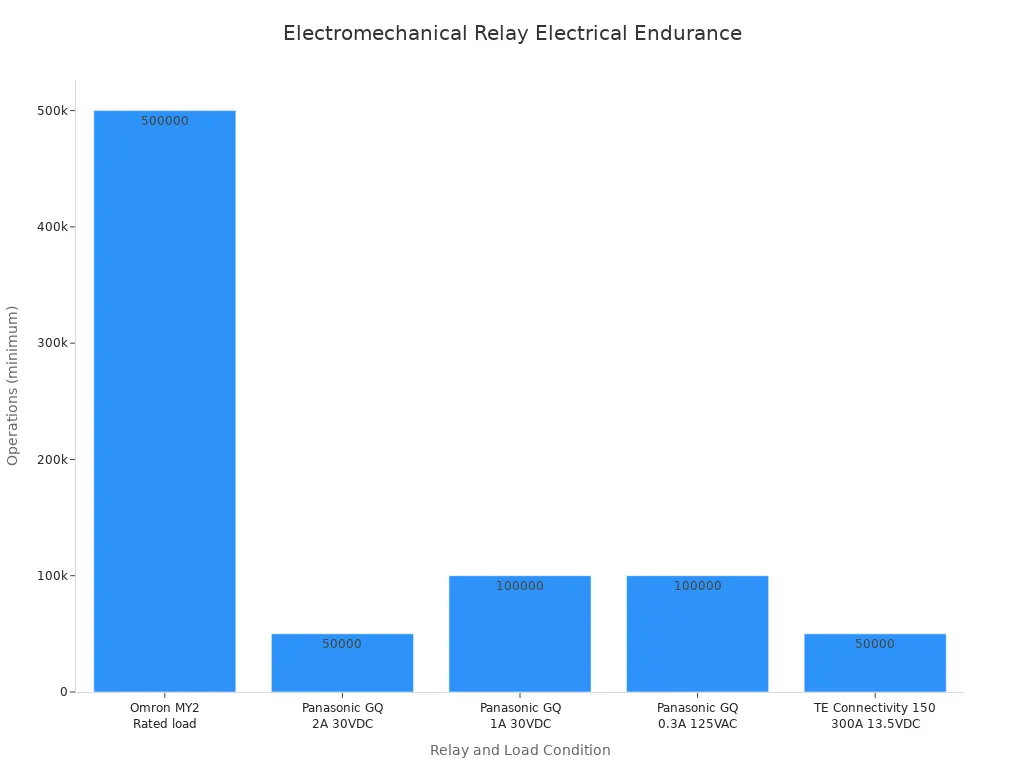
Real-world relay endurance varies widely by model and load. Here are documented figures:
| Relay Series | Electrical Endurance (Operations) | Load Condition |
|---|---|---|
| Omron MY2 | 500,000 minimum | Rated load |
| Panasonic GQ | 50,000 minimum | 2A, 30VDC resistive |
| Panasonic GQ | 100,000 minimum | 1A, 30VDC resistive |
| Panasonic GQ | 100,000 minimum | 0.3A, 125VAC resistive |
| TE Connectivity 150 | 50,000 cycles minimum | 300A, 13.5VDC |
You can extend relay life with protective measures. Snubber circuits suppress arcing. Controlled switching timing minimizes bounce. Hysteresis control prevents chattering. Electronic switching assistance pre-charges capacitive loads. Noise immunity filters prevent false triggering. These techniques help, but they cannot match the natural long life of a MOSFET.
The SRP1 series (MOSFET-based SSR) has been stress-tested to achieve up to 750,000 cycles, providing a verified benchmark for high-cycle switching endurance.
For applications that need fast and efficient switching, MOSFETs win clearly. For simple on-off control with isolation needs, relays are still a good choice. The difference between a mosfet and a relay in speed and lifespan often decides which device fits your project. Choose based on your switching frequency and expected operational life.
A Comparison of Electromechanical and MOSFET Relays: Electrical Characteristics
Isolation and Voltage Handling
Electrical isolation is one of the biggest differences between these two devices. Electromechanical relays give you full galvanic isolation because their control and load circuits connect only through a magnetic field. No wire links the input and output sides. This physical gap lets you switch AC and DC loads safely, even at high voltage or high current levels. You can control a 240 V AC appliance from a low-voltage logic signal without any shared ground path.
A MOSFET works in a different way. It is a three-terminal semiconductor device with no natural barrier between its control and load circuits. The gate, drain, and source share a common silicon base. This design means you cannot use a standard MOSFET for true electrical isolation. You also run into a parasitic diode problem. Every power MOSFET has a built-in body diode between drain and source. This diode conducts when the drain-source voltage reverses polarity. In DC circuits, this diode stays inactive during normal operation. In AC circuits, the diode conducts on every negative half-cycle, which shorts the load and ruins the switching function. You can place two MOSFETs back-to-back to block both polarities, but this adds complexity and cost. For simple AC switching, a relay is still the easy choice.
Drive Requirements and Power Consumption
The drive current needed to keep each device in its on-state shows another major gap. A MOSFET gate acts like a capacitor. Once the gate charges above the threshold voltage, the device stays on with almost no more current. A fully-on MOSFET uses basically no gate power. You only lose a small amount of power each time you charge and discharge the gate capacitance.
A relay coil works in a very different way. You must keep current flowing through the coil at all times to hold the contacts closed. A small 5 V relay usually draws 50 to 80 mA while energized. That current flows every second the relay stays on. In battery-powered or energy-sensitive designs, this constant drain hurts efficiency.
| Device | Steady-state drive current to stay ON |
|---|---|
| MOSFET | Near zero — gate is capacitive, so a fully-on device draws negligible gate current |
| Electromechanical relay | Continuous coil current, typically 50–80 mA while energized (e.g., a small 5V relay) |
The MOSFET gate behaves capacitively, so its drive current requirement in the on-state is extremely low and a fully-on MOSFET consumes essentially no gate power. By contrast, a relay must keep its coil energized to hold the contact position, continuously drawing current (commonly 50–80 mA for a small 5V coil), which represents a persistent drain in energy-sensitive applications.
This power difference shapes real designs. A mosfet vs relay decision for a battery-powered sensor node often favors the MOSFET for this exact reason. You save milliamps of constant draw, which extends runtime. A comparison of electromechanical and mosfet relays on power alone shows the semiconductor winning for low-power control. Relays still make sense when you need isolation or must switch AC and DC loads at high voltage or high current. The table below sums up the trade-offs.
| Characteristic | MOSFET | Electromechanical Relay |
|---|---|---|
| Electrical isolation | None (shared substrate) | Full galvanic isolation |
| AC switching | Limited by body diode | Native AC and DC capability |
| Steady-state drive power | Near zero | Continuous coil current |
| Control complexity | Voltage-driven gate | Current-driven coil |
MOSFET vs Relay: Key Differences in Practical Use
Noise, Size, and Cost
You will hear a clear difference in sound when you run these devices. A relay makes a distinct clicking noise every time its contacts move. A MOSFET-based switch runs silently because it has no moving parts. This quiet operation matters in audio equipment, medical devices, or any place where noise causes problems.
Size differences also shape your design choices. A relay holds a coil, an armature, and contact springs inside a bulky housing. A MOSFET is a small semiconductor chip that fits easily on a circuit board. But high-current MOSFETs may need a heatsink to get rid of heat, which adds size and weight to your design. Relays do not need heatsinks because their contacts handle heat in a different way.
Cost brings another trade-off. Small MOSFETs cost between $0.05 and $0.50 each. Power MOSFETs range from $0.30 to $3. Automotive relays cost $1.50 to $5, while power relays run $2 to $10 or more. Industrial-grade electromechanical relays average $5–15 in initial procurement cost. Equivalent solid-state relays cost $15–40. You pay more upfront for solid-state technology, but you gain longer life and better efficiency.
| Aspect | MOSFET-based switch (SSR) | Electromechanical relay |
|---|---|---|
| Audible noise | Operates silently | Generates acoustic noise during switching |
| Size/weight | May require heatsink for high-current loads | No heatsink requirement |
| Moving parts | None | Physical contacts present |
The Role of MOSFET Relays
You can get the best of both worlds with a hybrid device called a MOSFET relay. This solid-state relay mixes the isolation of a traditional relay with the speed and lifespan of a MOSFET. Many designs use optical coupling to keep the control circuit apart from the load circuit.
The internal structure has three main parts: an input circuit, an isolation coupling circuit, and an output circuit. When you send a control signal to the input terminals, an internal LED turns on. This LED lights up a photovoltaic cell that makes a voltage. That voltage pushes the MOSFET gate into conduction, which switches the load. The optical coupling gives complete electrical isolation between control and load sides.
These mosfet relays handle switching in microseconds rather than milliseconds. They stand up to vibration and offer long lifetimes because nothing wears out mechanically. You pay more for this technology, but you gain silent operation, fast switching, and true galvanic isolation in one package.
Many SSRs use optical coupling. The control voltage energizes an internal LED which illuminates and switches on a photo-sensitive diode; the diode current turns on a back-to-back MOSFET to switch the load.
When you compare mosfet vs relay options for your project, think about these practical factors. The mosfet vs relay: key differences reach beyond speed and lifespan into everyday usability. Choose based on your noise tolerance, space constraints, budget, and isolation needs.
How to Choose: Application-Specific Guidance
When to Use a MOSFET
Pick a MOSFET for tasks that need speed, low power use, and a long life. Pulse-width modulation motor control is a great match. You can switch a MOSFET gate thousands of times each second with no wear. Signal switching in data acquisition systems also works well. A MOSFET uses almost no steady-state current once its gate charges, so battery-powered designs last longer.
The operating environment often settles the mosfet vs relay question by itself. Solid-state devices handle harsh conditions better than mechanical contacts. The table below shows where a MOSFET or solid-state relay moves ahead.
| Factor | Advantage of Solid-State MOSFET/SSR over Electromechanical Relay |
|---|---|
| Ambient temperature | SSRs usually work across a wider temperature range, or they work without lowering the ampacity rating. |
| Vibration environment | SSRs have no moving parts, so shock and vibration do not affect them. This makes them the best pick for high-vibration uses and settings. |
| Vibration environment | SSRs resist shock and vibration well. They are a much better option for mounting on gear like a compressor or turbine. |
When you mount a switch on a compressor or turbine, vibration can cause contact misoperation and shorten the life of electromechanical relays. A MOSFET has no moving parts, so it resists shocks, strong vibrations, and electromagnetic fields. This makes mosfet vs relay choices in high-vibration settings an easy decision.
When to Use a Relay
Choose a relay for high-voltage or high-current AC switching, galvanic isolation, or simple on-off control. Electromechanical relays physically separate a low-voltage control circuit from a high-voltage power circuit. This electrical isolation protects microcontrollers from voltage spikes and electrical noise. A 5V or 12V DC signal can safely control a 230V AC load.
Home automation and industrial control both depend on this isolation. Common uses include:
-
Home automation: relay modules control lights, fans, air conditioners, and motorized curtains using low-power signals from microcontrollers.
-
Industrial control systems: relay modules control machinery, motors, solenoids, and other high-power equipment with reliable isolation between control and power circuits.
When you ask which is better for your application, think about your load type. A relay handles AC natively and gives you true isolation. A MOSFET cannot match that without extra circuitry. For simple on-off control of mains power, relays remain the practical choice. Mosfet relays offer a middle ground when you need isolation plus fast, silent switching. Evaluate your voltage, current, and isolation needs before you decide which is better for your application.
Your choice comes down to a simple trade-off. A mosfet wins on speed and lifespan. A relay wins on electrical isolation and high-power handling. Pick a mosfet for high-frequency, low-power jobs that need a long life. Pick relays for high-voltage AC switching, galvanic isolation, or basic on-off control. Weigh your voltage, current, speed, and environment needs first. The mosfet vs relay: key differences guide that final call. Remember that mosfet relays blend both worlds for special cases. Match the device to your project, and you get reliable switching every time.

Written by Jack Elliott from AIChipLink.
AIChipLink, one of the fastest-growing global independent electronic components distributors in the world, offers millions of products from thousands of manufacturers, and many of our in-stock parts is available to ship same day.
We mainly source and distribute integrated circuit (IC) products of brands such as Broadcom, Microchip, Texas Instruments, Infineon, NXP, Analog Devices, Qualcomm, Intel, etc., which are widely used in communication & network, telecom, industrial control, new energy and automotive electronics.
Empowered by AI, Linked to the Future. Get started on AIChipLink and submit your RFQ online today!
Frequently Asked Questions
Can a MOSFET replace a relay in every circuit?
No. A mosfet works well for DC loads and fast switching. It cannot block AC current because of its body diode. You need a relay for AC loads or when you want full electrical isolation between your control signal and the load.
Why do relays wear out faster than MOSFETs?
Relays have moving contacts that arc and erode each time they switch. Most models last 100,000 to 1 million cycles. A MOSFET has no moving parts, so it can handle over 100 million operations without mechanical wear.
Do MOSFET relays give me both speed and isolation?
Yes. These solid-state devices use optical coupling to separate the control side from the load side. You get microsecond switching, silent operation, and long life. The trade-off is a higher price than a standard electromechanical relay.
Which device draws less power to stay on?
A MOSFET wins here. Its gate is capacitive, so it needs almost no current once it turns on. A relay coil must stay energized to hold the contacts closed, which pulls 50 to 80 mA continuously for a small 5V coil.
What should I check before choosing between them?
Look at your load type, voltage, current, and switching speed. Pick a MOSFET for fast, low-power DC jobs. Pick a relay for high-voltage AC loads or when you need galvanic isolation. Weigh these factors before you decide.