Reed Relay vs Regular Relay Which One Is Faster in 2026
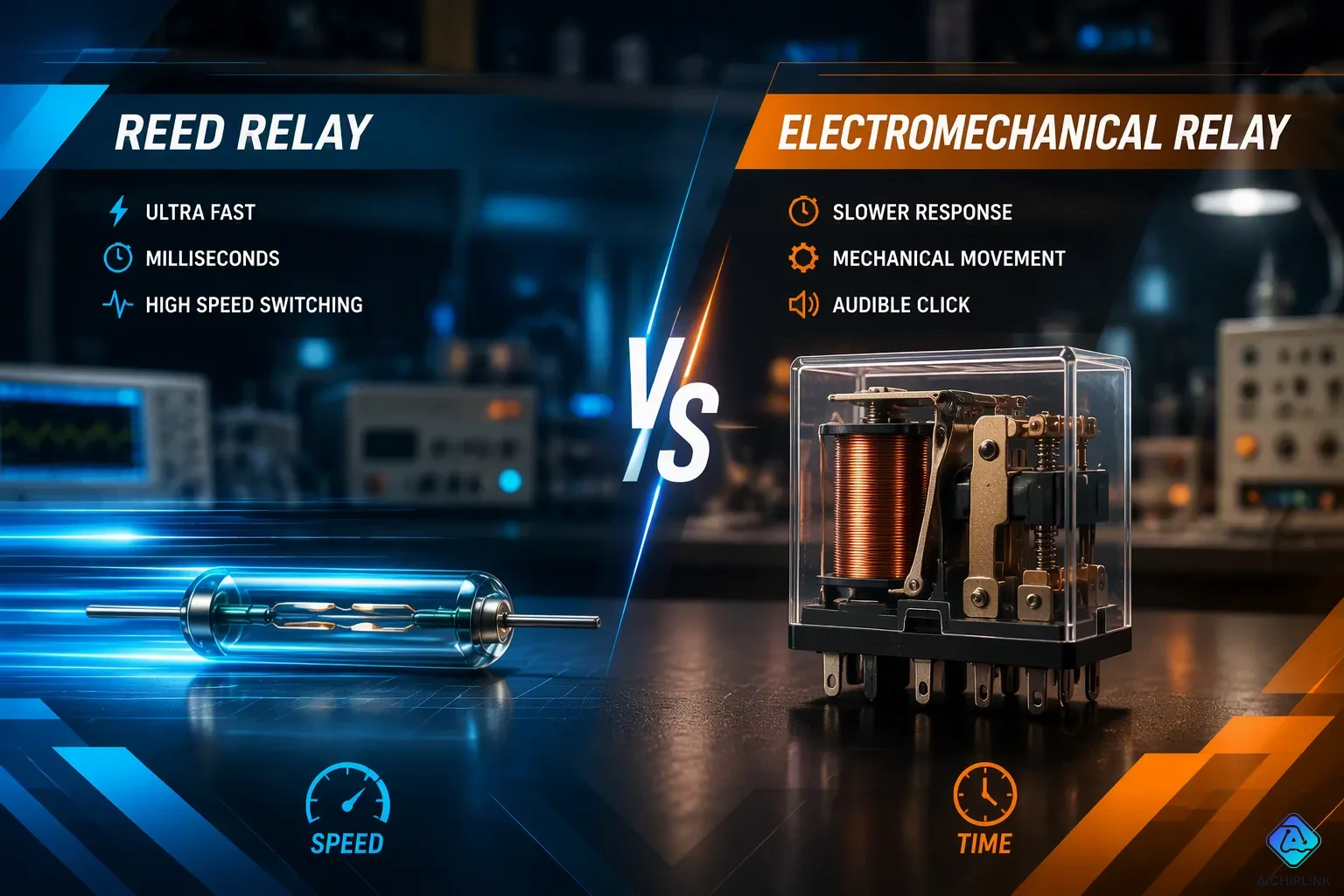
In 2026, reed relays will be much faster than regular electromechanical relays. National Instruments (NI) confirms this tech can switch about 10 times faster than a similar regular relay. This speed comes from its tiny moving parts and very short travel distance.
The global market for these parts was worth USD 244.43 Million in 2025. It is expected to hit USD 351.49 Million by 2035, growing at a CAGR of 3.70% from 2026 to 2035.
The main differences between these two types help you pick the right one for your job. A side-by-side look at reed relay vs EMR shows speed is the biggest difference. Pick a reed relay for fast tasks. Pick a regular relay for high-power jobs.
Key Takeaways
-
Reed relays switch up to 10 times faster than regular relays.
-
Their tiny, lightweight blades move a short distance for quick action.
-
Reed relays suit high-speed test equipment and low-power tasks.
-
Regular relays handle high-power loads but switch slower.
-
Choose reed relays for speed and isolation, not for high current.
Defining the Reed Relay and Regular Relay
Before you can compare speeds, you need to know what each device is. A reed relay is basically a reed switch wrapped with a coil. The reed switch sits inside the coil. When you give power to the coil, the magnetic field turns on the switch contacts. This simple build gives the reed relay its speed edge.
Anatomy of a Reed Switch
A reed switch has two thin, bendable metal blades called reeds. These reeds are made from ferromagnetic material, so they react to magnetic fields. Makers coat the contact tips with rhodium, ruthenium, or tungsten to ensure a steady electrical link. The whole setup sits inside a sealed glass tube.
During making, the glass tube gets filled with dry nitrogen or another inert gas. This tight seal creates a clean space inside the switch. Dust, wetness, and fumes cannot get to the contacts. This shield means the reed switch works the same way over its whole life. The sealed space also makes the switch safe for explosive areas, like fuel tanks.
The way a reed relay works depends on this sealed design. When a magnetic field comes near, the two reeds pull together and touch. When the field goes away, the reeds snap back apart. There are no hinges, pivots, or springs inside the glass tube. The reeds themselves give both the electrical path and the moving action.
Mechanics of an Armature Relay
A regular relay, also called an electromechanical relay, uses a totally different setup. The relay has a wire coil wrapped around a soft iron core. A hinged armature sits near this core, linked to one or more contact sets. When current flows through the coil, it makes an electromagnetic field. This field pulls the armature toward the core, which moves the contacts to open or close the circuit.
The armature relay has many more moving parts than a reed switch. You will see the armature itself, pivot points, return springs, and separate contact parts. Each of these parts adds weight and creates spots where parts rub. When you cut power to the coil, a spring pushes the armature back to its start spot, keeping an air gap in the magnetic circuit.
These build differences create the main differences in how they work. The reed switch only moves its tiny reed blades a tiny bit. The armature relay must move a heavier setup across a bigger space. This is why the reed relay switches about 10 times faster than a similar regular relay. The small, sealed reed switch design also stops contact dirt, giving it a longer working life than its bigger rival.
Why Reed Relays Are Faster by Design
The speed gap between these two devices comes down to physics. You need less force to move a lighter object a shorter distance. That principle explains everything about relay performance. A reed relay moves almost nothing. A regular relay moves a small machine.
Contact Mass and Travel Distance
Think about what happens inside each device when you send a signal. Inside a reed switch, two thin metal blades bend toward each other. These blades weigh almost nothing. They travel a fraction of a millimeter before touching. That tiny movement takes almost no time.
A regular relay works differently. Its armature assembly carries real weight. The moving parts include the armature itself, contact springs, and sometimes multiple contact fingers. These parts travel several millimeters to close the circuit. Heavier parts moving farther distances need more time and more force.
Consider the numbers. A typical armature relay needs 5 to 20 milliseconds to switch. A fast switching reed relay can complete the same action in 100 microseconds. That difference represents two orders of magnitude. You can perform dozens of reed relay operations in the time one regular relay takes for a single cycle.
The sealed glass tube of the reed switch also helps. No air resistance slows the blades. No friction points exist inside the tube. The blades move through dry nitrogen gas with minimal drag. This clean environment lets the contacts move freely every single time.
The Role of the Actuator: Coil vs. Armature
The actuator design creates another speed difference. Both devices use a coil to generate a magnetic field. However, they use that field in completely different ways.
A regular relay uses its coil to pull a hinged armature. This armature rotates around a pivot point. It must overcome spring tension and mechanical inertia. The magnetic field builds up, pulls the armature, compresses springs, and finally moves the contacts. Each step in that chain adds delay.
A reed relay uses its coil more directly. The magnetic field acts straight on the reed blades themselves. The blades sit inside the coil. When the field strengthens, the blades flex toward each other. No intermediate parts exist. No hinges slow the action. No springs resist the movement. The magnetic field does its work directly on the switching elements.
This direct actuation explains why reed relays respond so quickly. The coil surrounds the switch contacts. The magnetic path is short and efficient. You get faster magnetic saturation and quicker mechanical response.
| Actuator Type | Switching Speed Range |
|---|---|
| Armature actuator (regular control relay) | 5 ms – 20 ms |
| Coil actuator (reed relay, fast-switching variant) | as fast as 100 μs |
The table shows the practical result of these design choices. Your application determines which speed you need. High-speed test equipment demands the faster option. Heavy industrial controls work fine with slower switching.
The speed advantage also affects system design. Faster switching means you can sample more signals per second. You can build test sequences that run quicker. You can reduce measurement time in automated test equipment. These benefits flow directly from the mechanical design differences you have just examined.
Quantifying the Speed Advantage
When you look at the numbers, the speed difference between these two devices is obvious. The time to turn on, turn off, and settle all show the same result. Reed relays finish their switching action in a tiny fraction of the time a regular relay needs.
Operate and Release Times Compared
Operate time is how long a device takes to close its contacts after you send power. For a reed switch, this time can be as fast as 0.1 milliseconds (100 microseconds). The light reed blades snap together almost right away. A regular relay needs 5 to 20 milliseconds to do the same job. The armature must fight inertia, push springs, and move heavier contacts over a longer path.
Release time shows an even bigger gap. When you stop power to a regular relay, the armature must go back to its start spot. The spring pushes the parts back, but the heavier pieces resist that push. Data from relay makers shows that most general-purpose relays are in the medium-release group. Their release time is 3 to 50 milliseconds. Some relays called slow-release take 50 milliseconds or more to open. Only special fast-release relays can open in under 3 milliseconds.
A reed relay releases much faster. The reed blades spring back to their open spot with no mechanical parts to slow them down, resulting in a very fast release.
These numbers matter in real use. If you build automated test gear, faster release times let you check more devices each hour. If you design switching matrices, faster operate times cut signal routing delays. The gap between the reed relay's fast operate time (as low as 0.1 ms) and the regular relay's 5-20 ms may look small, but it grows across thousands of switching cycles.
Contact Bounce and Settling Time
Contact bounce happens when the contacts hit each other and bounce back before they settle into a steady link. No mechanical switch gets rid of bounce completely. The real question is how long the bounce lasts.
A reed relay has very short contact bounce. The light reed blades have almost no momentum when they touch. The bounce time is measured in microseconds. According to maker documents, the moving contact activity settles by 1.5 milliseconds after the coil voltage is applied. This means the contacts reach a steady state within 1.5 milliseconds of switching.
A regular relay has much longer bounce. The heavier armature and contact parts carry more momentum. The contacts can bounce for several milliseconds before they settle. Add that to the longer operate time, and the total time to reach a steady link can go past 20 milliseconds. This bounce causes issues in sensitive uses. Digital circuits may read wrong signals during the bounce period. Measurement gear may capture bad data.
The settling time gap matters for high-speed switching. If you need to sample a signal right after switching, the reed relay gives you a steady link faster. You can start your measurement within 2 milliseconds of applying the coil voltage. A regular relay may need a 20-millisecond wait before the contacts settle. That wait cuts your overall system speed.
The short settling time makes reed relays perfect for jobs that need exact timing. RF switching, automatic test gear, and data capture systems all gain from the fast steady state. The switching speeds of this tech let you build systems that work well at high frequencies without signal errors from contact bounce. You get a clean, steady signal path in less time than any regular relay can offer.
Reed Relays vs. Solid State Relays: A Speed Perspective
Mechanical vs. Electronic Switching Speed
Solid state relays switch using only electronic parts. A solid state relay has an LED, a photodetector, and a MOSFET or triac. No physical parts move inside the device. The switching happens electronically when the photodetector turns on the output circuit.
This electronic design gives solid state relays their speed edge. A solid state relay can switch in the microsecond range. The only delay comes from turning the LED on or off. You get nearly instant switching with no mechanical lag.
A reed relay cannot match that speed. This device uses moving parts. When you power the coil, the magnetic field must build up until the blades start moving. The blades then travel until they touch. The total operate time includes the magnetic field rise, blade travel, and any contact bounce. Release time adds more delay. The magnetic field must fade. The switch contacts must physically separate.
| Relay Type | Switching Speed | Galvanic Isolation |
|---|---|---|
| Reed Relay | Fast (<1 ms) | High and inherent, low EMI (hermetically sealed) |
| Solid State Relay | Extremely fast (µs) | Moderate (drivers required, can generate EMI) |
| Electromechanical Relay | Slower (5-20 ms) | Good (arcing risk) |
The table shows the speed order. Solid state relays are at the top. This device type and electromechanical relays are below. Each step down in speed comes from more mechanical parts. The switching speeds of a solid state relay are much faster than any mechanical device. The electronic switch has no moving parts to slow it down.
Where Reed Relays Fit in the Spectrum
The speed gap between this device and solid state relays looks big on paper. In practice, many jobs do not need the fastest possible switching speeds. They need sub-millisecond switching plus true mechanical isolation.
This device gives you that mix. The sealed contacts offer great dielectric separation between the switch contacts and the coil. You get very low leakage current. The off-state leakage is tiny, which matters for microvolt-level measurements. The simple mechanical design and sealed environment give steady performance over millions of cycles.
These traits make this device the right pick for certain jobs. EV battery systems use them in pre-charge circuits. The job needs fast switching to protect electronics while keeping high isolation between battery packs. Automated test equipment needs quick signal routing with galvanic separation. Cable testing requires fast switching of high voltages while isolating test channels. Medical devices need reliable isolation for patient safety plus fast switching for monitoring circuits.
Design Insight: Choose this device for mixed-signal switching (low-level + high voltage) when isolation accuracy and long-term signal stability matter more than raw switching speed.
This design insight shows the trade-off. You do not always need the fastest option. You need the option that balances speed with isolation, leakage, and reliability. This device fills that role perfectly.
Practical Implications and Disadvantages of Reed Relay Technology
High-Speed Test Equipment and ATE
Reed relays work great in automated test equipment because they switch fast. These machines need quick and steady switching. You will find them in semiconductor testers, cable testers, and switching matrices. These systems must send signals fast and correctly across many channels.
A common use for a reed relay is in a scanner card for a multimeter. The card holds many of these parts. The reed relay gives a clean signal path. The quick switch time lets the scanner check all test points in milliseconds. This speed means more products can pass through a production line each hour.
The dependability of these parts also matters in ATE. The sealed reed switch design keeps contacts free from dirt. No dust, wetness, or rust harms the connection over time. Makers say a reed switch can last over a billion operations in low-power uses. This long life means less downtime for fixes. The few moving parts inside the glass tube wear less than the armature in an electromechanical device.
Disadvantages of Reed Relay Technology
Even with these pluses, reed relays have clear limits. The main downside is how much power they can handle. A normal reed relay is designed for low-level switching, typically up to about 2 Amps. A regular electromechanical device can handle hundreds or thousands of watts. This gap limits where you can use the reed design.
You cannot use this device to start a motor or run a solenoid. The sudden rush of current would weld the contacts shut. The high current would also create sparks inside the glass tube. These sparks damage the contact surface and shorten the device life.
A high power reed relay does exist but has trade-offs. These designs use bigger contacts and thicker blades. The larger parts move slower and need more coil power. They also cost more than a standard electromechanical part with similar ratings.
Another downside is the price. Reed relays usually cost more than regular electromechanical options with similar voltage ratings. Making the sealed glass tube is harder. The exact work needed for the reed blades adds cost.
The quick switch action of a reed switch also creates a problem. The fast motion can cause signal ringing in some circuits. You may need extra filtering to clean up the signal path. This extra design work makes your system more complex.
This device works best in low-power, high-speed switching. But for high-power jobs, an electromechanical relay or solid state device is better. You must weigh the downsides against the speed benefits for your own design.
Reed relays win the race in 2026. Their tiny contacts travel only a fraction of a millimeter. You gain about a 10x advantage over a regular relay. The reed relay switches in microseconds, not milliseconds.
Solid state relays operate faster than any mechanical option. Reed relays offer a unique blend of speed, reliability, and true mechanical isolation. Regular relays still handle high-current loads better. Each device serves a distinct purpose.
The application of the reed relay suits fast test gear and RF switch matrices. Choose regular relays for heavy power loads. Pick solid state relays when microsecond response matters. Your needs determine the right switch. Balance speed against power handling and cost.

Written by Jack Elliott from AIChipLink.
AIChipLink, one of the fastest-growing global independent electronic components distributors in the world, offers millions of products from thousands of manufacturers, and many of our in-stock parts is available to ship same day.
We mainly source and distribute integrated circuit (IC) products of brands such as Broadcom, Microchip, Texas Instruments, Infineon, NXP, Analog Devices, Qualcomm, Intel, etc., which are widely used in communication & network, telecom, industrial control, new energy and automotive electronics.
Empowered by AI, Linked to the Future. Get started on AIChipLink and submit your RFQ online today!
Frequently Asked Questions
How long does a reed relay last compared to a regular relay?
A reed relay can work over a billion times in low-power jobs. The sealed reed switch design keeps dirt away from the contacts. A regular relay usually lasts far fewer cycles. Its armature parts wear down from rubbing and sparks. Your switching speed decides which device you need.
Can I use a 5v reed relay for high-current loads?
No. A 5V reed relay only handles low-level signals, typically up to about 2 Amps. High current would weld the contacts inside the glass tube. You should pick a regular relay for starting motors or running solenoids. Match the switch rating to your actual load needs.
What is the circuit diagram of reed relays?
The circuit diagram of reed relays shows a coil symbol around the switch contacts. You apply control voltage to the coil terminals. The magnetic field closes the reed switch contacts. This simple two-part design is different from regular relays, which show separate armature and contact parts in their diagrams.
What are the main disadvantages of reed relay technology?
The main downsides are limited power handling and higher cost. Reed relays cannot switch high currents without damage. They also cost more than regular relays with similar voltage ratings. The fast switching action may cause signal ringing in sensitive circuits. Think about these limits before choosing this technology.
When should I choose solid state relays over a reed relay?
Choose solid state relays when you need switching in microseconds. They have no moving parts at all. But they lack the true mechanical isolation that a reed relay gives. For microvolt-level measurements, the reed relay's sealed contacts offer lower leakage. Your application's speed and isolation needs decide the best choice.