Watts vs Volts vs Amps vs Ohms: Key Differences Explained
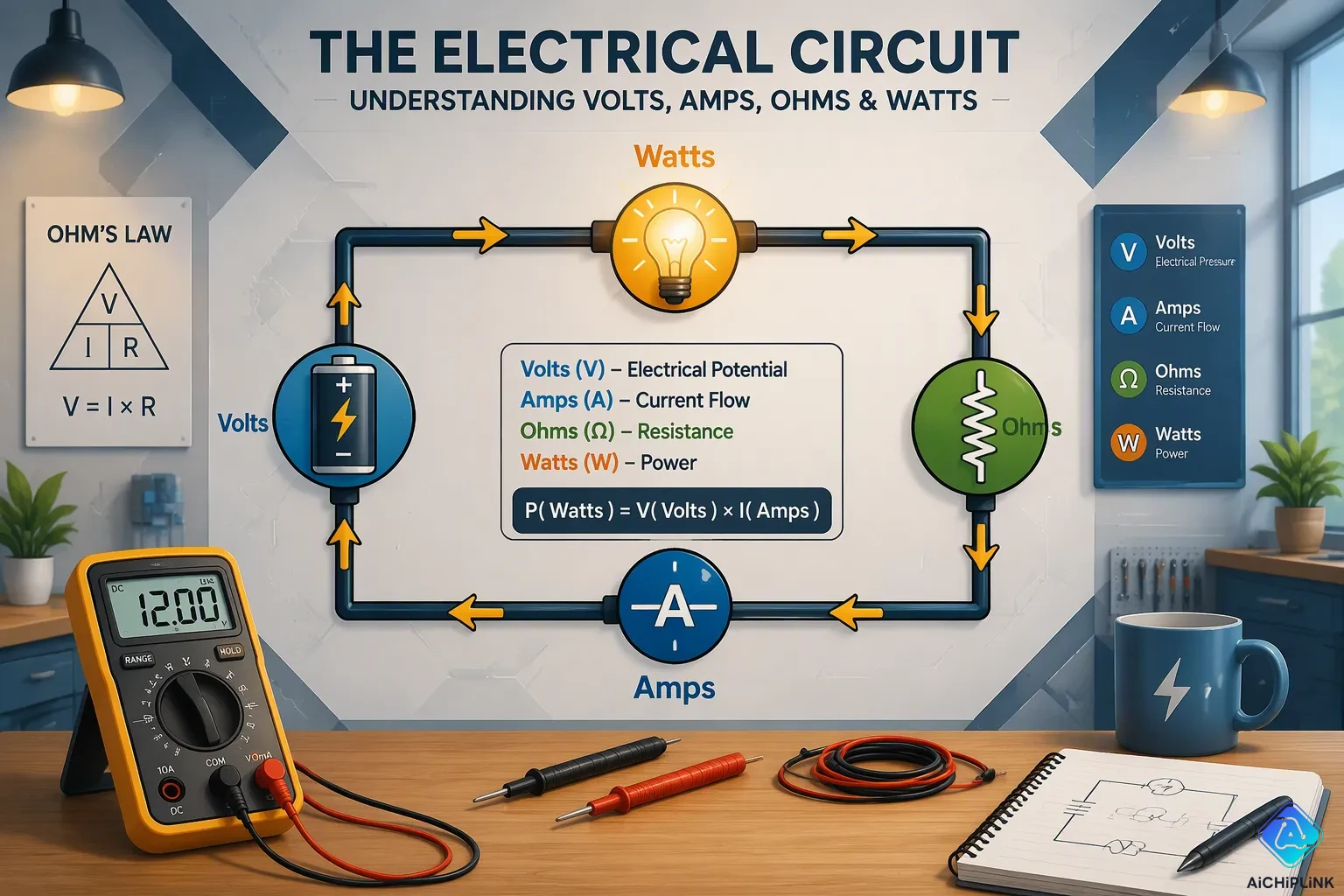
You're about to plug in a new appliance, and you see a label with numbers and letters like "120V" and "10A." What do they mean? This article will clearly define volts, amps, watts, and ohms, and explain how they work together in everyday electricity.
Think of electricity like water flowing through a pipe. Volts measure the pressure pushing the water. Amps measure how much water flows past a point each second. Watts tell you the total power delivered—the combination of pressure and flow. Ohms measure resistance, like a narrow section of pipe that slows the water down.
By the end, you'll be able to read any electrical label with confidence.
Key Takeaways
-
Volts measure the pressure of electricity. Amps measure how much electricity flows. Watts measure power. Ohms measure resistance.
-
These four units work together. You can use easy math to find one if you know the others.
-
Knowing these units helps you read labels on devices and stay safe.
-
You can use what you learned to choose the right charger, plan the size of a solar system, or stop electrical fires.
-
Think of the water pipe comparison: volts are like pressure, amps are like flow, watts are the total power, and ohms are how narrow the pipe is.
The Short Answer: Defining Each Unit
Before we go further, let's make the basics clear. You only need four simple definitions to read any electrical label. Volts measure electrical pressure. Amps measure electrical flow. Watts measure electrical power. Ohms measure resistance.
Here's a quick reference table to help you remember these electrical terms:
| Term | One-Sentence Definition |
|---|---|
| Volts | Voltage is the pressure that pushes electric current through a wire. |
| Amps | Amperage measures how fast current flows through an electrical circuit. |
| Watts | Watts are units of electric power. |
| Ohms | An ohm measures the resistance found in any electrical wire. |
Now imagine a garden hose. The water pressure inside is like voltage. The amount of water flowing through the hose each second is like amperage. A narrow or bent section of hose creates resistance, which is measured in ohms. The total power delivered by the water—the mix of pressure and flow—is like watts.
This water pipe comparison works because electricity and water act in surprisingly similar ways. Higher pressure pushes more water through the same hose. Higher voltage pushes more current through the same wire. A narrower hose limits flow. Higher resistance limits current too.
Volts: Electrical Pressure
Voltage is the push that gets electricity moving. Think of it as the force that moves current through a circuit. Without voltage, electrons just drift around randomly. They don't flow in any useful direction.
The water pipe comparison helps here. Voltage is the water pressure in the hose. Higher pressure means water travels farther and with more force. Higher voltage means current can push through more resistance or travel longer distances.
In the United States, wall outlets usually provide about 120 volts. That's the standard household voltage. Some heavy appliances, like electric dryers and ovens, use 240 volts instead. Those appliances need more pressure to work.
If you think of voltage as "electrical pressure" you can see why some things need lower pressure than others in an electrical system.
Here's something important: higher volts aren't always more dangerous. A static shock from a doorknob can reach thousands of volts, but it won't hurt you. The current is tiny and lasts only a split second. Voltage alone doesn't determine danger.
A Quick Comparison Table
Visualizing the Differences
A table lets you compare these four units easily. You can see what each one measures and match it to a water image you know.
| Unit | What It Measures | Common Analogy |
|---|---|---|
| Volt (V) | Electric potential difference | Water pressure |
| Ampere (A) | Rate of charge flow | Flow rate |
| Watt (W) | Energy used per second | Work being done |
| Ohm (Ω) | Opposition to current | Pipe narrowness |
The volt measures the push behind the electricity. The ampere measures how much charge passes a point each second. The watt measures the total energy used per second. The ohm measures how much a material blocks the flow.
See how each unit builds on the one before it. Voltage makes the push. That push moves current through a wire. Resistance limits how much current can flow. Power is what you get when voltage and current work together.
Everyday Examples of Each Unit
You already use these units every day, even if you never notice them. A phone charger often puts out about 5 volts. A US wall outlet gives roughly 120 volts. Those numbers tell you the pressure ready to push charge through your devices.
Now think about flow. A small phone charger pulls a tiny part of an amp. A hair dryer pulls many amps because it needs a big current to heat air fast. That higher amp draw is why hair dryers have thicker cords than phone chargers.
Power shows up on lightbulb boxes. A 60-watt bulb uses less power than a 1500-watt space heater. The watt rating tells you how much energy the device uses each second.
Resistance shows up in the wires themselves. Thin wires have higher resistance than thick ones. That resistance turns some electricity into heat, which is why old extension cords can feel warm. Knowing these everyday examples helps you read any label with confidence.
Volts: The Pushing Power
Voltage is the push that makes electrons move through a wire. Without it, electrons just drift around with no clear direction. Think of voltage as the energy each electron carries, ready to do work. This difference in electric potential between two points creates the force that drives current through a circuit.
The Water Pipe Comparison for Volts
Imagine a garden hose hooked up to a faucet. When you turn the handle, water pressure builds up inside the hose. That pressure pushes water forward with force. Voltage works the same way in your home's wiring. Higher voltage means more pressure, like a strong water jet that sprays across your yard.
The math behind this push is surprisingly simple. Voltage equals the potential energy per unit of charge. When you pull electrons away from their atoms, they gain potential energy. Let them go, and that energy turns into motion. This change happens incredibly fast. A modest 100-volt difference speeds an electron up to nearly six million meters per second. That speed shows you just how powerful voltage can be.
In the United States, standard wall outlets give about 120 volts. That's enough pressure to power your phone charger, lamp, or television. Heavy appliances like electric dryers need 240 volts instead. They need more push to make the heat they require.
Why Higher Volts Aren't Always Dangerous
You might think higher voltage always means more danger. That's not true. Static electricity from a doorknob can reach thousands of volts, yet it only gives you a quick sting. The reason comes down to energy and how long it lasts.
A static shock delivers less than one joule of energy. That's far too little to cause burns or harm your internal organs. The pulse lasts only a tiny fraction of a second. Your heart cells need a much longer signal to be stimulated, so they simply ignore the brief jolt.
Stun guns work on the same principle. They deliver high voltage but very short pulses. Only a small portion of that current ever reaches your chest, and even less affects your heart. The pulses target skeletal muscles instead, causing temporary incapacitation without lasting damage. So remember: voltage provides the push, but danger depends on how much current flows and how long it lasts.
Amps: The Flow of Current
Amps measure the rate that current flows through a wire. Think of them as the amount of water moving through a pipe each second. That rushing water is like electric current. One ampere equals exactly 6.241 × 10^18 electrons flowing past a single point every second.
The rate of charge flow tells you how much electricity a device actually uses. A small gadget might draw a fraction of an amp. A powerful appliance might draw many amps. The higher the amperage, the more electrons are moving through the circuit.
How Amps Relate to Wire Thickness
Higher amps mean more current flowing through a wire. More current generates more heat. That's why thicker wires are needed for higher amp draws. Wire gauge numbers work backward—smaller numbers mean thicker wires. A 14-gauge wire handles up to 15 amps. A 12-gauge wire handles 20 amps. A 6-gauge wire can carry 50-60 amps safely.
The technical term for this limit is ampacity. Ampacity is the maximum current a conductor can carry without overheating. Copper wire has higher ampacity than aluminum. That means aluminum wires must be thicker to handle the same load. Ambient temperature matters too. Hotter environments reduce ampacity, so you need thicker wire to stay safe.
You see this in your home. Lighting circuits often use 14-gauge wire with 15-amp breakers. Kitchen outlets use 12-gauge wire with 20-amp breakers. Electric ranges need 8-gauge wire. Central HVAC systems require 6-gauge wire.
Amps in Your Home Appliances
Different appliances draw very different amounts of current. A phone charger pulls just 0.5 to 1.5 amps. That's tiny. A refrigerator needs 5 to 8 amps to keep your food cold. A hair dryer on high heat draws 7 to 13 amps—nearly ten times what your phone charger uses.
That's why hair dryers have thick cords. They need to handle that higher current safely. The rate of current flow through those cords is much higher than through a phone charger's thin cable. If you plugged a hair dryer into a flimsy extension cord, the cord could overheat and melt.
Understanding amps helps you use electricity safely. You'll know why some outlets have different breaker sizes. You'll understand why certain appliances need dedicated circuits.
Watts: The Power You Use
Watts measure the real power you use. Think of watts as what you get when voltage and current work together. If volts are the pressure and amps are the flow, then watts tell you the total work that combination makes. A watt (W) is a unit of power that measures how much electricity a device uses at a given moment. Real power, measured in watts, is what makes useful results like light, heat, or motion.
Figuring Out Watts: Volts Times Amps
The math is simple. For a basic single-phase circuit, watts equal volts multiplied by amps. You can write it as W = V × A. This formula works best for resistive loads—devices like heaters and incandescent bulbs that turn electricity straight into heat or light.
For resistive loads, the power formula combines with Ohm's law to give you several ways to calculate power: P = IV = I²R = V²/R, where R is the electrical resistance.
Let's go through a real example. Suppose you have a device drawing 10 amps at 240 volts. Multiply those together: 10 × 240 = 2,400 watts. That's 2.4 kilowatts of power. A kilowatt equals 1,000 watts, so you can compare electrical demand across different voltage levels easily. The same 5-amp draw makes 600 watts at 120 volts, 1,040 watts at 208 volts, and 2,400 watts at 480 volts. Higher voltage means more power for the same current.
To change watts to amps, you just flip the formula. Divide watts by volts to get amps. For example, using 5,000 watts and 120 volts gives you about 41.67 amps. This conversion helps you understand what a circuit can handle.
Watts in Everyday Devices
You see watt ratings on almost every appliance you own. A standard 60-watt incandescent bulb uses 60 watts of power constantly. Most of that energy becomes heat rather than light, which is why LED replacements are far more efficient. A space heater, by contrast, draws much more power—typically 750 to 1,500 watts. Some larger units can reach 2,000 to 5,000 watts and need dedicated circuits to avoid tripping breakers.
Here's a quick look at typical wattage ranges for common household appliances:
| Appliance | Wattage Range (Watts) |
|---|---|
| Space heater | 750–1,500 W |
| TV | 50–400 W |
| Refrigerator | 100–800 W |
| Microwave oven | 600–1,200 W |
| Washing machine | 400–1,400 W |
| Dishwasher | 1,200–2,400 W |
These numbers help you understand your electricity usage. A 60W bulb running for 10 hours uses 600 watt-hours. A 1,500W space heater running for just one hour uses 1,500 watt-hours. That's why heating costs more than lighting. Understanding units of electric power lets you make smarter choices about which devices to run and when.
Ohms: Resistance to Current Flow
Resistance is how much a material pushes back against the flow of electricity. You measure it in ohms, shown by the Greek letter omega (Ω). Think of a narrow section in a water pipe. That narrow spot slows the water down, just like resistance slows the flow of electric charge.
As electrons move through a wire, they bump into atoms and other particles. Those collisions slow them down and create resistance. The higher the resistance, the lower the current flow when voltage stays the same. Lower the resistance, and more current can flow. One ohm means that 1 volt pushes 1 ampere of current through something, so 1 Ω = 1 V / 1 A.
How Resistance Affects Efficiency
Resistance changes how well a circuit works. When resistance goes up, current goes down for a given voltage. That relationship is inverse: current is inversely proportional to resistance. If you double the resistance, you cut the current in half.
Those electron collisions also produce heat. That heat wastes energy and lowers efficiency. A wire with high resistance turns more electricity into heat instead of useful work. That's why old, thin extension cords can feel warm. They waste power as heat because of their higher resistance.
Ohms in Wires and Components
Every wire and component has some resistance. Resistors are parts made to add a specific amount of resistance to a circuit. Their values often fall in the kilohm (kΩ) and megaohm (MΩ) ranges. For example, a 4,700Ω resistor equals 4.7kΩ, and a 5,600,000Ω resistor equals 5.6MΩ.
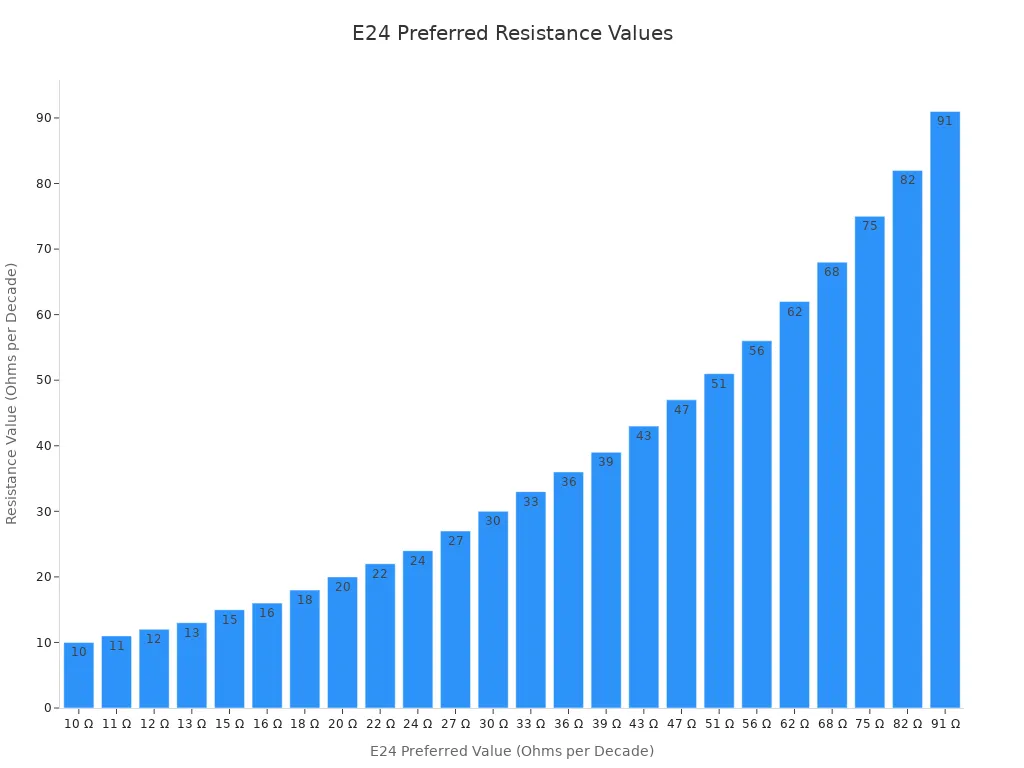
Common values you'll see include 10kΩ and 330Ω resistors, which people often use on breadboards and prototyping projects. Power resistor kits include low values such as 1Ω and 2Ω. The chart below shows the E24 preferred values from 10 to 91 ohms per decade.
Wire resistance depends on the material, its length, its cross-sectional area, and its temperature. Longer, thinner wires have more resistance. That extra resistance affects efficiency and can cause voltage drops along the wire.
How Volts, Amps, Watts, and Ohms Work Together
You've met each unit on its own. Now let's see how they connect. In a complete circuit, these four values never act alone. Change one, and the others shift too.
Ohm's Law Made Simple
Ohm's law ties voltage, current, and resistance into one neat relationship. It says voltage equals current multiplied by resistance, or V = I × R. Here, V stands for the electric potential difference measured in volts. I stands for current in amperes. R stands for resistance in ohms.
You can rearrange this equation two other ways. Current equals voltage divided by resistance (I = V ÷ R). Resistance equals voltage divided by current (R = V ÷ I). Each version solves for a different unknown.
Ohm's Law describes the relationship between voltage, current, and resistance in an electrical circuit: voltage equals current multiplied by resistance (V = IR). Pair that with the power equation – power equals current multiplied by voltage (P = IV) – and you get the four values that come up constantly in PV work: volts, amps, ohms, and watts.
Here's how the math plays out in practice. Push 2 amps through 12 ohms of resistance, and you get 24 volts. Hold that 24 volts across 12 ohms, and 2 amps flow. Raise the resistance to 36 ohms while keeping 9 volts, and current drops to 0.25 amps. Higher resistance always means less current for the same voltage.
The Power Formula with a Worked Example
The power formula connects everything to real work. It says watts equal volts times amps, or W = V × A. A watt measures the energy released each second. Power only exists when both voltage and current are present. In an open circuit, current is zero, so power is zero. In a short circuit, voltage is zero, so power is zero too.
Let's walk through a real appliance. Suppose your device runs on 120 volts and draws 5 amps. Multiply them: 5 amps × 120 volts = 600 watts. That's the power it consumes.
Now find its resistance. Use the formula watts = volts² ÷ ohms, rearranged to ohms = volts² ÷ watts. Plug in the numbers: 120² ÷ 600 = 14,400 ÷ 600 = 24 ohms. So this appliance has 24 ohms of resistance.
You can also flip the power formula to convert watts to amps. Divide watts by volts, and you get amps. That's how amps = watts ÷ volts works. A 1,000-watt device at 120 volts draws 8.33 amps. The same device at 240 volts draws only 4.2 amps. Higher voltage means less current for the same wattage.
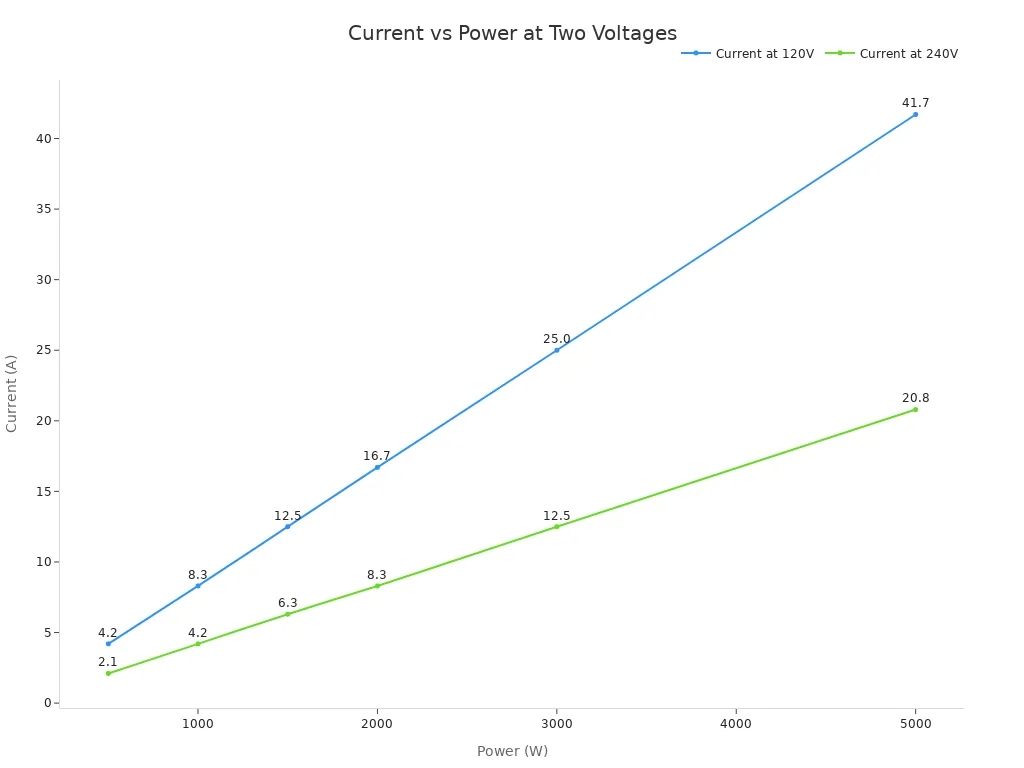
This chart shows the pattern clearly. As power rises, current climbs faster on a 120-volt circuit than on a 240-volt one. That's why higher-voltage systems use thinner wires for the same load. Understanding these relationships helps you read any label and predict how a device will behave.
Clearing Up Confusion: Amps vs. Volts vs. Watts vs. Ohms
People confuse these electrical terms all the time. You might hear someone claim that "amps kill you, not volts." Or you might think higher watts always mean better performance. Both ideas miss the bigger picture. Knowing how amps, volts, watts, and ohms differ helps you stay safe and pick the right devices.
Amps vs. Volts: Which Is More Dangerous?
Safety research shows that current, measured in amps, does the real damage during a shock. The current flowing through your body heats tissue and stirs your muscles and nerves. Voltage is the force that drives that current through you. Higher voltage can push past your skin's resistance, letting more current flow. But the current itself causes the harmful effects.
Look at these thresholds from electrical safety research:
| Mechanism of death | Current needed (mA) | Voltage needed (V AC) |
|---|---|---|
| Ventricular fibrillation | 100 | 30 |
| Tetanic contraction of respiratory muscles | 20 | 6 |
| Loss of muscle control (average man) | 16 | 4.8 |
| Loss of muscle control (sensitive female) | 10 | 3 |
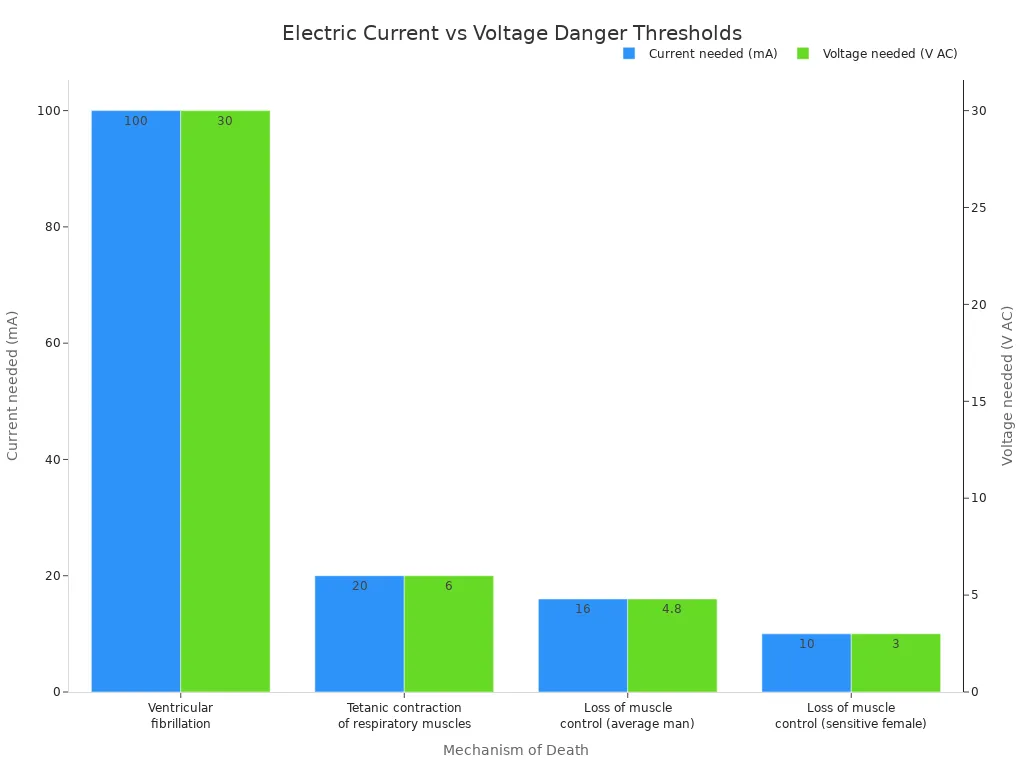
Notice how tiny amounts of current can cause serious harm. Only 10 milliamps can make you lose control of your muscles. That's why safety experts work to limit amperage, not just voltage. Your home's 120-volt outlets can send far more current than your body can take. That makes them dangerous even though the voltage seems modest. Just one ampere through your chest can throw off your heart's rhythm.
Watts vs. Volts: Why You Can't Just Look at One Number
Many people think higher voltage automatically means more power. That's not true. Power depends on voltage and current together. The formula is simple: watts = volts × amps. A high-voltage line with low current might deliver less power than a lower-voltage line with higher current.
Here's a common misconception table:
| Misconception | Truth |
|---|---|
| High voltage equals high power | Power depends on both voltage and current: Power (Watts) = Voltage × Current. |
| Amps and watts are interchangeable | Amps measure electrical flow, while watts measure total energy used. |
| Resistance (ohms) can be ignored | Resistance affects current flow, heat generation, and voltage drop. |
| Cable or breaker sizing is not critical | Incorrect sizing can cause fire hazards, melted cords, or lack of protection. |
You also need to know how to change watts to amps. Divide watts by volts to get amps. A 1,500-watt heater on a 120-volt circuit pulls 12.5 amps. That tells you whether your circuit breaker can handle the load.
Resistance matters too. If you ignore ohms, you get voltage drops and overheating. Every wire and part has some resistance. That resistance changes how much current flows through your electricity system.
Mastering these electrical terms makes you a smarter shopper. You'll read labels with confidence and steer clear of dangerous mistakes. That's the real value of knowing how these four units differ.
Practical Applications: Batteries and Solar Systems
Understanding Battery Ratings (mAh and Wh)
Battery labels show two main ratings: milliamp-hours (mAh) and watt-hours (Wh). The mAh rating tells you how much current a battery can give over time. Since 1 mA equals 0.001 A, a 1000 mAh battery can give 1 A for one hour in theory. It can also give 500 mA for two hours, or 100 mA for ten hours. That flexibility makes mAh helpful for comparing batteries at the same voltage.
But mAh alone doesn't show total energy because voltage matters too. The watt-hour measures the actual energy stored. You get it by multiplying voltage by capacity in ampere-hours, where 1 Ah equals 1000 mAh. For example, a 3000 mAh smartphone battery at 3.7 V stores 11.1 Wh. A 5000 mAh laptop battery at 11.1 V stores 55.5 Wh. This shows why comparing mAh alone can fool you when voltages differ.
To estimate run time, divide battery capacity in mAh by your device's average current use in mA. A 4000 mAh battery with 200 mA average draw gives you 4000 divided by 200, or 20 hours of estimated run time.
Sizing a Solar System: Matching Volts, Amps, and Watts
Solar installers match panel ratings to battery and inverter specs. You figure out current from power and voltage by dividing watts by volts. A 250 W panel at 24 V makes about 10.42 A. You find power by multiplying voltage and current together. An 18 V panel pushing 8.33 A gives you roughly 150 W.
Panel specs matter for compatibility. Pmax is the highest wattage output. Voc is open-circuit voltage, the highest no-load voltage. Vmpp is voltage at maximum power. Isc is short-circuit current, the highest amperage at zero volts. Impp is current at maximum power. You multiply these values by the number of panels in series or parallel to check your charge controller limits.
Connecting panels in series adds voltages while current stays the same. Three 12 V panels in series make a 36 V system. Parallel connections add currents while voltage stays constant. Your charge controller, inverter, and batteries must all be rated for the voltage and current your array makes.
Why Understanding These Ratings Matters
Avoiding Overloads and Fires
Overloading a circuit happens when you plug too many devices into one outlet or power strip. The wires get hot. Over time, they can melt or spark a fire. Nearly 60% of house fires come from electrical problems, according to numbers cited in industry reports. About half of home electrical fires involve wiring problems. Bad outlets and old wiring cause most of these.
Knowing amps and watts helps you stop this. Every circuit has a limit. A 15-amp breaker trips when the load goes past that amount. If you plug a 1,500-watt space heater and a 1,200-watt microwave into the same circuit, you draw too much power. The breaker should trip. But if it fails, the wires overheat.
Properly rated circuit breakers cut electrical fire risk by up to 50%, according to studies cited in industry articles. Ground fault detection adds another layer of safety. Only 30% of homeowners check their breakers on a regular basis, reports the Electrical Safety Foundation International. A monthly test takes seconds and can save lives.
Understanding circuit breakers is vital for electrical safety. They protect circuits from overloads and short circuits. A well-functioning circuit breaker can significantly reduce these risks, making your home safer.
Choosing the Right Charger and Power Strip
Matching a charger to your device comes down to two things: voltage and amperage. The charger output voltage must match your device exactly. Too low, and the device won't work. Too high, and you risk damage. The amperage rating must meet or exceed what your device needs. A charger rated higher than needed works safely. A charger rated lower may overheat or fail.
Power strips need the same care. Check the strip's wattage capacity against the total wattage of everything you plug in. Never daisy-chain power strips together. That practice draws more current than the strip can handle and creates a fire risk. Surge protection does not make overloading safe. The strip still has limits.
Inspect your cables and plugs regularly. Look for fraying, damage, or loose connections. Keep cords away from water and use GFCI protection near sinks. These habits keep your electricity use safe and efficient.
Volts are pressure, amps are flow, watts are power, and ohms are resistance. Keep the water pipe picture in mind. Voltage pushes the water, current is the water moving, and resistance is the narrow spot that slows it down. One watt equals one volt times one amp, and one ohm sets how much a material blocks flow. That model explains every label you meet.
These basics guide choices. You can size a battery, match a solar panel, or pick a charger. You will spot an overload before it starts a fire. A little knowledge about power keeps your home safer.
Now you can confidently read any electrical label and understand what it truly means.
Frequently Asked Questions
What is the difference between volts and amps?
Volts measure the push that moves electricity. Amps measure how much electricity actually flows. Think of a hose: volts are the water pressure, and amps are the water rushing out. You need both to do useful work.
How do I convert watts to amps?
Divide watts by volts. A 1,500-watt heater on a 120-volt circuit pulls 12.5 amps. This simple math helps you check whether an outlet or breaker can handle your device safely.
What does ohm's law actually tell me?
Ohm's law links voltage, current, and resistance in one relationship: voltage equals current times resistance. Raise the resistance, and less current flows for the same voltage. That single idea explains why thin wires heat up and why devices behave differently on the same circuit.
Why does my phone charger say 5V but my outlet says 120V?
Your charger steps the outlet's voltage down to a lower level your phone can handle. The charger also limits the ampere output. Matching both numbers keeps your device safe and working properly.
Does higher wattage always mean a better device?
No. A watt measures power use, not quality. A 60-watt bulb and a 1,500-watt space heater both do their jobs well. Higher watts simply mean the device consumes more energy each second.