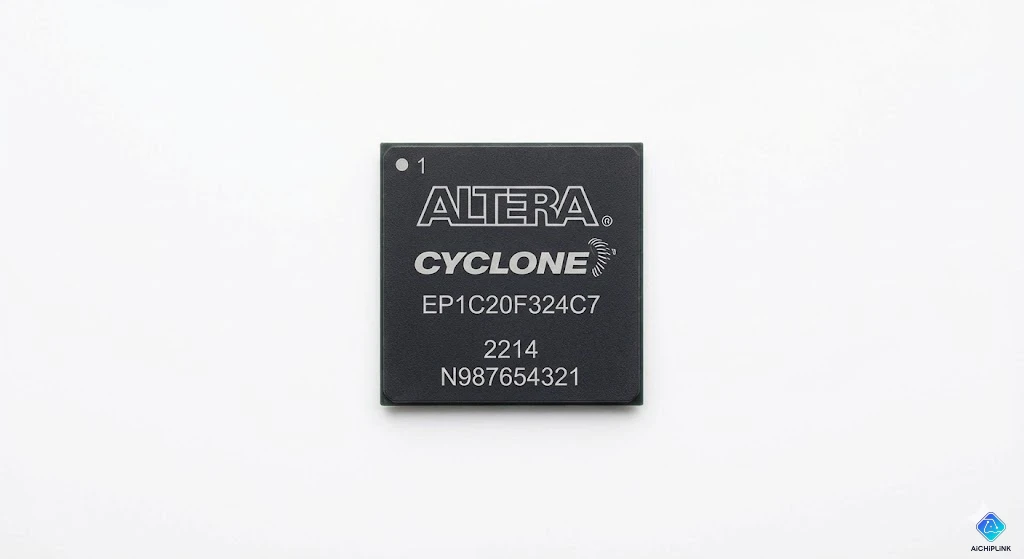
In the history of programmable logic, few chips are as iconic as the original Altera Cyclone®. It was the family that proved FPGAs could be low-cost alternatives to ASICs for high-volume applications.
The EP1C20F324C7 is one of the most popular members of this first generation.
While it is now considered an "Obsolete" or "Legacy" part by Intel, it remains widely used in industrial equipment maintenance, retro-computing projects, and educational boards. However, using a chip from the early 2000s comes with specific challenges—particularly regarding power rails and software support.
This guide covers everything you need to know to design with or repair systems using the EP1C20F324C7.
Table of Contents
- 1. Decoding the Part Number
- 2. Technical Specifications: The 130nm Workhorse
- 3. The "Software Trap": Quartus Compatibility
- 4. Hardware Considerations: Power & Package
- 5. Conclusion
1. Decoding the Part Number
Altera part numbers are structured to tell you the device density, package, and speed. Here is the breakdown for EP1C20F324C7:
The Breakdown Matrix
| Segment | Code | Meaning |
|---|---|---|
| EP1C | Cyclone I | The 1st Generation Low-Cost Family (130nm process). |
| 20 | Density | 20,060 Logic Elements (LEs). This is the "Large" mid-range device (Comparison: EP1C3 is minimal, EP1C20 is substantial). |
| F | Package Type | FineLine BGA (FBGA). |
| 324 | Pin Count | 324 Pins. (19x19 mm body). |
| C | Temp | Commercial (0°C to 85°C). |
| 7 | Speed | Speed Grade 7. (6 is Fastest, 8 is Slowest). |
Procurement Tip: [Check Stock for EP1C20F324C7 at Aichiplink]. Since this is a legacy part, verify the date codes with your supplier to ensure solderability.
2. Technical Specifications: The 130nm Workhorse
The EP1C20 was designed to balance price and performance. Even by today's standards, its logic density is sufficient for complex tasks like soft-core processors (Nios II) or multi-axis motor control.
- Logic Elements (LEs): 20,060.
- Embedded Memory: 294,912 bits (arranged in M4K blocks).
- PLLs: 2 Phase-Locked Loops. Essential for generating internal clocks from a single external crystal.
- Total I/O Pins: 233 User I/Os (in the F324 package).
- Configuration: Supports Active Serial (AS) using EPCS4/EPCS16 devices.
3. The "Software Trap": Quartus Compatibility
This is the most common issue new users face. Do not install the latest Quartus Prime Pro.
The Cyclone I family is no longer supported in modern Intel FPGA tools. If you try to open a project in Quartus Prime v20+, the device will not appear.
The Solution: You must use Altera Quartus II Web Edition v13.0sp1 (Service Pack 1).
- This is the last version to support the Cyclone I architecture.
- It is free to download from the Intel FPGA archive.
- OS Note: It runs best on Windows 7, but functions on Windows 10/11 (sometimes requiring compatibility mode).
4. Hardware Considerations: Power & Package
Designing a PCB for the EP1C20F324C7 requires attention to its older process technology.
A. Power Rails (Voltage)
Modern FPGAs typically use 1.2V or 1.0V cores. The Cyclone I is different:
- $V_{CCINT}$ (Core): 1.5V. You must provide a robust 1.5V rail for the internal logic.
- $V_{CCIO}$ (I/O): 3.3V (Typical). The Cyclone I is famous for its robust 3.3V tolerance, making it much easier to interface with 5V legacy logic (using resistors) compared to newer 1.8V-only chips.
B. The FBGA-324 Package
- Pitch: 1.0 mm.
- Routing: The 1.0mm pitch is forgiving. You can fan out this BGA using standard PCB manufacturing rules (unlike the 0.8mm or 0.5mm pitch of modern BGAs).
- Rework: It is possible to replace this chip using a decent hot air rework station due to the larger ball spacing.
5. Conclusion
The Intel Altera EP1C20F324C7 is a testament to the longevity of well-designed silicon. While it lacks the DSP blocks and high-speed transceivers of the Stratix series, its massive 3.3V I/O count and 20k LEs make it irreplaceable for maintaining legacy industrial systems.
Sourcing Legacy Altera FPGAs Struggling to find obsolete Cyclone chips? Visit Aichiplink.com to search for verified stock of the EP1C20F324C7 and compatible configuration memory.

Written by Jack Elliott from AIChipLink.
AIChipLink, one of the fastest-growing global independent electronic components distributors in the world, offers millions of products from thousands of manufacturers, and many of our in-stock parts is available to ship same day.
We mainly source and distribute integrated circuit (IC) products of brands such as Broadcom, Microchip, Texas Instruments, Infineon, NXP, Analog Devices, Qualcomm, Intel, etc., which are widely used in communication & network, telecom, industrial control, new energy and automotive electronics.
Empowered by AI, Linked to the Future. Get started on AIChipLink.com and submit your RFQ online today!
Frequently Asked Questions
1. What is the EP1C20F324C7 used for?
It is used in legacy industrial control systems, educational FPGA boards, and equipment maintenance projects.
2. Is EP1C20F324C7 still supported by Intel tools?
No. It is only supported up to Altera Quartus II v13.0sp1 and not in modern Quartus Prime versions.
3. What core voltage does the EP1C20 require?
The FPGA core (VCCINT) requires 1.5V, which is higher than most modern FPGAs.
4. What does F324 mean in the part number?
F324 indicates a FineLine BGA package with 324 pins and a 1.0 mm ball pitch.
5. Is EP1C20F324C7 suitable for new designs?
It is not recommended for new designs, but it is ideal for legacy system repair and replacement.