Broadcom’s Dominance in the 2026 AI Networking Supercycle
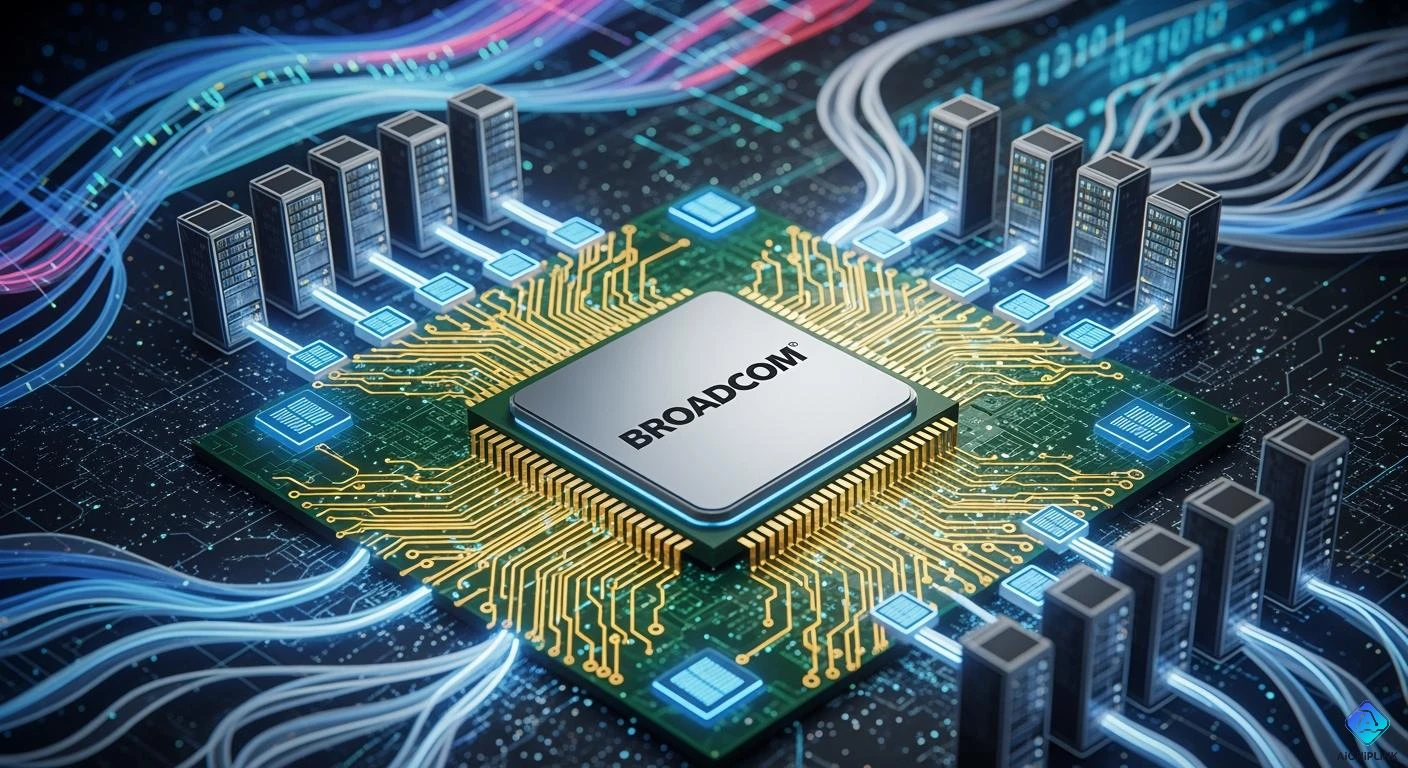
Broadcom’s dominance changes the 2026 ai networking supercycle and the future of digital intelligence. The company controls more than 80% of the high-end Ethernet switching market. It helps data innovation with custom ai accelerators. Big cloud providers depend on Broadcom for fast data movement. This supports the huge growth of artificial intelligence. Data centers need fiber-rich infrastructure to handle lots of data. This also helps reduce latency and gives more flexibility. Broadcom’s strength in data connectivity, networking, and intelligence is important. It pushes the next era of ai-driven data intelligence.
Key Takeaways
- Broadcom has more than 80% of the high-end Ethernet switching market. This makes Broadcom very important in AI networking. The Tomahawk 6 switch moves 102.4 Tbps of data. It helps big AI clusters work fast with little delay. Broadcom makes custom AI accelerators. These help companies get better performance and save money. This improves their AI skills. Broadcom works with big tech companies like OpenAI and Google. These partnerships make Broadcom stronger in the market and help it create new ideas. Investors should see Broadcom grow a lot. AI revenue may go over $40 billion by 2026.
Broadcom’s Dominance in AI Networking
Tomahawk 6 and Ethernet Leadership
Broadcom is a leader with its Tomahawk 6 switch. This chip is important for fast networking in ai data centers. Tomahawk 6 can move 102.4 Tbps of data per chip. It connects up to one million XPUs in one Ethernet system. The chip uses a 3nm CMOS process, which saves power. Broadcom uses a chiplet design to split SerDes from the main chip. This makes more ports and lowers costs.
| Feature | Specification |
|---|---|
| Switching Capacity | 102.4 Tbps per chip |
| Port Configurations | Up to 512 ports at 200 Gbps or 1,024 ports at 100 Gbps |
| Architecture | Chiplet architecture separating SerDes from processing die |
| AI Cluster Support | Supports up to one million XPUs in a unified Ethernet fabric |
| Process Node | 3nm CMOS for improved power efficiency |
Tomahawk 6 uses PAM-4 signaling for fast data transfer. It helps spread traffic well with endpoint-scheduled fabrics. Broadcom made Tomahawk 6 for almost full network use in ai clusters. The chip comes in regular and CPO types, which use less power and cut latency. Broadcom’s CPO builds on older Tomahawk chips.
| Feature | Broadcom Tomahawk 6 | Nvidia Spectrum Photonic ASICs |
|---|---|---|
| Maximum Bandwidth | 102.4 Tbps | 102.4 Tbps |
| Ecosystem | Open, standards-based | Proprietary, vertically integrated |
| Power Efficiency | Enhanced through CPO variant | Claims up to 3.5 times greater energy efficiency |
| Total Cost of Ownership | Reduced through mature CPO | Higher due to proprietary integration |
| Availability | Samples shipping to hyperscalers and OEMs | N/A |
Broadcom uses open standards and designs. This lets cloud providers grow their ai systems without being stuck with one vendor. Broadcom’s Ethernet leadership gives big companies more choices and saves money.
Custom AI Accelerators
Broadcom makes custom ai accelerators for top tech companies. These accelerators use special silicon for each customer. Broadcom makes ASICs for better performance and lower costs. The company fits custom solutions into customer hardware and software. Broadcom works with customers on long-term supply plans. This helps plan for parts and capacity.
| Unique Feature | Description |
|---|---|
| Custom Silicon Engagements | Focus on tailored silicon solutions for specific customer needs, unlike standardized offerings. |
| Workload-Specific Optimization | ASIC designs optimized for specific workloads, enhancing performance and cost efficiency. |
| Deep Integration with Customer Environments | Custom solutions that integrate closely with existing customer hardware and software setups. |
| Supply-Chain Planning with Customers | Collaborative multi-year programs for better capacity planning across various components. |
| Reduced Dependence on Merchant Platforms | Custom silicon complements existing GPU supplies rather than fully replacing them. |
“Our partnership with OpenAI keeps setting new standards for open, scalable, and power-efficient AI clusters,” said Charlie Kawwas, Ph.D., President of the Semiconductor Solutions Group for Broadcom Inc. “Custom accelerators work well with Ethernet networking solutions to give cost and performance optimized next-generation AI infrastructure.”
Broadcom’s custom ai accelerators help customers rely less on merchant platforms. They work with GPUs and help build bigger ai clusters. Broadcom’s close work with customers makes it different from others.
Market Share and Growth
Broadcom has over 70% of the custom ai accelerator market. The company works with Alphabet, Meta, OpenAI, and Anthropic. Broadcom’s ai revenue grew 220% in fiscal 2024, from $3.8 billion to $12.2 billion. In Q3 FY2025, ai chip revenue was $5.2 billion, up 63% from last year. Networking revenue for ai went up over 60% in the first quarter of fiscal 2026.
-
Networking revenue for ai will be almost one-third of all ai revenue.
-
It may reach 40% in the second quarter of fiscal 2026.
Broadcom’s ai backlog is $73 billion, with $53 billion in custom silicon backlog. Revenue is expected to come in six quarters. The ai switches backlog is over $10 billion. The total backlog is $162 billion, with delivery in 18 months.
| Metric | Value |
|---|---|
| AI semiconductor revenue growth | 74% year-over-year |
| AI semiconductor revenue | $6.5 billion |
| Projected AI semiconductor revenue | $8.2 billion (Q1 FY2026) |
| AI switches backlog | > $10 billion |
| Total AI order backlog | > $73 billion |
| Consolidated backlog | $162 billion |
| Expected delivery timeframe | 18 months |
-
AI revenue is expected to grow over 100% in 2026, reaching $40.4 billion.
-
There is more growth possible, with estimates up to $78 billion in 2028.
Broadcom’s lead in ai networking comes from its technology, custom silicon, and strong partnerships. The company’s fast revenue growth and big backlog show it is the industry leader.
Financial Strength and Strategic Moves
AI Revenue Surge
Broadcom keeps breaking records in the ai chip market. The company’s ai chip revenue went up to $8.4 billion in Q1 2026. This is more than double from before. Broadcom thinks its yearly revenue will go over $100 billion by 2027. Long-term deals with Google and Anthropic help this growth. The ai demand is about 10 gigawatts. That is as much power as 8 million U.S. homes use. Broadcom’s gross margins in ai networking are higher than most other companies.
| Segment | Gross Margin (%) |
|---|---|
| Broadcom AI Networking | 65 |
| VMware | 93 |
| Networking & Switches | 70 |
Broadcom’s strong money results show it leads in ai networking. The company’s high margins and fast revenue growth give it an edge.
Supply Agreements and Partnerships
Broadcom made supply deals with six big ai customers. These partnerships focus on custom ai accelerators and networking for large ai systems. OpenAI will help design the accelerators with Broadcom. This teamwork will help meet the world’s ai needs. The new systems will be used at OpenAI’s sites and partner data centers. Broadcom and OpenAI have worked together for a long time to make and supply ai accelerators.
-
Broadcom and OpenAI will work together to use 10 gigawatts of custom ai accelerators.
-
The new ai accelerator and network systems will start being used in the second half of 2026 and finish by the end of 2029.
-
The teamwork includes making systems that use Broadcom's Ethernet solutions.
Broadcom’s partnerships last a long time and include working together on new products. These deals help meet the growing need for ai in data centers.
Product Roadmap and OFC 2026 Highlights
Broadcom showed off new technology at OFC 2026. The company showed co-packaged optics (CPO) that worked for 50 million hours without problems. Broadcom launched the Taurus optical DSP, the first 400 gigabit per lambda PAM4 optical DSP. This helps ai systems grow bigger. The company also talked about its 3.5D silicon technology. This stacks compute dies to make things faster. Broadcom showed the new OCI MSA optical standard. This makes networks faster, cheaper, and use less power. The Ethernet for Scale-Up Networking Group’s 1.0 rules were announced. Tomahawk 6 now supports more advanced networking features.
| Product/Advancement | Description |
|---|---|
| Co-packaged optics (CPO) | Showed it can work for 50 million hours without link problems. |
| 400G/Lane Taurus Optical DSP | First 400 gigabit per lambda PAM4 optical DSP for bigger ai systems. |
| 3.5D silicon technology | Stacks two compute dies face-to-face, better than the old 2.5D way. |
Broadcom’s new products and OFC 2026 news show it is a leader in ai networking. The company’s new ideas help make next-generation data centers faster and more reliable.
The 2026 AI Networking Supercycle

Industry Trends and Shifts
The ai networking supercycle in 2026 brings big changes. The semiconductor industry grows fast because of ai. Memory bandwidth is now more important than speed. High-bandwidth memory gets more attention. Semiconductor spending hits $700 billion. Hyperscalers build bigger systems. Data centers need more power. Enterprise ai becomes common. Analog semiconductors help this growth.
-
Memory supercycle means more high-bandwidth memory is needed.
-
Semiconductor spending helps build more infrastructure.
-
Data centers use much more power.
-
Enterprise ai spreads quickly.
-
Analog semiconductors make supply chains stronger.
Switching from proprietary to Ethernet networking helps systems grow. It also saves money. DriveNets' AI Fabric makes jobs finish faster, by 10% to 30%. Networking costs are about 10% of the total system cost. Efficient networking is important for strong ai systems.
Broadcom vs. Competitors
Broadcom leads the ai networking market. It controls 70% of the custom ai ASIC market. Broadcom is second after NVIDIA in ai compute. Broadcom mixes ASIC design with networking tech. This makes it hard for customers to switch. Broadcom works closely with Google and Meta.
| Metric | Broadcom Value | Competitor Comparison |
|---|---|---|
| Custom AI ASIC Market Share | 70% | Second after NVIDIA |
| Q3 FY2025 AI Semiconductor Revenue | $5.2 billion (63% YoY increase) | N/A |
| Q4 FY2025 AI Revenue | $6.5 billion (74% YoY increase) | N/A |
| Q1 2026 AI Revenue Guidance | $8.2 billion (100% YoY increase) | N/A |
Broadcom is strong in the ai ASIC market. Its products work well together. It has good relationships with big customers. But Broadcom depends on a few main clients. Its profit margins are lower than NVIDIA.
Impact on Cloud and Hyperscalers
Broadcom's technology changes cloud providers and hyperscalers. Using Ethernet standards lets companies avoid being stuck with one vendor. It also helps systems work together. Hyperscalers team up with Broadcom to make custom ASICs. They stop relying on just one supplier. Broadcom's Tomahawk 6 switch gives high bandwidth and low latency. This helps big ai compute clusters. Open standards and co-packaged optics give more choices for data centers. Broadcom's ai revenue goes up because of strong demand in search, social media, and ai research.
Cloud providers use Broadcom's networking solutions. This lets them build flexible systems for growing ai workloads.
Challenges and Opportunities
Regulatory and Supply Chain Risks
Broadcom faces some risks as it leads the AI market. Changes in rules can affect how companies use data. Companies must follow strict privacy laws. Geopolitical events make many companies use private clouds for sensitive data. These trends mean strong cybersecurity and compliance are needed.
-
Broadcom started early with quantum-safe encryption. This matches new government standards for post-quantum cryptography.
-
Using private cloud solutions helps keep data safe and follow rules.
-
Experts think companies will focus on staying strong. They will mix cybersecurity with business continuity.
Broadcom’s supply chain is strong. Management has secured production until 2028. This helps Broadcom deliver products on time, even if there are global problems.
Integration and Innovation
Broadcom keeps solving integration challenges in AI networking. The company builds lossless, high-performance connections across far sites. As AI workloads grow, networks must connect more data centers. Power and space limits, plus the need for resiliency, change data center design.
-
Network infrastructure can slow performance in big AI training jobs.
-
Broadcom makes AI-specific hardware for cloud environments.
-
The company supports open standards and modular architecture. This makes integration easier.
Broadcom also helps the Kubernetes community. Projects like Antrea and Cluster API help standardize AI workloads. The Certified Kubernetes AI Conformance Program makes sure systems work together. Broadcom’s VMware vSphere Kubernetes Service meets these standards. This makes operations more consistent.
Future AI Workloads
The next wave of AI workloads will need even more from networking solutions. Hyperscale data centers need custom AI accelerators and fast connections. Broadcom focuses on interconnection to help scale AI model training and inference. The CEO says demand stays strong as large language models change.
| Evidence Description | Source |
|---|---|
| Broadcom makes custom AI accelerators and networking infrastructure. | TradingKey |
| The company co-designs chips with top AI companies for special needs. | TradingKey |
| Supply chain secured until 2028 for production needs. | TradingKey |
| AI semiconductor revenue for training and inference chips has gone up. | TradingKey |
| ASICs do better than GPUs in some inference tasks. | Fool |
Broadcom leads in the AI compute sector. This helps it meet future workload needs. The company’s strategy supports bigger compute clusters and advanced data center architecture.
Broadcom’s Future in AI Networking
Long-Term Industry Impact
Broadcom is very important for AI networking. The company owns 80% of the market for fast Ethernet switching and routing chips. These chips help AI clusters grow bigger. The need for networking solutions will grow by 20% to 30% each year. Broadcom also has 70% to 80% of the custom AI chip market. Experts think this market will grow by 29% every year until 2033.
-
Broadcom buys software companies to make customers stay longer and pay more.
-
The company’s smart plans and strong money results make it a top choice for clients.
-
Broadcom helps move from special tech to Ethernet, which makes systems bigger and more open.
-
New ideas like Silicon Photonics help send data faster for AI jobs.
-
Broadcom’s Tomahawk 5 switch can move 51.2 Tbps, which is twice as fast as others.
Industry rules keep changing as Broadcom leads the way with Ethernet for new jobs. The company’s top spot shapes how AI systems and data centers will work in the future.
Implications for Investors
Investors think Broadcom is a top company in AI networking. The company’s AI business is expected to be a big part of its future money. Strong customer ties and good software help Broadcom beat other companies. Custom silicon and networking skills keep Broadcom strong in the market.
| Year | Estimated AI Infrastructure Revenue Opportunity | Market Growth Factor |
|---|---|---|
| 2027 | $60 billion to $90 billion | 4x current market size |
Broadcom’s revenue went up 24% to a new high of $64 billion. AI revenue grew by 65% compared to last year. Software revenue went up 26%. The company made a non-GAAP EPS of $1.95, which is 37% more than last year. Broadcom’s free cash flow margin should go back to 50%. The company raised its dividend by 10%, and the payout is still under 30%.
Investors know Broadcom can handle ups and downs in the chip business. The company’s big backlog and growing money show it is steady and has a bright future.
Broadcom is ahead in the AI networking supercycle because it has great technology and strong partners. Custom silicon, Ethernet leadership, and fast revenue growth are important reasons for Broadcom’s success. The company helps decide how AI infrastructure will look and affects the tech industry.
-
Broadcom’s new ideas help data centers grow and work well.
-
Investors and cloud providers gain from Broadcom’s smart choices.
Broadcom will keep making new rules in AI networking. People should look for updates in custom accelerators and Ethernet solutions.

Written by Jack Elliott from AIChipLink.
AIChipLink, one of the fastest-growing global independent electronic components distributors in the world, offers millions of products from thousands of manufacturers, and many of our in-stock parts is available to ship same day.
We mainly source and distribute integrated circuit (IC) products of brands such as Broadcom, Microchip, Texas Instruments, Infineon, NXP, Analog Devices, Qualcomm, Intel, etc., which are widely used in communication & network, telecom, industrial control, new energy and automotive electronics.
Empowered by AI, Linked to the Future. Get started on AIChipLink and submit your RFQ online today!
Frequently Asked Questions
What makes Broadcom’s Tomahawk 6 switch important for AI?
Tomahawk 6 can move a lot of data, up to 102.4 Tbps. It links big AI clusters and keeps delays low. The switch uses a special chiplet design. Many cloud companies pick it because it is fast and works well.
How does Broadcom support custom AI accelerators?
Broadcom teams up with top tech companies. They make custom silicon for different jobs. These accelerators help things run better and cost less. Customers get solutions that match their hardware and software.
Why do hyperscalers prefer Ethernet-based networking?
Ethernet networking is flexible and costs less money. Hyperscalers do not get stuck with one vendor. Open standards let them grow AI clusters easily. Broadcom’s Ethernet skills give them more options.
What risks does Broadcom face in AI networking?
Changes in rules and supply chain problems are risks. Broadcom spends money on cybersecurity and follows the rules. The company makes sure it can build enough products even if there are problems.