What Is Conductance vs Resistance and How Does It Affect Current Flow
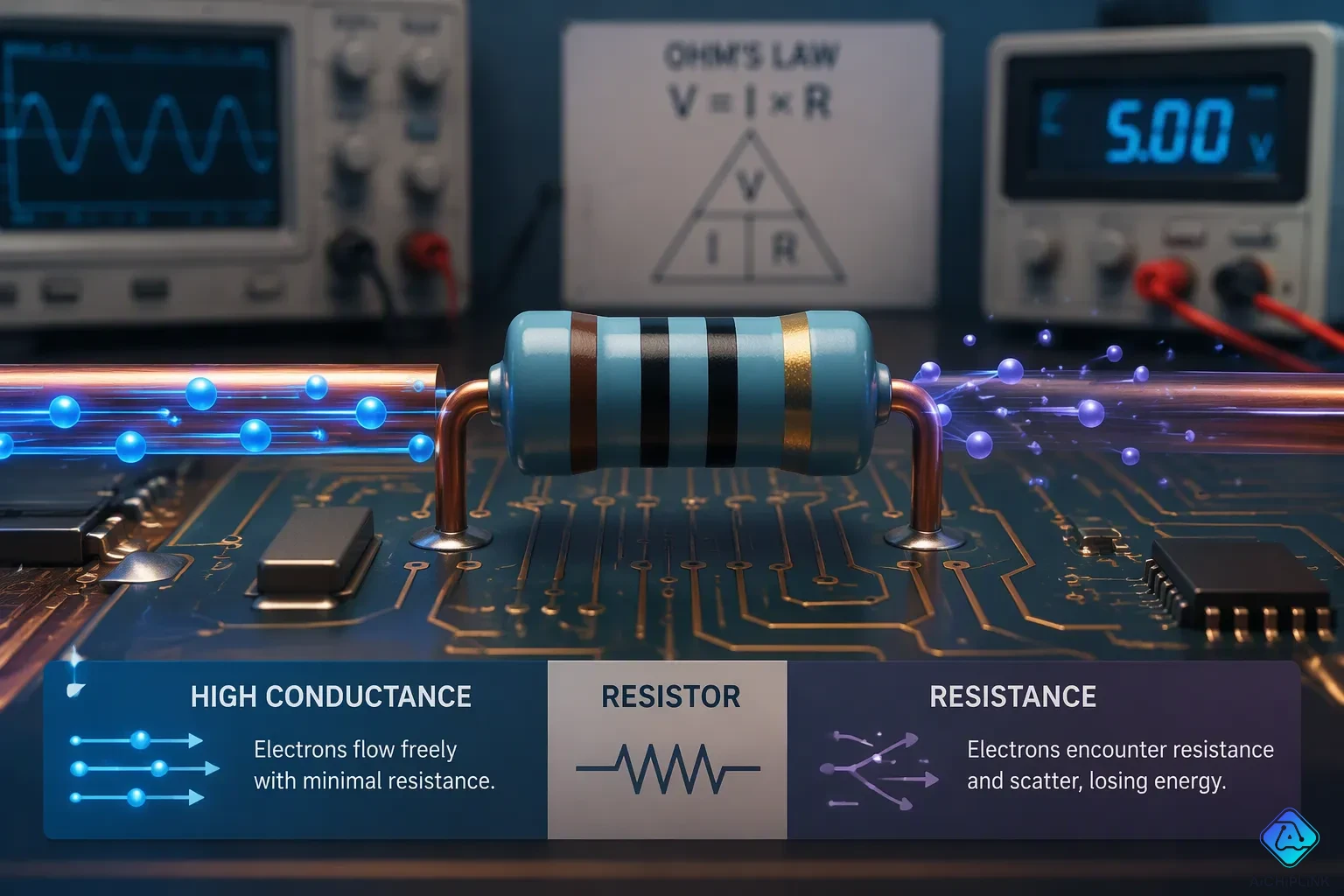
Resistance works against the flow of electric current. Conductance measures how easily that current moves through a material. The two quantities are exact opposites, so one goes up as the other goes down.
What is conductance, in simple words? It is a material's willingness to let current pass, and engineers use the letter G for it. You will see conductance vs resistance as a paired idea in circuit work.
A wider path means lower resistance. The material you pick, the temperature, and the shape of the conductor all change conductance. Ohm's law ties these ideas together: current equals voltage divided by resistance, so conductance directly shapes current flow.
Key Takeaways
-
Resistance works against current flow, while conductance measures how easily current passes.
-
Conductance and resistance are opposites: when one goes up, the other goes down.
-
You can find conductance by taking the reciprocal of resistance, using G = 1/R.
-
A short, wide conductor has high conductance and lets more current flow.
-
Use Ohm's law written as I = V × G to find current from voltage and conductance.
Conductance vs Resistance Defined
What Resistance Measures
Electrical resistance is the natural opposition a material gives to the flow of electric current. You can think of it as the normal interference an electron meets as it tries to move along a circuit. The resistance of an object tells you how strongly that object pushes back against moving charge.
Engineers define resistance as the ratio of the voltage across a conductor to the current flowing through it. In simple terms, resistance equals voltage divided by current. The SI unit of electrical resistance is the ohm, written with the symbol Ω. One ohm equals one volt per ampere, so a resistor that develops one volt across it for every ampere of current has a resistance of one ohm. This definition comes straight from Ohm's law, which states that current through a metal conductor is directly proportional to the voltage across it at a given temperature.
| Electrical Parameter | Measuring Unit | Symbol | Description |
|---|---|---|---|
| Voltage | Volt | V or E | Unit of Electrical Potential, V = I × R |
| Current | Ampere | I or i | Unit of Electrical Current, I = V ÷ R |
| Resistance | Ohm | R or Ω | Unit of DC Resistance, R = V ÷ I |
What Conductance Measures
Electrical conductance is the opposite quantity. It measures how easily electricity flows through a material, and engineers use the letter G for it. The unit of conductance is the siemens, shortened to S. One siemens equals the reciprocal of one ohm, which is also written as A/V. The siemens is the exact opposite of resistance in unit terms: where the ohm describes opposition, the siemens describes ease of passage.
A simple pipe analogy makes the contrast easy to grasp. Water flow through a pipe maps to current through a wire, and pressure drop maps to voltage drop. Conductance corresponds to how much flow results from a given pressure. A wide, short pipe permits greater flow at the same pressure, so it has high conductance. A long, narrow pipe restricts flow, so it has low conductance.
A severe constriction in a water pipe resists flow much like a resistor resists electric current. The constriction adds more resistance than the rest of the pipe system, just as a resistor generally has much more resistance than the connecting wire—showing low conductance in the restricted section versus high conductance in the open pipe.
Pumping water at a fixed pressure through a narrow 1/4-inch pipe yields much less flow than the pump's rated capacity. Pumping the same water at the same pressure through a wider 1-inch pipe allows far more flow. The same shape logic applies to wires: a short, thick copper wire has higher conductance, while a long, thin one has lower conductance. Understanding conductance vs resistance starts with this picture of a wide path versus a narrow one.
Resistance and Conductance Are Inversely Related
The Reciprocal Formula
You can show the link between these two quantities with a simple pair of equations. Conductance equals one divided by resistance, or G = 1/R. If you turn the formula around, you get R = 1/G. The unit of conductance is the siemens, and one siemens equals one divided by one ohm.
A worked example makes the math concrete. Take a resistor with a resistance of 10 ohms. Its conductance is G = 1/10 = 0.1 S, which is 100 millisiemens. A 100-ohm resistor gives G = 1/100 = 0.01 S, or 10 millisiemens. The larger resistance always produces the smaller conductance.
| Quantity | Inverse Relationship | Formula |
|---|---|---|
| Conductance (G) vs. Resistance (R) | Conductance is the reciprocal (inverse) of resistance | G = 1/R |
| Conductivity (σ) vs. Resistivity (ρ) | Conductivity is the reciprocal (inverse) of resistivity | σ = 1/ρ |
Reading the Relationship in Plain Terms
This reciprocal relationship has a practical meaning you can use right away. High conductance means low resistance, so electric current flows easily. Low conductance means high resistance, so the same voltage pushes less current through the part. Conductance is the opposite of resistance in both unit and behavior.
Material properties drive both values at the same time. Resistivity is a built-in property of a material that measures how strongly it opposes the flow of electrical current, symbolized by ρ and expressed in Ω·m. It is the reciprocal of electrical conductivity (ρ = 1/σ). Good conductors have high conductivity and low resistivity, while good insulators have low conductivity and high resistivity.
The greater the resistivity, the larger the electric field needed to produce a given current density.
You can see how conductance vs resistance stays tied to the same underlying material. A material with high conductivity gives you high conductance and low electrical resistance in one step. That single property explains why copper and aluminum work so well in wiring.
Factors That Affect Conductance
Material and Temperature
The metal you pick sets where performance starts. Copper, zinc, and iron are all good choices for materials that conduct well. Dents, damage, or changed atoms lower electrical conductivity. Mixing metals into an alloy also changes how well a metal conducts. Electrical resistivity and conductivity are opposites, so low opposition means high conductance. You can compare electrical resistivity and conductivity across metals.
Temperature changes conductance in everyday wires. In metals, electrical conductivity usually drops as temperature goes up. Hotter temperatures make metal atoms vibrate harder, and that gets in the way of free electrons. Metals lose conductivity at higher temperatures, but semiconductors gain it. The table below shows how electrical resistivity changes with heat for common conductors.
| Material | Temperature Coefficient α (per °C, at 20°C) |
|---|---|
| Copper | 0.00386 |
| Copper, annealed | 0.00393 |
| Aluminum | 0.00429 |
The temperature coefficient of resistivity for aluminum is positive, about 0.0039 per °C. That means for every 1°C increase, resistivity goes up by 0.39% of its value at 20°C.
A warmer aluminum wire carries less current at the same voltage. Electrical resistivity and conductivity explain that drop.
Conductor Geometry
Length and cross-sectional area shape a wire's resistance and conductance. Resistance is proportional to length: double the length and you double the resistance, so conductance drops by half. Resistance is inversely proportional to cross-sectional area: a wider conductor lowers resistance and helps electric current flow. A narrow conductor blocks electron flow more than a wide one, much like a narrow pipe.
The formula R = ρl/A ties these traits together, where ρ is the material's specific resistance. Electrical resistivity and conductivity stay reciprocal here too. Length changes electrical resistivity and conductivity in a predictable way. Area changes electrical resistivity and conductivity. A longer conductor gives you lower conductivity. A larger diameter raises cross-sectional area and lowers the resistance of an object. Engineers track electrical resistivity and conductivity when they size a wire. Electrical resistivity and conductivity depend on the material. These factors that affect resistance and conductance apply to every wire you size. Keep resistivity and conductivity in mind for every conductor. Resistivity and conductivity set the baseline.
How Conductance Drives Current Flow
Conductance Through Ohm's Law
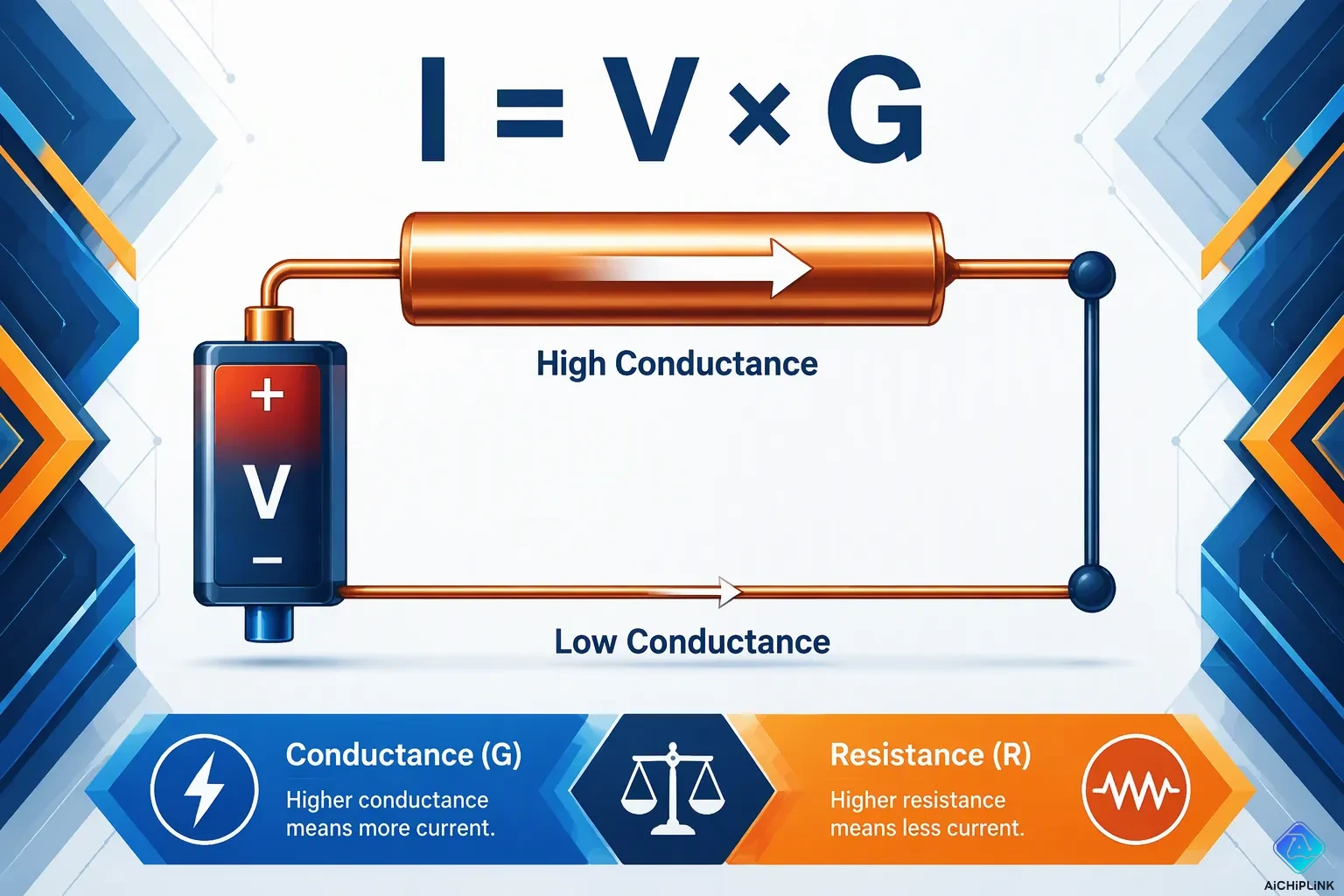
Ohm's law shows you the direct link between conductance and current. The form you know is I = V/R, where I is current in amperes, V is voltage in volts, and R is resistance in ohms. If you swap resistance for its reciprocal, the same law reads I = V × G. Current equals voltage multiplied by conductance.
Ohm's law can be written as V = I R, or in terms of the reciprocal constant of proportionality — the electrical conductance — as I = G V, where I is the current through the conductor, V is the voltage across it, R is its resistance, and G = 1/R is its conductance. Ohm's law states that R (or G) is constant and does not depend on the current. So when you know conductance, you can find current directly from voltage using I = G V.
You can get the second form in three short steps:
-
Conductance is the reciprocal of resistance: G = 1/R.
-
Ohm's law links voltage, current, and resistance: V = I·R.
-
Putting R = 1/G into Ohm's law gives V = I/G, which rearranges to I = V·G.
The link between current and voltage gets simple once you know the conductance of that component. Measure the voltage across the component, multiply by G, and you have the current. A part with high conductance passes a large current at a modest voltage. A part with low conductance passes only a small current at that same voltage.
A Practical Example
Picture two copper wires under the same applied voltage. One is thick and short. The other is long and thin. The table below shows how they compare.
| Conductor Type | Practical Example (same metal) | Conductance | Current Flow (for a given voltage) |
|---|---|---|---|
| High-conductance conductor | Thick or short wire | High (G = 1/R, low resistance) | Lets more current pass easily |
| Low-conductance conductor | Long or thin wire | Low (high resistance) | Limits current flow |
The thick, short wire gives a wide path, so its conductance is high and the flow of electric current is strong. The long, thin wire adds opposition along its length and through its narrow area, so its conductance is low and the flow of electrical current is weak. Both wires obey ohm's law. Only the conductance value is different.
This example gives a clear design lesson. Picking high-conductance materials and shapes lowers resistance and improves current flow. You get more useful electric current from the same supply voltage. You also waste less energy as heat along the run. When you size a conductor, treat conductance as the number you want to raise. Every step that lowers electrical resistance raises conductance by the same factor, and the current responds in step.
Conductance and resistance are opposites that work as a pair. When resistance goes down, conductance goes up, so electric current flows more easily. The formula G = 1/R shows this pair in one short line.
You can use this right away. Good conductors like copper and aluminum, shaped short and wide, lower resistance and help current flow. Every design choice that lowers opposition raises conductance by the same amount.
This pair helps you in daily practice. Once you see the two as views of one property, circuit design and troubleshooting both become easier to understand. You can read a circuit with real confidence. That insight pays off when you size a wire.

Written by Jack Elliott from AIChipLink.
AIChipLink, one of the fastest-growing global independent electronic components distributors in the world, offers millions of products from thousands of manufacturers, and many of our in-stock parts is available to ship same day.
We mainly source and distribute integrated circuit (IC) products of brands such as Broadcom, Microchip, Texas Instruments, Infineon, NXP, Analog Devices, Qualcomm, Intel, etc., which are widely used in communication & network, telecom, industrial control, new energy and automotive electronics.
Empowered by AI, Linked to the Future. Get started on AIChipLink and submit your RFQ online today!
Frequently Asked Questions
What is the difference between conductance and resistance?
Resistance measures how strongly a material blocks current flow. Conductance measures how easily current passes through that same material. The two are exact opposites, so a part with high conductance always has low resistance. You can fully describe one property just by knowing the other.
What unit do you use for conductance?
You measure conductance in siemens, written as S. One siemens equals one divided by one ohm. Engineers also write it as A/V. This unit mirrors the ohm, which measures resistance. A part with 0.1 S of conductance has 10 ohms of resistance.
How does temperature change conductance in a wire?
Heat usually lowers conductance in metals. Warmer atoms vibrate harder and block moving electrons. Aluminum shows this clearly, with a positive temperature coefficient of about 0.0039 per °C. Resistivity and conductivity stay opposite here, so rising resistivity means falling conductivity and falling conductance.
How do length and area affect conductance?
A longer conductor lowers conductance, because resistance grows with length. A wider conductor raises conductance, because resistance falls as cross-sectional area grows. You can use both effects together. A short, thick wire gives you the highest conductance for a given metal.
How do you find current from conductance?
Use the conductance form of Ohm's law: current equals voltage multiplied by conductance, or I = V × G. Measure the voltage across the part, multiply by its conductance, and you have the current in amperes. This form works because conductance is simply 1/R.