Table of Contents
- 1.0 What is the XC4003E-4PQ100C? (Datasheet Explained)
- 1.1 The Legacy Xilinx XC4000E Family
- 1.2 Decoding the Part Number: XC4003E-4PQ100C
- 1.3 Status in 2025: An Obsolete MRO Component
- 2.0 XC4003E-4PQ100C Datasheet & Specs
- 2.1 Core Logic and Memory Specs
- 2.2 Operating Voltage and Package Details
- 3.0 XC4003E-4PQ100C Pinout (PQ100 Package)
- 3.1 100-Pin PQFP Diagram
- 3.2 Key Pin Functions: Power, JTAG & Configuration
- 4.0 Programming and Replacement Guide
- 4.1 Finding an XC4003E-4PQ100C Replacement
- 4.2 Required Legacy Software (Xilinx Foundation/ISE)
- 4.3 Common Legacy Applications
1.0 What is the XC4003E-4PQ100C? (Datasheet Explained)
If you're an engineer, technician, or supply chain manager, you've probably stumbled upon a part number like XC4003E-4PQ100C and thought, "What is this?" You won't find this chip in a new 2025-era design. This component is a true veteran of the electronics industry, a foundational piece of technology from the Xilinx XC4000E family. This was one of the first commercially successful FPGA families, released in the mid-1990s.
Why are we talking about a 30-year-old chip? Because the global market for Maintenance, Repair, and Operations (MRO) for long-life-cycle industrial, medical, and aerospace equipment is massive. A 2024 industry report on factory automation highlighted that the average lifespan of critical manufacturing equipment often exceeds 20 years. When a $300,000 piece of test equipment or a factory control system goes down, it's often because of a single, obsolete chip like this.
You're not here for a history lesson. You're here for technical data because you have a problem to solve today. This guide is your engineering deep-dive into the XC4003E-4PQ100C datasheet, covering its specs, pinout, and the critical (and tricky) legacy software needed to work with it.
1.1 The Legacy Xilinx XC4000E Family
The Xilinx XC4000E family was a game-changer. It was built on a 5V, SRAM-based architecture that allowed designers to replace boards full of 74-series "glue logic" chips with a single, reconfigurable component.
- SRAM-Based: Like modern FPGAs, its configuration is volatile. This means it must be configured from an external source (like a boot PROM) every time it's powered on.
- CLB Architecture: It introduced the world to the Configurable Logic Block (CLB), the fundamental building block of all Xilinx FPGAs, which contains function generators and flip-flops.
- I/O Blocks (IOBs): It featured programmable I/O blocks that could interface with standard 5V TTL and CMOS logic levels.
The XC4003E was a smaller, cost-effective member of this family, offering a balance of logic capacity and I/O for its time.
1.2 Decoding the Part Number: XC4003E-4PQ100C
The part number is a technical code that tells you exactly what you're holding.
- XC4003E: The device family. "XC" for Xilinx, "4000E" for the family, and "03" for the density. This chip has 100 CLBs.
- -4: This is the speed grade. For this family, a lower number is faster. A
-4is the slowest commercial speed grade, making it a cost-effective choice for general-purpose logic. - PQ100: This is the package. PQ = Plastic Quad Flat Pack. 100 = 100 pins.
- C: This is the temperature grade. C = Commercial, with an operating range of 0°C to 85°C. An "I" (e.g., XC4003E-4PQ100I) would indicate an Industrial grade.
1.3 Status in 2025: An Obsolete MRO Component
Official Status: OBSOLETE / END-OF-LIFE (EOL)
Let's be perfectly clear: the XC4003E-4PQ100C and the entire Xilinx XC4000E family are completely obsolete. They have not been manufactured for many years and are Not Recommended for New Designs (NRND).
Its entire value today is as a critical MRO (Maintenance, Repair, and Operations) component. Because of its 5V operation, unique package, and specific architecture, there is no modern, drop-in replacement. Repairing a board with a failed XC4003E requires sourcing a genuine, identical part.
2.0 XC4003E-4PQ100C Datasheet & Specs
When you're sourcing a replacement, matching the XC4003E-4PQ100C specs is non-negotiable. Here is the critical information from the legacy datasheet.
2.1 Core Logic and Memory Specs
This device is from an era before "millions of gates" was a marketing term. Its resources are measured in CLBs.
| Specification | Value |
|---|---|
| Family | XC4000E |
| Configurable Logic Blocks (CLBs) | 100 (in a 10x10 matrix) |
| Logic Cells (approx.) | 676 |
| Total Flip-Flops | 360 (100 in IOBs, 200 in CLBs) |
| Max On-Chip RAM | 6,400 bits (6.25 kbits) |
| Max User I/O | 80 |
| Logic Gates (approx.) | 3,000 |
| Technology | SRAM-based CMOS (5V) |
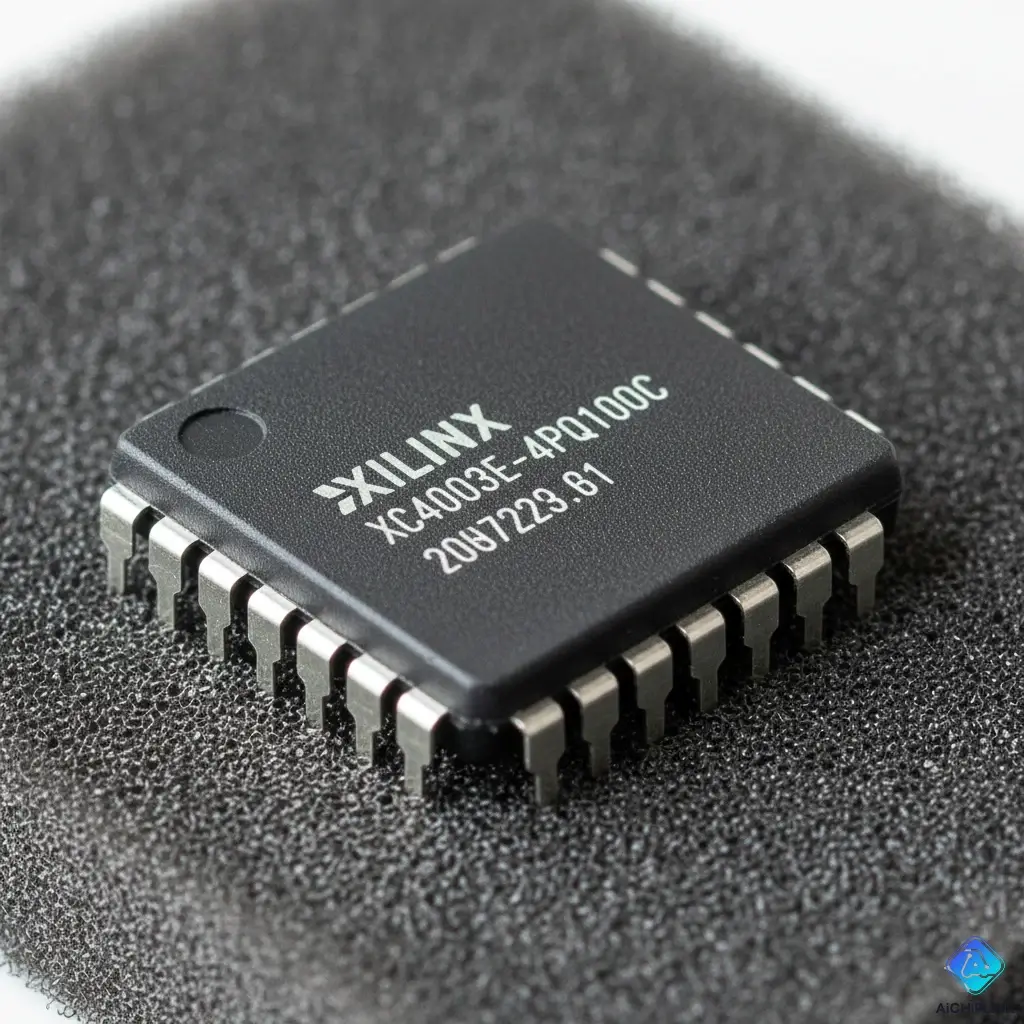
2.2 Operating Voltage and Package Details
This is a key differentiator from modern FPGAs.
- Core Supply Voltage (VCC): 5V (± 5%)
- I/O Voltage: 5V TTL / CMOS compatible
- Package: 100-Pin Plastic Quad Flat Pack (PQFP)
- Temperature Range: Commercial (0°C to 85°C)
The 5V operation is the most critical spec. A modern 1.2V FPGA would be instantly destroyed if placed in this socket, and the 5V signals from the rest of the board would destroy a modern chip's I/O.
3.0 XC4003E-4PQ100C Pinout (PQ100 Package)
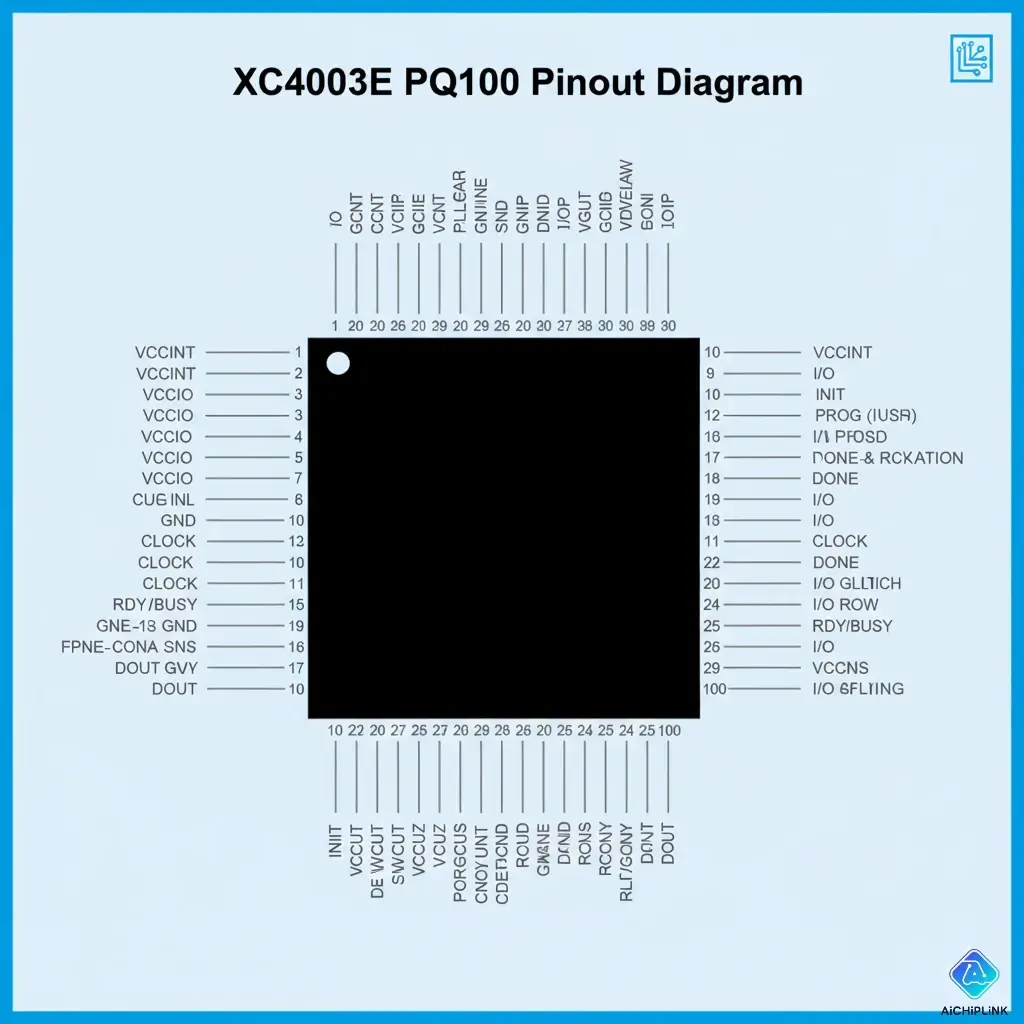
If you're troubleshooting a dead board, the XC4003E-4PQ100C pinout is your map. The PQ100 is a 100-pin surface-mount package with 25 "gull-wing" leads on each of its four sides.
3.1 100-Pin PQFP Diagram
3.2 Key Pin Functions: Power, JTAG & Configuration
When a board fails, you don't probe all 80 I/O pins. You check the "housekeeping" pins first.
| Pin Type | Pin Name(s) | Function |
|---|---|---|
| Power | VCC, GND | Multiple 5V (VCC) and Ground (GND) pins. All must be connected and stable. |
| JTAG | TDI, TDO, TCK, TMS | The 4-pin JTAG port. Used for boundary-scan testing and programming. |
| Mode | M0, M1, M2 | These pins are hard-wired on the PCB (high or low) to set the configuration mode (e.g., Master Serial, Slave Serial, etc.). |
| Config | CCLK, DIN, DOUT | The pins used to load the configuration data from an external serial PROM. |
| Status | DONE | This pin goes HIGH when the FPGA has successfully loaded its configuration. If this pin is low, the FPGA is not booted. |
4.0 Programming and Replacement Guide
This is the most critical information for an engineer in 2025. How do you program this chip, and what do you do if you can't find one?
4.1 Finding an XC4003E-4PQ100C Replacement
You have one main challenge: this part is obsolete.
- Direct Replacement: The only 100% drop-in, pin-compatible replacement is another XC4003E-4PQ100C. You can almost always use a faster speed grade (like a
-3or-2) to replace a-4, but you can never use a slower one. - Modern Redesign: There is no modern, pin-compatible replacement. A redesign would mean using a modern, low-voltage FPGA (like an Artix-7 or Cyclone 10) or a CPLD, and then redesigning the entire PCB to accommodate the new footprint, voltage levels (1.2V, 3.3V), and level-shifters. This is a massive, expensive engineering project.
Expert's Note: For MRO, a direct replacement is your only realistic option. The cost of re-engineering and re-validating a 30-year-old product is almost always prohibitive. The primary challenge is finding a genuine, reliable source for this obsolete part.
4.2 Required Legacy Software (Xilinx Foundation/ISE)
This is the single biggest hurdle for working with these parts. You cannot use modern Xilinx Vivado or even later versions of Xilinx ISE.
- Required Software: You must find and install the original Xilinx Foundation Series software or the very early versions of Xilinx ISE (e.g., ISE 4, 5, or 6).
- OS Compatibility: This legacy software is 32-bit and was designed for Windows XP or Windows 98. You will need to run this on a dedicated older machine or in a virtual machine (VM) like DOSBox or PCem for the really old tools.
- Programming Hardware: You need a compatible JTAG programming cable, such as the original Xilinx Parallel Cable III (which requires a parallel port!) or a very early USB Platform Cable.
4.3 Common Legacy Applications
You will find the XC4003E-4PQ100C in long-life industrial, medical, and telecom equipment built in the 90s.
- Industrial Control: The brains of PLCs, CNC machines, and robotic arms.
- Telecommunications: In legacy switching hardware, T1/E1 line cards, and protocol converters.
- Test & Measurement: The logic core for older oscilloscopes, spectrum analyzers, and waveform generators.
- Aerospace & Defense: In long-service-life avionics and ground control systems.
Conclusion: The MRO Challenge of a True Veteran
The XC4003E-4PQ100C FPGA is a true classic. It represents the dawn of the FPGA era, a time of 5V logic and revolutionary reconfigurable hardware. Today, its role has shifted from innovation to sustainment. For the thousands of critical systems worldwide built around this chip, it remains an indispensable component.
Working with this device requires specialized legacy knowledge, the right (and very old) software, and a trusted supply chain. Sourcing a 30-year-old part is a high-risk task. You cannot afford to risk a line-down situation on a counterfeit or improperly stored component.
If you are facing the challenge of sourcing this or other "unobtanium" legacy FPGAs, you need a partner who understands the MRO market.
Explore our full catalog of FPGAs contact AichipLink today. We are experts in sourcing hard-to-find and obsolete components, and we can help you get the genuine parts you need to keep your legacy systems operational.

Written by Jack Elliott from AIChipLink.
AIChipLink, one of the fastest-growing global independent electronic components distributors in the world, offers millions of products from thousands of manufacturers, and many of our in-stock parts is available to ship same day.
We mainly source and distribute integrated circuit (IC) products of brands such as Broadcom, Microchip, Texas Instruments, Infineon, NXP, Analog Devices, Qualcomm, Intel, etc., which are widely used in communication & network, telecom, industrial control, new energy and automotive electronics.
Empowered by AI, Linked to the Future. Get started on AIChipLink.com and submit your RFQ online today!
Frequently Asked Questions
What is the XC4003E-4PQ100C?
The **XC4003E-4PQ100C** is a legacy 5V, SRAM-based **FPGA** from the Xilinx XC4000E family. It features 3,000 typical gates (100 CLBs) and 80 user I/O pins. It is in a 100-pin Plastic Quad Flat Pack (PQFP) and is rated for the commercial temperature range with a -4 speed grade.
Is the XC4003E-4PQ100C obsolete?
Yes, this part is **completely obsolete** and End-of-Life (EOL). It is no longer manufactured by Xilinx/AMD and is not recommended for new designs. Its only use today is as a replacement part for maintenance and repair (MRO) of very old equipment.
What software do I use to program the XC4003E-4PQ100C?
You must use the legacy **Xilinx Foundation Series** or **Xilinx ISE** (Integrated Software Environment) software, typically version 6 or older. The modern Xilinx Vivado suite **does not** support the XC4000E family. You will likely need a 32-bit OS (like Windows XP) to run this old software. You can find some of these legacy tools at the Xilinx download archive.
Is the XC4003E-4PQ100C a 5V part?
Yes. The **XC4003E-4PQ100C** is a **true 5V device**. Its core (VCC) and I/O banks both operate at a nominal 5V, making it directly compatible with 5V TTL and CMOS logic systems.
What is a replacement for the XC4003E-4PQ100C?
There is **no direct, pin-for-pin modern replacement**. For a repair, you must source an identical **XC4003E-4PQ100C** or a pin-compatible part from the same family (like the XC4005E or XC4006E, though this may require recompiling the design). A full system redesign is the only other (and very costly) alternative.