What Are the Functions of an Engine Control Unit?
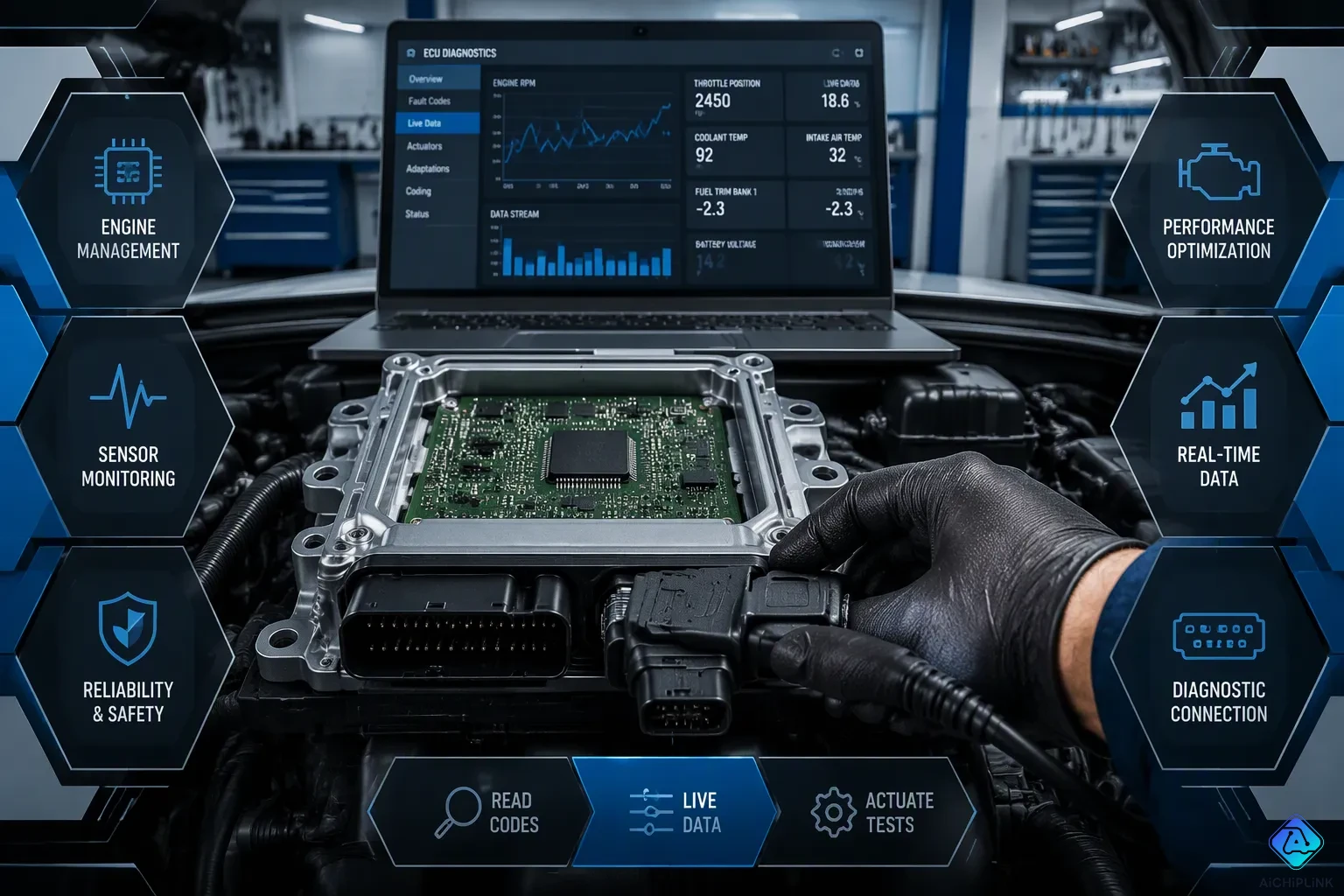
The engine control unit works like the brain of your car's engine. This small computer decides how much gas to inject, when to fire the spark plugs, and how to keep everything running smoothly.
Those choices affect three things drivers notice every day: engine performance, fuel efficiency, and emissions. A healthy ECU keeps all three in balance. A faulty one can cost power, waste gas, and turn on a warning light.
This guide explains each key function in plain language. Readers will see what the ECU does, why it matters, and how to keep it working. No engineering degree required — just clear explanations of the systems under the hood.
Key Takeaways
-
The ECU works like the car's brain and controls fuel injection, ignition timing, and idle speed.
-
The ECU balances engine power, fuel economy, and emissions for daily driving.
-
Sensors send data to the ECU, which makes changes right away to keep things running smoothly.
-
Routine upkeep and expert scans keep the ECU in good shape and stop pricey issues.
-
Experts can carefully tune the ECU to boost power or efficiency.
What Is an ECU?
The Car's Main Computer
The engine control unit is the car's main computer. Drivers often hear it called the brain of the engine, and that name fits well. This small device controls the fuel injection system and the ignition system. The engine depends on these two systems for every revolution.
The question "what is an ECU?" has a simple answer. It is a computer that reads data, makes decisions, and sends commands many times per second. It sits at the center of the vehicle's electronic network. Other modules report to it, and it coordinates their work with the engine.
Beyond the Engine
The engine control module, or ECM, does more than manage combustion. It also oversees features like anti-lock brakes, cruise control, and theft protection. These systems rely on the same network of sensors and signals.
This wider role explains why a single fault can affect several features at once. A weak signal or a loose connection may disturb the brakes and the cruise control together. Technicians who understand the full scope of the ECU solve problems faster. They trace faults across systems instead of guessing at one part.
The engine remains the primary focus of this computer. Fuel delivery, spark timing, and idle speed all depend on its commands. Yet the modern ECU touches almost every electronic function in the car. That reach makes it one of the most important components under the hood.
How Does the ECU Work?
The engine control unit depends on a steady stream of information. Sensors report what is happening around the engine. The ECU reads that data and decides what to do next. This cycle repeats thousands of times every minute.
Sensor Inputs
Sensors work like the eyes and ears of the system. Each one measures a certain condition and sends a signal back to the computer. The table below shows the main sensors and what they report.
| Sensor | Parameter(s) measured / reported to ECU |
|---|---|
| Crankshaft & Camshaft Position Sensors | Engine speed (RPM) and exact piston position in the four-stroke cycle |
| Throttle Position Sensor (TPS) | Throttle position (used to estimate/compute engine load) |
| Mass Air Flow (MAF) sensor | Mass air flow into the engine (grams per second) |
| Manifold Air Pressure (MAP) sensor | Intake manifold pressure (used for speed-density load calculation) |
| Intake Air Temperature (IAT) sensor | Intake air temperature (used with MAP for load) |
| UEGO / Wideband O2 Sensor | Actual running air-fuel ratio (feedback for fueling correction) |
| Knock Sensor | Engine knock (feedback for ignition timing correction) |
| Coolant Temperature Sensor (CTS) | Engine coolant temperature |
| Barometric Pressure (BARO) Sensor | Atmospheric/barometric pressure |
| Fuel Pressure (FP) Sensor | Fuel pressure (for delivered-fuel calculation and diagnostics) |
| Vehicle Speed Sensor (VSS) | Vehicle speed (used to infer gear) |
The crankshaft position sensor is worth a closer look. It tells the computer exactly where the crank is at any moment.
The crankshaft position sensor determines the position and/or rotational speed (RPM) of the crank. Engine Control Units use the transmitted information to control parameters such as ignition timing and fuel injection timing; in a diesel it controls fuel injection. The output may also be combined with cam position data to derive the current combustion cycle, which is important for starting a four-stroke engine.
That position data lets the ECU time each injection pulse and spark event very precisely. The throttle position sensor adds another layer. It reports how far the driver has pressed the pedal, which helps the computer estimate load.
Maps and Adjustments
Raw sensor data by itself means little. The ECU compares incoming signals against pre-programmed maps. These maps are tables of values that set the best settings for each operating condition. A map might state how much fuel to deliver at a given engine speed and load.
The computer then makes adjustments in real time. It balances three goals at once: emissions, fuel efficiency, and performance. A rich mixture may boost power, for example, but it raises emissions. The ECU finds the best compromise for the current situation.
Feedback loops keep everything in check. The oxygen sensor reports the actual air-fuel ratio. The knock sensor listens for detonation. The ECU uses these signals to fine-tune its commands on the fly. This constant correction is how the system stays precise as conditions change.
Key Functions of the ECU
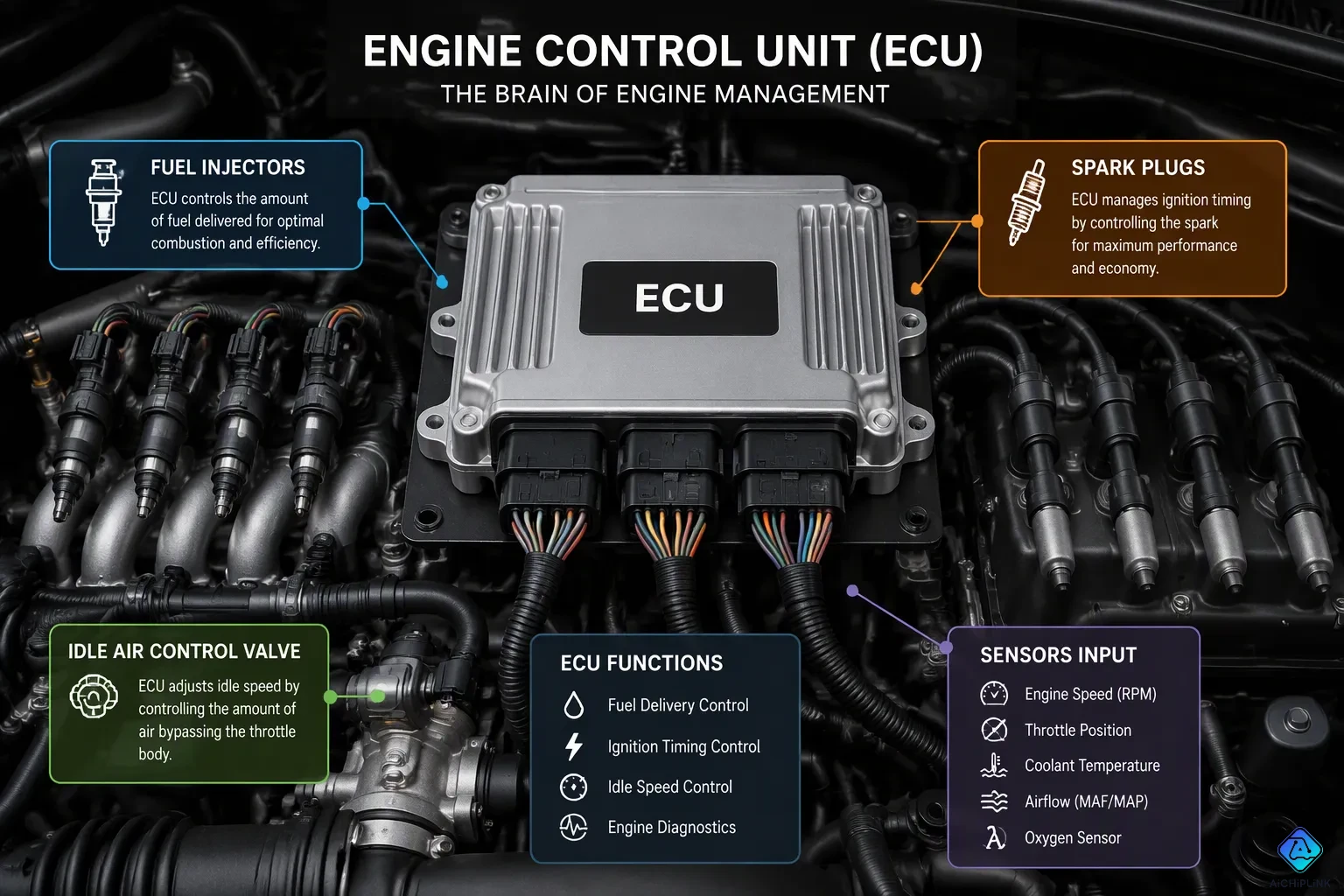
Fuel, Ignition, and Idle Control
The engine control unit controls fuel delivery very precisely. Fuel injection control sets both the amount of fuel and the moment it enters the cylinder. The table below shows the main levers the ECU uses.
| Control Mechanism | How the ECU Uses It to Optimize Performance |
|---|---|
| Injector pulse width | The ECU sets how long the injector stays open in milliseconds; this is the main lever for fuel amount per event. |
| Injection timing | The ECU decides when the pulse begins; timing affects performance, emissions, and efficiency across engine speed and load. |
| Dead time compensation | Injectors do not open right away, so the ECU adds an offset to every event so delivered fuel matches the command. |
| Voltage compensation | When battery voltage drops, the ECU makes pulse widths longer to keep fueling steady. |
| Multiple injection events | The ECU can schedule pre-injection, main injection, and post-injection for finer combustion control. |
| Transient fueling | During quick throttle changes, the ECU adjusts fuel to improve drivability and response. |
This careful fuel injection into the engine cylinders helps fuel burn at its best. The ECU also controls spark plug ignition by adjusting ignition timing to match load and speed. Retarding or advancing the spark changes when the flame front builds pressure in the cylinder. Engine timing for both fuel and spark relies on crankshaft position data.
Engine idle speed control keeps the engine steady when the throttle closes. The idle air control valve handles this task through a repeating cycle.
-
The ECM compares actual idle RPM against a target speed stored in memory.
-
When idle speed drifts, the ECM signals the idle air control valve actuator.
-
The actuator varies the width of the air bypass passage in small steps.
-
Opening wider raises idle speed; closing lowers it, keeping RPM stable under loads like A/C or headlights.
-
The valve also fine-tunes airflow during low-speed driving to prevent hesitation or stalling.
Emissions and Diagnostics
Emission control depends on constant feedback. The oxygen sensor measures unburned oxygen in the exhaust stream. The ECU reads that signal and judges whether the mixture is lean or rich. It then corrects fuel injection in real time as driving conditions change. Sensors sit before and after the catalytic converter, so the ECU can monitor exhaust emissions upstream and downstream of the converter.
The diagnostic functions watch every sensor and actuator. The vehicle's onboard diagnostics run diagnostic checks on the engine system and store trouble codes when a reading falls outside its expected range. These emission controls and diagnostic functions protect the catalytic converter, cut exhaust emissions, and warn the driver before a small fault grows. A warning light gives the driver time to act.
ECU Maintenance and Repair
Signs of a Failing ECU
A failing computer rarely quits without warning. Drivers often notice small changes first. The engine may crank longer before it starts, or it may not start at all. The computer might stop sending signals to the fuel pump or the ignition system.
Other clues show up in daily driving. The transmission may shift roughly, delay a gear change, or slip under load. Gauges can act strangely. A speedometer or tachometer may jump around, and warning lights may turn on for no reason. Drivers may also feel jerking at idle, sputtering, or backfiring. A sudden surge without pressing the pedal points to a misread throttle position.
A check engine light that stays on deserves attention, especially when it shows up with these symptoms. A sharp drop in fuel economy over a few weeks is another strong sign. Gradual wear causes slow declines, but a sudden change suggests a mixture or timing fault. None of these signs proves a bad unit. They simply justify a professional scan.
Keeping the ECU Healthy
Moisture is a leading cause of circuit board corrosion. Owners should inspect housing seals, grommets, and cable entry points. Cracked weather seals need replacement before each operating season.
Heat matters just as much. A ventilated engine compartment, a working cooling system, and intact heat shields all help. Voltage spikes also damage electronics, so transient suppressors on feed circuits add protection. Quarterly checks of battery health and alternator output catch weak charging early.
Connector care is simple. Dielectric grease on terminals and a look for green or white oxidation during service preserve signal integrity. Proactive scanning finds stored trouble codes even when no light shows. Following the manufacturer's service schedule for sensors, harnesses, and software updates keeps calibration drift in check. A technician with the right scan tools can confirm a fault before any part is replaced.
Tuning and Performance Upgrades
What an ECU Tune Changes
A tune rewrites the tables inside the ecu. Fuel mapping sets how much fuel reaches each cylinder at any moment. The ecu adjusts that delivery across throttle and rpm conditions to hold a balanced air-fuel ratio. Ignition timing mapping controls the exact moment the spark plug fires. Modern units store these values in 3D tables keyed to engine speed and load.
Timing deserves careful attention. The spark must fire before Top Dead Center so that peak cylinder pressure builds after TDC. Higher rpm leaves less time for combustion and calls for more advance. Higher load needs less advance. Leaner mixtures burn slower and want more timing. Higher octane fuel tolerates more advance. Manufacturers ship conservative maps to suit varied fuel quality, which leaves room for gains.
A tuner works in small steps:
-
Add timing in small increments and test the engine under load.
-
Monitor for detonation with the knock sensor.
-
Refine in small increments to optimize power, throttle response, or efficiency.
Fine-tuning air-fuel ratios and spark advance together raises horsepower and torque. Careful fuel mapping also lifts fuel economy. Both paths start with the same fuel injection and injection tables.
Choosing an Upgrade Path
Several factors shape the right choice. Budget comes first, and it must cover auxiliary hardware such as sensors, boost solenoids, and coils, plus tuning costs. Vehicle type and age matter, since a modern car offers different options than an older one. Intended use separates street driving from competition. Experience and skill level point novices toward products with strong documentation and manufacturer support.
Engine requirements set hard limits. Cylinder count, ignition outputs, variable valve timing, and drive-by-wire throttle control must all be supported. Desired functions such as data logging, launch control, flex fuel, and wideband lambda control need confirmation. Future-proofing favors extra inputs and outputs when the budget allows. A professional tuner's recommendation often settles the decision, because that expert knows both the vehicle and the product.
The engine control unit shapes every drive by managing fuel injection timing, air-to-fuel ratios, and ignition timing. These choices balance performance, fuel efficiency, and emissions in real time. The ecu also controls exhaust gas recirculation to keep emissions in line with the rules.
Regular maintenance and professional diagnosis protect the engine and the driver's wallet. A technician can find a failing sensor before it harms costly parts. Stored trouble codes help guide the diagnosis. Early repair also keeps the ecu calibration within emission compliance limits.
Owners should ask a qualified technician for ecu service or tuning. Expert care keeps the vehicle reliable, efficient, and ready for the road.

Written by Jack Elliott from AIChipLink.
AIChipLink, one of the fastest-growing global independent electronic components distributors in the world, offers millions of products from thousands of manufacturers, and many of our in-stock parts is available to ship same day.
We mainly source and distribute integrated circuit (IC) products of brands such as Broadcom, Microchip, Texas Instruments, Infineon, NXP, Analog Devices, Qualcomm, Intel, etc., which are widely used in communication & network, telecom, industrial control, new energy and automotive electronics.
Empowered by AI, Linked to the Future. Get started on AIChipLink and submit your RFQ online today!
Frequently Asked Questions
What does the ECU control in a car?
The ecu handles fuel delivery, spark timing, and idle speed. It also keeps an eye on emissions and runs diagnostic checks. Other systems, like cruise control and anti-lock brakes, share its network. This central role explains why one fault can affect several features at once.
How does the computer know when to fire the spark plugs?
The crankshaft position sensor reports the exact crank position and speed. The computer uses that data to time each ignition event precisely. Camshaft data helps it identify the current stroke. This teamwork keeps combustion smooth at every speed.
Can a bad ECU cause other problems?
Yes. A failing unit may disrupt the fuel pump, the transmission, or the gauges. Drivers might see rough shifting, strange gauge readings, or a sudden drop in fuel economy. A professional scan confirms the cause before anyone replaces parts.
Does tuning harm the engine?
A careful tune stays within safe limits. The tuner adds timing in small steps and checks for knock after each change. Conservative factory maps leave room for gains. Professional work protects the engine while it improves power or efficiency.
When should a driver seek professional ECU service?
Warning lights, hard starts, or erratic gauges justify a scan. Early diagnosis catches weak sensors before they harm costly parts. A qualified technician can read stored codes, test the circuit, and confirm the fault. Prompt service protects both the engine and the budget.