Single Supply vs Dual Supply Op-Amps Pros and Cons Explained
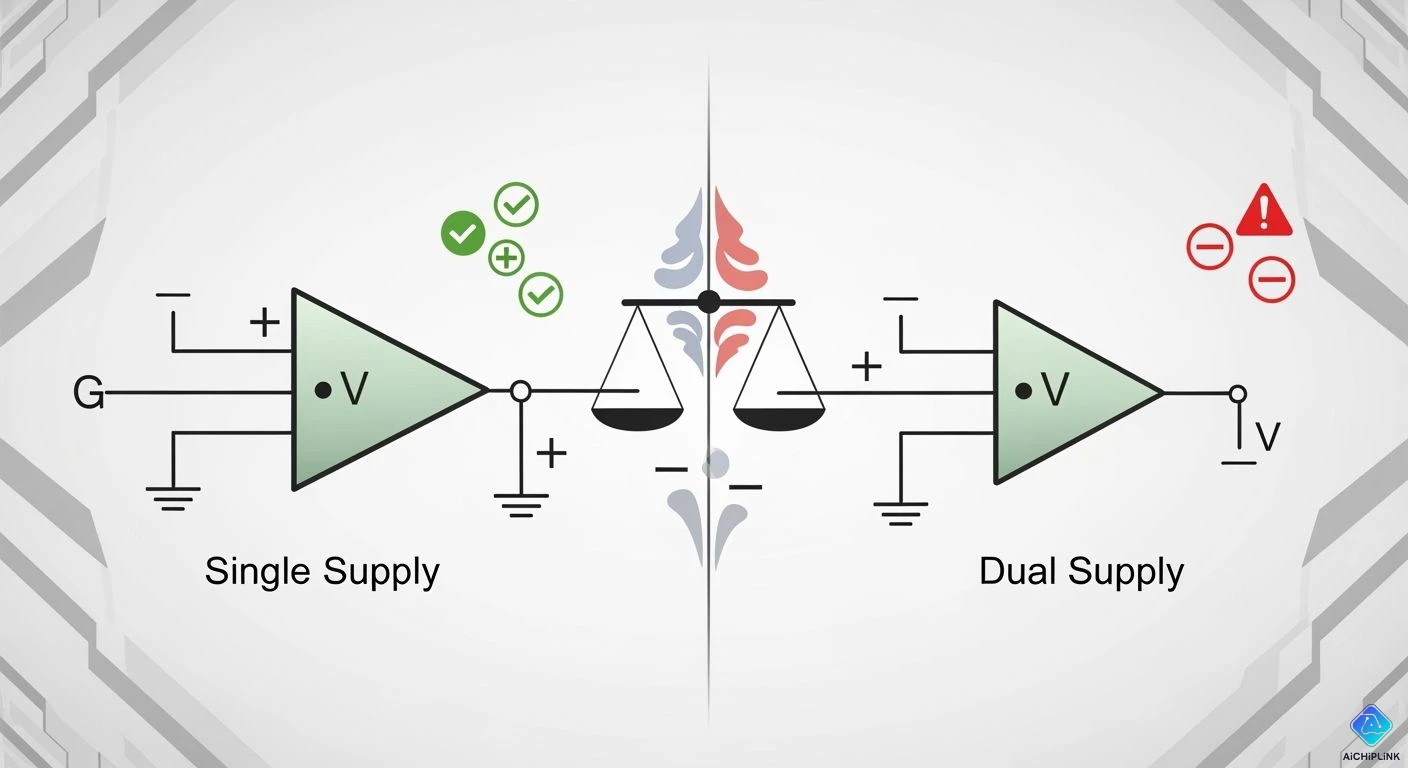
When building circuits, you typically have to choose between single supply vs dual supply op-amps. Single supply op-amps operate with one positive voltage and ground, making them ideal for battery-powered devices. In contrast, dual supply op-amps utilize both positive and negative voltages, providing better output swing and simplifying biasing for audio circuits. Each type of op-amp influences circuit functionality in its unique way. Therefore, your project's requirements will guide your selection.
Key Takeaways
-
Single supply op-amps work well in battery devices. They are simple and save energy.
-
Dual supply op-amps can handle signals above and below ground. This makes them better for audio and AC circuits.
-
Think about your project’s power needs and signal types. This helps you pick single or dual supply op-amps.
-
Single supply op-amps might not swing output as much. You must set them up carefully to stop distortion.
-
Dual supply op-amps give a full output swing and less noise. But, they make the power supply setup harder.
Single Supply vs Dual Supply Op-Amps Overview
What Is a Single Supply Op-Amp?
A single supply op-amp uses one positive voltage and ground. You do not need a negative voltage for it to work. This makes it good for battery-powered devices. Most single supply op-amps let the input voltage get close to the power rails. For example, the input can move within 2 volts of ground and 5 volts of the positive supply. The output does not always reach the highest supply voltage. If you use a +48V supply, the output might only go up to 34V because of a voltage drop.
Single supply op-amps often need special biasing to keep a steady reference point. Sometimes, people use a virtual ground for this. But the virtual ground can drift. This can cause distortion or uneven current draw.
What Is a Dual Supply Op-Amp?
A dual supply op-amp uses both a positive and a negative voltage. You connect one side to positive, one side to negative, and the middle to ground. This lets the op-amp handle signals above and below ground. Dual supply op-amps are common in audio circuits. They can process AC signals easily. They also give a full output swing in both directions.
Tip: Dual supply op-amps help when you need to handle signals with both positive and negative voltages.
Key Differences in Operation
When you compare single supply and dual supply op-amps, you see some clear differences. Single supply op-amps use one voltage and ground. Dual supply op-amps need both positive and negative voltages. Dual supply op-amps handle bipolar signals better. This is important for audio or AC signal circuits. Single supply op-amps may have limited output swing. They can have distortion if the virtual ground is not steady. Dual supply op-amps usually have better noise performance and less distortion.
If you want to choose between single supply and dual supply op-amps, think about your power source. Also think about the type of signal you need to process. Consider how much output swing your circuit needs.
Op Amp Advantages and Disadvantages
Single Supply Op Amp Advantages
Single supply op-amps have many good points, especially for battery-powered gadgets. These op-amps help you make simple and efficient circuits. Here is a table that lists the main benefits:
| Advantage | Description |
|---|---|
| Energy Efficient | Micropower op amps use less power, so they are great for portable devices. |
| High Input Impedance | They stop signal loss by taking almost no current from the input. |
| Compact and Affordable | Small IC packages make them easy to use and cheap. |
Single supply op-amps also make your design easier. You can connect the negative pin right to ground. This means you do not need a separate negative power supply. You will use fewer parts, which saves money and makes your circuit less complicated. Many electronics use this way to save space and cost.
Disadvantages of Single Supply Op-Amps
There are also some problems with single supply op-amps. These op-amps have some limits you should know:
-
The input voltage range is small. You must keep the input inside a certain range, usually less than the supply voltages.
-
The output voltage swing does not reach the full supply rails. For example, the output may only go from (V-) plus 1V to (V+) minus 1.5V.
-
Biasing can be tricky. Input offset voltages and bias currents might cause errors in the output.
-
You may need matching resistor networks to balance voltage drops from bias currents. This makes things more complex and can add thermal noise.
| Voltage Range Type | Description |
|---|---|
| Input Common-Mode Voltage Range | Measured compared to supply voltages |
| Output Voltage Range | Limited to (V-)+1V to (V+)-1.5V |
These problems can cause distortion, especially in audio circuits. You might also see signal clipping if the input or output goes past the allowed range. Biasing issues make it harder to keep a steady zero point, which can hurt signal quality.
Dual Supply Op Amp Advantages
Dual supply op-amps have several good points for your projects. You can work with signals that go above and below ground. This is important for audio and AC circuits. Dual supply op-amps give you a steady zero point, so you avoid biasing problems.
-
You get a full output swing both ways, which makes signals better.
-
You can handle bipolar signals without extra parts.
-
Audio sounds better because there is less distortion and noise.
If you compare single supply and dual supply op-amps, you will see dual supply types are better for high-quality audio and precise measurements. You do not need to make a virtual ground, so your design is more stable.
Disadvantages of Dual Supply Op-Amps
There are also some problems with dual supply op-amps. These op-amps need both positive and negative voltages, which makes your power supply more complex.
-
You need more parts and wires, which can make your project bigger and cost more.
-
Dual supply circuits are not good for battery-powered or portable devices.
-
You might have trouble using them in simple electronics.
These problems can make dual supply op-amps less useful for small, low-power, or cheap designs. You should think about these things when you pick between single supply and dual supply op-amps for your project.
Application Scenarios for Op-Amps
When to Use Single Supply Op-Amps
Single supply op-amps are good for battery-powered gadgets. They help keep circuits small and simple. You often find them in sensor circuits and microcontroller projects. Many consumer electronics use single supply op-amps too. These op-amps save energy and are easy to connect.
But there are some things to think about in low-voltage uses. The table below shows what you should know:
| Trade-off | Description |
|---|---|
| Input and Output Ranges | Smaller ranges make input offset voltage, bias currents, and noise matter more. |
| Open-Loop Gain | Usually lower, between 25,000 and 30,000. |
| Output Swing | Often stays within about 100 mV of the supply rails. |
You need to check if your project can handle these limits. If you need to work with signals close to ground or the supply voltage, single supply op-amps might be right for you.
When to Use Dual Supply Op-Amps
Dual supply op-amps are used when signals go above and below ground. They are common in audio circuits and science tools. You also see them in industrial control systems. These op-amps give better sound and less distortion. If you need to work with AC signals or want a steady zero point, dual supply op-amps are helpful.
You need a more complicated power supply for dual supply op-amps. They are not great for battery-powered devices. Dual supply op-amps are best for high-performance projects where signal quality is very important.
Choosing the Right Op-Amp for Your Project
You need to pick the right op-amp for your project. Think about your power supply and voltage needs. Here are some tips to help you choose:
-
The output voltage depends on the power supply. Most op-amps give an output that is less than the supply voltages.
-
High-voltage and high-power op-amps are needed for big output voltages and currents.
-
The input voltage limits are tied to the power supply voltages. This affects how well the op-amp works for your project.
If you want something portable and low-power, single supply op-amps are best. If you need high signal quality and full output swing, pick dual supply op-amps. Always check what your project needs before you choose an op-amp.
Single Supply vs Dual Supply Op-Amps Comparison Table
It is important to look at both single supply and dual supply op-amps before you start building. The table below shows the main ways they are different. This can help you pick the right op-amp for your project.
| Key Decision Factor | Single Supply Op-Amp | Dual Supply Op-Amp |
|---|---|---|
| Power Requirements | Needs only one positive voltage and ground. Good for battery-powered devices. | Needs both positive and negative voltages. Not ideal for portable use. |
| Output Swing | Output does not reach full supply rails. Limited swing can cause clipping. | Output can swing from negative to positive supply. Handles full signal range. |
| Biasing | Needs careful biasing. Virtual ground may drift. | Has a stable zero reference. No need for virtual ground. |
| Input Voltage Range | Input must stay within a smaller range. | Input can cover a wider range, from negative to positive supply. |
| Design Complexity | Simple design. Fewer parts. Easy to use in small circuits. | More complex. Needs extra power supply and wiring. |
| Application Fit | Best for low-power, portable, or simple circuits. | Best for audio, AC signals, and high-performance needs. |
Tip: Pick a single supply op-amp if you want a simple circuit for a battery-powered device. If you need to work with high-quality audio or signals that go above and below ground, a dual supply op-amp is better.
You should always choose the op-amp that fits your project. Think about what kind of power you have, what signals you need to use, and how much output swing you want. This table helps you see which op-amp will make your circuit work well.
You should learn what each op-amp type does best and worst.
-
Single supply op-amps are good for battery-powered things and easy circuits.
-
Dual supply op-amps let the output move more and match channels better, which is great for audio and stereo projects.
-
Some op-amps are built just for single supply and might not work well with dual supply power.
-
Dual supply designs can handle signals that go above and below ground, so they are perfect for really good audio.
Pick the op-amp that matches your power and signal needs. Knowing these things helps you make circuits that work well.

Written by Jack Elliott from AIChipLink.
AIChipLink, one of the fastest-growing global independent electronic components distributors in the world, offers millions of products from thousands of manufacturers, and many of our in-stock parts is available to ship same day.
We mainly source and distribute integrated circuit (IC) products of brands such as Broadcom, Microchip, Texas Instruments, Infineon, NXP, Analog Devices, Qualcomm, Intel, etc., which are widely used in communication & network, telecom, industrial control, new energy and automotive electronics.
Empowered by AI, Linked to the Future. Get started on AIChipLink and submit your RFQ online today!
Frequently Asked Questions
What is the main difference between single supply and dual supply op-amps?
You use a single supply op-amp with one positive voltage and ground. You use a dual supply op-amp with both positive and negative voltages. This difference affects how you design your circuit and what signals you can process.
Can I use a single supply op-amp for audio projects?
You can use a single supply op-amp for simple audio tasks. For high-quality sound, you should choose a dual supply op-amp. Dual supply designs reduce distortion and give you better performance in audio circuits.
Why do battery-powered devices often use single supply op-amps?
You see single supply op-amps in battery-powered devices because they are cost-effective and easy to connect. You do not need a negative supply. This makes your design simple and helps you save space and energy.
How do I choose a cost-effective op-amp for my project?
You should look at your supply needs first. If you want a cost-effective solution, pick a single supply op-amp for low-power or portable projects. For high-performance needs, a dual supply op-amp may give you better results, but it can cost more.
Do I need special biasing for single supply op-amps?
You need to set a reference point for single supply op-amps. This helps your circuit work well with the supply voltage. Dual supply op-amps do not need this step because the supply gives a natural zero reference.