What Are Real and Virtual Images and How Do They Differ
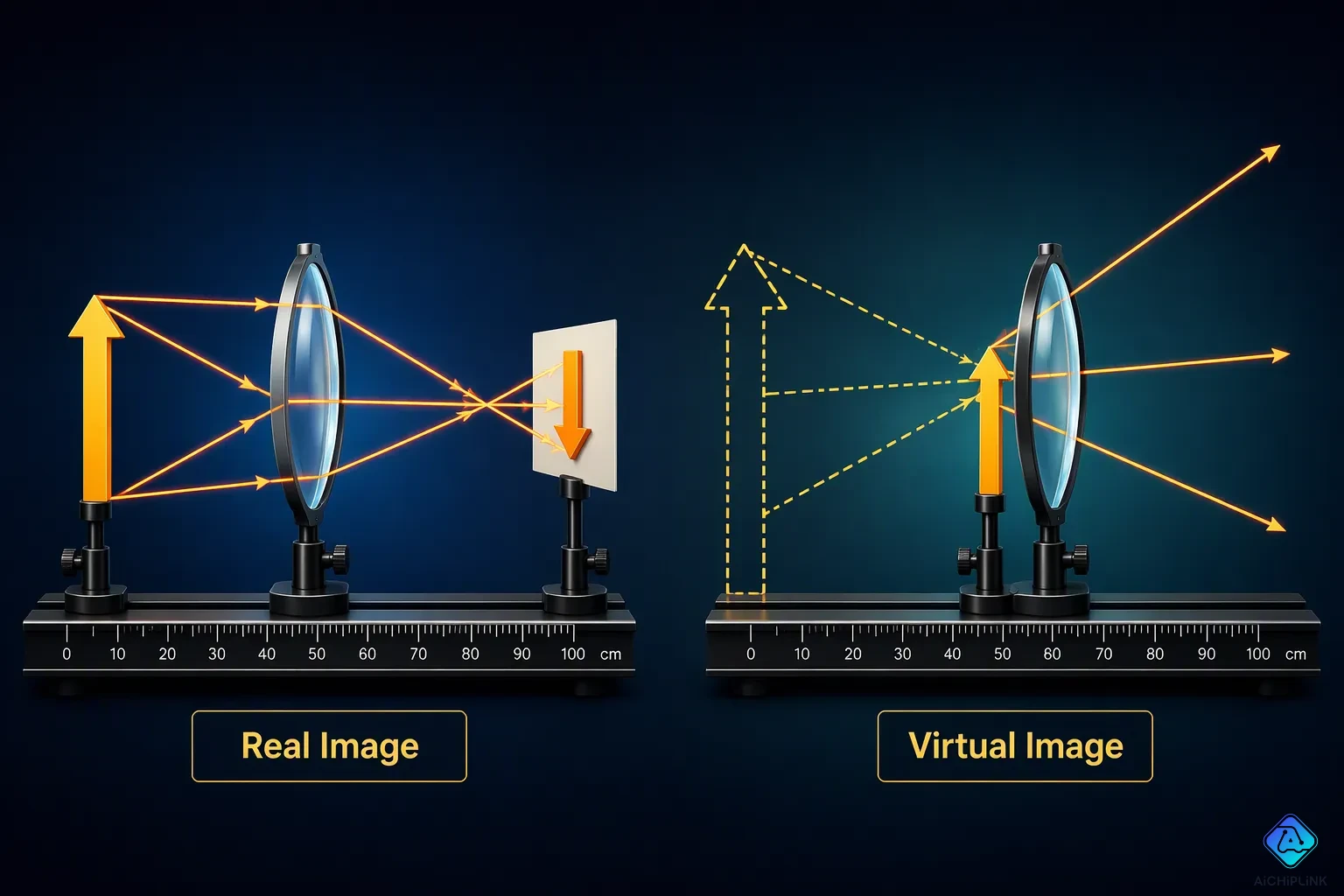
You see yourself in a flat mirror, but you cannot catch that reflection on paper. Is that image real or virtual, and how can you tell? The core difference between a real image vs. virtual image comes down to one point. Real and virtual images differ because light rays meet in one case and light rays only appear to meet in the other. These rays do not actually meet. The screen test is the easiest way to identify each type. Place a screen where the image forms. If you see the image on the screen, it is real. If not, it is virtual. This difference affects cameras, eyeglasses, mirrors, and projectors.
Key Takeaways
-
Light rays meet at a single point to create a real image. A screen can show this image.
-
A virtual image only makes the rays seem to meet. No screen can show it. Your eye follows the rays backward.
-
The screen test tells the two images apart. An image caught on a screen is real. A virtual image never shows up on a screen.
-
Convex lenses can make both kinds of images. Concave mirrors can make both kinds of images. Convex mirrors make virtual images. Concave lenses make virtual images.
-
Virtual images are real optical effects. No light gathers at the spot where they seem to be. Your eye still focuses on them.
What Is a Real Image?
Light Rays That Actually Meet
A real image forms when light rays from one point on an object come together at a single spot. This is the main feature of real image formation. In a convex lens, light rays that enter parallel to the lens axis meet at one point on the other side. That point is the focal point. When you place an object past the focal point, rays from one point on the object go through different parts of the lens. The lens bends them so they meet again at one shared point on the other side. That point is where the real image of that object point shows up.
An image is called a real image if the rays from an object come together at some place, such as your eye or on another surface, like film. Real images can be shown on screens, because the light rays from an object are truly going there.
The main idea is easy. The rays really meet at the image location. They do not just seem to meet. They truly cross at that spot. This is why a real image can be caught on screen, film, or a retina.
Real Images Can Be Projected
You can show real images on a screen because the light truly reaches that spot. A movie projector forms a larger real image on an outside screen. A camera forms a real image on its sensor or film by focusing light from the scene. In both cases, the image is real because the rays cross at a point where a screen can catch them.
Real images are often upside down. When you use a convex lens to project an image of a far window onto paper, the picture looks flipped. These real inverted images form because the rays cross after going through the lens. The image is found where the traced rays meet. Because the light truly comes together there, you can catch the image on a screen. A virtual image cannot do this. No screen will show a virtual image because the rays never really meet.
What Is a Virtual Image?
Light Rays That Only Appear to Meet
A virtual image appears at the spot where light seems to meet, but no light truly arrives. In geometric optics, when light rays spread out from a point that photons never actually visited, a virtual image forms. Light from a virtual image spreads out, rather than coming together at a real image. Your brain thinks light moves in straight lines. Your brain follows reflected rays backward to a seeming point of origin when they reach your eye. The traced-back spot is the virtual image.
The easiest everyday example is a flat mirror. Light rays from a point on an object hit a flat mirror and then bounce off following the law of reflection. If you trace these reflected rays backward behind the mirror, they seem to come from a point behind that mirror. Those rays look as if they meet, but they never cross. A plane mirror always puts a virtual image behind the mirror. The image sits as far behind the mirror as the object sits in front. The image is upright and the same size as the object.
Ray tracing can help you locate a virtual image. From the object's tip, draw a single ray through the optical center of a lens. This ray does not bend. Draw another ray parallel to the optical axis, and then extend it backward. The extended rays cross at the top of the virtual image. The resulting virtual image is upright and cannot be focused on a screen.
Why Virtual Images Cannot Be Projected
Virtual images cannot be caught on a screen, film, or sensor. No light really reaches the image spot, so nothing gets there to expose a surface. That is the main reason virtual images cannot be captured the way real images can. A movie screen catches a real image because light truly arrives. A flat mirror reflection gives you nothing to catch.
Virtual is not fake at all. A virtual image is a true optical effect. Your eye's optics bend spreading light from the virtual image to make a real image on your retina. That is why you can see the reflection clearly. The image is real to your eye, even though it is virtual in space.
Real Image vs. Virtual Image: Main Differences
Real vs Virtual Images Compared
You can compare these two image types in four key ways. The table below explains the differences between real and virtual images in convergence, projection, orientation, and formation conditions.
| Aspect | Real Image | Virtual Image |
|---|---|---|
| Light ray convergence | Rays truly meet at one point in space. | The rays never really meet; your eye follows them backward. |
| Projection ability | Can be shown on screens or sensors. | Cannot be shown on any surface. |
| Orientation | Usually inverted in simple systems. | Usually upright in simple systems. |
| Formation conditions | Made by convex lenses and concave mirrors. | Made by plane mirrors, convex mirrors, and diverging lenses. |
The key difference between real and virtual images is one main test. Ask if light rays actually hit a screen where the image forms. A real image passes this test because light energy gathers there. A virtual image fails because no light arrives at the spot where the image seems to be.
In mirror and thin-lens equations, a real image goes with a positive image distance. A virtual image goes with a negative image distance. This sign rule gives you a mathematical way to check what your eyes observe. The real vs virtual image label depends on where the light actually goes, not on what you see.
Are Virtual Images Always Upright?
In simple optical systems, virtual images stay upright. A plane mirror keeps your image right-side up. A convex mirror in a store gives a wider view that is still upright. A concave lens gives the same result. Since the rays never really meet, these virtual images stay upright.
Real inverted images act differently. When light rays go through a convex lens and meet at a focal point, the top of the object becomes the bottom of the image. This is why a projector makes an upside-down picture that the lens flips back for the screen.
But orientation can change in complex multi-lens systems. A camera lens with many glass parts may make an upright real image on the sensor. So the rule "real equals inverted" works for simple systems, but not everywhere.
The real vs virtual image difference in orientation comes from rays crossing. When rays cross, the image flips. When rays only seem to meet, the image stays upright. You can test this yourself with a magnifying glass. Hold it near a page and you see an upright virtual image. Move it far away from the page and project the real image onto a wall. The projected image looks upside down.
Knowing the difference between real and virtual images helps you predict what you will see. Comparing real vs virtual images shows that convergence is the main cause. Every other property depends on whether the rays actually meet.
How Mirrors and Lenses Form Real vs Virtual Images
When Mirrors and Lenses Create Real Images
A concave mirror or convex lens makes a real image when the object is outside the focal point. Light rays from one point on the object meet at one spot. Because the rays truly cross there, a screen can catch the image. These real images always pass the screen test.
The mirror equation proves this rule. Place an object beyond the focal point of a concave mirror. It gives a positive image distance. A positive value tells you the image is inverted. A convex lens acts the same way. An object beyond the focal point forms an inverted image, and its size depends on how far the object is from the lens. You can catch every case on a screen.
When Mirrors and Lenses Create Virtual Images
Move the object inside the focal point, and the mirror creates a virtual image. The mirror equation gives a negative image distance. That puts the virtual image behind the mirror. It stays upright and enlarged. A convex lens works the same way. An object inside the focal length forms a virtual image on the same side. No light arrives there, so no screen can show these virtual magnified images.
Some elements always make virtual images. A convex mirror spreads light, and a concave lens spreads rays. Both make upright virtual images you cannot project. The rays only seem to meet if traced backward.
The mirrors and lenses rule is simple. A concave mirror and a convex lens make real and virtual images possible. A convex mirror and a concave lens only make virtual images. The real vs virtual image test asks whether light lands at the image spot. If light lands, the image passes the real vs virtual images test. If it only seems to land, you are looking at a virtual image. That is the other side of the real vs virtual image rule.
Why the Real vs Virtual Image Difference Matters
Everyday Clues for Real and Virtual Images
You already use real and virtual images every day, even if you never name them. A movie projector throws a bright picture onto a theater screen. The film or display panel acts as the object, and the projection lens bends light from that object to form a magnified real image at the screen. The screen sits exactly where the rays converge. Move the screen closer or farther, and the picture blurs because the rays no longer meet at that surface.
Your phone camera works the same way. The lens must place the real image plane right on the sensor. If the rays do not converge at the pixels, the photo comes out soft. Autofocus exists for this single job: sliding the lens until the real image lands on the sensor.
Now think about a dressing-room mirror. You see yourself upright and life-sized, but no light ever gathers behind the glass. That reflection is a virtual image. A store security mirror, which is a convex mirror, gives a wide view of the aisles. It also makes a virtual image. You can see it, but you cannot catch it on a wall or a piece of paper.
These examples give you a simple habit. When you spot an image, ask one question: does light truly land at that spot? A projector screen and a camera sensor say yes. A flat mirror and a convex mirror say no.
Memory Tricks for Real and Virtual Images
Two quick tests will keep the real vs virtual image difference straight in your head. The first is the screen test. Hold a sheet of paper where the image forms. A real image appears on the paper. A virtual image does not, because no light arrives there to be captured on screen.
The second is the dashed-ray test. Trace the light rays with your finger. If the rays truly cross, you have a real image. If you must draw dashed lines backward to make them meet, you have a virtual image. Dashed lines mean your eye is doing the work, not the light.
A third trick uses the hardware itself. A convex lens and a concave mirror can make both real and virtual images, depending on where you place the object. A convex mirror and a concave lens only make virtual images. When you know the device, you already know half the answer.
Put the tests together and the real vs virtual image question becomes easy. Real images pass the screen test. Virtual images pass only the dashed-ray test. You can now sort real and virtual images on sight, whether you meet them in a physics problem or in a hallway mirror.
Use the screen test one final time. If you can catch the image on a screen, it is real. If you cannot, it is virtual. A virtual image is not imaginary. It is a genuine optical effect. Light rays only appear to meet. Your eye still forms a focused picture.
Try this yourself. Hold a magnifying glass close to a page. You see an upright version. Move it far away and project that image onto a wall. The real image appears upside down. A concave mirror works similarly. A flat mirror always gives you a virtual reflection.
Remember this rule every time you look through a lens or mirror. Once you know where the light rays meet, you can classify any image confidently.

Written by Jack Elliott from AIChipLink.
AIChipLink, one of the fastest-growing global independent electronic components distributors in the world, offers millions of products from thousands of manufacturers, and many of our in-stock parts is available to ship same day.
We mainly source and distribute integrated circuit (IC) products of brands such as Broadcom, Microchip, Texas Instruments, Infineon, NXP, Analog Devices, Qualcomm, Intel, etc., which are widely used in communication & network, telecom, industrial control, new energy and automotive electronics.
Empowered by AI, Linked to the Future. Get started on AIChipLink and submit your RFQ online today!
Frequently Asked Questions
Can a virtual image ever appear on a screen?
No. A screen only shows light that truly lands on it. Virtual images form where rays only seem to meet, so no light reaches that spot. Your eye sees the image, but a screen stays blank.
Why does a projector make an upside-down picture?
A projector lens forms a real image, and real images from a single lens are inverted. The film or panel sits upside down inside the projector. The lens flips the picture again, so the screen shows it right-side up.
Is your reflection in a flat mirror a real image?
No, it is virtual. Light bounces off the mirror and spreads toward your eyes. Trace those rays backward, and they seem to come from behind the glass. No light actually gathers there.
Can a concave mirror make both types of image?
Yes. Place an object beyond the focal point, and you get a real, inverted image you can project. Move the object inside the focal point, and the mirror gives an upright, enlarged virtual image.
Does a magnifying glass make a real image?
It can make both. Hold it close to a page, and you see an upright virtual image. Move it far from the page, and it forms a real, inverted image you can project onto a wall.