What Is an OBD2 Scanner and How Does It Diagnose Modern Car Issues?
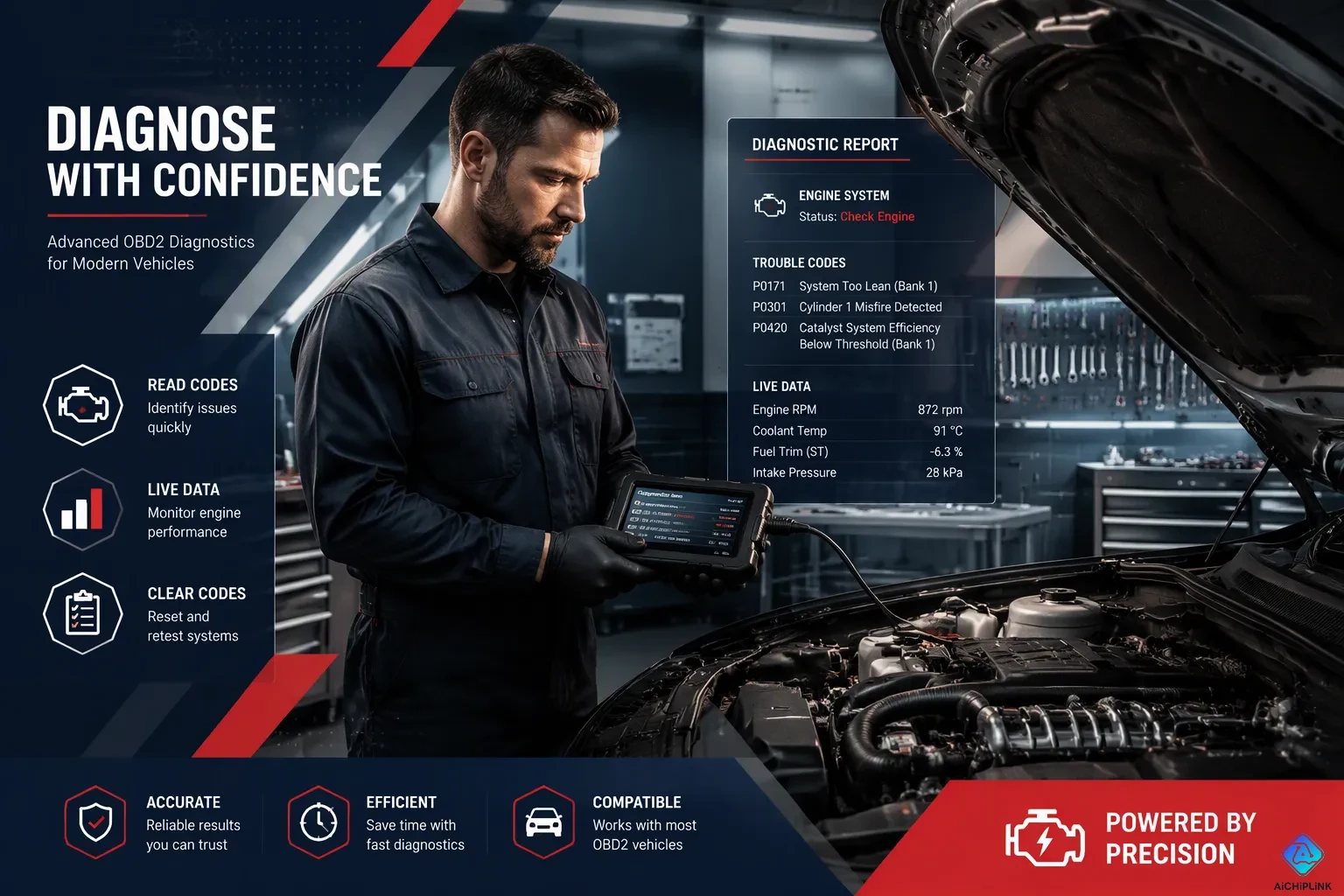
An obd2 scanner is a small electronic device that plugs into your car's standard diagnostic port and reads data from onboard computers. This built-in self-diagnostic obd2 system follows a common obd2 protocol. Manufacturers have put this obd2 port in U.S. cars since 1996, and it is still the standard today.
Using one before a shop visit saves you real money on diagnostics:
| Time Period | Estimated Savings |
|---|---|
| Per year (2–3 uses) | $200–$600 avoided |
| Over five years | $1,000–$3,000 total |
The table above shows what home diagnostics can give back. Codes from the scanner show symptoms, not fixed answers. You will learn how this tool talks with your car's computers and where its limits are.
Key Takeaways
-
An OBD2 scanner connects to your car's port and gets data from its computers.
-
The scanner shows trouble codes that point to problem areas, not the exact broken parts.
-
Using a scanner before you go to a repair shop can help you save money.
-
Basic code readers read engine codes, but advanced scanners check more systems.
-
After using a scanner, always check the repair by testing it yourself.
What Is an OBD2 Scanner?
OBD2 means On-Board Diagnostics, second generation. An obd2 scanner is a diagnostic tool that works as the way into a vehicle's electronic systems. It shows faults, system performance, and repair needs. The obd2 system checks emissions and engine function.
The OBD-II Standard and the 1996 Mandate
This standard explains why every car uses the same port. CARB brought in OBD1 in the 1980s as an early emissions-checking system. That first generation was different for each maker. The EPA then required OBD2 in the mid-1990s as a common standard with standard diagnostic trouble codes and real-time data.
SAE J1962 made the On-Board Diagnostic port standard, also called the Diagnostic Link Connector (DLC). The OBD-II 16-pin trapezoidal connector follows this SAE standard. Car makers had to follow it to sell cars in 1996. The connector is D-shaped, female, and 16-pin. Type A works for 12V vehicles, and Type B works for 24V vehicles. Type B has a groove that stops a Type A plug. The port must be within three feet of the driver. You will usually find it under the dash.
Code Readers vs. Scan Tools
These terms mean different tools. A code reader is a simple handheld device. It reads and clears check-engine light codes. A scan tool gives live data and advanced functions.
| Functional Area | Basic Code Reader | Professional Scan Tool |
|---|---|---|
| Live data | Freeze frame snapshot | Dynamic graphing, multiple streams |
| Bidirectional control | Read-only | Active tests, component actuation |
| ABS/airbag access | Usually none | Full-system diagnosis |
Basic code readers usually cannot reach ABS or airbag (SRS) systems. Standard obd2 protocols cover only engine and emissions. A professional scan tool asks every computer on the network. Obd2 scanners act as the way into these electronic systems. Obd2 scanning helps you pick the right tool. Choose a code reader for ease and cost, or an obd2 scanner for deep diagnostics. Both obd systems and newer obd2 systems share the same port. Many obd2 scanners also support onboard diagnostics beyond the engine. The OBD-II standard keeps the port the same. You can use obd2 for emissions checks. The obd2 port has been required since 1996.
How OBD2 Scanners Work
To understand how obd2 scanners work, find the diagnostic port under the dashboard. Plug the obd2 scanner in while the key is Off. Turn the ignition to On. Do not start the engine. This state is Key On Engine Off, or KOEO. The scan tool can already communicate with the computers. You can read vehicle data in KOEO. You can also read it with the engine running, which is KOER.
CAN Networks and Electronic Modules
Modern cars depend on a Controller Area Network, or CAN. This message-based protocol runs on a shared bus. Electronic control modules send and receive messages without a central computer. Think of each module as a bus stop. Data can be picked up or dropped off. When you connect your scan tool, it becomes another stop on that network. It monitors the data moving between modules. If a module cannot communicate, it sets a U-code. U0403 is one example: invalid data from the transfer case. The scanner reads the fault from the network. Older obd systems lacked this common connector. Modern diagnostics rely on CAN. The SAE J1962 connector uses populated pins to identify the protocol. Pins 6 and 14 indicate CAN. Pin 7 alone means ISO 9141-2 or KWP2000. Pins 2 and 10 mean J1850 PWM. Pin 2 alone means J1850 VPW. Modern passenger vehicles use ISO 15765-4, called OBD-II over CAN. High-speed CAN per ISO 11898-2 runs up to 1 Mbit/s. Low-speed CAN per ISO 11898-3 runs from 40 to 125 kbit/s. Most powertrain networks run near 1 Mbps, so many modules exchange data quickly.
OBD2 Codes and Real-Time Data
Your vehicle's obd2 system responds to coded requests. The scanner sends a CAN frame to a control module. For example, an engine RPM request uses length 0x02, service 0x01, and PID 0x0C. The full request looks like [02] [01] [0C] [00] [00] [00] [00] [00]. Requests can broadcast to all ECUs on functional ID 0x7DF. They can target one ECU on physical IDs 0x7E0 through 0x7E7. Responses return on IDs 0x7E8 through 0x7EF. If the ECU cannot answer, it sends service ID 0x7F with a negative response code such as requestOutOfRange.
Parameter IDs, or PIDs, carry live sensor data. The Powertrain Control Module receives raw electrical signals from sensors. It then reports those signals through standardized channels. Engine coolant temperature PID shows what the coolant sensor reads. Oxygen sensor voltage PID helps the PCM adjust fuel mixture. A healthy O2 sensor must exceed 0.8 V and drop below 0.2 V quickly. Engine RPM PID helps you verify idle control. PIDs deliver real-time vehicle data, not just saved codes. This is not a lab scope. The stream cannot capture every short voltage spike. Mode 1 requests current PIDs. Mode 3 retrieves stored diagnostic trouble codes. Many scanners also show a freeze frame. This snapshot captures one instant of sensor readings at the moment a fault set. Compare that snapshot with current PIDs to see what changed. A mechanic then tests hardware to find the failed part. obd2 scanning lets you compare what happened during a past fault with current behavior. Basic obd2 scanners do this well. They cannot replace physical inspection. Still, they narrow the problem area before you open a wrench.
Understanding DTCs
When your check-engine light comes on, your car saves a diagnostic trouble code. This code has five characters. The first character is a letter that names the vehicle system. The next four numbers describe the exact problem. The SAE J2012 format makes this label the same for all cars, so any OBD2 scanner can read it.
| Character Position | Meaning |
|---|---|
| 1st character | Letter identifying the code category |
| 2nd–5th characters | Four numerals with specific issue details |
P, B, C, and U Codes Explained
The first letter tells you where to begin looking. P covers powertrain parts like the engine, transmission, and drivetrain. B covers body systems such as lighting, airbags, and climate control. C covers chassis parts like suspension, steering, and brakes. U covers the network that lets modules and sensors share data.
| Letter | Category | Key Systems |
|---|---|---|
| P | Powertrain | Engine, transmission, drivetrain |
| B | Body | Lighting, airbags, climate control |
| C | Chassis | Suspension, steering, brakes |
| U | Network | Module communication and sensors |
The second character of a P code adds more detail. A zero after the P means the label is generic and the same for all OBD2 vehicles. A one after the P means the label is made by the manufacturer. That type does not use the normal third-digit subsystem numbering. You need factory papers to figure it out. Some example labels are P0123 for a throttle position sensor circuit, B0567 for a body control fault, C1234 for an ABS sensor issue, and U0140 for lost communication with a body control module.
Why Codes Show Symptoms, Not Root Causes
Diagnostic codes show symptoms, not the real cause. Think about P0301, a cylinder 1 misfire code. The code tells you which cylinder misfires, but it does not tell you why. The cause could be a worn spark plug, a bad ignition coil, a vacuum leak, or low compression. The code makes your search smaller. You still need to test the part to find what failed.
Modern OBD2 systems also confirm codes in steps. For an emission-related fault, the engine control module logs a pending DTC on the first failed drive cycle. This is a two-trip code. The check-engine light stays off. If the same test fails on the next drive cycle, the module stores a confirmed DTC and turns on the malfunction indicator lamp. Bad faults, like misfires that can damage the catalytic converter, are one-trip DTCs. They turn on the light right away in a single drive cycle. Your OBD2 scanner can show pending and confirmed states, which helps you decide how urgent a problem is.
When the module stores a confirmed code, it also saves freeze frame data. This snapshot captures sensor readings at the exact moment of the fault. You can see engine speed, coolant temperature, and fuel trim values. If several DTCs show up at once, the code in the freeze frame points to the main cause. Most vehicles save only one freeze frame. A newer fault can erase the old snapshot, so read it before you clear anything.
This diagnostic information lets you compare a past fault with current live data. An OBD2 scanner gives you a smart starting point, but it cannot tell you if a part is physically broken. Use the code as a guide, then check the part with inspection or a direct test. That mix saves money and stops guesswork.
Scanner Capabilities and Limits
Retrieving Codes, Guiding Diagnosis, Verifying Repairs
An obd2 scanner saves you money by finding the problem area before you go to a shop. The tool pulls stored diagnostic trouble codes from your car's computer. Basic models show a code like P0171 or P0456. Advanced models show both the code and a description of the problem. Most scanners beyond basic engine-only readers can also diagnose ABS and airbag issues. You can clear codes after a repair and watch to see if they come back.
Freeze-frame data adds another layer. This snapshot captures conditions such as engine temperature, load, and RPM at the moment the fault happened. You can tell a one-time glitch from a problem that keeps happening. After a repair, run the scanner again to confirm the fix. This post-repair check confirms the system now meets preset standards. A code does not always mean a specific part is bad. An oxygen sensor code could come from the sensor itself, an exhaust leak, a fuel mixture imbalance, or a failing catalytic converter. The scanner gives you a correct starting point for vehicle diagnostics.
Limits of Basic Tools and Manufacturer Diagnostics
Generic obd2 scanners cannot reach every module. They usually access standard OBD2 and powertrain diagnostics over high-speed CAN. Manufacturer-specific tools open doors that generic obd2 scanning cannot. GM HVAC and body control modules need SWCAN at 33.3 kbps through GDS2. Vehicles that require CAN FD at the diagnostic gateway fall outside public v1 hardware support. Brand-specific protocols like older Subaru SSM3 or pre-2008 Honda K-line ECUs need different physical layers. Modules that require DoIP also remain out of reach.
Physical inspection still matters. You must check wiring harnesses, test electrical circuits, and perform mechanical evaluations. Diagnostics give direction, but confirming the exact issue often requires hands-on testing. A trustworthy approach prioritizes repairs and identifies what is urgent versus what can wait. Use your obd2 scanner as a guide, then verify with direct testing. This mix prevents unnecessary work and ensures accurate repairs.
Choosing and Using OBD2 Scanners
Picking the Right Tool for Your Car
You can find three levels of obd2 scanners for sale. Cheap code readers do simple jobs. They read and clear engine codes, then show a freeze frame snapshot. Mid-range scanners add live data graphs and can reach ABS or airbag systems. Professional scan tools give bidirectional control, active tests, and full-system access. Match the tool to your needs before you buy.
Compatibility decides if your obd2 scanner works at all. Check these features against your vehicle.
| Feature to Look For | What You Should Verify |
|---|---|
| Make, model, and year compatibility | Make sure the scanner works with your exact vehicle. Some tools work with all OBD II cars. Others have brand limits or need extra adapters. |
| OBD2 protocol support | Check that the scanner handles every protocol your car uses. A multi-protocol universal scanner covers many different vehicles. |
| Vehicle type suitability | Match the scanner to your vehicle class. Light-duty passenger cars are not the same as heavy-duty commercial trucks. |
| Overall compatibility check | Confirm the scanner supports your make, model, year, and protocols together before you buy. |
Protocol support matters most for older cars. CAN is common in modern vehicles, especially from 2008 onward. Older vehicles may use KWP2000, ISO 9141-2, or SAE J1850 types. A scanner must match your car's protocol. If it does not, it may fail to read data and be useless. Pick a tool that supports many protocols for better coverage.
A Simple Repair Workflow
A clear process turns obd2 scanning into real answers. Follow these steps for accurate results.
-
Write down symptoms, recent repairs, and warning lights.
-
Scan all modules you can reach, not just the powertrain.
-
Check live sensor data for values that are out of range.
-
Repeat the symptom during a road test.
-
Run targeted tests based on what the scan found.
-
Write down every recommended repair with its cost.
-
Do a confirmatory scan after the repair.
A pre-scan sets a baseline of current faults. It finds hidden damage and marks modules that need calibration. A post-scan confirms all faults are fixed. It checks that no new faults appeared and records completed calibrations.
Clearing a code is not the same as fixing the system. You can clear a DTC and make the warning light go out, but if a forward-facing camera needs calibration, clearing the code does nothing to restore the system's accuracy. Only a completed calibration — confirmed by a post-scan showing no faults and the calibration status reading "complete" — proves the vehicle is genuinely repaired.
Both scans protect you. They record the vehicle's electronic condition before and after work. Use your obd2 scanner as a guide, then verify with hands-on testing.
An obd2 scanner is your way into the vehicle's computer system. It pulls live data and points you toward the problem area. obd2 scanning makes your search smaller, but it does not replace hands-on inspection or manufacturer-specific tools. Treat the obd2 scanner as a disease-helper, not a final answer. Pair it with hands-on testing and know-how. That approach turns modern vehicle diagnostics into accurate repairs. obd2 scanners give you direction. Your own inspection confirms the fix. Keep in mind, codes show symptoms, not root causes. Always check with direct testing. The obd2 port links you to a network of modules, yet only a full workflow ensures success.

Written by Jack Elliott from AIChipLink.
AIChipLink, one of the fastest-growing global independent electronic components distributors in the world, offers millions of products from thousands of manufacturers, and many of our in-stock parts is available to ship same day.
We mainly source and distribute integrated circuit (IC) products of brands such as Broadcom, Microchip, Texas Instruments, Infineon, NXP, Analog Devices, Qualcomm, Intel, etc., which are widely used in communication & network, telecom, industrial control, new energy and automotive electronics.
Empowered by AI, Linked to the Future. Get started on AIChipLink and submit your RFQ online today!
Frequently Asked Questions
Does an obd2 scanner tell you exactly which part to replace?
No. A code points to a symptom, not a failed part. A P0301 misfire code names cylinder 1, but the cause could be a spark plug, coil, vacuum leak, or low compression. You still need hands-on testing to confirm the real problem.
Can you clear a code and call the repair done?
Clearing a code only turns off the warning light. It does not fix the system. If the fault remains, the code returns on the next drive cycle. Always verify the repair with a post-scan before you trust the fix.
Will a cheap code reader work on any car?
A basic reader handles engine and emissions codes on most cars built after 1996. It usually cannot reach ABS, airbag, or body modules. Check protocol support before you buy, especially for older vehicles that use KWP2000 or SAE J1850.
Where do you plug in the scanner?
Look under the dashboard within three feet of the driver. The port is a D-shaped, 16-pin connector called the Diagnostic Link Connector. Turn the ignition to On without starting the engine, then plug in your tool.
Is obd2 scanning enough for a full diagnosis?
No. A scanner narrows the problem area and guides your search. Physical inspection, circuit testing, and manufacturer-specific tools still matter. Treat the scanner as a starting point, not a final answer.