Optical Encoders vs Magnetic Encoders: Which Is Better?
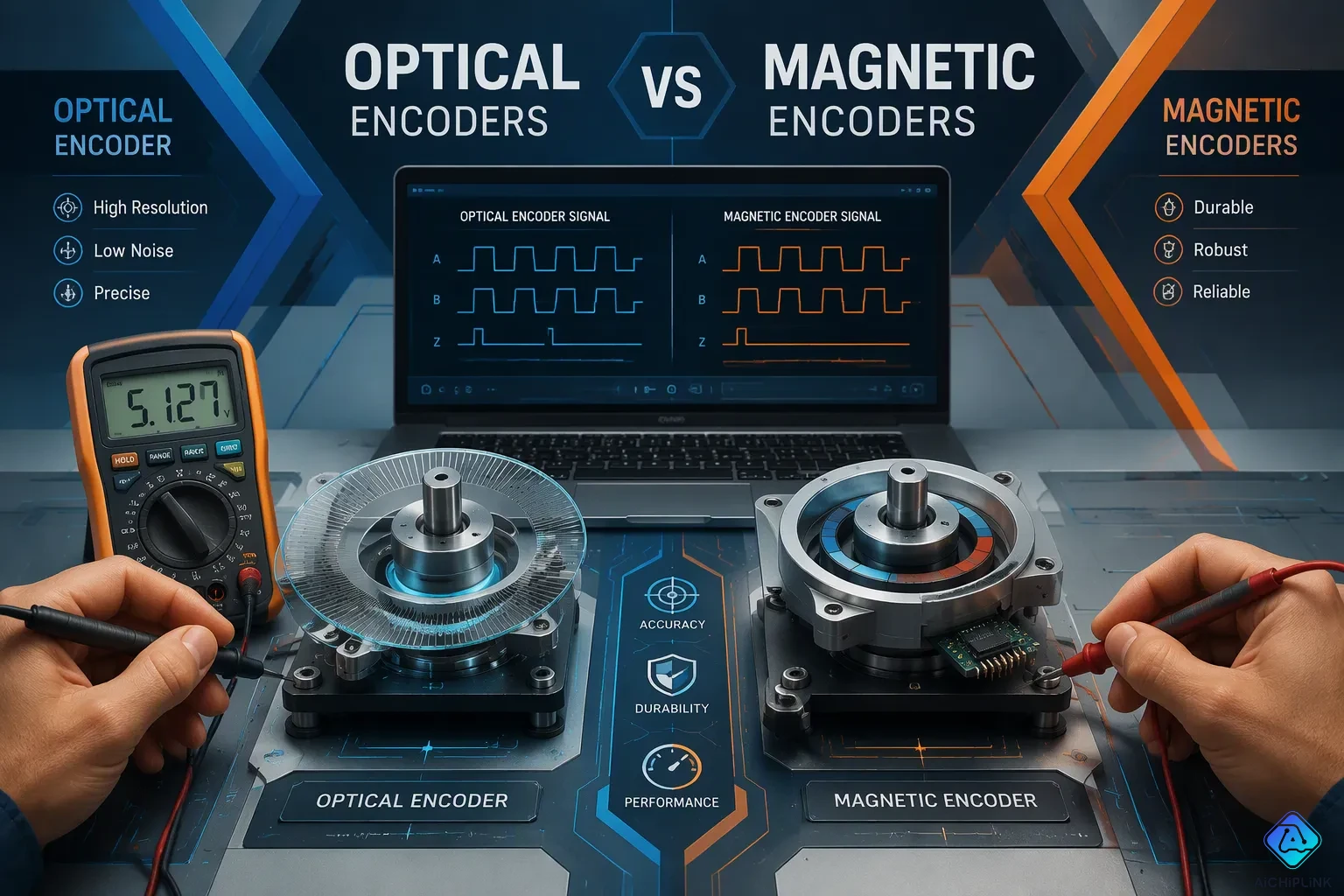
There is no single best choice in the optical encoders vs magnetic encoders debate. The right option depends on what the application needs. Optical encoders held 51.85% of industry revenue in 2025, yet magnetic designs are growing quickly, and each type earns its place.
Five factors should guide the decision: resolution, accuracy, environmental robustness, cost, and power consumption. A design that needs fine position feedback in a clean room points one way. A machine that faces dust and moisture points another.
This comparison explains how both encoder technologies work. It then helps you match the encoder type to your own use case.
Key Takeaways
-
Optical encoders give higher resolution and accuracy for clean, precise tasks.
-
Magnetic encoders stand up to dust, moisture, and vibration, so they work well in harsh environments.
-
Magnetic encoders usually cost less overall, but optical encoders offer high resolution at a low price.
-
Pick optical encoders for machine tools and robots in controlled places.
-
Pick magnetic encoders for outdoor equipment and machines that need to save money in harsh conditions.
Encoder Basics: Reading the Signals
What Encoders Do
An encoder is a sensor that reports motion. It turns mechanical movement into an electrical signal. A controller reads that signal and uses it for position control. Rotary encoders mount on a motor shaft and track shaft angle. Linear versions track travel along a rail. Either way, the device supplies position feedback to the drive.
The signal travels back to the controller as encoder feedback. The controller compares the commanded position with the measured position. It then adjusts the motor output. This closed loop keeps machines on target. Without reliable feedback, a drive runs blind and cannot correct for load changes or drift.
Incremental vs Absolute Signals
Encoders output one of two signal types: incremental or absolute. Incremental optical encoders report change, not location. They send out pulses as the shaft turns. The controller counts pulses to figure out position. A power loss erases that count, so the system must reset at a reference point after each restart.
Absolute optical encoders report a unique code for every shaft angle. The controller knows the exact position the moment power returns. No homing move is needed. This difference matters for selection. Incremental encoders usually cost less than similar absolute encoders. That savings can shrink once you add battery backup, reference sensors, and more complex control electronics. Absolute encoders avoid cumulative error and cut reinitialization downtime. Choose based on whether your machine can afford a homing cycle and whether budget or restart speed drives the design.
How Optical Encoders Work
Light, Discs, and Detectors
An optical encoder uses a light source, a code disk, and a photodetector. The light sits on one side of the disk. The photodetector sits on the other side. The code disk has a pattern of slots or windows. As the shaft turns, the disk spins between the light and the detector.
Light goes through the open slots and is blocked by the solid parts. The photodetector turns this on-off pattern into an electrical signal. The controller reads the signal and figures out speed and position from it. A finer slot pattern makes more pulses per revolution. That is why this technology has a resolution advantage.
Strengths of Optical Encoders
Optical encoders give higher standard resolution and accuracy than magnetic encoders. The optical sensing method can read very fine slot patterns, so each revolution gives many distinct counts. This makes optical encoders a strong choice for high-resolution jobs. Machine tools, robotics, and precision stages often rely on this fine feedback.
Cost is the second strength. Optical encoders work well for low-cost applications that still need fine feedback. The parts are simple and widely made. Designers get high resolution without a high price. Absolute optical encoders add a unique code for every shaft angle, so the controller knows position at power-up. That removes the homing cycle. For many designs, optical encoders give the best balance of resolution and cost.
How Magnetic Encoders Work
Magnetic Fields and Sensors
A magnetic encoder uses a magnetic ring or disc and a sensor element. The ring has a pattern of alternating magnetic poles. It mounts on the motor shaft and turns with it. The sensor sits close to the ring and reads the field. It detects the change in magnetic polarity as each pole passes.
The sensor turns this field pattern into an electrical signal. The controller reads the signal and works out speed and position from it. No light source and no line of sight are needed. The field passes through the air gap, so the sensing stays stable. This simple setup explains why magnetic encoder technology suits tough conditions.
Strengths of Magnetic Encoders
Magnetic encoders are cost-effective, rugged, and reliable. The code disk and read head are harder to break than optical parts. There is no glass disk to crack and no lamp to burn out. The design handles shock and vibration well. These traits make magnetic encoders a practical choice for demanding machinery.
Durability and reliability stand out in dirty settings. Dust, moisture, and oil do not block a magnetic field. The sensor keeps reading the ring through the contamination. Maintenance teams value this reliability, because the encoder keeps working without frequent service. A magnetic encoder also fits tight budgets. The parts are cheap to make, so the total cost stays low. For cost-sensitive designs that face harsh conditions, magnetic encoders deliver solid performance. They trade some resolution for toughness, and that trade fits many industrial applications.
Optical Encoders vs Magnetic Encoders: Performance
Resolution and Accuracy
The performance gap between these two designs starts with resolution. Optical encoders have a higher standard resolution and accuracy than magnetic encoders. Magnetic units usually offer lower resolution. That difference is about what fits the job, not which one is better.
The published specs show the spread. Mitsubishi Electric reports magnetic encoders reaching up to 17-bit, or 131,072 positions per revolution. Its optical encoders reach up to 20-bit, or 1,048,576 positions per revolution. FANUC lists magnetic absolute encoders at an effective 19-bit with ±2 arc-second accuracy. Its optical versions reach 22-bit with ±0.5 arc-second precision. Both figures assume controlled conditions.
| Specification | Magnetic Encoders | Optical Encoders |
|---|---|---|
| Typical resolution range | 8-bit to 16-bit per revolution | Exceeding 20-bit per revolution |
| Accuracy (controlled conditions) | ±2 arc-second | ±0.5 arc-second, sub-arc-second precision |
| Temperature stability | Consistent across -40°C to +125°C | May degrade 10–15% at temperature extremes |
Encoder resolution also depends on what limits each design. Magnetic units are limited by sensor sensitivity, field uniformity, and temperature-dependent variation. Optical units are limited by light source stability, photodetector noise, and thermal expansion. Neither list is shorter than the other. The question is which limits your application can handle.
Speed and Signal Stability
Speed behavior differs as well. Jitter describes the positional noise an encoder outputs while standing still. Lower jitter helps an encoder hold position, reduces heat in linear motors, and gives smoother velocity control at low speeds.
Jitter is the amount of positional noise an encoder outputs when it is not moving. This figure is normally quoted in RMS, but there are many ways to measure positional noise; the bandwidth of the measurement is particularly crucial.
Optical designs post strong numbers here. A TONiC optical system reaches 1.35 m/s at 0.1 μm resolution with a 20 MHz Ti interface and 15 MHz clocked output. Its theoretical maximum is 1.5 m/s, which is not achievable in practice. The analog signal bandwidth caps the system near 10 m/s. Signal noise at a given position sits near 0.3°, close to one state at 1024 counts per revolution (360° / 1024 = 0.35°).
For high-precision positioning, optical encoders with a line driver are the recommended path. They offer higher resolution, less jitter, and lower integral nonlinearity than interpolated magnetic encoders. That guidance fits machines chasing fine position accuracy. Magnetic units still serve well where moderate resolution and ruggedness matter more than sub-arc-second precision. Match the specification to the task, and either technology performs as intended.
Environmental Robustness Compared
Dust, Moisture, and Vibration
The place where an encoder will be used often decides which type to pick, even before performance specs matter. Magnetic encoders can work in areas with more humidity, dirt, and dust. That ability to handle tough conditions makes them the best choice for harsh places. The magnetic field passes right through contamination that would block a light beam. Sealed optical encoders still do well indoors, where dust particles and occasional chemical vapors stay at controlled levels.
Ingress protection ratings show how well each design is sealed. Indoor optical encoders usually carry IP54, IP64, or IP65 ratings. Outdoor units reach IP65, IP67, or IP68, and sealed models such as the Renishaw RESOLUTE hold IP67/IP68 for harsh outdoor use.
IP (Ingress Protection) rating defines the sealing of an electrical enclosure using two digits: the first for dust ingress and the second for water ingress (e.g., IP64 = 6 dust, 4 water), as defined in IEC 60529.
Vibration is the second stress. Optical encoders offer outstanding resolution, but they are easily harmed by vibration that causes mechanical misalignment from bearing wear and housing deformation. Ground accelerations above 0.5g can permanently damage standard housings. Steady vibration in the 10–50 Hz range speeds up bearing wear and increases backlash. Magnetic encoders have no glass disk to crack and no lamp to burn out, so shock and vibration do less harm.
Matching Magnetic Encoders to Harsh Environments
Maintenance data makes the case for matching the technology to the setting. Unprotected encoders in dusty places show yearly failure rates of 15–25%, with cleaning and recalibration every 3–6 months. Better protection systems drop that rate to 2–5%, with service every 12–18 months. A magnetic encoder reaches that reliability through its simple, sealed sensing path.
Optical encoders suit cleaner, controlled environments. Machine tools, laboratories, and precision stages give them the steady conditions their fine optics need. Neither technology is wrong here. Each one fits a different set of conditions, and the application defines which set applies.
Compliance and Cost Factors
Certification Considerations
Both technologies must follow rules, and the marks you need depend on where the machine ships and how it is used. Common needs include CE and UKCA marks, UL or cULus safety certification, and RoHS environmental compliance. Sites with explosive atmospheres add ATEX or IECEx approval. Functional safety duties may call for certification under recognized safety standards, and quality systems such as ISO 9001 support the audit trail.
-
Regulatory markings: CE, UKCA
-
Safety certification: UL, cULus, CSA
-
Environmental compliance: RoHS, WEEE
-
Hazardous locations: ATEX, IECEx
-
Functional safety: SIL and performance-level ratings
-
Quality management: ISO 9001
Suppliers often hold several of these at once. One maker says it holds ISO, CE, RoHS, and SGS certifications, covering quality management, EU rules, environmental, and third-party testing needs. Check that the certificates match your target market before you finalize the design.
Total Cost of Ownership
The purchase price is only one line in the cost picture. Optical encoders usually cost more to buy. Etching high-resolution lines on a code disk and putting the unit together in a clean room raise the bill of materials. Magnetic encoders have traditionally been cheaper, and the gap is shrinking as high-resolution magnetic sensor chips become more affordable.
The cost detail matters. Magnetic encoders are generally more cost-effective overall. Optical encoders stay low cost for high-resolution needs, where their fine feedback avoids extra parts. Add installation, sealing, maintenance, and downtime to the comparison. A tough magnetic encoder in a dirty plant may cost less over its life than a delicate optical unit that needs frequent service. Match the total cost to the duty cycle, not just the price tag.
Optical Encoders vs Magnetic Encoders: Summary Table
The table below puts the whole comparison into one view. Each row shows the trade-offs we covered above. No single row makes the choice by itself. Read the table as a whole, then weigh the rows that matter most for your machine.
| Factor | Optical Encoders | Magnetic Encoders |
|---|---|---|
| Resolution | Higher standard resolution; more than 20-bit per revolution | Lower resolution; usually 8-bit to 16-bit per revolution |
| Accuracy | ±0.5 arc-second in controlled conditions | ±2 arc-second in controlled conditions |
| Environmental robustness | Fits clean, controlled settings; sensitive to dust and vibration | Handles humidity, dirt, and dust; resists shock and vibration |
| Cost | Low cost for high-resolution needs; generally more to buy | Generally more cost-effective overall |
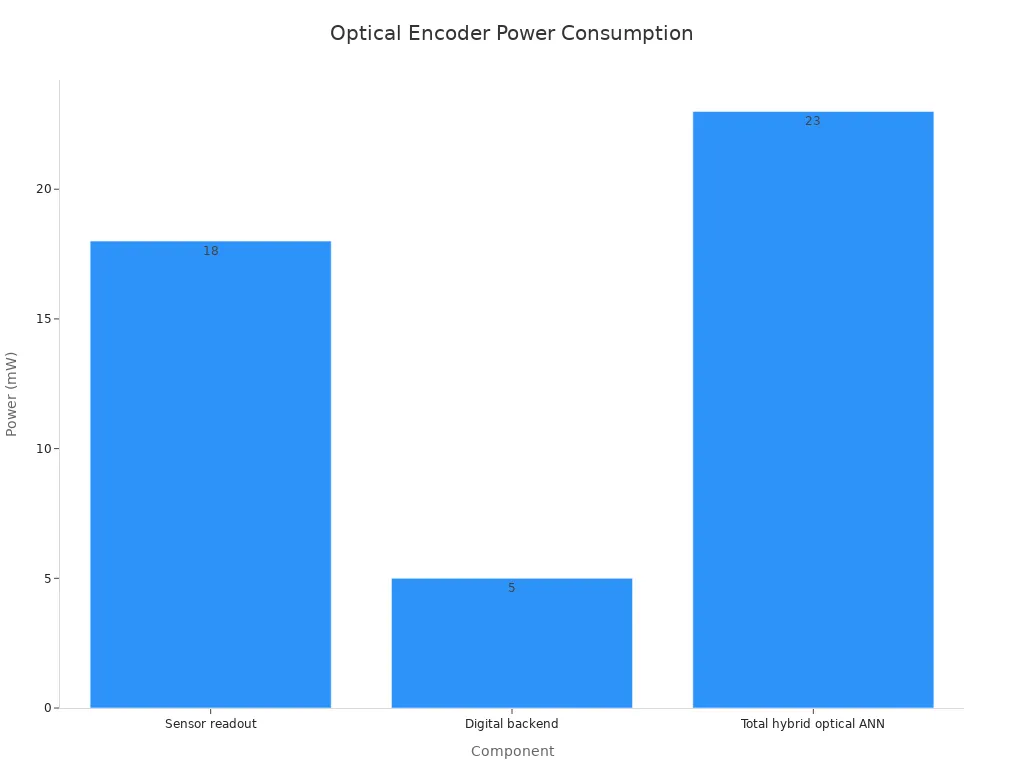
| Power consumption | Light source and detector use modest power; a hybrid optical design can total about 23 mW | No light source; sensing power stays low |
| Best-fit applications | Machine tools, robotics, precision stages, laboratories | Harsh plants, outdoor equipment, cost-sensitive machinery |
Power use deserves a closer look, because it changes with design. In one hybrid optical design, the sensor readout draws about 18 mW and the digital backend about 5 mW, for a total near 23 mW at roughly 10 kHz operation. Magnetic encoders skip the light source, so their draw stays modest. Neither type is a major load in most systems.
Use this table as a starting filter, not a final answer. An application where position matters most, in a clean room, leans toward optical units. A dusty site with tight budgets leans toward magnetic units. The next section shows how Oriental Motor products map to each case.
Oriental Motor Encoder Examples
Oriental Motor puts both encoder types into its motor and actuator lines. The examples below show where each design works best. Neither option is the weaker choice. Each one serves a different set of application needs.
Optical Encoder Solutions
Oriental Motor's optical encoder lineup focuses on incremental models with a range of resolutions. Standard units come in 200, 400, and 1000 pulses per revolution (P/R). Semi-custom orders stretch the range from 100 to 4000 P/R, with options such as 300, 500, 600, 720, 800, 1800, 2000, 2500, and 3600 P/R. These optical encoders fit machines that need fine position feedback in a controlled setting.
| Encoder Code | Resolution (P/R) |
|---|---|
| R3E | 200 |
| R3F | 400 |
| R3G | 500 |
| R3J | 1000 |
| R3EL | 200 |
| R3FL | 400 |
| R3GL | 500 |
| R3JL | 1000 |
| R3EN | 200 |
| R3FN | 400 |
| R3JN | 1000 |
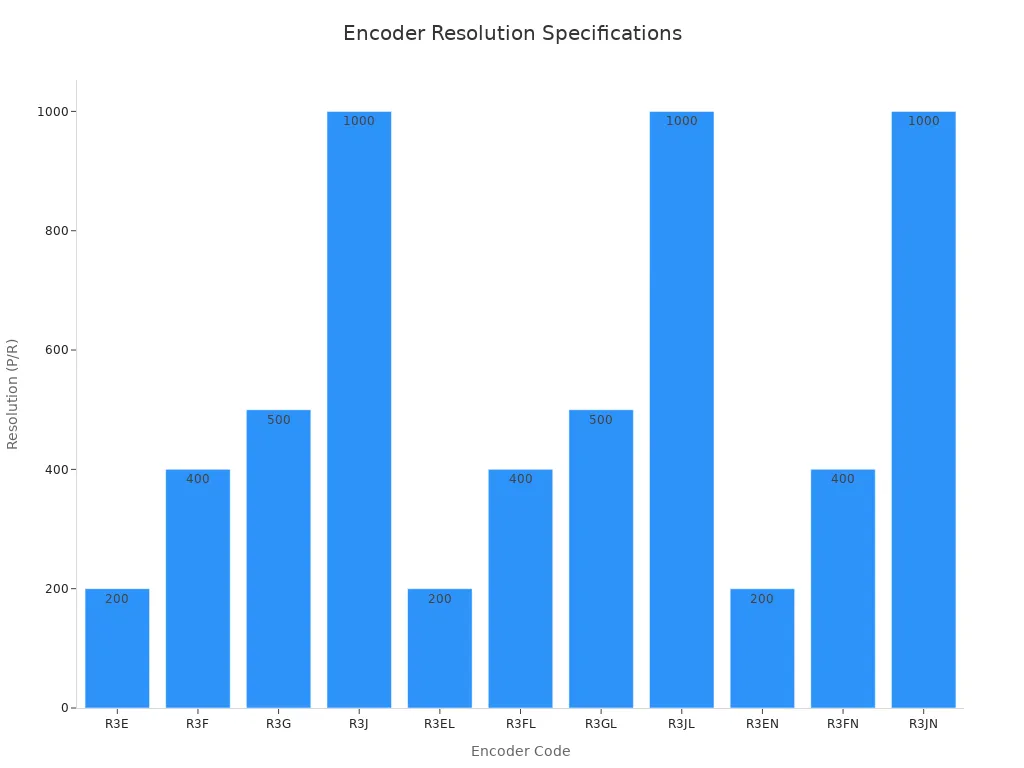
The higher-resolution codes fit precision work. A 1000 P/R optical encoder gives fine feedback for indexing tables, lab equipment, and small robotics. Lower codes such as 200 P/R serve simpler speed and position tasks. All of these units output incremental signals, so the controller counts pulses to track position. A machine that can run a homing cycle at startup gets a clean, low-cost fit from this family.
Magnetic Encoder Solutions
Oriental Motor also offers magnetic encoder designs for tougher settings. These units fit machinery that faces dust, moisture, or vibration. The sealed sensing path keeps working where a light beam would struggle. Plants with dirty air or washdown routines gain a reliable feedback source from this option.
Cost-sensitive builds benefit as well. A magnetic encoder delivers solid performance at a lower total cost. Outdoor equipment, conveyors, and heavy industrial frames are natural fits. The trade-off is resolution, and that trade suits many motion tasks. For moderate position needs in a harsh place, a magnetic encoder is the practical pick.
Which Encoder Works for Your Job?
There is no single winner in the optical encoders vs magnetic encoders question. What fits your job decides the outcome. Weigh resolution and accuracy needs against environmental demands, cost, and power draw. A clean, precision-driven machine favors optical encoders. A dusty site with a tight budget favors magnetic encoders.
Both technologies keep getting better. Miniaturization and energy-efficient designs now appear in each family, and magnetic units grow tougher for harsh settings. Define your application requirements first. Then pick the encoder type that meets them. Oriental Motor's range covers both paths, with optical and magnetic encoders ready to support your position control needs.

Written by Jack Elliott from AIChipLink.
AIChipLink, one of the fastest-growing global independent electronic components distributors in the world, offers millions of products from thousands of manufacturers, and many of our in-stock parts is available to ship same day.
We mainly source and distribute integrated circuit (IC) products of brands such as Broadcom, Microchip, Texas Instruments, Infineon, NXP, Analog Devices, Qualcomm, Intel, etc., which are widely used in communication & network, telecom, industrial control, new energy and automotive electronics.
Empowered by AI, Linked to the Future. Get started on AIChipLink and submit your RFQ online today!
Frequently Asked Questions
Are optical encoders more accurate than magnetic encoders?
Yes, when conditions are controlled. Optical units reach about ±0.5 arc-second, while magnetic units reach about ±2 arc-second. That gap comes from design limits, not a flaw. A clean, precision-driven machine gains from the finer feedback. A dusty site may never need that level of accuracy.
Can magnetic encoders handle dust and moisture?
Yes. A magnetic field passes through contamination that would block a light beam. Sealed magnetic units keep reading through dust, humidity, and oil. That toughness makes them the practical pick for harsh plants and outdoor equipment. Optical encoders still suit clean, controlled settings.
Do I need absolute encoders for my machine?
Only if restart speed matters. Absolute encoders report exact position at power-up, so no homing cycle is needed. Incremental units cost less and work well when a startup reference move is acceptable. Match the signal type to your control sequence before you compare brands.
Which type costs less overall?
Magnetic encoders are generally more cost-effective overall. Optical units stay low cost for high-resolution needs. Add sealing, maintenance, and downtime to the comparison. Total cost depends on the duty cycle, not the price tag alone.
How much power does each type draw?
Magnetic encoders skip the light source, so their sensing draw stays modest. A hybrid optical design can total about 23 mW at roughly 10 kHz operation. Neither type is a major load in most systems. Check the datasheet for your specific model.