title: "What Are the Different Types of Amplifiers?" description: "Understanding amplifier types means knowing how conduction angle defines classes A, B, AB, C, D, G, and H. Compare their efficiency, sound, and best uses." slug: "understanding-amplifier-types-classes-explained" featured_image: "https://statics.mylandingpages.co/static/aaanxdmf26c522mpaaaiuf7phi2uovkv/image/0e8aa2fb8c1f4b2191acfb090af47fdc.webp" category: "" date: "2026-10-23" author: ""
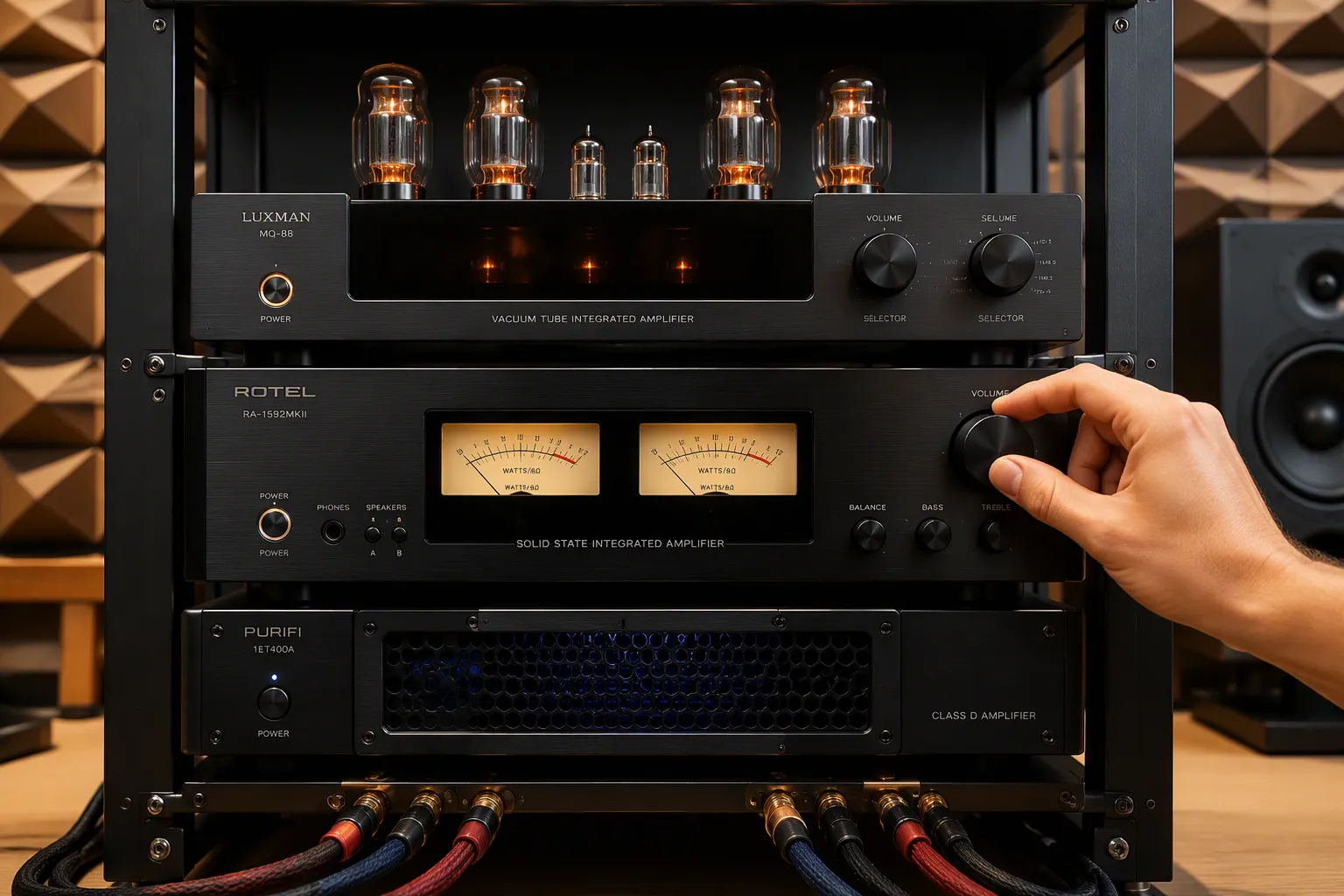
What Are the Different Types of Amplifiers?
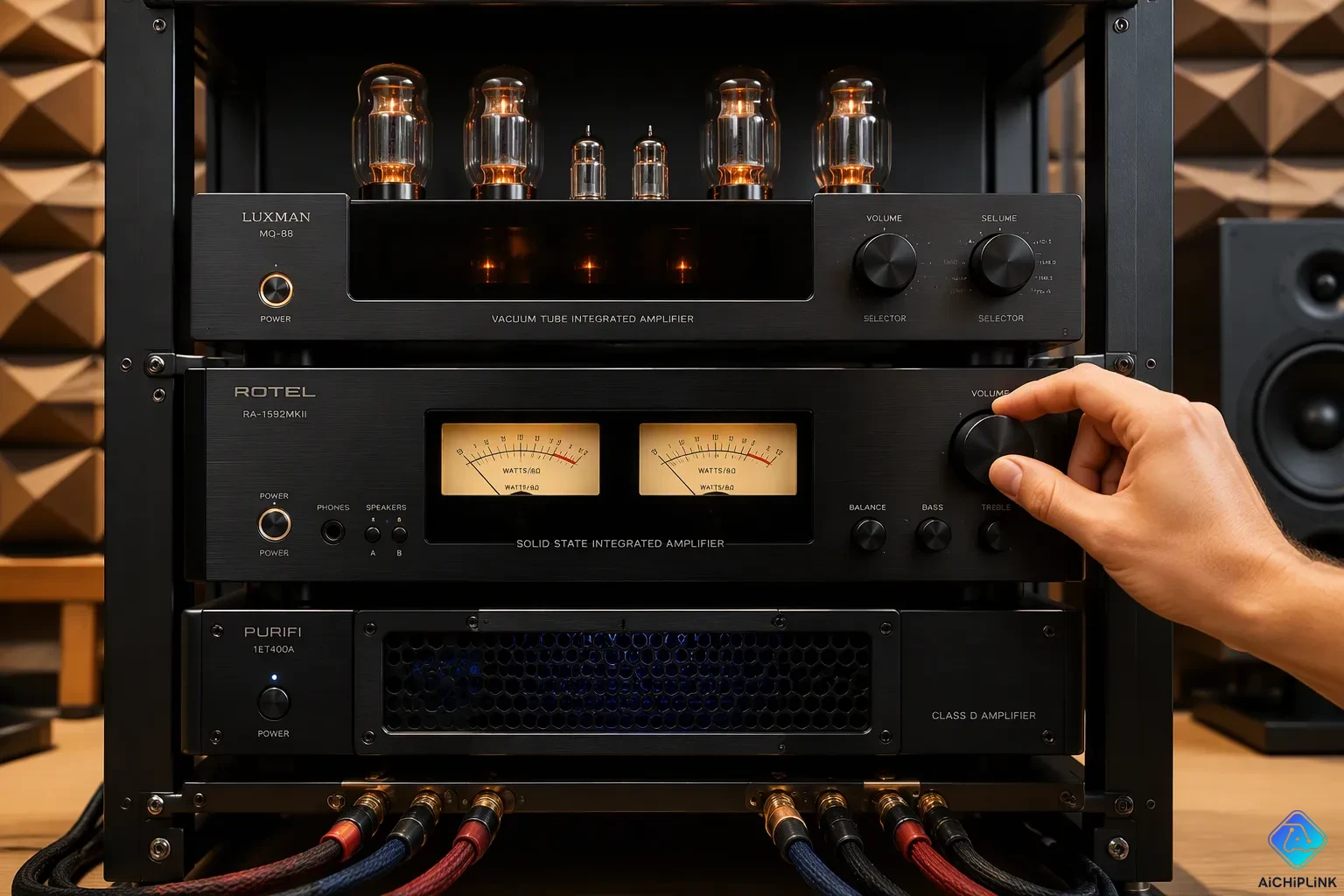
Audio amplifiers come in seven main classes: A, B, AB, C, D, G, and H. Each class balances efficiency, sound quality, cost, and size in its own way. No single design is best at everything. A cheap model and a high-end model can be in the same class. An amplifier takes a small audio signal and makes it stronger. The stronger signal then powers your speakers. This post explains these amplifier classes, shows how they differ, and helps you pick one for your setup. You will see that understanding amplifier types starts with one key idea: how long each device conducts during a signal cycle. That idea is what separates the different amplifier classes.
Key Takeaways
-
Amplifier classes differ by how long each device stays on during a signal cycle.
-
Class A gives the cleanest sound but wastes power and runs hot.
-
Class AB balances good sound and efficiency for most home audio.
-
Class D is the most efficient and fits portable and slim devices.
-
Choose an amplifier class based on your needs, not just specifications.
Understanding Amplifier Types: The Big Picture
What an Amplifier Does
An amplifier takes a small audio signal and makes it bigger. It boosts that weak signal until it is strong enough to power speakers. You can think of it like a valve that controls a large flow of power with a small input.
This basic job is the same in every design. The differences appear in how each circuit does that job. Those differences affect the sound, the heat, and the power use you get.
Amplifier Class by Conduction Angle Explained
The conduction angle tells you how much of one signal cycle the amplifying device stays on. A full cycle counts as 360 degrees. A half cycle counts as 180 degrees. This one measure drives the letter-based amplifier classes, so it is at the heart of any amplifier class by conduction angle discussion.
Engineers also group amplifiers by function, such as voltage, current, power, and small-signal types. That classification of amplifiers matters in circuit design. This post focuses on audio power amplifier classes instead.
The table below shows the conduction angle for each class.
| Amplifier Class | Conduction Angle |
|---|---|
| Class A | 360° (full cycle) |
| Class AB | Between 180° and 360° |
| Class B | 180° (half cycle) |
| Class C | Less than 180° |
| Class D | Switching operation; set by pulse-width modulation, not a fixed angle |
| Class G | Variant of Class AB with multiple supply rails |
| Class H | Variant of Class AB with a tracking supply voltage |
This table gives you a quick map of the types of amplifier designs. The conduction angle alone does not tell the whole story, though. Each class also trades off efficiency, linearity, and cost in its own way. The next sections walk through those trade-offs one class at a time.
Amplifier Classes by Conduction Angle
Class A: High Linearity, Low Efficiency
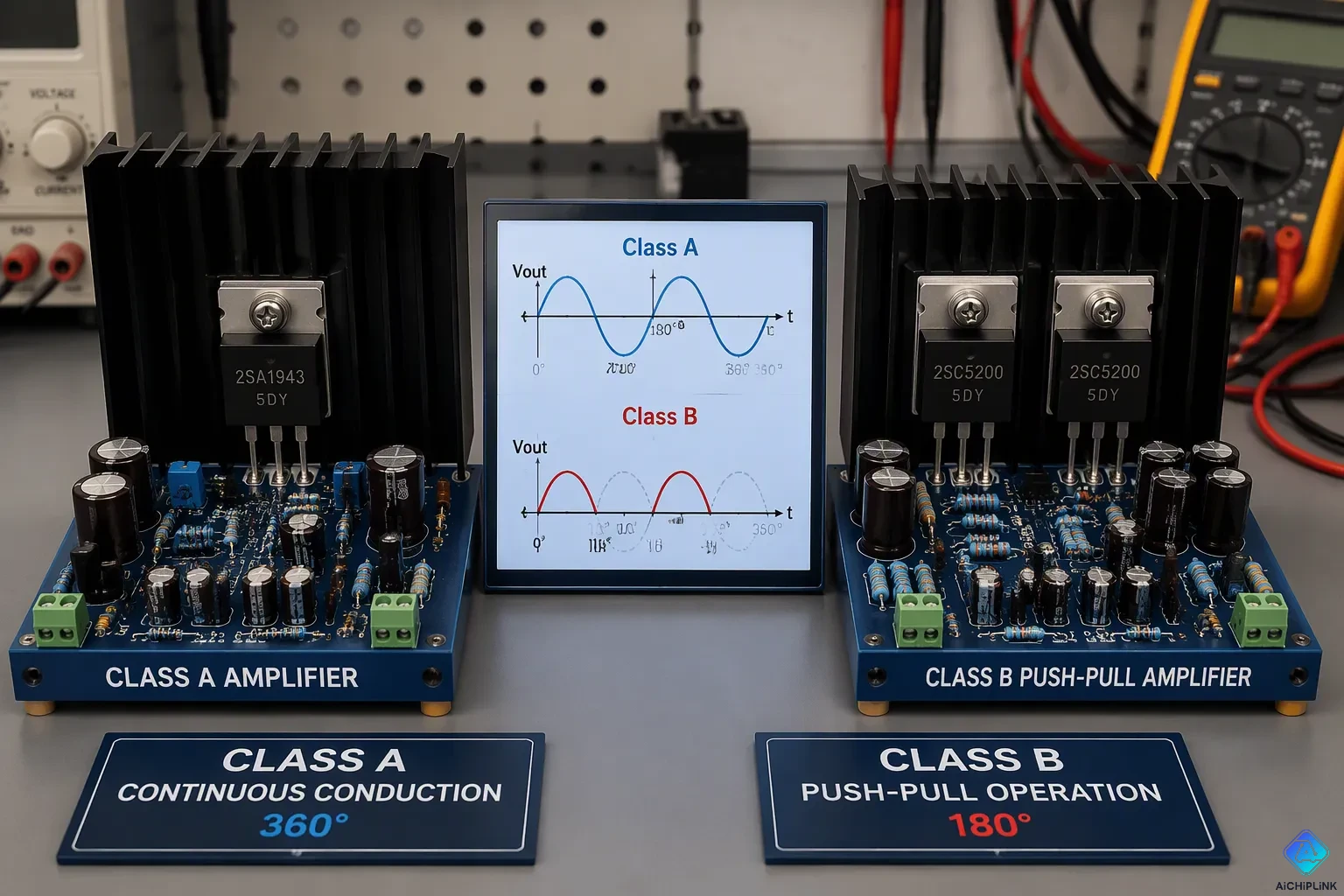
A class-a amplifier keeps its output device on for the whole 360-degree cycle. This full-cycle conduction angle is what makes class a what it is. The device never turns off, so it boosts every part of the waveform without passing it to another device. That steady operation gives class-a amplifiers very high linearity. You hear low distortion and a smooth, detailed sound. Many listeners call class a amplifiers warm and musical.
The downside is efficiency. A class-a amplifier turns only a small part of its power into sound. Most of the input power becomes heat. Class a amplifiers therefore run hot and need large heatsinks. They also pull a lot of power even when idle. This heat and power draw make a class-a amplifier cost more. You usually find class a in high-end audio gear, where sound quality matters more than power bills. A class-a amplifier suits listeners who want the cleanest possible signal and accept the heat and cost that come with it.
Engineers call this the classification of amplifiers by conduction angle. Among all amplifier classes, class a stands out for purity. The class-a approach favors linearity over efficiency. A well-built class-a design can last for decades. Owners of class-a amplifiers accept the heat for the sound. The class a design is still a favorite in high-end rooms. You will find class a in premium stereo systems. For class a, heat is the main cost. These amplifier classes differ in how long each device conducts. The conduction angle sets the boundary for these amplifier classes. Most class-a amplifiers use large heatsinks and heavy power supplies. A class-a amplifier never switches its device off.
Class B: Push-Pull Efficiency
A class-b amplifier splits the work between two devices in a push-pull setup. One device conducts for the positive half of the cycle, and the other conducts for the negative half. Each device works for a 180-degree conduction angle. This split gives the class-b amplifier a clear efficiency edge over class a. Each device rests during half the cycle, so the class b design wastes less power as heat.
The push-pull topology brings one main drawback: crossover distortion in the class-b amplifier. The two devices hand off the signal at the zero crossing. A small glitch can show up at that handoff point. This glitch is the crossover distortion trade-off of the class-b amplifier. Engineers use several techniques to reduce it. Class AB biasing overlaps the conduction regions of the two devices, so the handoff becomes gradual. Feedback error correction compares the output to the input and corrects the error after it occurs in a class-b amplifier. Feedforward error correction inverts the difference and adds it to the output, and it can give roughly 30–50 dB of distortion reduction in a class b design. These methods keep the class-b amplifier efficiency gain while taming its distortion.
The class-b amplifier remains a building block for many amplifier classes. A class b stage can drive high power with modest heat. Designers of class-b amplifiers value that balance. The class b layout also keeps the chassis smaller. For class b, efficiency is the main draw. A class-b amplifier still needs care at the handoff point. The class b stage rewards good bias design. Every class-b amplifier faces the same crossover challenge.
Class AB Amplifier: The Practical Middle Ground
How Class AB Combines A and B
The class ab amplifier sits between two extremes. Its output devices stay on for more than half the cycle but less than the full cycle. That overlap is the whole idea behind the class-ab amplifier configuration. You get much of the linearity of class-a designs and much of the efficiency of class-b designs in one package.
Here is how the trick works. A class ab amplifier uses a complementary pair of transistors, one PNP and one NPN. A small bias voltage keeps both devices just above cutoff. Diodes in series with resistors usually set that bias and make up for temperature-driven changes in the emitter-base voltage. Both transistors therefore keep conducting through the transition region between the positive and negative halves of the signal. The dead zone that causes crossover distortion in a class-b stage goes away. The result is a more linear output with lower distortion.
The bias also changes the electrical behavior at the handoff. In a class-b stage, one device conducts at a time, so transconductance varies through the crossover. In a properly biased class-ab amplifier, both transistors contribute, transconductance roughly doubles, and that variation shrinks. Emitter ballasting and feedback add further stability. Most low-distortion designs accept the quiescent current cost to gain this behavior.
Class-AB Amplifier Pros and Cons
Efficiency is the headline gain. A class ab amplifier usually reaches 50–70% efficiency, well above the 25–30% of class-a and below the 70–80% of class-b. Distortion stays low, with only small amounts in normal operation. Heat output drops compared with class-a, so heatsinks and chassis can be smaller. Cost follows the same path. This mix explains why the class a/b amplifier is the most common choice in home and pro audio. A class a/b design handles home theater, stereo, and stage work without extreme heat or price.
The trade-offs are real but modest. A class-ab amplifier still burns quiescent current, and bias drift needs care across temperature. The class-ab stage also gives up some efficiency to class-b. Still, the class-ab amplifier configuration remains the practical default for full-range audio.
Related amplifier classes include the class c amplifier, which conducts for less than half the cycle. A class-c amplifier reaches very high efficiency, above 80%, but produces large amounts of distortion. That makes the class c amplifier and class-c amplifier designs a poor fit for full-range audio. You find them mainly in RF and specialized applications.
| Amplifier Class | Efficiency | Distortion Characteristic |
|---|---|---|
| Class A | 25–30% | None if well set up |
| Class B | 70–80% | Occurs at crossover point |
| Class AB | 50–70% | Small amounts |
| Class C | >80% | Large amounts |
| Class D | >90% | Minimal |
Class D Amplifiers: Efficiency First
How Class D Works
A class d amplifier doesn't keep its output devices on for part of the wave. Instead, the devices switch all the way on and all the way off very fast. This quick switching is the heart of how class d works. The circuit turns the audio signal into the width of each pulse. A wider pulse means a louder moment, and a narrower pulse means a quieter one. A filter then smooths the pulses back into an audio waveform.
You can picture it as a light switch flipped thousands of times per second. The switch is either fully on or fully off, so it wastes very little energy as heat. That is why a class-d audio amplifier runs cool compared with designs that stay on the whole time.
Efficiency, Sound, and Typical Uses
Efficiency is the main strength of class d. A class d amplifier usually reaches 85–95% efficiency, and top models sit at the high end of that range. A class d design can reach about 75% with little design effort, and higher numbers show up at higher power levels, around 100 W or more. Compare that with class ab, which struggles near 20% real operating efficiency once you count the crest factor of real music signals.
| Amplifier Class | Typical Efficiency Range |
|---|---|
| Class D | 85–95% |
| Class AB | ~40–60% |
Low heat means compact size. Class d amplifiers fit into slim home theater receivers, portable speakers, and pro sound racks. Sound quality has gotten much better, and modern class d amplifiers work well for critical listening too. Among amplifier classes, class d fits best where you want power, portability, and low running cost together.
Class G and H Amplifiers
Class G and Class H are types built to save power by changing supply voltage to match what the signal needs. Both are based on the Class AB design. They add extra supply rails and switching circuitry. This setup lets them cut wasted power at low and medium output levels. You will find them in high-power pro audio and installed sound systems.
Class G: Stepped Supply Rails
A Class G amplifier has several power supply rails at different voltage levels. A Class AB design runs on one fixed rail. The Class G circuit changes that. As the output signal gets close to each rail level, the amplifier switches to the next higher rail. A higher voltage turns on only when the signal peak goes above the current supply level. When the peak drops back, the amplifier switches down to a lower rail.
This stepped rail selection gives the efficiency gain. The output transistors only ever see the smallest rail that is enough for the signal at that moment. The voltage drop across them shrinks, so wasted power and heat drop too. A Class AB stage always runs on one high rail and burns more power because of it. During low-power operation, a Class G amplifier runs on a lower rail than a Class AB unit of similar rating. That cuts power consumption. As output demand rises, the amplifier steps up to a higher rail. Among amplifier classes, this approach follows the signal's needs instead of always running from the highest supply.
Class H: Tracking Supply Rails
Class H takes the same goal further. Instead of switching between separate rails in steps, a Class H amplifier continuously adjusts its supply voltage to follow the signal. The rail tracks the waveform moment by moment. The output devices therefore see only a small voltage margin above the signal at any instant. This continuous tracking reduces wasted power even more smoothly than stepped rails.
The trade-offs are cost and complexity. Both designs need extra power supply hardware and control circuitry. That raises the build cost and makes repairs more complex. You usually see these amplifier classes in high-power pro audio rigs and installed sound systems, where efficiency and heat control matter at scale. For a home stereo at modest power, the added cost rarely pays off.
Comparing Amplifier Classes
Performance, Efficiency, and Cost at a Glance
The table below gives a quick look at how the amplifier classes compare. It describes each design. It does not rank them.
| Class | Efficiency | Sound Quality | Heat | Size | Cost | Typical Use |
|---|---|---|---|---|---|---|
| Class A | Low | Very high linearity | High | Large | High | High-end stereo |
| Class B | High | Crossover distortion | Moderate | Moderate | Moderate | Building block for other designs |
| Class AB | Moderate | Low distortion | Moderate | Moderate | Moderate | Home and pro audio |
| Class D | Very high | Good and improving | Low | Small | Varies | Portable, home theater, pro sound |
| Class G/H | High | Low distortion | Low | Moderate | Higher | High-power pro and installed sound |
You can see the pattern. A class-a amplifier gives you clean sound, but you pay for it in heat and cost. A class-b amplifier saves power, but it needs care at the crossover. The class ab amplifier sits in the middle, and the class d amplifier leads on efficiency. Class G and H add supply-rail hardware to cut waste at high power.
Rules and laws are also a real factor when you buy. The European Union's stricter Ecodesign directive from 2023 pushes the market toward higher efficiency. In May 2025, the EU added new limits on standby power for products such as wireless speakers. These rules favor class-d designs. Check the efficiency and standby ratings on the label before you buy.
Matching a Class to Your Application
Your use case should guide the choice. For home audio, the class a/b amplifier remains a safe default. It delivers low distortion at a fair price. A class-a amplifier suits a listener who wants the cleanest signal and accepts the heat. For portable gear, pick class d. Its small size and low heat fit tight enclosures. Home theater and pro sound also benefit from class d amplifiers and class-ab designs. High-power installed systems often use Class G or H.
Specialty work calls for other choices. RF gear uses Class C, where high distortion does not matter. This classification of amplifiers by use keeps your decision simple. Understanding amplifier types starts with your own setup, not a spec sheet.
No set of amplifier classes wins on every front. Your best pick balances price, sound, efficiency, and the job at hand. That balance defines understanding amplifier types.
A class-a amplifier or class-a amplifiers suit high-end listening. A class ab amplifier, a class-ab amplifier, or class-ab covers most home systems; class a/b works too. A class-b amplifier rarely stands alone; class-b stages serve other designs. Class d amplifiers, a class d amplifier, and class-d gear fit portable use. Class d runs cool. Class d suits tight spaces.
Listen first. Let your ears and use case guide the choice among amplifier classes. Class a and class-a fans know the trade-off. Class a buyers trust their taste.

Written by Jack Elliott from AIChipLink.
AIChipLink, one of the fastest-growing global independent electronic components distributors in the world, offers millions of products from thousands of manufacturers, and many of our in-stock parts is available to ship same day.
We mainly source and distribute integrated circuit (IC) products of brands such as Broadcom, Microchip, Texas Instruments, Infineon, NXP, Analog Devices, Qualcomm, Intel, etc., which are widely used in communication & network, telecom, industrial control, new energy and automotive electronics.
Empowered by AI, Linked to the Future. Get started on AIChipLink and submit your RFQ online today!
Frequently Asked Questions
Which amplifier class should you pick for a home stereo?
A class ab amplifier suits most home systems. It keeps distortion low at a fair price. A class a/b design handles stereo and home theater well. Pick class-a only if you accept the heat and cost. For slim receivers, class d works too.
Why does a class-a amplifier run so hot?
A class-a amplifier keeps its output device on for the full 360-degree cycle. It turns only a small part of its power into sound. The rest becomes heat. That is why class-a designs need large heatsinks and burn power even when idle.
Does a class d amplifier sound as good as older designs?
Modern class d sound quality has improved a lot. A class d amplifier now works well for critical listening. Class d amplifiers reach 85–95% efficiency, so they run cool and fit tight spaces. Class-d gear fits portable use and home theater.
What does conduction angle mean in amplifier classes?
Conduction angle is the share of one signal cycle that the device stays on. A full cycle is 360 degrees. A half cycle is 180 degrees. This measure sets the letter-based amplifier classes. A class-b amplifier conducts for half the cycle, and a class-a conducts for all of it.
What do Class G and H add over a standard design?
Both adjust supply voltage to match the signal. Class G switches between stepped rails. Class H tracks the signal continuously. They cut wasted power at high output. You find them in high-power pro and installed sound, where heat control matters.