Why Resistors Are Crucial for Circuit Safety
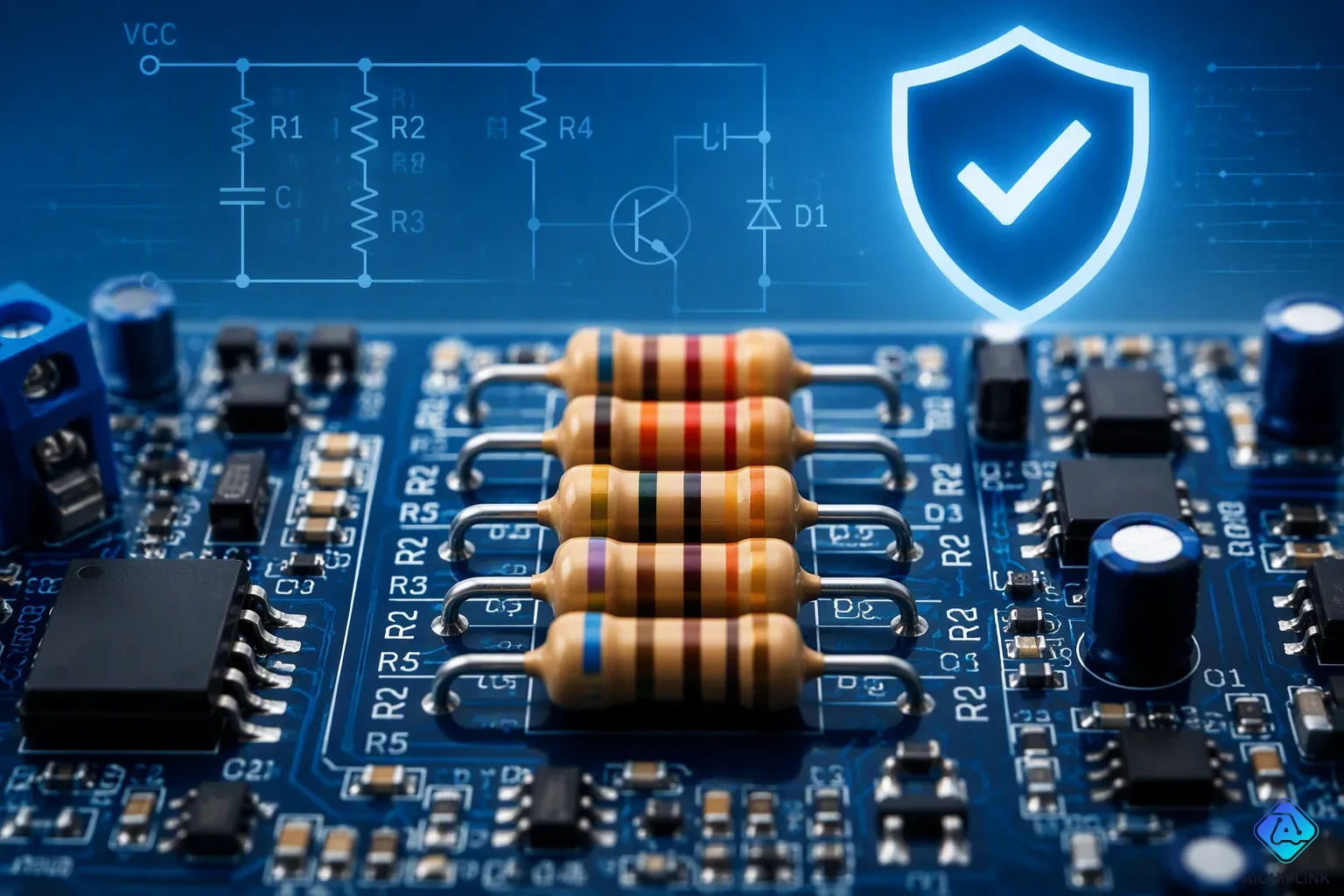
Imagine this situation: You connect a bright LED directly to a 9V battery. For a short moment, it glows very bright, then pops and stops working. Why? The circuit has no resistors to control the current.
If you remove the resistor in a simple beginner circuit, too much current can flow. This can make the LED too bright, too hot, or cause it to be unreliable or permanently damaged.
Resistors are very important for circuit safety. They do important jobs. Resistors limit current to safe levels. They divide voltage to protect parts. They dampen harmful oscillations that can cause instability. What is a resistor used for? To protect circuits. Every resistor matters. Choosing the right resistor value is very important. Without these resistors, failure is sure to happen. Resistors are not optional; they are active safety devices.
Key Takeaways
-
Resistors stop too much current from destroying your circuit parts.
-
Use Ohm's Law to figure out the correct resistor value so the current flows safely.
-
Resistors split voltage to keep delicate parts like sensors safe.
-
Never skip a resistor—it stops overheating and fire dangers.
What Is a Resistor Used For?
The Basic Role of a Resistor
A resistor is a small part with two ends that slows down the flow of electric current. We measure this slowing effect in ohms (Ω). One ohm lets one ampere of current pass when one volt is applied across the ends. Think of water moving through a pipe. Voltage is like water pressure. Current is like how fast the water flows. A resistor is like a narrow part of the pipe that slows the water down. This narrowing lowers the pressure further along the pipe. The same idea works for electricity.
You may ask, what is a resistor used for? The answer is about control. Resistors set exact current levels in your circuits. They also change voltage levels when you put them in a line. These jobs make resistors key for circuits to work right. Builders use them to "adjust" the electrical setup. Without them, you cannot know how much current will flow. This unknown factor can harm your parts.
Ohm's Law shows how voltage, current, and resistance relate. The rule says V = I × R. This means current goes up when voltage goes up, if resistance stays the same. On the other hand, current goes down when resistance goes up, if voltage stays the same. You use this rule to find the right resistor value for any job. This math keeps your parts safe from too much current.
Real-World Uses in Everyday Circuits
What is a resistor used for in real life? Look at LED brightness control. You put a resistor in line with an LED to limit current. Different resistor values give different brightness levels:
| Resistor Value (Ohms) | LED Brightness Seen |
|---|---|
| 100 Ω | Shines brightly |
| 1,000 Ω (1k) | Medium brightness |
| 4,700 Ω (4.7k) | Faint glow |
A lower resistance lets more current pass, so the LED shines brighter. A higher resistance blocks more current, making the light dimmer. You can also use a potentiometer, which is a changeable resistor, in line with the LED. Turning its dial changes resistance smoothly. This way gives you easy brightness control without swapping fixed resistors.
Resistors also make time delays when used with capacitors. These RC circuits slowly charge capacitors through the resistor. The time constant equals R × C, measured in seconds. Full charging takes about five time constants. This idea powers timing features in many gadgets.
Another key use involves sensors. A light-dependent resistor (LDR) works with a fixed resistor, like 10kΩ, to form a voltage divider. The output voltage changes with light level. In darkness, LDR resistance goes up, so most of the voltage drops across it. In bright light, resistance goes down, giving near-zero voltage. An analog input reads this voltage, turning light level into a signal the circuit can understand.
These examples show how resistors act as basic building blocks in electronics. Their uses cover countless devices. What is a resistor used for? The list keeps growing. From simple LED circuits to complex sensor systems, resistors in series and resistors in parallel allow fine control. They handle power loss and affect overall performance. Knowing these uses helps you build safer, more dependable circuits. Every project gains from picking the right resistor, boosting circuit performance and making parts last longer.
The Safety Functions of Resistors
Now you get to the core of circuit protection. Resistors are the first shield against electrical problems. Their safety jobs fall into three main groups: limiting current, splitting voltage, and stopping oscillations. Each job protects your parts in its own way.
How a Resistor Limits Current
The main safety job of a resistor is to control current flow. Think about a normal LED. Its top forward current rating is about 20 mA. Go past that, even for a moment, and the LED burns out. With no resistor, the LED takes whatever current the source gives. A 9V battery can push much more than 20 mA through an unprotected LED. What happens? A bright flash, a pop, and a broken part.
You put a resistor in line with the LED to stop this problem. The resistor value sets how much current flows. You find the right value using Ohm's Law: R = (VS - VF) / IF. Here, VS is the source voltage, VF is the LED's forward voltage (usually 1.7V to 3.4V based on color), and IF is the current you want, at or below 20 mA.
With a 5V supply and an LED forward voltage drop of 2.2V, the current through a 220-ohm resistor is: I = (5V - 2.2V) / 220Ω ≈ 12.7mA.
This math shows how one resistor keeps the LED safe within its working range. The same idea works for transistors. An emitter resistor stops thermal runaway through negative feedback. As the transistor heats up, current goes up. The voltage drop across the emitter resistor rises. This lowers the base-emitter voltage, which limits more current. The bad feedback loop breaks, and the transistor stays cool.
Voltage Division and Component Protection
Resistors also guard parts from too much voltage. Many sensors and microcontrollers run at lower voltages than your power supply gives. You fix this gap with resistors in series forming a voltage divider.
Think of a 3.3V sensor hooked to a 5V source. You pick R1 = 1.8kΩ and R2 = 3.3kΩ. The voltage divider formula Vout = Vin × (R2 / (R1 + R2)) gives Vout = 5V × (3.3kΩ / (1.8kΩ + 3.3kΩ)) ≈ 3.24V. This output fits within the safe range for the sensor.
Important limitation: Voltage dividers should not power a load. Any current the sensor pulls must go through R1, causing power loss as heat. If the power goes past the resistor's rating, it can overheat or melt. Use this method only for signal level shifting.
Microcontrollers also get help from resistors. AVR/Arduino pins have a safe working range of -0.5V to Vcc + 0.5V. Resistors keep current through internal protection diodes below 1mA. This lets the diodes clip higher input voltages safely. For mains voltage detection, you might use two 1MΩ resistors in series to spread out the voltage drop.
Resistors also stop harmful oscillations. In circuits with inductors and capacitors, energy can bounce back and forth, creating ringing that hurts parts. A damping resistor soaks up this extra energy as heat.
| Condition | Behavior |
|---|---|
| Underdamped (R/2L < 1/√LC) | Current oscillates about zero, with amplitude decreasing each cycle |
| Overdamped (R/2L > 1/√LC) | Current does not oscillate; it damps out to zero |
| Critically damped (R/2L = 1/√LC) | Current does not oscillate; it damps out to zero quickly |
This damping action absorbs sudden energy from quick voltage changes. It stops self-starting oscillations that could twist signals. The resistor works like a shock absorber for your circuit.
These safety jobs are not add-ons. A good circuit uses resistors to make a safe working zone for every part. Your circuit's performance depends on picking the right resistor. Each resistor you choose affects overall performance and reliability. Without them, you face part failure, overheating, and possible fire risks. Resistors turn wild electrical behavior into controlled, safe operation.
What Happens Without Resistors?
The Domino Effect of Component Failure
Take the resistor out of a circuit, and you start a chain reaction. One part fails from too much current. That broken part can short-circuit. A short circuit causes a sudden power surge. That surge moves through the rest of the circuit. Other parts get hit by that harmful spike. They fail one after another. This domino effect destroys many parts in just seconds.
Think about a simple transistor switch. Without a base resistor, the transistor gets full drive current. The transistor gets too hot and breaks down. Its inner junction turns into a short circuit. Now the full supply voltage reaches the next stage. The microcontroller connected there gets a deadly voltage spike. Its internal protection diodes cannot handle the energy. The microcontroller dies too. One missing resistor caused the loss of several parts.
From Overheating to Fire Hazards
Too much current creates heat. Every part has a maximum temperature rating. Go past that rating, and materials start to break down. The plastic insulation around wires gets soft. The epoxy coating on integrated circuits cracks. The copper traces on a PCB can peel away from the board. These failures harm the whole circuit.
The best outcome involves a burnt-out part. You replace it and keep going. The worst outcome is much more dangerous. Overheated parts can set fire to nearby materials. The PCB itself can catch fire. The melting insulation can expose bare wires. Those wires can touch and create more short circuits. This situation quickly becomes a fire hazard.
Think about the LED example from the start. You connect it straight to a 9V battery without a resistor. The LED shines very bright for a quick moment. Then it burns out with a small pop. The damage stays small because the LED is tiny. Make that same mistake with a power transistor. Make it with an integrated circuit handling real power. The result becomes disastrous. Large parts store more energy. They release that energy as strong heat when they fail. That heat can ignite nearby materials.
Resistors act as the first shield against these failures. They limit current flow before damage happens. They keep parts within their safe working temperatures. They stop the domino effect from starting. Without them, circuit performance drops fast. The overall performance of your project suffers. Every resistor you add works as a protector. Each one guards the parts around it. This protection makes resistors vital for safe circuit design. You cannot get reliable circuit performance without them.
Resistors perform three vital safety jobs. They limit current, divide voltage, and dampen harmful oscillations. These functions are practical necessities, not abstract ideas. Without resistors, your circuit faces overheating, component failure, and fire hazards.
| Resistor Function | Safety Benefit |
|---|---|
| Current Limitation | Prevents damage and fire risk |
| Voltage Adjustment | Stops overvoltage damage |
| Protective Action | Shields sensitive parts |
Choosing the correct resistor demands discipline. Follow these steps:
-
Calculate resistance using Ohm's Law: R = V / I.
-
Determine power dissipation with P = I²R.
-
Select a power rating at least twice the calculated value.
-
Apply margin for reliability.
These calculations protect your circuit performance. Every resistor choice affects overall performance. The next time you pick up a resistor, remember you're not just grabbing a part—you're installing a safety device that protects your project and yourself.

Written by Jack Elliott from AIChipLink.
AIChipLink, one of the fastest-growing global independent electronic components distributors in the world, offers millions of products from thousands of manufacturers, and many of our in-stock parts is available to ship same day.
We mainly source and distribute integrated circuit (IC) products of brands such as Broadcom, Microchip, Texas Instruments, Infineon, NXP, Analog Devices, Qualcomm, Intel, etc., which are widely used in communication & network, telecom, industrial control, new energy and automotive electronics.
Empowered by AI, Linked to the Future. Get started on AIChipLink and submit your RFQ online today!
Frequently Asked Questions
How do I choose the right resistor value for my LED?
You need three numbers: source voltage, LED forward voltage, and desired current. Use Ohm's Law: R = (VS - VF) / IF. For a 5V supply with a 2.2V LED at 20mA, you need a 140Ω resistor. Pick the nearest standard value.
Can I use any resistor for any circuit?
No. Each resistor has a power rating. Calculate the power with P = I²R. Choose a resistor with a rating at least double your calculated value. A small resistor handling too much power will overheat and fail.
What happens if I use a resistor with too high a value?
Your circuit still works, but performance drops. An LED becomes dimmer. A sensor signal becomes weaker. The component stays safe, yet the circuit may not respond correctly. Always calculate the proper value rather than guessing.
Do resistors protect against short circuits?
Resistors limit current during normal operation. A true short circuit bypasses the resistor entirely. You still need fuses or circuit breakers for direct short protection. Resistors guard components from overcurrent, not from wiring faults.
Why do some circuits need multiple resistors?
Different parts need different current and voltage levels. One resistor cannot serve every function. Series resistors divide voltage. Parallel resistors share current. Each resistor performs a specific safety job. Together, they create a complete protection system for your circuit.