Introduction
Are you designing IoT devices, automotive systems, or industrial equipment requiring reliable embedded storage? The SDINBDG4-8G represents SanDisk's proven solution for applications demanding compact, integrated flash storage with proven reliability and automotive-grade performance characteristics.
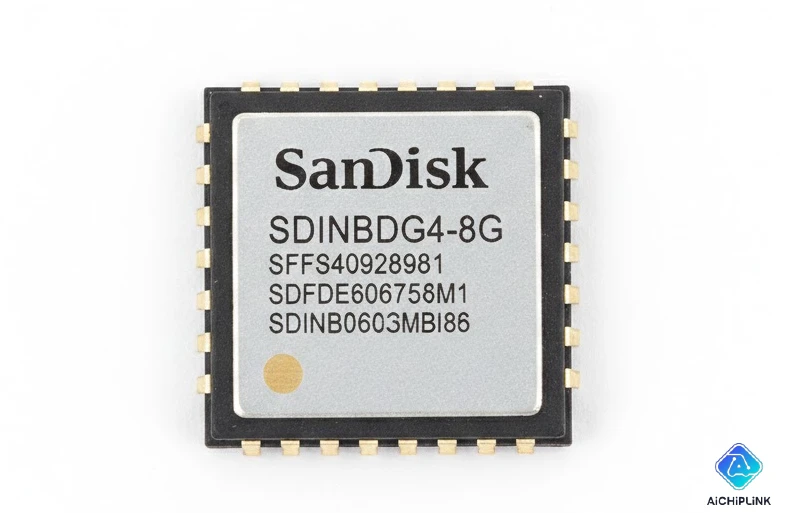
The SDINBDG4-8G is an 8GB embedded MultiMediaCard (eMMC) storage device manufactured by SanDisk (now part of Western Digital, a global leader in flash storage technology. This chip integrates NAND flash memory with a built-in controller in a compact BGA package, providing a complete storage subsystem optimized for embedded applications in automotive infotainment, industrial IoT, consumer electronics, and enterprise edge computing.
According to Yole Development's 2024 embedded storage report, eMMC continues to serve critical roles in embedded markets despite UFS adoption in premium smartphones, with eMMC maintaining dominant positions in automotive (65% share), industrial IoT (80% share), and entry-level consumer electronics due to proven reliability, cost-effectiveness, and broad ecosystem support.
In this comprehensive technical guide, you'll discover the SDINBDG4-8G's architecture, complete specifications, performance characteristics, real-world applications, implementation best practices, and competitive positioning to support informed storage selection for embedded system designs.
SDINBDG4-8G Technical Overview
The SDINBDG4-8G is a fully-integrated embedded flash storage solution combining NAND flash memory, controller, and firmware in a single package designed for soldered-down embedded applications.
Core Specifications Summary
| Parameter | Specification | Significance |
|---|---|---|
| Capacity | 8 GB | 8 gigabytes usable storage |
| Technology | eMMC 5.1 | Enhanced MultiMediaCard standard |
| Interface | eMMC 5.1 (HS400) | Up to 400 MB/s interface speed |
| NAND Type | MLC or TLC | Multi-level or triple-level cell |
| Package | 153-ball BGA | 11.5mm × 13mm footprint |
| Voltage | 3.3V I/O, 1.8V optional | Standard or low-voltage operation |
| Temperature | -25°C to 85°C | Automotive-grade range |
| Endurance | ~3,000 P/E cycles (MLC) | Program/erase cycle rating |
iNAND Brand Overview
SanDisk's iNAND branding represents:
Product Line:
- Embedded flash storage solutions
- Automotive and industrial focus
- Integrated controller and firmware
- Proven reliability and qualification
Market Position:
- Leading eMMC supplier globally
- Strong automotive presence (Tier-1 relationships)
- Industrial IoT focus
- Consumer electronics heritage
Technology Leadership:
- In-house NAND fabrication (Western Digital fabs)
- Advanced controller design
- Sophisticated firmware algorithms
- Long-term support commitment
Part Number Decoder
Understanding SanDisk nomenclature:
SDINBDG4-8G breakdown:
- SD = SanDisk
- INBD = iNAND series designation
- G4 = Generation/product family
- -8G = Capacity (8 gigabytes)
Key Features
Integrated Solution:
- NAND flash + controller + firmware in one package
- No external components required
- Simplified PCB design
- Reduced BOM cost
Automotive Qualification:
- AEC-Q100 Grade 2 capable (-40°C to +105°C extended temp)
- Vibration and shock tested
- High reliability for automotive environments
- Suitable for infotainment, instrument clusters, ADAS
Advanced Features:
- Wear leveling: Extends NAND lifetime
- Bad block management: Automatic bad block handling
- ECC (Error Correction): Multi-bit error correction
- Power loss protection: Data integrity during power failure
- Secure erase: Cryptographic data erasure
- Write protection: Hardware write-protect support
eMMC Architecture and Technology
Understanding eMMC technology reveals how the SDINBDG4-8G achieves reliability, performance, and integration for embedded applications.
eMMC Standard Overview
eMMC (embedded MultiMediaCard) is a managed NAND storage standard:
| Standard | Max Speed | Features | Introduced |
|---|---|---|---|
| eMMC 4.5 | 200 MB/s (HS200) | Enhanced reliability | 2011 |
| eMMC 5.0 | 400 MB/s (HS400) | Command queuing | 2013 |
| eMMC 5.1 | 400 MB/s | Enhanced features | 2015 |
The SDINBDG4-8G implements eMMC 5.1 specification, providing:
- HS400 mode (400 MB/s theoretical)
- Enhanced strobe signaling
- Command queuing for improved performance
- Cache management features
Internal Architecture
The SDINBDG4-8G integrates three main components:
┌─────────────────────────────────────────────┐
│       SDINBDG4-8G Internal Architecture      │
├─────────────────────────────────────────────┤
│                                              │
│  ┌──────────────────────────────────────┐  │
│  │      NAND Flash Array (8GB)          │  │
│  │  - MLC or TLC NAND                   │  │
│  │  - Multiple planes                   │  │
│  │  - ECC per page                      │  │
│  └──────────────┬───────────────────────┘  │
│                 │                           │
│  ┌──────────────▼───────────────────────┐  │
│  │       Flash Controller               │  │
│  │  - Flash management                  │  │
│  │  - Wear leveling                     │  │
│  │  - Bad block management              │  │
│  │  - ECC engine                        │  │
│  └──────────────┬───────────────────────┘  │
│                 │                           │
│  ┌──────────────▼───────────────────────┐  │
│  │       eMMC Interface                 │  │
│  │  - CMD/DAT signals                   │  │
│  │  - HS400 support                     │  │
│  │  - Voltage translation               │  │
│  └──────────────────────────────────────┘  │
│                                              │
└─────────────────────────────────────────────┘
1. NAND Flash Array:
- 8GB capacity organized in blocks and pages
- MLC or TLC technology (multi-level or triple-level cell)
- Each cell stores 2 bits (MLC) or 3 bits (TLC)
- ECC metadata stored with each page
2. Flash Controller:
- Wear leveling: Distributes writes across NAND cells
- Bad block management: Remaps failed blocks automatically
- Garbage collection: Reclaims space from deleted data
- ECC engine: BCH or LDPC error correction
3. eMMC Interface:
- CMD line: Command signaling
- 8-bit DAT lines: Data transfer (DAT0-DAT7)
- CLK: Clock signal (up to 200 MHz)
- Strobe: Enhanced timing (HS400 mode)
Managed NAND Advantages
eMMC provides "managed" NAND versus raw NAND:
| Feature | eMMC (SDINBDG4-8G) | Raw NAND |
|---|---|---|
| Controller | Integrated | External required |
| Firmware | Built-in | Host implementation |
| Bad blocks | Auto-managed | Manual handling |
| Wear leveling | Automatic | Host responsibility |
| ECC | Hardware-accelerated | Software or controller |
| Complexity | Low (simple interface) | High (complex protocol) |
| Cost (low volume) | Lower total | Higher (controller + NAND) |
| Reliability | Proven, consistent | Depends on implementation |
Key Advantage: eMMC simplifies embedded storage implementation, reducing development time and risk.
NAND Technology
The SDINBDG4-8G likely uses MLC (Multi-Level Cell) NAND:
MLC Characteristics:
- 2 bits per cell (4 voltage levels)
- Endurance: ~3,000 P/E cycles typical
- Performance: Good read/write speeds
- Cost: Moderate (between SLC and TLC)
Possible TLC:
- Some capacity points may use TLC (3 bits/cell)
- Lower endurance (~1,000 P/E cycles)
- Higher density, lower cost
- Suitable for read-intensive applications
Wear Leveling Impact: With wear leveling, effective lifetime:
- MLC: 3,000 P/E × wear leveling factor (~10x) = ~30,000 effective cycles per logical block
- Translates to years of operation in typical use cases
Complete Technical Specifications
Let's examine the detailed specifications defining the SDINBDG4-8G's capabilities and operational parameters.
Storage Capacity
| Parameter | Value | Details |
|---|---|---|
| User Capacity | 8 GB | 7.45 GiB actual usable |
| Raw Capacity | ~8.59 GB | Before overhead |
| Reserved Area | ~7-10% | Over-provisioning, bad blocks |
| Sector Size | 512 bytes | Standard sector format |
| Total Sectors | ~15,633,408 | 512-byte sectors |
Note: Actual capacity slightly less than 8GB due to binary vs decimal notation and reserved areas.
Interface Specifications
eMMC 5.1 Interface:
- Bus Width: 1-bit, 4-bit, or 8-bit data
- Clock Frequency: Up to 200 MHz
- Voltage Levels:
- I/O: 3.3V ±10% or 1.8V ±10%
- VCC: 3.3V ±10% (may support 1.8V)
- VCCQ: I/O voltage (1.8V or 3.3V)
Supported Modes:
| Mode | Bus Width | Clock | Max Speed | Notes |
|---|---|---|---|---|
| Legacy | 1-bit | 26 MHz | 26 MB/s | Basic mode |
| HS (High Speed) | 4/8-bit | 52 MHz | 52 MB/s | Backward compatible |
| HS200 | 8-bit | 200 MHz | 200 MB/s | Single data rate |
| HS400 | 8-bit | 200 MHz | 400 MB/s | Double data rate + strobe |
Performance Specifications
Sequential Performance (typical):
- Read: 250-280 MB/s (HS400 mode)
- Write: 80-120 MB/s (varies by workload)
Random Performance (typical):
- Random read IOPS: 4,000-6,000 IOPS (4KB)
- Random write IOPS: 1,000-2,000 IOPS (4KB)
Latency:
- Read latency: <1ms typical
- Write latency: <5ms typical (depends on cache)
Note: Actual performance depends on host controller, workload pattern, and device state.
Reliability and Endurance
Endurance Specifications:
- Program/Erase Cycles: ~3,000 cycles (MLC typical)
- Data Retention: 10 years @ 25°C (post-endurance)
- Warranty: Typically 3-5 years for automotive/industrial
Reliability Metrics:
- MTBF: >1,000,000 hours
- Uncorrectable Bit Error Rate: <1 sector per 10^17 bits read
- Refresh: Automatic background data refresh
Wear Leveling:
- Global wear leveling across entire device
- Extends effective lifetime significantly
- Typical amplification: 5-10x nominal P/E cycles
Physical Specifications
Package:
- Type: 153-ball BGA (Ball Grid Array)
- Dimensions: 11.5mm × 13mm × 1.0mm (L × W × H)
- Ball Pitch: 0.5mm
- Weight: ~0.2 grams
Environmental:
- Operating Temperature: -25°C to +85°C (standard)
- Extended Temperature: -40°C to +105°C (automotive grade)
- Storage Temperature: -40°C to +125°C
- Humidity: 5-95% non-condensing
- Shock: 1,500 G (0.5ms duration)
- Vibration: 20 G (10-2,000 Hz)
Power Specifications
Voltage Requirements:
- VCC: 2.7V to 3.6V (3.3V nominal)
- VCCQ: 2.7V to 3.6V or 1.7V to 1.95V (I/O voltage)
Power Consumption (typical @ 3.3V):
- Active Read: 100-150 mA
- Active Write: 150-200 mA
- Standby: <1 mA
- Sleep Mode: <100 μA
Power Efficiency:
- Lower power than SSD (no DRAM cache)
- Suitable for battery-powered devices
- Multiple power states for optimization
Performance Analysis and Benchmarks
How does the SDINBDG4-8G perform in real-world applications? Let's examine performance characteristics and benchmarks.
Sequential Performance
Sequential Read:
- Best case (HS400): 280 MB/s
- Typical (HS400): 250-270 MB/s
- HS200 mode: 180-200 MB/s
Sequential Write:
- Best case: 120 MB/s (when cache available)
- Sustained: 80-100 MB/s (cache exhausted)
- Worst case: 40-50 MB/s (garbage collection active)
Performance Pattern:
Sequential Write Speed Over Time:

MB/s
120 |████████████▄▄▄▄
    |                ▄▄▄▄▄▄▄▄▄▄▄▄▄▄
 80 |                                ▄▄▄▄▄▄▄▄▄▄
    |                                            ▄▄▄▄▄
 40 |_______________________________________________
    0     1GB    2GB    3GB    4GB    5GB    6GB

Phase 1: Cache write (fast)
Phase 2: Cache flush + direct write (moderate)
Phase 3: Sustained write (steady-state)
Random Performance
4KB Random Operations:
| Operation | IOPS (typical) | Latency (avg) | Use Case |
|---|---|---|---|
| Random Read | 5,000 IOPS | 0.8ms | Database, metadata |
| Random Write | 1,500 IOPS | 3ms | Configuration, logs |
| Mixed (70R/30W) | 3,500 IOPS | 1.5ms | General embedded |
Random Performance Factors:
- Highly dependent on access pattern
- Write amplification affects performance
- Controller firmware optimization critical
Real-World Application Performance
Boot Time (Linux):
- Kernel load: 2-3 seconds
- Full boot to userspace: 8-12 seconds
- Faster than SD card, slower than NVMe SSD
Video Recording (1080p):
- Bitrate supported: 20-30 Mbps continuous
- 4K recording: Possible at lower bitrates (<100 Mbps)
- Suitable for automotive dashcam, security camera
Database Operations:
- SQLite read: Good performance
- SQLite write: Adequate (journaling impacts)
- Better with write-ahead-log (WAL) mode
Firmware Updates:
- 500MB update: ~6-8 seconds write time
- Verification read: ~2 seconds
- Total time: <15 seconds typical
Comparison with Other Storage
| Storage Type | Seq Read | Seq Write | Random IOPS | Cost | Best For |
|---|---|---|---|---|---|
| SDINBDG4-8G (eMMC) | 250 MB/s | 80 MB/s | 5K / 1.5K | $$ | Embedded |
| SD Card (Class 10) | 90 MB/s | 40 MB/s | 1K / 0.5K | $ | Removable |
| UFS 2.1 | 600 MB/s | 200 MB/s | 40K / 35K | $$$ | Premium mobile |
| SATA SSD | 550 MB/s | 500 MB/s | 90K / 80K | $$$$ | PC/enterprise |
SDINBDG4-8G Sweet Spot: Balanced performance for embedded applications at reasonable cost.
Application Scenarios
Where does the SDINBDG4-8G excel in embedded deployments? Let's examine specific use cases and requirements.
1. Automotive Infotainment
Applications:
- In-vehicle entertainment systems
- Navigation and mapping
- Digital instrument clusters
- Rear-seat entertainment
Requirements:
- Temperature: -40°C to +105°C extended range
- Vibration: Automotive shock/vibration specs
- Reliability: AEC-Q100 qualification
- Endurance: 5-10 year vehicle lifetime
SDINBDG4-8G Advantages:
- Automotive-grade temperature range
- Proven reliability in harsh environments
- Adequate capacity for maps, media, UI
- Cost-effective for volume automotive
Typical Configuration:
- 8GB for OS, navigation data, applications
- Paired with 16-32GB for media storage
- Connected via eMMC interface to automotive SoC
2. Industrial IoT and Edge Computing
Applications:
- Industrial gateways
- Edge computing nodes
- Manufacturing equipment controllers
- Building automation systems
Requirements:
- Reliability: 24/7 operation for years
- Temperature: Extended industrial range
- Data logging: Continuous write operations
- Firmware updates: OTA update capability
SDINBDG4-8G Fit:
- 8GB adequate for Linux + applications
- Wear leveling handles continuous logging
- Power-loss protection prevents corruption
- Standard eMMC interface (broad SoC support)
Use Case Example:
- Linux OS: 2GB
- Applications: 2GB
- Data logging: 3GB (circular buffer)
- Reserved: 1GB (over-provisioning)
3. Consumer Electronics
Applications:
- Set-top boxes
- Smart home hubs
- Digital signage players
- Streaming media devices
Requirements:
- Cost-sensitive: Competitive pricing critical
- Performance: Adequate for media streaming
- Compact: Small form factor
- Simple integration: Standard interface
SDINBDG4-8G Benefits:
- Cost-effective 8GB capacity
- Adequate performance for media playback
- Compact BGA package
- Simplified PCB design (integrated solution)
4. Medical Devices
Applications:
- Patient monitors
- Portable diagnostic devices
- Medical imaging systems (entry-level)
- Laboratory equipment
Requirements:
- Reliability: Critical for patient safety
- Data integrity: ECC, power-loss protection
- Longevity: 10+ year product lifecycle
- Regulatory: FDA/IEC compliance considerations
SDINBDG4-8G Appropriateness:
- High reliability (automotive-grade)
- Data integrity features (ECC, power-loss protection)
- Long-term availability from WD/SanDisk
- Note: Medical-specific qualification may be required
5. Point-of-Sale and Kiosks
Applications:
- POS terminals
- Self-service kiosks
- Ticketing machines
- ATMs (non-critical storage)
Requirements:
- Reliability: Deployed in field for years
- Security: Secure erase capability
- Tamper resistance: Physical security
- Update capability: Remote firmware updates
SDINBDG4-8G Features:
- Reliable operation in varied environments
- Secure erase for data sanitization
- Adequate capacity for POS applications
- Standard interface for easy integration
Application Suitability Matrix
| Application Domain | Suitability | Key Considerations |
|---|---|---|
| Automotive Infotainment | ⭐⭐⭐⭐⭐ | Temperature, vibration, AEC-Q100 |
| Industrial IoT | ⭐⭐⭐⭐⭐ | Reliability, endurance, 24/7 operation |
| Consumer Electronics | ⭐⭐⭐⭐ | Cost-effective, adequate performance |
| Medical Devices | ⭐⭐⭐⭐ | High reliability (regulatory considerations) |
| Smartphones | ⭐⭐ | UFS preferred for performance |
| High-Performance Computing | ⭐ | SSD/NVMe required |
Implementation and Integration Guide
How do you properly implement the SDINBDG4-8G in embedded hardware designs? Let's examine integration requirements and best practices.
PCB Design Guidelines
Schematic Design:
Host SoC          SDINBDG4-8G
┌─────────┐      ┌─────────┐
│         │      │         │
│  eMMC   │◄────►│  CMD    │ (Command)
│  Host   │◄────►│  CLK    │ (Clock)
│  Ctrl   │◄────►│  DAT0-7 │ (8-bit data)
│         │◄────►│  DS     │ (Data strobe, HS400)
│         │      │         │
│  VCC    │─────→│  VCC    │ (3.3V power)
│  VCCQ   │─────→│  VCCQ   │ (I/O voltage)
│  GND    │─────→│  GND    │ (Ground)
│         │      │         │
└─────────┘      └─────────┘
Signal Integrity:
- Impedance: 50Ω ±10% for CLK, CMD, DAT lines
- Trace length matching: DAT0-7 within ±5mm, CLK/CMD within ±10mm
- Route as controlled impedance: Use microstrip or stripline
- Avoid stubs: No via stubs on high-speed signals
Power Delivery:
- Decoupling: 10μF tantalum + 100nF ceramic near VCC/VCCQ pins
- Power plane: Dedicated or shared with low-noise supplies
- Current capacity: 200mA peak for VCC
- Ripple: <50mV p-p recommended
Layout Guidelines:
- Place SDINBDG4-8G close to host controller (<25mm ideal)
- Keep high-speed signals away from switching noise sources
- Use ground plane directly under eMMC signals
- Fanout pattern: Route from controller to eMMC with minimal vias
Software Integration
Linux Kernel Support:
eMMC is well-supported in Linux kernel:
# Device tree configuration example
emmc: mmc@1c0f000 {
    compatible = "allwinner,sun50i-a64-mmc";
    reg = <0x01c0f000 0x1000>;
    clocks = <&ccu CLK_BUS_MMC0>, <&ccu CLK_MMC0>;
    resets = <&ccu RST_BUS_MMC0>;
    interrupts = <GIC_SPI 60 IRQ_TYPE_LEVEL_HIGH>;
    bus-width = <8>;
    non-removable;
    cap-mmc-highspeed;
    cap-mmc-hw-reset;
    mmc-hs200-1_8v;
    status = "okay";
};
Driver Configuration:
- Use
mmc_blockandmmc_corekernel modules - Enable HS200/HS400 support in device tree
- Configure voltage (1.8V or 3.3V) appropriately
- Enable hardware reset if available
Partitioning Strategy:
SDINBDG4-8G Partition Example (8GB total):

┌──────────────┬──────────┬────────────┬─────────────┐
│   U-Boot     │  Kernel  │  RootFS    │  User Data  │
│   (4 MB)     │  (32 MB) │  (2 GB)    │  (5.9 GB)   │
└──────────────┴──────────┴────────────┴─────────────┘
  /dev/mmcblk0p1  p2         p3           p4
Filesystem Recommendations:
| Filesystem | Characteristics | Best For |
|---|---|---|
| ext4 | Full-featured Linux FS | General Linux embedded |
| F2FS | Flash-friendly FS | High write workloads |
| squashfs | Read-only compressed | Root filesystem (immutable) |
| FAT32 | Universal compatibility | Shared data, bootloader |
Boot Configuration
Boot Sequence:
- BootROM loads bootloader from eMMC boot partition
- Bootloader (U-Boot) loads kernel from eMMC
- Kernel mounts root filesystem from eMMC
- System boots to userspace
eMMC Boot Partitions:
- Boot0/Boot1: 4MB each (bootloader storage)
- RPMB: Replay Protected Memory Block (security)
- User Area: Main storage partition (7.4GB usable)
Configuration:
# Enable hardware boot partition (Linux)
echo 1 > /sys/block/mmcblk0boot0/force_ro  # Make writable
dd if=u-boot.bin of=/dev/mmcblk0boot0 bs=512  # Write bootloader
mmc bootpart enable 1 1 /dev/mmcblk0  # Enable boot from boot0
Firmware and OTA Updates
Update Strategies:
A/B Partitioning:
- Two complete system images (A and B)
- Update inactive partition, reboot to switch
- Rollback capability if update fails
- Requires 2x storage (4GB per image)
Delta Updates:
- Transfer only changed blocks
- Smaller download size
- Faster update process
- Requires update software (e.g., Mender, SWUpdate)
Security Considerations:
- Sign update images cryptographically
- Verify signature before applying
- Use eMMC secure erase for old data
- Enable RPMB for secure storage
Comparison with Alternative Solutions
How does the SDINBDG4-8G compare to alternative embedded storage options? Let's examine competitive positioning.
eMMC Capacity Comparison
| Product | Capacity | Interface | Temp Range | Target Market |
|---|---|---|---|---|
| SDINBDG4-8G | 8 GB | eMMC 5.1 | -25 to +85°C | Automotive, industrial |
| SDINBDG4-16G | 16 GB | eMMC 5.1 | -25 to +85°C | Higher capacity needs |
| SDINBDG4-32G | 32 GB | eMMC 5.1 | -25 to +85°C | Premium automotive |
| SDINBDG4-64G | 64 GB | eMMC 5.1 | -25 to +85°C | High-end infotainment |
Choosing Capacity:
- 8GB (SDINBDG4-8G): Entry-level systems, cost-sensitive
- 16GB: Mainstream automotive, moderate storage needs
- 32GB+: Premium infotainment, multiple OS images
eMMC vs UFS Comparison
| Feature | eMMC 5.1 (SDINBDG4-8G) | UFS 2.1 | Analysis |
|---|---|---|---|
| Max Read | 400 MB/s (HS400) | 800+ MB/s | UFS 2x faster |
| Max Write | 200 MB/s | 400+ MB/s | UFS 2x faster |
| Random IOPS | 5K / 1.5K | 40K / 35K | UFS 10x+ faster |
| Interface | Half-duplex (shared CMD/DAT) | Full-duplex (separate TX/RX) | UFS advantage |
| Command Queuing | Basic | Advanced (32 depth) | UFS better |
| Power | Lower | Higher | eMMC advantage |
| Cost | $$ | $$$ | eMMC 30-50% cheaper |
| Ecosystem | Mature, broad | Growing | eMMC wider support |
When to Choose eMMC (SDINBDG4-8G):
- ✅ Cost-sensitive designs
- ✅ Adequate performance for application
- ✅ Power efficiency priority
- ✅ Broad SoC compatibility needed
- ✅ Automotive/industrial (proven reliability)
When UFS Preferred:
- ✅ High-performance applications
- ✅ Premium smartphone segment
- ✅ Heavy multitasking workloads
- ✅ Budget accommodates premium
eMMC vs SD Card
| Aspect | eMMC (SDINBDG4-8G) | SD Card (Class 10) |
|---|---|---|
| Mounting | Soldered (permanent) | Socket (removable) |
| Reliability | Higher (no connectors) | Lower (wear, contact issues) |
| Performance | Better (direct connection) | Variable (card quality) |
| Cost (8GB) | Moderate | Lower |
| Replacement | Requires rework | User-replaceable |
| Best For | Embedded products | Prototyping, field upgrades |
Recommendation: Use eMMC for production embedded systems; SD cards for prototyping and user-accessible storage.
Competitive eMMC Alternatives
| Manufacturer | Part Number | Capacity | Speed | Notes |
|---|---|---|---|---|
| SanDisk/WD | SDINBDG4-8G | 8 GB | HS400 | Strong automotive presence |
| Samsung | KLMAG2GEND-B031 | 8 GB | HS400 | Market leader, premium quality |
| Micron | MTFC8GAKAJCN-4M | 8 GB | HS400 | Industrial/automotive focus |
| Kingston | EMMC08G-M325 | 8 GB | HS400 | Cost-competitive option |
| Toshiba | THGBMHG7A1LBAIL | 8 GB | HS400 | Reliable industrial grade |
SanDisk/WD (SDINBDG4-8G) Positioning:
- Strong automotive pedigree (Tier-1 relationships)
- Proven reliability track record
- Competitive pricing (mid-range)
- Good technical support and documentation
Conclusion
The SDINBDG4-8G represents SanDisk's proven embedded flash storage solution, delivering reliable eMMC 5.1 performance in a compact, integrated package optimized for automotive, industrial, and embedded applications. With 8GB capacity, HS400 interface support (400 MB/s), automotive-grade temperature range, and comprehensive reliability features, this device simplifies embedded storage implementation while providing the performance and durability required for demanding deployment environments.
Key Advantages:
✅ Integrated Solution: NAND + controller + firmware in single package
✅ Automotive Grade: -25°C to +85°C, AEC-Q100 capable
✅ Proven Reliability: Wear leveling, ECC, power-loss protection
✅ Adequate Performance: 250+ MB/s read, suitable for most embedded use
✅ Simplified Design: No external components, standard eMMC interface
✅ Cost-Effective: Lower TCO than implementing raw NAND solutions
For embedded system engineers designing automotive infotainment, industrial IoT engineers planning edge computing devices, or product managers specifying storage for consumer electronics, the SDINBDG4-8G delivers practical storage performance with proven reliability at competitive economics.
Ready to implement SDINBDG4-8G in your design? Visit AiChipLink.com for technical resources, reference designs, and expert consultation on embedded storage architecture and component selection.
Leverage proven eMMC technology for reliable embedded storage—the SDINBDG4-8G delivers performance and integration for modern embedded systems.

Written by Jack Elliott from AIChipLink.
AIChipLink, one of the fastest-growing global independent electronic components distributors in the world, offers millions of products from thousands of manufacturers, and many of our in-stock parts is available to ship same day.
We mainly source and distribute integrated circuit (IC) products of brands such as Broadcom, Microchip, Texas Instruments, Infineon, NXP, Analog Devices, Qualcomm, Intel, etc., which are widely used in communication & network, telecom, industrial control, new energy and automotive electronics.
Empowered by AI, Linked to the Future. Get started on AIChipLink.com and submit your RFQ online today!
Frequently Asked Questions
What type of storage is SDINBDG4-8G?
SDINBDG4-8G is an 8GB embedded eMMC 5.1 flash storage device.
What interface does SDINBDG4-8G use?
It uses the eMMC 5.1 interface with HS400 support.
What is the operating temperature range of SDINBDG4-8G?
The standard operating range is -25°C to +85°C.
Is SDINBDG4-8G suitable for automotive and industrial applications?
Yes. It is designed for automotive infotainment and industrial embedded systems.
Does SDINBDG4-8G include a built-in controller and error correction?
Yes. It integrates a flash controller with wear leveling and ECC.