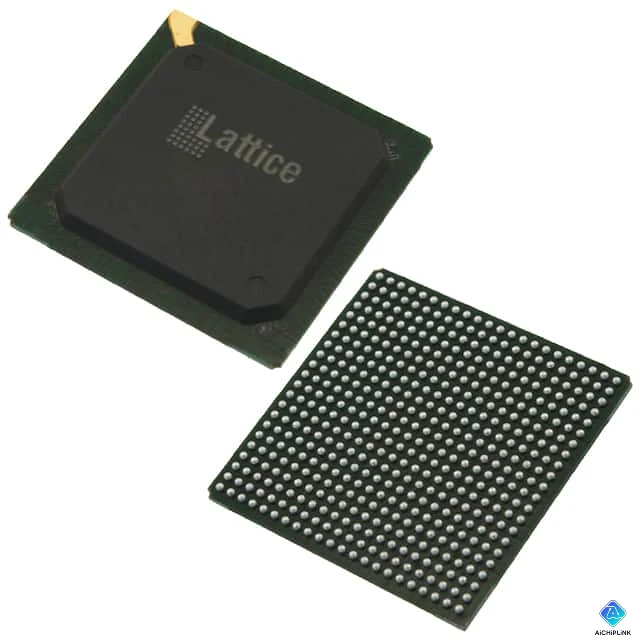
In the FPGA world, most devices are "amnesiacs"—they lose their configuration the moment you cut power. This requires an external boot chip (PROM) and creates a delay at startup while the data loads.
The Lattice LFXP2-40E-7FN484C breaks this rule.
As part of the LatticeXP2™ family, this chip combines the flexibility of an SRAM FPGA with the permanence of on-chip Flash. This makes it a Single-Chip Solution that turns on instantly, secures your IP, and saves precious PCB space.
Whether you are designing a system controller that needs to wake up before the CPU, or a secure industrial module, this guide covers the specs and advantages of the LFXP2-40E.
Table of Contents
- 1. Decoding the Part Number: Specs at a Glance
- 2. The Core Tech: flexFLASH Architecture
- 3. Security: Why Your IP is Safe
- 4. TransFR: Updating Without Downtime
- 5. Development Tools: Lattice Diamond
- 6. Conclusion
1. Decoding the Part Number: Specs at a Glance
Lattice part numbers are structured to tell you the density and speed immediately. Here is the breakdown for LFXP2-40E-7FN484C:
The Breakdown Matrix
| Segment | Code | Meaning |
|---|---|---|
| LFXP2 | LatticeXP2 | 2nd Generation Extreme Performance Non-Volatile Family. |
| 40 | Density | 40,000 LUTs (Look-Up Tables). The largest capability in the XP2 family. |
| E | Voltage | Standard Voltage (1.2V Core). |
| -7 | Speed Grade | High Performance. (-5 is slowest, -7 is the fastest standard grade). |
| FN | Package | fpBGA (Lead-Free / RoHS Fine Pitch BGA). |
| 484 | Pin Count | 484 Balls. |
| C | Temp | Commercial (0°C to 85°C). |
Procurement Tip: [Check Stock for LFXP2-40E-7FN484C at Aichiplink] to find verified inventory. This part is popular for its high logic density in a secure package.
2. The Core Tech: flexFLASH Architecture
The defining feature of this chip is flexFLASH.
Most FPGAs (like Xilinx Spartan or Intel Cyclone) are SRAM-based. They need an external Flash chip to load their "brain" at startup via SPI. The LatticeXP2 has Flash memory built directly onto the silicon die alongside the SRAM.
Benefit 1: Instant-On
The LFXP2-40E wakes up and starts working in milliseconds.
- Use Case: It is perfect for Power Management and System Reset logic. It can wake up, check voltage rails, and release the reset line for the main CPU before the CPU even knows what happened.
Benefit 2: Single-Chip Solution
You save:
- Board Space: No external SPI Flash chip required.
- BOM Cost: One less component to buy, inventory, and place.
- Routing: Frees up I/O pins that would normally be dedicated to booting.
3. Security: Why Your IP is Safe
Cloning is a major threat in consumer and industrial electronics. With a standard FPGA, a competitor can probe the traces between the external Flash chip and the FPGA to sniff and steal your bitstream design.
With the LFXP2-40E-7FN484C, the bitstream never leaves the chip.
- Internal Load: The configuration moves from internal Flash to internal SRAM. There are no external traces to sniff.
- FlashLock: You can permanently lock the readback interface, making it impossible to read the design out via JTAG.
- 128-bit AES: The bitstream can be encrypted for maximum security.
If you are building a proprietary algorithm or a secure crypto-module, this non-volatile architecture is significantly safer than standard FPGAs.
4. TransFR: Updating Without Downtime
In high-availability systems (like telecom servers or networking gear), you often cannot afford to turn the device off to update the firmware.
Lattice TransFR (Transparent Field Reconfiguration) technology allows you to:
- Program the internal Flash with a new design...
- ...while the SRAM is still running the old design.
- Trigger a refresh command to swap them instantly.
This minimizes downtime and allows for seamless field upgrades without interrupting critical background tasks.
5. Development Tools: Lattice Diamond
To design for the LFXP2-40E, you use Lattice Diamond Design Software.
- License: This part (40K LUTs) typically requires a licensed version of Diamond, unlike the smaller XP2 devices which might work with the free version. Always check the current Lattice licensing policy.
- Programming: Use the Lattice HW-USBN-2B (USB programming cable) to connect to the JTAG port.
- Legacy Support: It is also supported by the older ispLEVER Classic if you are maintaining very old projects.
6. Conclusion
The Lattice LFXP2-40E-7FN484C is the "Special Forces" of FPGAs. It isn't the biggest or the absolute fastest chip on the market, but it is self-contained, highly secure, and ready for action instantly. For designs requiring high logic density (40K LUTs) without the vulnerability and bulk of external configuration memory, the XP2 remains a top choice.
Sourcing Lattice FPGAs Need to secure your supply chain? Visit Aichiplink.com to search for the LFXP2-40E-7FN484C and other non-volatile FPGA solutions.

Written by Jack Elliott from AIChipLink.
AIChipLink, one of the fastest-growing global independent electronic components distributors in the world, offers millions of products from thousands of manufacturers, and many of our in-stock parts is available to ship same day.
We mainly source and distribute integrated circuit (IC) products of brands such as Broadcom, Microchip, Texas Instruments, Infineon, NXP, Analog Devices, Qualcomm, Intel, etc., which are widely used in communication & network, telecom, industrial control, new energy and automotive electronics.
Empowered by AI, Linked to the Future. Get started on AIChipLink.com and submit your RFQ online today!
Frequently Asked Questions
What makes the LFXP2-40E different from standard FPGAs?
It is a non-volatile FPGA with on-chip Flash, so it does not need an external configuration memory.
What does “Instant-On” mean for LFXP2-40E?
The FPGA becomes fully functional immediately after power-up, with no boot delay.
What is the core voltage of LFXP2-40E-7FN484C?
The core voltage is 1.2V, suitable for low-power and high-performance designs.
Is LFXP2-40E secure against bitstream copying?
Yes. It supports internal Flash loading, FlashLock, and AES encryption for IP protection.
Which software is used to program LFXP2-40E?
It is programmed using Lattice Diamond Design Software.