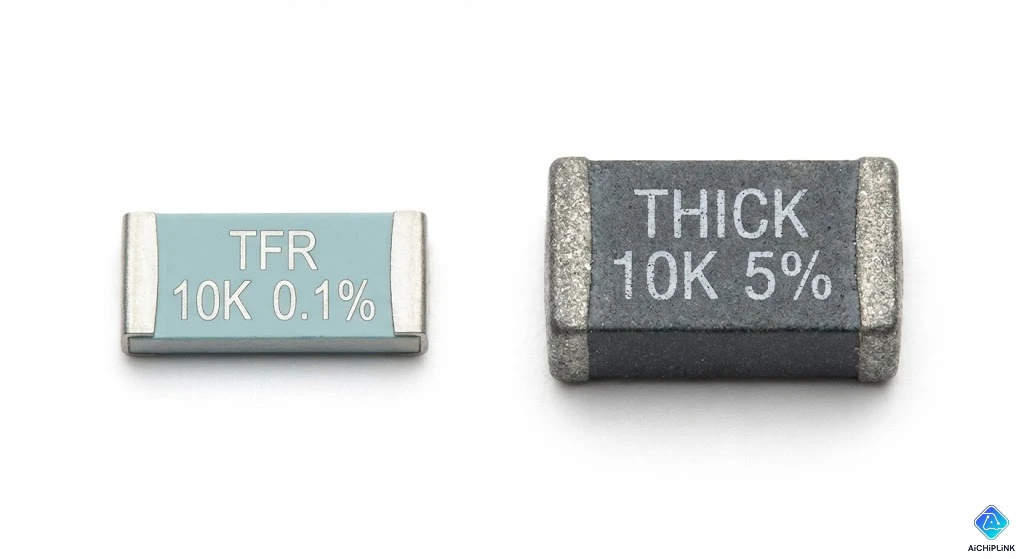
To the naked eye, a 10kΩ SMD resistor looks like any other 10kΩ SMD resistor. But peel back the epoxy coating, and you'll find two completely different worlds of physics.
The choice between Thin Film and Thick Film resistors is often the difference between a precision medical instrument and a cheap toy. One is built for accuracy and stability; the other is built for durability and cost.
If you are selecting components for a Bill of Materials (BOM), understanding the trade-offs is critical. This guide breaks down the manufacturing, performance, and application differences.
Table of Contents
- The Manufacturing Difference: Sputtering vs. Printing
- Performance Showdown: TCR, Noise, and Precision
- The Cost Factor
- When to Use Which? (Selection Guide)
- Conclusion
1. The Manufacturing Difference: Sputtering vs. Printing
The names "Thin" and "Thick" refer to the resistive layer's actual physical thickness, but the real story is how that layer gets there.
Thick Film: The "T-Shirt Printing" Method
Thick Film resistors are made using a Screen Printing process.
- Material: A paste mixture of glass frit and metal oxides (usually Ruthenium Oxide).
- Process: This paste is squeegeed through a mesh screen onto a ceramic substrate and then baked (fired) at 850°C.
- Thickness: ~100 µm (Micrometers).
- Result: A robust, glass-like resistive element. It’s cheap and fast to make.
Thin Film: The High-Tech Vacuum Method
Thin Film resistors are made using Vacuum Sputtering (Deposition).
- Material: A pure metal alloy, typically Nichrome (NiCr) or Tantalum Nitride.
- Process: In a vacuum chamber, the metal is bombarded with ions, causing atoms to eject and coat the ceramic substrate in a perfectly uniform layer.
- Thickness: ~0.1 µm (1000x thinner than thick film).
- Result: A highly uniform, dense metallic layer that allows for extreme precision laser trimming.
2. Performance Showdown: TCR, Noise, and Precision
Because Thin Film uses a pure metal alloy and Thick Film uses a glass-paste mix, their electrical properties differ wildly.
| Feature | Thin Film | Thick Film |
|---|---|---|
| Precision (Tolerance) | High (0.1%, 0.05%) | Standard (1%, 5%) |
| TCR (Temp Coefficient) | Stable (±5 to ±50 ppm/°C) | Drifty (±100 to ±200 ppm/°C) |
| Noise | Silent (Low Current Noise) | Noisy (Grainy structure creates noise) |
| High Frequency | Excellent (Low parasitic L/C) | Good |
| Surge / Pulse | Low (Thin mass heats up fast) | High (Thick mass absorbs heat) |
| Moisture Resistance | Good (with passivation) | Excellent (Glass-like nature) |
The "Gotcha" with Thick Film: The granular structure of the thick film paste creates Current Noise. For digital pull-up resistors, this doesn't matter. But in a high-gain audio amplifier or sensor front-end, a thick film resistor can introduce a hiss that ruins the signal.
3. The Cost Factor
- Thick Film: These are commodity parts. You can buy a reel of 5,000 for the price of a lunch. They are the default choice for 90% of the resistors on a standard PCB.
- Thin Film: These are premium parts. They can cost 10x to 100x more than thick film depending on the precision. You only pay for them when you need them.
4. When to Use Which? (Selection Guide)
Choose Thick Film If:
- Cost is King: You are building consumer electronics, toys, or general appliances.
- Function is Basic: Pull-up/down resistors, LED current limiting, or digital logic protection.
- High Power/Surge: Snubber circuits or areas prone to ESD spikes (the thicker mass survives pulses better).
Choose Thin Film If:
- Precision Matters: Setting the gain of an Op-Amp, voltage reference dividers, or ADC inputs.
- Low Noise is Critical: High-end audio equipment, medical ECG/EEG monitors.
- Environment Varies: Outdoor equipment where temperature swings would cause a thick film resistor to drift and change values (High TCR).
5. Conclusion
There is no "better" resistor—only the right tool for the job.
- Use Thick Film for the 95% of your board that just needs "a resistance."
- Save Thin Film for the critical signal paths where accuracy, stability, and low noise are non-negotiable.
Sourcing Resistors? Whether you need a reel of general-purpose Thick Film or high-precision 0.1% Thin Film, finding the right spec is easy. Visit Aichiplink.com to search for stock from major manufacturers like Yageo, Vishay, and Panasonic.

Written by Jack Elliott from AIChipLink.
AIChipLink, one of the fastest-growing global independent electronic components distributors in the world, offers millions of products from thousands of manufacturers, and many of our in-stock parts is available to ship same day.
We mainly source and distribute integrated circuit (IC) products of brands such as Broadcom, Microchip, Texas Instruments, Infineon, NXP, Analog Devices, Qualcomm, Intel, etc., which are widely used in communication & network, telecom, industrial control, new energy and automotive electronics.
Empowered by AI, Linked to the Future. Get started on AIChipLink.com and submit your RFQ online today!
Frequently Asked Questions
1. What is the main difference between thin film and thick film resistors?
Thin film resistors offer higher precision and stability, while thick film resistors focus on low cost and robustness.
2. Which resistor type has better accuracy?
Thin film resistors provide tighter tolerance and lower temperature drift (TCR).
3. Are thick film resistors noisy?
Yes, thick film resistors generate more electrical noise, which can affect sensitive analog circuits.
4. When should I use thick film resistors?
Use them for general-purpose circuits, such as pull-up resistors, LED limiting, and digital logic.
5. Are thin film resistors worth the higher cost?
Yes, when precision, low noise, or temperature stability is critical, thin film resistors are the better choice.