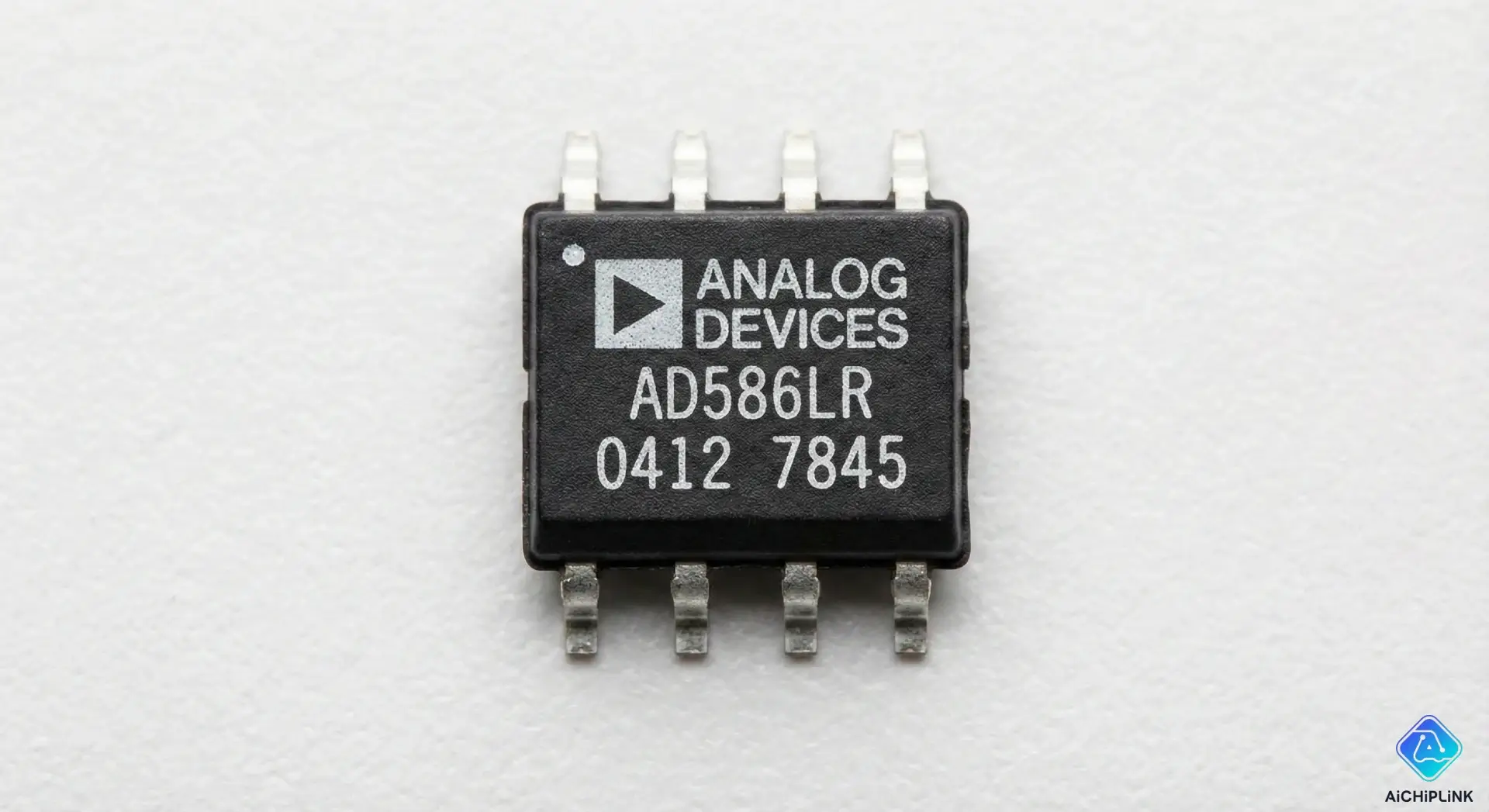
In the realm of precision analog electronics, the "reference" is the foundation upon which all measurements stand. The Analog Devices AD586LR is a legendary component in this space, known for providing a rock-solid 5.000 V output with exceptional stability.
Utilizing a proprietary buried Zener diode architecture, the AD586LR offers lower noise and drift compared to standard bandgap references. Whether you are designing a high-resolution 16-bit A/D converter system or calibrating industrial instrumentation, understanding the specific attributes of the "L" grade and "R" package is essential.
Table of Contents
- AD586LR Datasheet & Key Specifications
- SOIC-8 Pinout & PCB Configuration
- Circuit Design & Application Examples
- Conclusion
AD586LR Datasheet & Key Specifications
The AD586 series comes in various grades (J, K, L, M). The AD586LR specifically refers to the L-Grade in a standard SOIC-8 (Small Outline Integrated Circuit) package, indicated by the "R" suffix in Analog Devices' nomenclature.
Key Specifications Table
| Feature | Specification |
|---|---|
| Output Voltage | +5.000 V ± 2.5 mV |
| Temperature Coefficient (Drift) | 5 ppm/°C (Max) |
| Supply Voltage Range | +10.8 V to +36 V |
| Quiescent Current | 3.0 mA |
| Output Current Capacity | 10 mA |
| Noise (0.1 Hz to 10 Hz) | 4 µV p-p |
| Package | 8-Lead SOIC (R-8) |
Understanding the "L" Grade Accuracy
The "L" grade is one of the premium commercial tiers.
- Comparison: While the standard "J" grade has a drift of 25 ppm/°C, the AD586L offers a significantly tighter 5 ppm/°C maximum drift.
- Significance: For a system operating over a 50°C temperature span, an L-grade reference minimizes the error budget, ensuring reliable measurements without complex software calibration.
Price Analysis & Stock Availability
High-precision references like the AD586LR maintain steady demand.
Note: Precision analog parts often face lead time issues. [Check Stock for AD586LR at Aichiplink] to view real-time inventory from authorized global distributors.
SOIC-8 Pinout & PCB Configuration
The AD586LR uses a standard 8-pin SOIC pinout, but it includes special function pins that are critical for maximizing performance.
Pin Function Map
- Pin 1 (NC): No Connect.
- Pin 2 (VIN): Input Voltage (+10.8V to +36V).
- Pin 4 (GND): Ground.
- Pin 5 (TRIM): Fine output adjustment.
- Pin 6 (VOUT): +5V Output.
- Pin 8 (NR): Noise Reduction.
The Noise Reduction Pin (Pin 8)
One of the standout features of the AD586 is the NR pin.
- Function: By connecting a 1 µF capacitor between Pin 8 and Ground, you can form a low-pass filter with the internal resistance.
- Result: This significantly reduces high-frequency wideband noise, which is crucial for preventing bit-flipping in sensitive 14-bit or 16-bit ADC applications.
Fine-Trimming the Output Voltage
Although the AD586LR is laser-trimmed at the factory, some applications require absolute precision to match a specific system requirement.
- Circuit: Connect a 10kΩ potentiometer between the Output (Pin 6) and Ground, with the wiper connected to the TRIM (Pin 5) through a large resistor (approx 100kΩ).
- Adjustment: This allows for a narrow adjustment range of ±15 mV to calibrate out system offset errors.
Circuit Design & Application Examples
Standard 5V Source Connection
Integrating the AD586LR is straightforward:
- Connect a clean supply (>10.8V) to Pin 2.
- Place a 0.1 µF bypass capacitor close to Pin 2.
- Connect Pin 4 to a star ground point.
- Important: If driving a capacitive load (like a long cable or a large decoupling cap >0.1 µF on the output), check stability. The AD586 is stable with capacitive loads, but excessive capacitance may slow down transient response.
Comparison: AD586 vs. REF02
Engineers often decide between the AD586 and the classic REF02.
- REF02: Standard bandgap, higher noise, usually higher drift (10-25 ppm/°C for standard grades). Includes a "TEMP" output pin.
- AD586: Buried Zener architecture, lower noise, lower drift, and capable of sourcing more current (10mA). It is the superior choice for high-precision metrology.
Conclusion
The AD586LR remains a gold standard for 5V voltage references. Its combination of the "L" grade precision drift characteristics and the noise reduction capability makes it indispensable for precision circuit design.
Looking for high-precision voltage references? Ensure your measurements are accurate by sourcing authentic components. Visit Aichiplink.com to search for AD586LR and other Analog Devices precision parts.

Written by Jack Elliott from AIChipLink.
AIChipLink, one of the fastest-growing global independent electronic components distributors in the world, offers millions of products from thousands of manufacturers, and many of our in-stock parts is available to ship same day.
We mainly source and distribute integrated circuit (IC) products of brands such as Broadcom, Microchip, Texas Instruments, Infineon, NXP, Analog Devices, Qualcomm, Intel, etc., which are widely used in communication & network, telecom, industrial control, new energy and automotive electronics.
Empowered by AI, Linked to the Future. Get started on AIChipLink.com and submit your RFQ online today!
Frequently Asked Questions
What is the minimum input voltage for AD586LR?
The AD586 requires a "headroom" of approximately 5.8V. Therefore, the minimum input supply voltage is **+10.8 V** to maintain a regulated +5.000 V output.
Can the AD586LR sink current?
The AD586 is primarily designed to **source** current (up to 10 mA). It has very limited current sinking capability. If your load requires sinking, an external buffer op-amp is recommended.
What is the difference between AD586AR and AD586LR?
The difference lies in the accuracy grade. * **A-Grade**: 20 mV initial error, 25 ppm/°C drift. * **L-Grade**: 2.5 mV initial error, 5 ppm/°C drift. The "R" in both denotes the SOIC-8 package.
Does the AD586LR require an output capacitor?
No, it does not strictly require an output capacitor for stability, unlike some LDOs. However, a small decoupling capacitor (0.1 µF) is often used to buffer transient load steps.
Why use a Buried Zener reference over a Bandgap?
Buried Zener references like the AD586 generally offer lower noise and better long-term stability than Bandgap references, making them ideal for high-end instrumentation, though they typically require higher supply voltages (headroom).