Understanding the Difference Between Capacitor and Capacitance
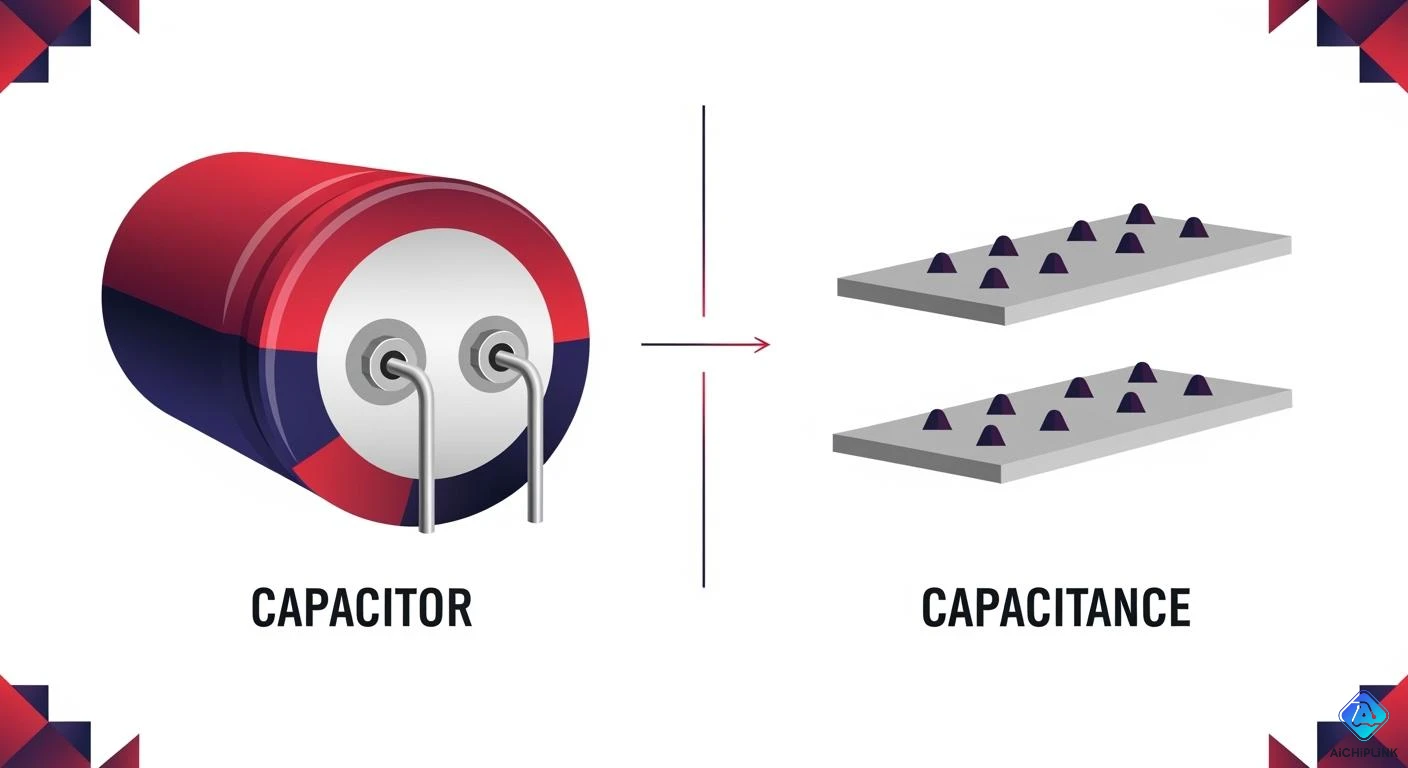
You should know that a capacitor is a real device. Capacitance means how much charge the device can hold. Capacitors and capacitance are both important in electronics. Knowing the difference helps you pick the right parts for circuits.
-
The right capacitor helps store energy.
-
Good capacitance makes signal filtering better.
-
Changing capacitance changes timing in circuits.
Key Takeaways
-
A capacitor is a device that holds electric charge. Capacitance tells us how much charge it can keep at a certain voltage.
-
Picking the right capacitor is very important for your circuit. Always check the type and capacitance before you choose one.
-
Capacitance changes how well a capacitor can filter signals. It also changes how much energy it can store. If capacitance is higher, it can hold more charge.
-
There are different types of capacitors for different jobs. Electrolytic capacitors are good for storing energy. Ceramic capacitors are better for high-frequency uses.
-
Knowing the difference between capacitors and capacitance helps you make better circuits. It also helps you not make mistakes in electronics.
What Is a Capacitor?
Capacitor Definition
A capacitor is a part used in electronics to hold electric charge. It has two metal plates with a material called a dielectric between them. The plates can be made from metals like aluminum or tantalum. The dielectric can be ceramic, plastic film, paper, or a thin oxide layer. This setup lets the capacitor keep charge and give it out when needed. You can find capacitors in almost every electronic device.
How a Capacitor Works
When you connect a capacitor to power, electrons move onto one plate and leave the other. This makes a difference in charge between the plates. The capacitor holds the charge until its voltage matches the power source. The dielectric keeps the charge apart and stops current from going straight through. In a circuit, the capacitor can charge, block direct current, and let alternating current pass.
Tip: Capacitors are helpful for storing energy, filtering signals, and timing in circuits.
Role in Circuits
Capacitors do many important things in circuits:
-
They store energy for quick use, like in camera flashes.
-
They filter and smooth out voltage in power supplies.
-
They help reduce noise in microcontrollers and chips.
-
They set delays or control blinking lights and alarms.
-
They help tune radios or pick audio frequencies.
Here are some types of capacitors you might see:
| Type of Capacitor | Description |
|---|---|
| Polarized Capacitors | Need correct polarity; includes electrolytic and tantalum. |
| Non-Polarized Capacitors | Work in any direction; includes ceramic, film, and mica. |
| Fixed Capacitors | Have one set value; used in many circuits. |
| Variable Capacitors | Can change value; used for tuning. |
| Ceramic | Small, used for high-frequency jobs. |
| Film | Stable and reliable, used in audio and precise circuits. |
| Electrolytic | High capacitance, smooths power supply. |
| Tantalum | Small and stable, good for mobile and medical devices. |
| Mica, Paper, Polymer, Glass | Used for special or high-performance needs. |
Units and Symbols
Capacitors store charge measured in farads (F). Most are much smaller than one farad:
| Prefix Name | Abbreviation | Equivalent Farads |
|---|---|---|
| Picofarad | pF | 0.000000000001 F |
| Nanofarad | nF | 0.000000001 F |
| Microfarad | µF | 0.000001 F |
In circuit drawings, you see different capacitor symbols:
-
Two lines for a fixed capacitor.
-
A straight and a curved line for a polarized capacitor.
-
Two lines with an arrow for a variable capacitor.
Now you know a capacitor is important in circuits. It helps store charge and control how circuits work.
What Is Capacitance?
Capacitance Definition
Capacitance is how much charge a device can store. It shows how much charge fits for a certain voltage. In science, you use the formula C = q/V. C means capacitance, q means charge, and V means voltage. Capacitance changes with the shape and size of the plates. It also depends on the material between them. For a parallel plate capacitor, the formula is C = εA/d. Here, ε is the permittivity of the material. A is the plate area. d is the distance between plates.
What Capacitance Measures
Capacitance tells how well a capacitor stores charge. When you add voltage, the plates hold charge. Capacitance is the property that lets this happen. You find it by dividing charge by voltage. The unit for capacitance is farads. A high capacitance means more charge for the same voltage.
Note: Capacitance helps you pick the right capacitor for your circuit.
Units of Capacitance
The farad is the main unit for capacitance. Most capacitors are much smaller than one farad. You often see microfarads, nanofarads, or picofarads.
| Unit | Symbol | Factor |
|---|---|---|
| Farad | F | 1 |
| Microfarad | μF | 10⁻⁶ |
| Nanofarad | nF | 10⁻⁹ |
| Picofarad | pF | 10⁻¹² |
Factors Affecting Capacitance
Many things change capacitance in a capacitor:
-
Bigger plates give more capacitance.
-
Smaller gaps between plates increase capacitance.
-
Better dielectric materials raise capacitance.
-
The type of capacitor changes the value.
-
The voltage rating affects how much charge it can store.
If you make the plates bigger, capacitance goes up. If you make the plates closer, capacitance also goes up. The dielectric material is important too. Ceramic capacitors use barium titanate for high capacitance. High-voltage capacitors need thicker dielectrics, which lowers capacitance. You need to think about all these things when you choose a capacitor.
Capacitors and Capacitance Compared
Capacitor vs. Capacitance
When you work with electronics, you should know the difference between capacitors and capacitance. These words sound alike, but they are not the same thing. The table below shows how they are different:
| Aspect | Capacitor | Capacitance |
|---|---|---|
| Definition | A physical component that stores electric charge | A measure of a capacitor's ability to store charge relative to voltage |
| Function | Used to store electric energy, block direct current, allow alternating current, couple signals, and more | Tells you how much charge can be stored per unit voltage |
| Measurement | Measured in farads (F) | Calculated using the formula q = cv |
| Role in Circuits | Acts as a device in circuits for energy storage, filtering, and timing | Describes the property that lets a capacitor store charge |
A capacitor is a real part you put in a circuit. Capacitance tells how well that part can hold charge. Both use farads for measurement, but a capacitor is something you can touch. Capacitance is a property you can measure.
Tip: To pick the right part for your project, check both the type of capacitor and its capacitance value.
Here are some main things to remember about capacitors and capacitance:
-
Capacitors are real parts that store electric charge.
-
Capacitance is how much charge a capacitor can hold at a certain voltage.
-
You use capacitors for smoothing power, filtering signals, and timing.
-
Capacitance tells how much energy you can store for your needs.
Examples
Let’s look at some examples to help you see the difference:
-
A radio has a capacitor inside. It might have a capacitance of 100 nanofarads. This means it can hold a certain amount of charge when you add voltage.
-
If you use a variable air capacitor in a radio, you can change its capacitance by turning a knob. This helps you tune to different stations.
-
An electrolytic capacitor in a power supply might have a high capacitance, like 1.0 farad. You use this to smooth out voltage changes.
-
Two capacitors can look the same on the outside, but one might have a higher capacitance. This happens if it has bigger plates, a smaller gap, or a better material inside.
-
In a timing circuit, you need a certain capacitance to set how long a light stays on. You pick a capacitor with the right value to get the timing you want.
Note: When you design a circuit, you must pick the right capacitor for the job. You check the capacitance to make sure it can store enough charge for what you need.
You see capacitors and capacitance in many devices. Radios, TVs, computers, and cars all use them. You can also find them in backup power systems, audio equipment, and microwaves for timing. The value of capacitance changes how each device works.
If you look inside a capacitor, you see two metal plates with an insulator between them. The size of the plates, the space between them, and the material in the middle all change the capacitance. Bigger plates or a better material let you store more charge.
Now you know capacitors and capacitance are not the same. You use a capacitor as a part, and you use capacitance to see how well it works.
Why the Difference Matters
Practical Importance
It is important to know the difference between a capacitor and capacitance. This helps you make good choices in electronics. When you pick a capacitor, you need to know how much energy it can hold. Capacitance tells you this amount. If you choose the wrong capacitance, your circuit might not work right. For example, too much capacitance in a high-frequency circuit can cause trouble. The circuit might not be stable or could lose power. You might see problems like resonance or higher impedance. These issues make fixing the circuit harder.
Capacitors are used for storing energy, filtering signals, and keeping circuits steady. The right capacitance helps you handle signals and store energy safely. If you mix up the words, you might pick the wrong part. This mistake can waste your time and money. Your device works better when you match the right capacitor and capacitance to your project.
Here is a table that shows how knowing the difference helps your device:
| Term | Definition | Role in Device Performance |
|---|---|---|
| Capacitor | An electronic component that stores electric charge. | Used for energy storage, signal coupling, filtering, and circuit stability. |
| Capacitance | A measure of a capacitor's ability to store charge per unit voltage. | Influences how much energy can be stored and how effectively signals can be processed. |
When you understand these ideas, you get better at fixing and building circuits. Teachers use hands-on lessons to help you learn about capacitors and capacitance. These lessons help you find and fix problems in circuits.
Common Misunderstandings
Many students think capacitors store current. But capacitors really store energy. Current only moves when charging or discharging. This mistake can make it hard to understand how capacitors work.
Some people think all capacitors are the same. But there are many types of capacitors. Each type acts differently with changes in frequency and temperature.
You can avoid these mistakes by learning the right meanings. You also learn how to talk about energy storage, find capacitance, and tell capacitor types apart. Teachers use experiments and simple explanations to help you understand. You feel more sure about electronics when you know the difference between capacitor and capacitance.
You have learned that a capacitor is a real thing you can touch. Capacitance tells how much charge the capacitor can keep.
-
Use the correct words when you talk about electronics.
-
Always look at the type and value before picking a capacitor.
Remember: Knowing these words helps you make better circuits. Try using what you learned in your next project or class.

Written by Jack Elliott from AIChipLink.
AIChipLink, one of the fastest-growing global independent electronic components distributors in the world, offers millions of products from thousands of manufacturers, and many of our in-stock parts is available to ship same day.
We mainly source and distribute integrated circuit (IC) products of brands such as Broadcom, Microchip, Texas Instruments, Infineon, NXP, Analog Devices, Qualcomm, Intel, etc., which are widely used in communication & network, telecom, industrial control, new energy and automotive electronics.
Empowered by AI, Linked to the Future. Get started on AIChipLink and submit your RFQ online today!
Frequently Asked Questions
What is the main difference between a capacitor and capacitance?
A capacitor is a real part you can touch. Capacitance is a property that shows how much charge it can hold. Both are used in electronics, but they are not the same.
Can two capacitors have the same size but different capacitance?
Yes! Two capacitors can look the same but store different amounts of charge. The inside material and the space between plates change how much charge they hold.
Why do you need to know the capacitance value?
You need to know the capacitance value to choose the right part. The value tells you how much energy it can store. It also shows how it will change timing or filtering in your circuit.
How do you read the value on a capacitor?
You usually see numbers and letters on the capacitor. These show the capacitance value, like microfarads (μF), nanofarads (nF), or picofarads (pF). Some use color bands or a three-digit code.
Do all capacitors work the same way in every circuit?
No. Different types of capacitors work best in different circuits. For example, ceramic capacitors are good for high frequencies. Electrolytic capacitors store more energy but are better for low-frequency circuits.