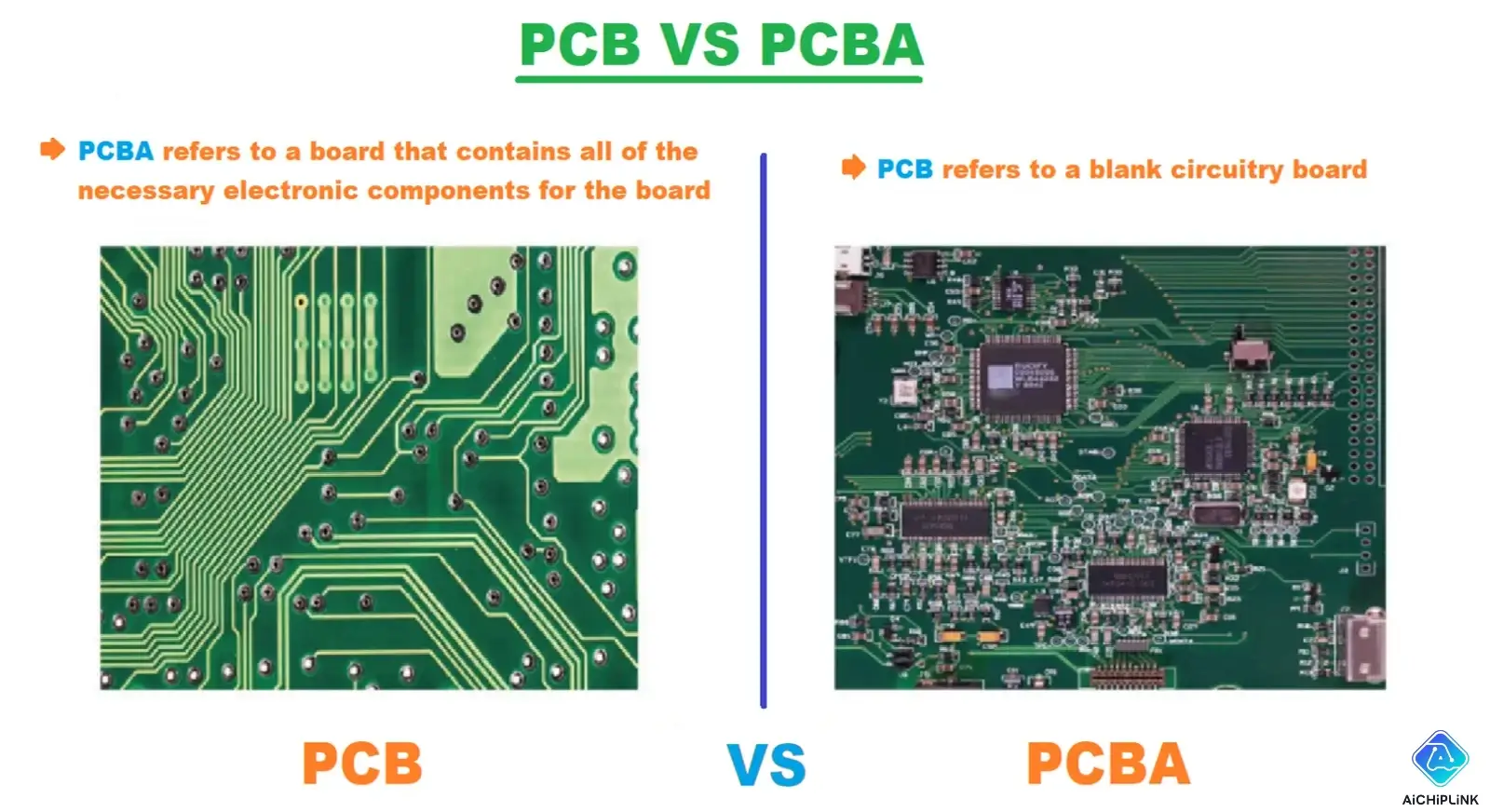
If you are new to the world of electronics manufacturing, you will see two acronyms thrown around constantly: PCB and PCBA.
They sound similar. They look related. But in the supply chain, they refer to two completely different stages of a product's life. Confusing them can lead to ordering empty boards when you needed a finished product, or sending incomplete files to your manufacturer.
In simple terms:
- PCB is the Blank Canvas.
- PCBA is the Finished Painting.
This guide explores the technical differences, the manufacturing processes involved, and what you need to know when sourcing parts for your next project.
Table of Contents
- The Short Answer: The Foundation vs. The House
- What is a PCB? (The Bare Board)
- What is PCBA? (The Functional Product)
- The Assembly Process: SMT vs. THT
- Key Differences Matrix
- Why This Matters for Manufacturing
- Conclusion
1. The Short Answer: The Foundation vs. The House
Think of electronics manufacturing like building a city.
- The PCB (Printed Circuit Board) is the land with paved roads (copper traces) and designated plots (pads). It defines where everything goes and how they connect, but it is empty. No one lives there yet.
- The PCBA (Printed Circuit Board Assembly) is the city after the buildings (components) have been constructed. Now, the "traffic" (electricity) can flow, and the city actually functions.
You cannot have a PCBA without a PCB.
2. What is a PCB? (The Bare Board)
PCB stands for Printed Circuit Board. It provides the mechanical support and electrical connections for the circuit.
Key Composition:
- Substrate (FR4): The rigid, fiberglass core that gives the board its structure.
- Copper Layers: The conductive pathways (traces) etched onto the board that carry electricity.
- Solder Mask: The iconic green (or blue/black) coating that insulates the copper and prevents short circuits.
- Silkscreen: The white text and symbols printed on top to label component locations (e.g., "R1", "C1", "LED1").
At this stage, the board is essentially a passive skeleton. It does nothing on its own.
3. What is PCBA? (The Functional Product)
PCBA stands for Printed Circuit Board Assembly. This is the process—and the result—of populating the bare PCB with electronic components.
Once resistors, capacitors, integrated circuits (ICs), and connectors are soldered onto the PCB, it becomes a PCBA. This is the "motherboard" inside your computer or the green card inside your USB drive.
The Goal: To create a fully functional electronic device that can pass Logic/Functional testing.
4. The Assembly Process: SMT vs. THT
How does a bare board become a PCBA? It goes through one (or both) of these assembly methods:
1. SMT (Surface Mount Technology)
This is the modern standard for 90% of components.
- The Components: Tiny devices (SMDs) with no legs, designed to sit flat on the board.
- The Process:
- Solder Paste Printing: Stenciling paste onto the pads.
- Pick and Place: A robotic machine places components at high speed.
- Reflow Soldering: The board goes into an oven where the paste melts and fuses the parts.
2. THT (Through-Hole Technology)
Used for older components or heavy-duty parts that need strong mechanical bonding (like USB ports or large capacitors).
- The Components: Have long metal leads (legs).
- The Process: The leads are inserted through holes in the board and soldered from the bottom, often using Wave Soldering machines.
5. Key Differences Matrix
| Feature | PCB (Bare Board) | PCBA (Assembled Board) |
|---|---|---|
| Definition | Printed Circuit Board (Empty) | PCB + Assembly (Finished) |
| Components | None (Just Copper & FR4) | Resistors, ICs, Chips, Connectors |
| Functionality | Non-functional (Structure only) | Fully Functional Electronic Device |
| Manufacturing | Etching, Drilling, Plating | Solder Paste, Pick & Place, Reflow |
| Files Needed | Gerber Files | Gerber + BOM + CPL (Pick & Place) |
| Cost | Low (Material cost) | High (Components + Labor + Testing) |
6. Why This Matters for Manufacturing
Understanding this distinction saves you money and headaches when talking to suppliers.
1. File Requirements
- If you order a PCB, you only need to send the Gerber Files (layout drawings).
- If you order PCBA (Turnkey Service), you must also provide the BOM (Bill of Materials). This is the shopping list of every component (Part Number, Quantity, Value) that needs to be bought and soldered.
2. Cost Estimation
- PCB Cost: Determined by size, layers, and quantity.
- PCBA Cost: Determined by the number of solder pads, the cost of the components (BOM cost), and testing requirements. The components are usually the most expensive part of the PCBA.
3. Sourcing Strategy
Many engineers source the PCB from one factory and the components from a distributor (like Aichiplink), then send them to an assembly house. This is called Kitted Assembly. Alternatively, Turnkey Assembly is when the manufacturer buys everything for you.
7. Conclusion
While PCB and PCBA are often used interchangeably in casual conversation, they represent the start and finish line of electronics manufacturing. The PCB is the custom-designed skeleton; the PCBA is the living, breathing device powered by the components you select.
Sourcing Components for Your PCBA? Whether you are building a prototype or running mass production, the quality of your PCBA depends on the quality of your chips. Visit Aichiplink.com to search for reliable ICs, Microcontrollers, and Passives for your Bill of Materials.

Written by Jack Elliott from AIChipLink.
AIChipLink, one of the fastest-growing global independent electronic components distributors in the world, offers millions of products from thousands of manufacturers, and many of our in-stock parts is available to ship same day.
We mainly source and distribute integrated circuit (IC) products of brands such as Broadcom, Microchip, Texas Instruments, Infineon, NXP, Analog Devices, Qualcomm, Intel, etc., which are widely used in communication & network, telecom, industrial control, new energy and automotive electronics.
Empowered by AI, Linked to the Future. Get started on AIChipLink.com and submit your RFQ online today!
Frequently Asked Questions
What is the main difference between PCB and PCBA?
A PCB is a bare circuit board, while a PCBA is the PCB with electronic components assembled and soldered.
Can a PCB work without assembly?
No. A PCB alone is non-functional until components are mounted and soldered to form a PCBA.
Is PCBA more expensive than PCB?
Yes. PCBA costs more because it includes components, assembly labor, and testing, not just the board.
What files are required for PCBA manufacturing?
PCBA requires Gerber files, BOM (Bill of Materials), and Pick-and-Place (CPL) files.
Are PCB and PCBA interchangeable terms?
No. They refer to different stages of electronics manufacturing and should not be used interchangeably.