What are Graphene Transistors?
Imagine an electronic switch that is as thin as an atom, very fast, and bendable. This is the promise of graphene transistors. A graphene transistor is a switch made from a single layer of carbon atoms. This material, called graphene, conducts electricity with great efficiency. You might wonder why graphene matters. Its speed and flexibility could be better than silicon in future devices. This article explains how graphene transistors work, why they make engineers excited, and what problems remain. You will learn about the unique structure of this carbon material. You will also discover how it can be used in bendable electronics. The path from lab to your device takes time, but graphene promises a big change in computing power and energy savings.
Key Takeaways
-
Graphene transistors use a single layer of carbon atoms for very fast electron movement.
-
They provide high speed, flexibility, and low power use, perfect for future electronics.
-
The main challenge is that graphene lacks a band gap, so it is hard to turn off completely.
-
Researchers are making progress, with recent breakthroughs in creating working graphene semiconductors.
-
Graphene might take the place of silicon in gadgets, making tech that is quicker, flexible, and uses less power.
Unique Properties of Graphene
Atomic Structure of a Wonder Material
Imagine graphene as a single layer of carbon atoms in a honeycomb pattern. Each carbon atom connects to three neighbors. This forms a hexagonal lattice that looks like chicken wire. This structure gives graphene its special properties. The whole sheet is extremely thin. That makes it the thinnest material known to science.
The way carbon atoms are arranged gives graphene amazing electrical conductivity. Electrons move through the graphene lattice with almost no resistance. This movement happens faster than in any other known material. The carbon bonds are very strong, too. Each bond holds the lattice together with great stability.
Speed, Strength, and Flexibility
Graphene's electrical conductivity is special among all materials. Electrons travel through graphene at very high speeds. This property makes graphene perfect for high-speed transistors. The material also conducts heat very well. Its thermal conductivity is notably high.
The mechanical strength of graphene amazes many people. A sheet of graphene is exceptionally strong, yet it stays flexible. You can bend, stretch, and fold graphene without breaking it. These properties make graphene a unique material.
The mix of strength and flexibility creates new possibilities. You could make bendable screens or wearable sensors. Graphene's transparency adds another useful property. A single layer absorbs only a small fraction of light. This transparency, together with conductivity, makes it good for touchscreens and solar cells.
These properties of graphene come directly from its atomic structure. The carbon lattice provides both strength and electron movement. No other material combines these features so completely. Engineers see graphene as a base for future electronics. The properties of graphene promise devices that are faster, thinner, and more flexible than today's technology.
How Graphene Transistors Work
Structure of a GFET
A graphene field-effect transistor, or GFET, has a simple setup. You put a strip of graphene between two electrodes. These electrodes are the source and the drain. The graphene strip works as the channel. The channel is very short. Electric charges move through it very fast.
The gate electrode sits above or below the channel. You put a voltage on this gate. That voltage makes an electric field. This field controls how charges flow from source to drain. Think of the gate like a faucet handle. You turn it to let more or less water flow. The gate works the same way for electric current.
Graphene has a high surface area compared to its volume. This makes the channel very sensitive. Small changes on the graphene surface can change the current flow. You get fine control over the transistor with this sensitivity. The gate voltage can adjust the channel's conductivity very precisely.
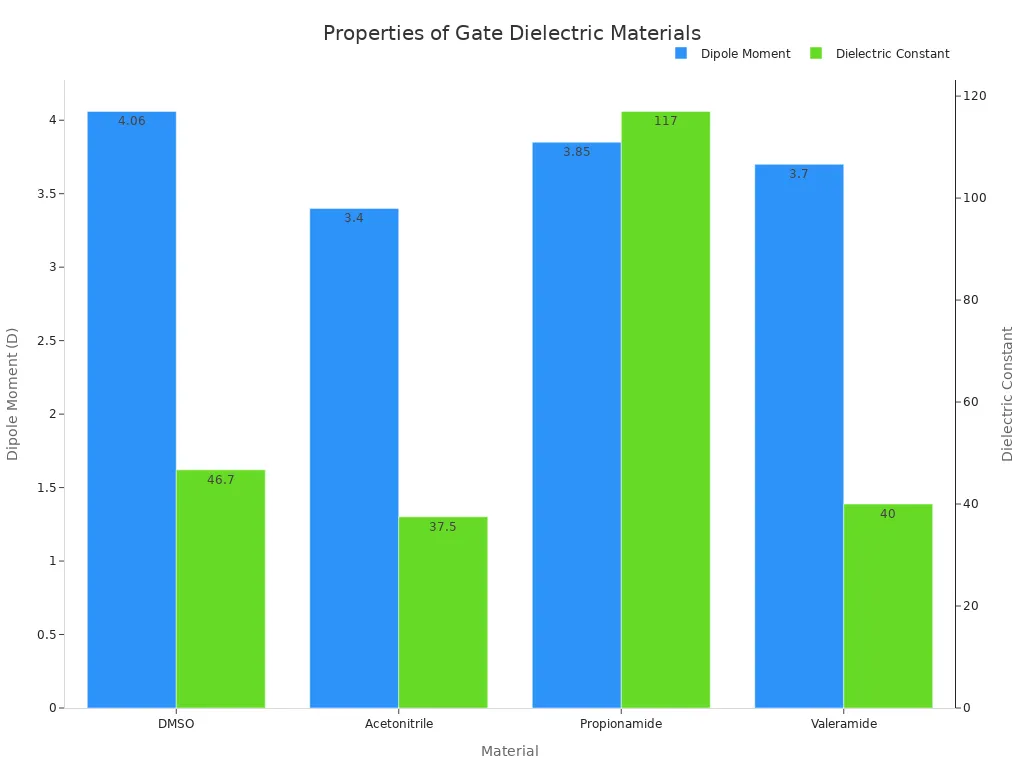
The gate dielectric material is important for performance. Researchers have tested liquid polar organic molecules for this job. These molecules sit between the gate and the graphene channel. They help the electric field reach the graphene well. The table below shows four such materials and their properties.
| Organic Molecule | Dipole Moment (D) | Dielectric Constant |
|---|---|---|
| DMSO | 4.06 | 46.7 |
| Acetonitrile | 3.40 | 37.5 |
| Propionamide | 3.85 | 117 |
| Valeramide | 3.70 | 40 |
The dipole moment shows how the molecule's charge is split. The dielectric constant tells how well the material supports an electric field. Propionamide stands out with a very high dielectric constant. This makes it a good gate dielectric. The chart below compares these materials.
The Band Gap Challenge
Every transistor needs to turn off completely. Silicon transistors can do this. They have a natural band gap. A band gap is an energy range where no electrons can exist. This gap lets the transistor switch between conducting and non-conducting states.
Graphene does not have this feature. Pure graphene has a zero band gap. Scientists call graphene a zero band gap semiconductor. No band gap means electrons always find a path. You cannot stop the current entirely. The transistor stays partly on even when you want it off.
"Graphene is a zero band gap semiconductor."
This missing gap creates a big problem for digital logic. Digital circuits rely on clear on and off states. A transistor that cannot turn off causes errors. Current leaks through the channel all the time. This leakage wastes power and creates heat.
Researchers are exploring various approaches to create a band gap in graphene, though each method has trade-offs. Some approaches may reduce electron mobility, while others add complexity or introduce defects. The band gap challenge remains the biggest hurdle for graphene transistors. Engineers keep looking for a practical solution. They need a method that keeps graphene's great speed while allowing proper switching. This search drives much of the current research. Success would unlock the full potential of this amazing carbon material.
Key Advantages of Graphene Transistors
Speed and Higher Frequencies
The most striking advantage of graphene lies in its electron speed. Electrons travel through this carbon lattice at extraordinary velocities. This speed translates directly into faster switching in a transistor. You get a device that responds to signals almost instantly. This capability matters greatly for radio frequency (RF) applications.
Consider a simple comparison. A graphene transistor with a 240-nanometer gate length achieves a cut-off frequency of 100 GHz. A silicon transistor with the same gate length reaches only about 40 GHz. That difference means graphene operates at 2.5 times the frequency of silicon. You can send and receive signals much faster with graphene-based components.
"A key advantage of graphene lies in the very high speeds in which electrons propagate, which is essential for achieving high-speed, high-performance next generation transistors." — Dr. T.C. Chen, VP, Science and Technology, IBM Research
This statement captures the core benefit. The high speed of electrons in graphene enables better performance in communication systems. You can build amplifiers and switches that handle higher frequencies. These components find use in radar systems, wireless communications, and satellite technology.
Researchers continue to push the limits of graphene speed. One study reported a record-high cutoff frequency of 427 GHz. This achievement came from a scalable fabrication method. The process used self-aligned structures with transferred gate stacks on glass substrates. This value stands as the highest cutoff frequency to date in that study. You can see how quickly graphene technology advances.
The high speed of graphene also reduces signal delay. Information travels through the channel faster. This speed improves the overall performance of electronic circuits. You get quicker response times in your devices. The properties of graphene make this possible.
Flexibility and Low Power
Graphene offers more than just speed. You also get remarkable flexibility. A single layer of carbon atoms can bend without breaking. This flexibility opens new possibilities for electronic devices. You can create screens that fold or wearables that wrap around your wrist.
The mechanical strength of graphene supports this flexibility. The material is exceptionally strong, supporting its flexibility. This combination suits next-generation flexible electronics perfectly.
Graphene also conducts heat very well. This property helps manage heat in compact devices. You avoid overheating even in tight spaces. The electrical conductivity of graphene remains high while staying flexible.
Transparency adds another advantage. A single graphene layer absorbs only a small fraction of light. You can see through it clearly. This transparency makes graphene useful for touchscreens and display technologies. You get a conductive surface that does not block your view.
Low power consumption stands as a key benefit. Graphene transistors require less energy to operate. The high carrier mobility means electrons move with minimal resistance. You waste less energy as heat. This efficiency extends battery life in portable devices. You can use your phone or wearable longer between charges.
These advantages make graphene attractive for many applications. Flexible displays, medical sensors, and smart clothing all benefit. The properties of graphene enable devices that are thin, light, and efficient. You get high performance without sacrificing comfort or durability.
The combination of speed, flexibility, and low power sets graphene apart. You see why engineers view this material as a game-changer. The path to commercial adoption continues, but the potential is clear. Graphene transistors promise a new generation of electronics that are faster and more adaptable than anything available today.
Current Challenges and Progress
Manufacturing and Integration Hurdles
Making graphene transistors in large numbers comes with real problems. First, you need big sheets of perfect graphene. Many methods only create small flakes or sheets with flaws. These flaws lower how well the transistor works. You need a dependable way to grow clean graphene over large areas. That goal is still hard to reach.
The band gap issue makes things harder. Pure graphene has no band gap. Scientists found ways to create one, but every method has downsides. Some approaches to create a band gap can reduce electron mobility or introduce defects. These trade-offs weaken the very benefits that make graphene special.
Mixing graphene with current silicon technology is another hurdle. The chip industry depends on silicon methods. You cannot just swap in graphene. The production lines are different. You need new tools and new steps. This change costs both time and money.
Recent Milestones in GFETs
Even with these problems, graphene research moves fast. Scientists now see this carbon material as a real option for post-silicon electronics. You can see this progress in recent prototypes and demos.
A key study in Nature showed a big step forward. Researchers at Georgia Tech built the world's first working graphene semiconductor. They grew graphene on silicon carbide wafers. Then they added materials to make working transistors. The study showed that electrons move through graphene better than through silicon. The fast electron speed allows high-speed communication uses. This finding could lead to quicker and more efficient computers. The research proved that real devices are possible. This material opens doors to new device designs.
This milestone builds on years of steady work. Earlier studies hit record-high cutoff frequencies. One study reached a cutoff frequency of 427 GHz. These abilities make graphene useful for communication. You can see the field getting closer to real-world use.
Other teams have explored flexible devices. These bendable transistors could power wearable tech. Graphene's strength and flexibility make this possible. You get devices that fit your body without breaking.
Research speed keeps increasing. This work pushes the field forward. Each new study tackles one more problem. Manufacturing methods get better. Band gap fixes become more practical. Integration plans emerge. You can expect more real uses in the next few years.
Graphene transistors give you a way to make electronics that are faster, more flexible, and use less energy. The speed of electrons in this carbon material is much faster than what silicon can do. You also get bendable devices that use less power. But the missing band gap and manufacturing problems are still real issues. Graphene-based transistors have improved quickly and are now seen as a possible choice for future electronics. Research keeps working to solve these problems. Each new breakthrough brings graphene technology closer to real-world use. Using it in products may take time, but progress is getting faster. Graphene electronics will change how you use technology. The future looks bright for this amazing material.

Written by Jack Elliott from AIChipLink.
AIChipLink, one of the fastest-growing global independent electronic components distributors in the world, offers millions of products from thousands of manufacturers, and many of our in-stock parts is available to ship same day.
We mainly source and distribute integrated circuit (IC) products of brands such as Broadcom, Microchip, Texas Instruments, Infineon, NXP, Analog Devices, Qualcomm, Intel, etc., which are widely used in communication & network, telecom, industrial control, new energy and automotive electronics.
Empowered by AI, Linked to the Future. Get started on AIChipLink and submit your RFQ online today!
Frequently Asked Questions
Why should you care about graphene transistors?
Graphene could replace silicon in future electronics, so it matters to you. This carbon material conducts electricity at very high speeds. That speed means quicker devices and longer battery life. Flexible screens and wearable sensors become possible with this technology.
What makes graphene different from silicon?
Silicon has a natural band gap that lets transistors turn off completely. Graphene lacks this feature entirely. You cannot stop the current flow in pure graphene. This difference creates the main obstacle for digital computing applications.
How close are graphene transistors to commercial use?
Researchers have built working prototypes in laboratories. One study demonstrated a cutoff frequency of 427 GHz. Manufacturing challenges remain significant. You will likely see graphene in specialized applications first, such as radio frequency components and flexible displays, before general computing.
Can graphene transistors bend without breaking?
Yes, you can bend and fold graphene without damage. A single layer of carbon atoms is exceptionally strong, yet it remains flexible. This flexibility enables wearable devices and foldable screens that silicon cannot provide.