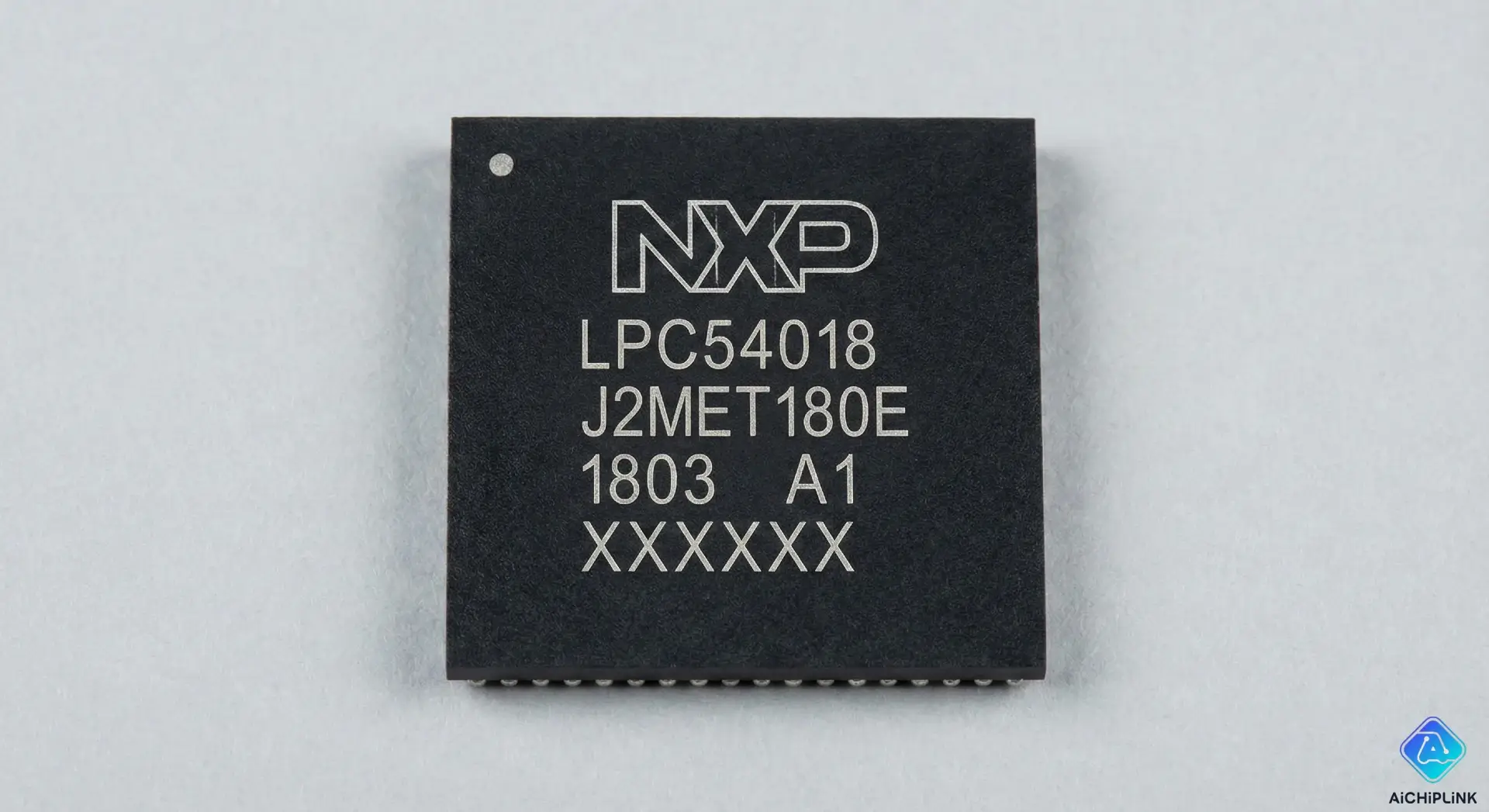
In the fragmented world of IoT microcontrollers, finding a chip that balances high performance, large memory, and turnkey cloud connectivity is a challenge. The NXP LPC54018J2MET180E stands out as a unique solution designed specifically to solve this problem.
Often referred to as the "IoT Module" chip, this device is a powerhouse ARM Cortex-M4 microcontroller running at 180 MHz. But its real secret weapon is its memory architecture: it integrates 2MB of Flash and 360KB of SRAM directly into the package (System-in-Package), making it capable of running heavy IoT stacks like Amazon FreeRTOS without needing external memory chips.
This guide breaks down the datasheet, clarifies the "Flashless vs. SiP" confusion, and explains why this chip is the go-to for secure edge gateways.
Table of Contents
- 1. Decoding the Silicon: LPC54018J2MET180E Specs
- 2. High-Performance Connectivity for IoT
- 3. Software Ecosystem: Amazon FreeRTOS & MCUXpresso
- 4. Hardware Design & TFBGA180 Package
- 5. Conclusion
1. Decoding the Silicon: LPC54018J2MET180E Specs
The LPC54018 represents the high-performance tier of NXP's LPC54000 series, bridging the gap between standard MCUs and Application Processors.
Key Specifications Matrix
| Feature | Specification | Impact |
|---|---|---|
| Core | ARM Cortex-M4 | 180 MHz performance for edge processing. |
| SRAM | 360 KB | Large buffer for TLS/SSL stacks and OTA updates. |
| Flash | 2 MB (SiP) | Integrated QSPI Flash via SPIFI interface. |
| USB | Dual Port | 1x High Speed (480Mbps) + 1x Full Speed (12Mbps). |
| Ethernet | 10/100 MAC | Built-in support for wired IoT gateways. |
| Package | TFBGA180 | 12x12mm, high I/O density (137 GPIOs). |
The "J2M" Advantage: 2MB Internal QSPI Flash
One of the most confusing aspects of this chip is its flash memory configuration.
- Standard LPC540xx: These are typically "Flashless" MCUs, requiring you to route an external flash chip on the PCB.
- LPC54018J2M...: The "J2M" suffix indicates that NXP has stacked a 2MB QSPI Flash die inside the chip package.
- Technology: This is a System-in-Package (SiP).
- Benefit: You get the performance of XIP (Execute-In-Place) via the specialized SPIFI interface, but with the PCB simplicity of an MCU with internal flash. You don't need to route high-speed QSPI traces on your board, saving space and reducing EMI/EMC risks.
Price Analysis & Stock Availability
This chip is popular in IoT modules and gateways due to its integration.
Procurement Tip: Due to its specialized SiP nature, stock can be specific. [Check Stock for LPC54018J2MET180E at Aichiplink] to view inventory from verified distributors.
2. High-Performance Connectivity for IoT
The LPC54018 is built to serve as a communication hub for multiple protocols.
Dual USB Architecture
Unlike many MCUs that only offer Full Speed (12 Mbps) USB, the LPC54018 includes a High Speed (480 Mbps) PHY on-chip.
- Port 1 (High Speed): Ideal for rapid data transfer, such as offloading sensor logs to a PC or connecting a high-bandwidth 4G/LTE modem.
- Port 0 (Full Speed): Perfect for standard HID tasks (keyboard/mouse) or firmware debugging.
180 MHz Performance Myth
Clarification: You may see the number "360" associated with this chip in marketing materials.
- 180 MHz: This is the actual max CPU Clock Speed of the Cortex-M4 core.
- 360 KB: This is the size of the internal SRAM. Do not confuse the two. However, 180 MHz is exceptionally fast for an M4, capable of handling complex audio processing (via I2S) or running a full TCP/IP stack with TLS encryption without bottling updates.
3. Software Ecosystem: Amazon FreeRTOS & MCUXpresso
The hardware is excellent, but the software ecosystem is what makes it "IoT Ready."
Building Cloud-Connected Devices
The LPC54018 is a fully qualified platform for Amazon FreeRTOS.
- AWS Integration: NXP provides ready-to-use SDKs that include the AWS IoT device SDK. This means you have pre-validated libraries for MQTT, Shadow Device updates, and Greengrass discovery out of the box.
- Security: The chip supports secure boot and OTA (Over-The-Air) updates. The large 2MB flash allows for "A/B Partitioning," where a new firmware image is downloaded to the second half of the flash before swapping, ensuring the device never bricks during an update.
Migration from LPC546xx
If you are migrating from the LPC546xx family (which has traditional on-die flash), the transition to the LPC54018 is seamless. The SPIFI peripheral maps the QSPI flash to the system memory map (typically at address 0x1000 0000). Your code executes just as if it were in standard internal flash, with the integrated cache controller masking the serial interface latency.
4. Hardware Design & TFBGA180 Package
The TFBGA180 package (12x12mm, 0.8mm pitch) offers a huge number of I/Os but requires careful PCB layout.
- PCB Layers: A 4-layer PCB is the absolute minimum, but a 6-layer stack-up is recommended to cleanly route the BGA breakout and provide solid ground planes for the High-Speed USB.
- Power Supply: Ensure stable 3.3V rails. The internal QSPI flash and High-Speed USB PHY can draw dynamic current bursts; place decoupling capacitors as close to the VDD pins as possible.
5. Conclusion
The NXP LPC54018J2MET180E is a "Goldilocks" chip for the IoT era. It offers the ease of use of a microcontroller with the connectivity and memory density typically reserved for application processors. With its integrated 2MB SiP Flash, Dual USB, and native Amazon FreeRTOS support, it is the ideal engine for your next secure, cloud-connected product.
Sourcing NXP IoT Solutions Secure your supply chain for high-performance MCUs. Visit Aichiplink.com to search for LPC54018J2MET180E and compatible development boards like the OM40007.

Written by Jack Elliott from AIChipLink.
AIChipLink, one of the fastest-growing global independent electronic components distributors in the world, offers millions of products from thousands of manufacturers, and many of our in-stock parts is available to ship same day.
We mainly source and distribute integrated circuit (IC) products of brands such as Broadcom, Microchip, Texas Instruments, Infineon, NXP, Analog Devices, Qualcomm, Intel, etc., which are widely used in communication & network, telecom, industrial control, new energy and automotive electronics.
Empowered by AI, Linked to the Future. Get started on AIChipLink.com and submit your RFQ online today!
Frequently Asked Questions
Does the LPC54018J2MET180E need external flash?
**No.** The "J2M" variant has 2MB of flash built inside the package. However, if you need *more* than 2MB (e.g., for storing large graphical assets or long-term data logs), you can still add another external QSPI flash chip.
Can I use the LPC54018 for audio applications?
**Yes.** It includes multiple Flexcomm interfaces (configurable as I2S) and a PLL dedicated to audio, making it great for smart speakers or voice-enabled IoT nodes.
What is the difference between LPC54018 and LPC54S018?
The **"S"** version (LPC54S018) includes advanced security features like **PUF (Physical Unclonable Function)** for secure key storage. If your IoT device handles sensitive data or payments, the "S" version is recommended.
Is the USB High Speed PHY integrated?
**Yes.** Port 1 includes an integrated High-Speed PHY (Physical Layer). You do not need an external ULPI transceiver chip, which saves BOM cost and board space.
Does it support Linux?
**No.** This is a microcontroller (Cortex-M4) designed for RTOS (FreeRTOS, Zephyr). It does not have an MMU (Memory Management Unit) required for standard Linux distributions. For Linux applications, look at the NXP i.MX series.