Shunt vs Hall vs Fluxgate Current Sensors Which Offers the Best Accuracy
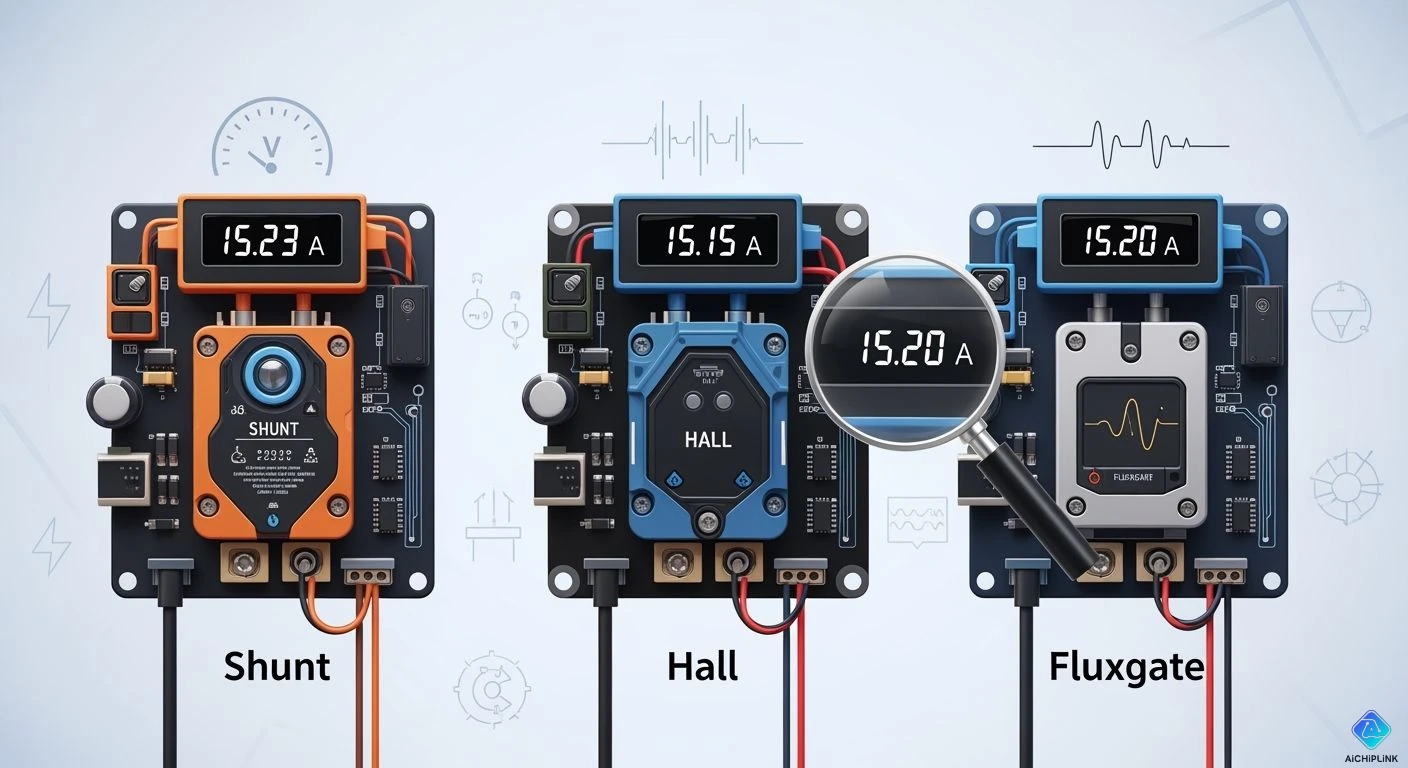
When measuring current, achieving very good accuracy is essential, especially in systems that must operate effectively. Among the options available, Fluxgate current sensors, particularly the zero-flux types, stand out as the most precise, with errors as low as 0.001%. Shunt current sensors also offer high accuracy at a lower cost, while Hall effect current sensors have improved significantly and can achieve about 1–2% accuracy. The table below illustrates the comparison of Shunt vs Hall vs Fluxgate current sensors in industrial settings:
| Method | Accuracy |
|---|---|
| Shunt | 0.1–2% |
| Hall effect | 0.5–5% |
| Fluxgate | 0.001–0.5% |
Accuracy is crucial because:
-
It aids in protecting and controlling power systems.
-
Factors like temperature and noise can affect sensor readings.
-
Poor accuracy can lead to operational failures.
Before selecting your sensor, consider both the price and your specific requirements.
Key Takeaways
-
Fluxgate sensors are the most accurate. Their errors can be as low as 0.001%. Use them when you need very precise results.
-
Shunt sensors do not cost much and are still accurate. They are good for projects that need to save money but also need good measurements.
-
Hall effect sensors keep electricity separate and work with both AC and DC. They are great for cars and smart meters.
-
Think about things like temperature and magnetic fields when you pick a sensor. These things can change how well the sensor works.
-
Always pick the sensor that fits your needs. Try to balance accuracy, price, and what you need it for to get the best results.
Sensor Types Overview
Shunt Sensors: Principle and Accuracy
Shunt sensors measure current using Ohm’s Law. They check the voltage drop across a resistor. This helps you find the current directly. Shunt sensors are accurate, between 0.1% and 2%. They cost less and fit easily into many systems.
Here are some strengths and weaknesses of shunt sensors:
| Strengths | Weaknesses |
|---|---|
| High accuracy | Power dissipation |
| Excellent temperature stability | Need for physical contact |
| Cost-effectiveness | Heat generation |
| Compact and easy to integrate | Large footprint |
| Less susceptible to external interference | Accuracy limitations |
Shunt sensors are good for measuring DC current. Some power is lost because of the resistor. Still, shunt sensors are popular for their accuracy and low price.
Hall Effect Sensors: Features and Accuracy
Hall effect sensors use the Lorentz force. They make a voltage when current flows in a magnetic field. You do not need to touch the conductor. This gives electrical isolation. Hall effect sensors measure AC and DC currents. Their accuracy is between 1% and 10%. New designs make them more accurate, about 1% to 2%.
You can benefit from these features:
-
Electrical isolation for safety
-
Non-intrusive measurement
-
Compact size for easy installation
Hall effect sensors can be affected by magnetic fields. This matters if you work near strong electromagnetic interference. Technology has made hall effect sensors more reliable. You can use them in cars, factories, and power systems. Hall effect sensors are easy to use. They measure current without breaking the circuit. Hall effect sensors are good for battery monitoring. You find them in electric vehicles and renewable energy systems. Hall effect sensors are used in smart meters. They help track energy use. Hall effect sensors are also in robots and automation. Hall effect sensors are best when you need isolation. Hall effect sensors improve every year. They are now more accurate and stable. Hall effect sensors work for many current sensing needs.
Fluxgate Sensors: Precision and Use Cases
Fluxgate sensors are the most accurate for measuring current. They use a magnetic core to check changes in magnetic flux. The zero-flux method balances forces from a known current and the measured current. This lets you get accuracy up to 0.001%. Fluxgate sensors have wide bandwidth and work well in different temperatures.
You will find fluxgate sensors in:
-
Calibration systems
-
Diagnostic systems
-
Laboratory equipment
-
Medical systems
-
High-precision power monitoring
Fluxgate sensors are sensitive and stable. You may need to calibrate them. They give excellent linearity and a big dynamic range. If you want error-free readings, fluxgate sensors are the best choice.
| Sensor Type | Accuracy Range |
|---|---|
| Fluxgate Sensors | 0.001% to 0.5% |
| Shunt Resistors | 0.1% to 2% |
| Hall Effect Sensors | 1% to 10% |
Accuracy Comparison in Current Measurement
Shunt vs Hall vs Fluxgate Current Sensors
When you look at shunt, hall, and fluxgate sensors, you notice they are different. Shunt sensors use Ohm’s law to measure current. They are very accurate, between 0.1% and 2%. You can use shunt sensors for many jobs. They are simple and not expensive. Hall effect sensors can measure AC and DC. They give electrical isolation. Their accuracy is from 1% to 10%. Hall effect sensors are easy to put in place. Strong magnetic fields can change their readings. Fluxgate current transducers are the most accurate. They can have errors as low as 0.001%. These sensors use a magnetic core and special balancing. You get very exact measurements, even for DC. Fluxgate sensors work well in tough places. They stay accurate for a long time.
You can see the main differences in this table:
| Sensor Type | Typical Accuracy | Best Use Case |
|---|---|---|
| Shunt | 0.1% – 2% | Cost-sensitive, high accuracy |
| Hall Effect | 1% – 10% | Isolation, AC/DC, easy install |
| Fluxgate Transducer | 0.001% – 0.5% | Precision, stability, DC |
If you want the best accuracy, pick fluxgate current transducers. Shunt sensors are also good and work for many uses. Hall effect sensors are less accurate but have other helpful features.
Influencing Factors: Temperature, Magnetic Fields, Signal Type
Many things can change how accurate shunt, hall, and fluxgate sensors are. Temperature changes can cause mistakes in measuring. Shunt sensors handle temperature well but can get hot. Hall effect sensors are more sensitive to temperature changes. Their readings can drift if it gets hotter or colder. Fluxgate current transducers stay stable even in extreme temperatures. They keep their accuracy from -40°C to 85°C.
Magnetic fields outside the sensor also matter. Here is how each sensor reacts:
-
Fluxgate current transducers are not bothered much by outside magnetic fields. They give good readings in noisy places.
-
Hall effect sensors are affected a lot by stray magnetic fields. This can make their readings wrong.
-
Shunt sensors do not react to magnetic fields. They need to touch the circuit directly.
The type of signal is important too. Shunt sensors are best for DC and low-frequency AC. Hall effect sensors can measure AC and DC. Fluxgate current transducers are great for DC and can measure AC with high accuracy.
Stability and Calibration Needs
Long-term stability is important when picking shunt, hall, or fluxgate sensors. Shunt sensors stay stable, but their accuracy can change if the resistor gets old or hot. Hall effect sensors can drift more over time. This happens if they face strong magnetic fields or temperature changes. You may need to calibrate them often.
Fluxgate current transducers are the most stable over time. They drift less than Hall effect sensors. You can trust them for high accuracy for many years. They also give great electrical isolation. This is important for high-voltage systems. Their high sensitivity lets you find big currents and tiny leaks. This makes them good for battery safety and other important jobs.
Tip: If you want the most stable and accurate sensor, choose fluxgate current transducers. For jobs where price matters but you still need accuracy, shunt sensors are a smart pick.
Cost and Application Trade-Offs
Cost Comparison of Current Sensors
You should think about price when picking a current sensor. Shunt sensors are the cheapest because they use simple resistors. Hall effect sensors cost more, but they give electrical isolation and are easy to install. Fluxgate sensors cost the most because they have a complex design. You pay extra for better accuracy and stability. In cars, fluxgate sensors are getting cheaper. They are more accurate than shunt sensors and keep circuits safe. Hall effect sensors are good if you care most about price. Companies make them more accurate every year.
| Sensor Type | Cost Comparison | Accuracy Level |
|---|---|---|
| Fluxgate Sensors | Higher due to complex design | High |
| Hall Effect Sensors | Lower, cost-effective for large scales | Moderate |
| Shunt Sensors | Economical, requires direct contact | Accurate |
Tip: Pick fluxgate sensors if you want the best accuracy and can pay more. Choose shunt sensors if you need good readings and a low price. Hall effect sensors are great for big projects where price matters.
Application Suitability: Industrial, Automotive, Power
Different jobs need different sensors. Battery management systems use very accurate sensors to check charge and health. Motor drives need sensors that react fast for control and safety. Power grid monitoring uses sensors with high voltage isolation and accuracy. Shunt sensors are in small gadgets and cheap products. Hall effect sensors work well in cars and smart meters. They give isolation and measure both AC and DC. Fluxgate sensors are used in labs, calibration, and places where you need top accuracy.
-
Battery management systems
-
Motor drive applications
-
Power grid monitoring
-
Automotive applications
-
Industrial automation
-
Renewable energy applications
-
Diagnostic applications
-
Laboratory applications
-
Medical applications
-
High-precision power monitoring
-
Smart meter applications
Accuracy Impact on Real-World Use
Accurate current sensors help you find power problems. They make electrical systems work better. In factories, good sensors keep things safe and help fix problems before they get worse. You protect machines and stop breakdowns. Renewable energy needs accurate sensors to work well and keep the grid steady. Using the right sensor makes things safer and work better.
Note: Picking the right sensor for your job makes things safer and more reliable. You save money and keep your systems working well.
Summary Table: Sensors, Accuracy, and Cost
Quick Reference Comparison
You need to pick the right current sensor for your project. The table below helps you compare shunt, Hall effect, and fluxgate sensors. It shows how each sensor does in accuracy, cost, isolation, and best use.
| Sensor Type | Accuracy Range | Cost Level | Electrical Isolation | Best Use Case | Calibration Needs |
|---|---|---|---|---|---|
| Shunt | 0.1% – 2% | Low | No | Cost-sensitive, high accuracy | Occasional |
| Hall Effect | 1% – 10% | Moderate | Yes | AC/DC, isolation, easy installation | Regular |
| Fluxgate | 0.001% – 0.5% | High | Yes | Precision, stability, DC/AC | Minimal |
Tip: Choose a fluxgate sensor if you want the best accuracy. Pick a shunt sensor if you want good accuracy and a low price. Use a Hall effect sensor for easy setup and electrical isolation.
Quick Tips for Choosing a Sensor:
-
Use shunt sensors for simple projects that need good accuracy and low cost.
-
Pick Hall effect sensors if you need to measure both AC and DC, or want electrical isolation.
-
Choose fluxgate sensors for lab work, calibration, or jobs that need top accuracy.
This table is a guide to help you pick the right sensor. It lets you match your needs to the best choice. You can save time and avoid mistakes by looking at these features.
Remember: The best sensor depends on what you need for accuracy, your budget, and your project. Always check the sensor’s details before you choose.
Fluxgate current sensors are the most accurate for tough jobs. Shunt sensors are good if you want accuracy and to save money. Hall effect sensors are helpful when you need isolation and quick results. Look at the table below to see which sensor fits your project:
| Sensor Type | Key Features | Best Applications |
|---|---|---|
| Shunt | High accuracy, stable temperature | Battery management systems |
| Hall Effect | Fast response, isolation | Inverter drives, automation |
| Fluxgate | Low drift, top accuracy | High-voltage battery management |
Always pick a sensor that matches what you need. Accurate sensors stop expensive mistakes and keep things safe. Cheaper sensors might look good, but they can cause more repairs and hidden costs. Decide what is most important for your project before you choose.

Written by Jack Elliott from AIChipLink.
AIChipLink, one of the fastest-growing global independent electronic components distributors in the world, offers millions of products from thousands of manufacturers, and many of our in-stock parts is available to ship same day.
We mainly source and distribute integrated circuit (IC) products of brands such as Broadcom, Microchip, Texas Instruments, Infineon, NXP, Analog Devices, Qualcomm, Intel, etc., which are widely used in communication & network, telecom, industrial control, new energy and automotive electronics.
Empowered by AI, Linked to the Future. Get started on AIChipLink and submit your RFQ online today!
Frequently Asked Questions
What makes shunt resistors accurate for current measurement?
Shunt resistors are very accurate because they use a simple way to measure current. They check the voltage drop across a resistor. This method works for both DC and AC current. Shunt resistors are trusted in factories and other places. They are good when you need something cheap and reliable.
How do hall effect current transducers provide non-contact measurement?
Hall effect current transducers can measure current without touching the wire. They sense the magnetic field around the wire. This keeps you safe from electric shock. These sensors are used in cars and factories. They help when you need to measure current safely.
Why should you choose fluxgate sensors for precision applications?
Fluxgate sensors are best when you need very accurate readings. They can measure both small and large currents. You can trust them for battery checks and other important jobs. They are picked when you need the most reliable results.
Are shunt sensors good for automotive applications?
Shunt sensors work well in cars when you need to know the exact current. They are not expensive and last a long time. You can use them to watch battery systems and other car parts. They help make sure current stays steady.
How do temperature and magnetic fields affect hall sensors?
Hall sensors can give different readings if it gets hotter or colder. Strong magnetic fields can also change their results. You need to check these sensors often to make sure they work right. Hall effect current transducers work best when the area is controlled. This helps them stay reliable.